
 100% FREE ACCESS
12th Standard Syllabus & Materials
12th Standard
TN 12th Maths Applications of Matrices and Determinants Sample Question Papers Study Material - QB365 Set A
NEW12th Standard
TN 12th Computer Applications மின்னணு தரவு பரிமாற்றம் Sample Question Papers Study Material - QB365 Set A
NEW12th Standard
TN 12th Computer Applications மின் - வணிக பாதுகாப்பு அமைப்புகள் Sample Question Papers Study Material - QB365 Set A
NEW12th Standard
TN 12th Computer Applications மின்னணு செலுத்தல் முறைகள் Sample Question Papers Study Material - QB365 Set A
NEW12th Standard
TN 12th Computer Applications மின் - வணிகம் Sample Question Papers Study Material - QB365 Set A
NEW12th Standard
TN 12th Computer Applications திறந்த மூல கருத்துருக்கள் Sample Question Papers Study Material - QB365 Set A

Published on: 01/03/2021
12th Standard English Medium Business Maths Syllabus Five Mark Important Questions with Answer key - 2021(Public Exam )
Download Tamil Nadu 12th Standard Business Maths and Statistics question papers, model tests, one-mark questions, important questions, and public exam papers in PDF format. Free study materials and answer keys for TN State Board students.
Questions + Answers key
Take MCQ Business Maths and Statistics Test
1.
The probability function of a random variable X is given by
\(p(x)=\left\{\begin{array}{l} \frac{1}{4}, \text { for } x=-2 \\ \frac{1}{4}, \text { for } x=0 \\ \frac{1}{2}, \text { for } x=10 \\ 0, \text { elsewhere } \end{array}\right.\)
Evaluate the following probabilities.
P(|X|\(\le\)2)
2.
Using Lagrange’s interpolation formula find a polynomial which passes through the points (0, –12), (1, 0), (3, 6) and (4,12).
3.
Using interpolation estimate the output of a factory in 1986 from the following data
| Year | 1974 | 1978 | 1982 | 1990 |
| Output in 1000 tones | 25 | 60 | 80 | 170 |
4.
From the following table find the number of students who obtained marks less than 45.
| Marks | 30-40 | 40-50 | 50-60 | 60-70 | 70-80 |
| No. of Students | 31 | 42 | 51 | 35 | 31 |
5.
Solve the following:
\(x\frac { dy }{ dx } +2y={ x }^{ 4 }\)
6.
If the marginal cost of producing x shoes is given by (3xy + y2)dx + (x2 + xy)dy = 0 and the total cost of producing a pair of shoes is given by Rs. 12. Then find the total cost function.
7.
The normal lines to a given curve at each point(x,y) on the curve pass through the point (1, 0). The curve passes through the point (1, 2). Formulate the differential equation representing the problem and hence find the equation of the curve.
8.
Evaluate the following using properties of definite integrals:
\(\int _{ 0 }^{ 1 }{ \frac { x }{ ({ 1-x) }^{ \frac { 3 }{ 4 } } } dx } \)
9.
Derive the mean and variance of binomial distribution.
10.
A sample of 125 dry battery cells tested to find the length of life produced the following resultd with mean 12 and SD 3 hours. Assuming that the data to be normal distributed , what percentage of battery cells are expected to have life
(i) more than 13 hours
(ii) less than 5 hours
(iii) between 9 and 14 hours
11.
A bank manager has observed that the length of time the customers have to wait for being attended by the teller is normally distributed with mean time of 5 minutes and standard deviation of 0.6 minutes. Find the probability that a customer has to wait
(i) for less than 6 minutes
(ii) between 3.5 and 6.5 minutes
12.
The demand equation for a product is pd = 20 − 5x and the supply equation is ps = 4x + 8. Determine the consumer’s surplus and producer’s surplus under market equilibrium.
13.
Suppose the life in hours of a radio tube has the probability density function
\(f(x)=\left\{\begin{array}{l} e^{-\frac{x}{100}}, \text { when } x \geq 100 \\ 0, \quad \text { when } x<100 \end{array}\right.\)
Find the mean of the life of a radio tube.
14.
The demand equation for a products is x = \(\sqrt { 100-p } \) and the supply equation is x = \(\frac{p}{2}\) -10. Determine the consumer’s surplus and producer’s surplus, under market equilibrium.
15.
Suppose that the time in minutes that a person has to wait at a certain station for a train is found to be a random phenomenon with a probability function specified by the distribution function\(F(x)\begin{cases} 0,\quad \text{for}\quad x<0 \\ \frac { 1 }{ 2 } ,\quad \text{for}\quad 0\le x<1 \\ 0,\quad \text{for}\quad 1\le x<2\quad \\ \frac { 1 }{ 4 } ,\quad \text{for}\quad 2\le x<4 \\ 0,\quad \text{for}\quad x\ge 4 \end{cases}\)
(a) Is the distribution function continuous? If so, give its probability density function?
(b) What is the probability that a person will have to wait
(i) more than 3 minutes,
(ii) less than 3 minutes and
(iii) between 1 and 3 minutes?
16.
The distribution of a continuous random variable X in range (–3, 3) is given by p.d.f.
\(f(x)=\left\{\begin{array}{l} \frac{1}{16}(3+x)^{2},-3 \leq x \leq-1 \\ \frac{1}{16}\left(6-2 x^{2}\right),-1 \leq x \leq 1 \\ \frac{1}{16}(3-x)^{2}, 1 \leq x \leq 3 \end{array}\right.\)
Verify that the area under the curve is unity.
17.
The elasticity of demand with respect to price p for a commodity is \(\eta _{ d }=\frac { p+2{ p }^{ 2 } }{ 100-p-{ p }^{ 2 } } \).Find demand function where price is Rs. 5 and the demand is 70.
18.
19.
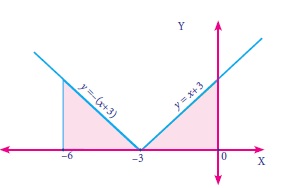
Sketch the graph \(y=\left| x+3 \right| \) and evaluate \(\int _{ -6 }^{ 0 }{ \left| x+3 \right| } \) dx.
20.
Integrate the following with respect to x.
\(\frac { { 3x }^{ 2 }-2x+5 }{ { \left( x-1 \right) }\left( x^{ 2 }+5 \right) } \)
21.
A new transit system has just gone into operation in Chennai. Of those who use the transit system this year, 30% will switch over to using metro train next year and 70% will continue to use the transit system. Of those who use metro train this year, 70% will continue to use metro train next year and 30% will switch over to the transit system. Suppose the population of Chennai city remains constant and that 60% of the commuters use the transit system and 40% of the commuters use metro train this year.
(i) What percent of commuters will be using the transit system after one year?
(ii) What percent of commuters will be using the transit system in the long run?
22.
An automobile company uses three types of Steel S1, S2 and S3 for providing three different types of Cars C1, C2 and C3. Steel requirement R (in tonnes) for each type of car and total available steel of all the three types are summarized in the following table.
| Types of Steel | Types of Car | Total Steel available | ||
| C1 | C2 | C3 | ||
| S1 | 3 | 2 | 4 | 28 |
| S2 | 1 | 1 | 2 | 13 |
| S3 | 2 | 2 | 2 | 14 |
Determine the number of Cars of each type which can be produced by Cramer’s rule.
23.
Investigate for what values of ‘a’ and ‘b’ the following system of equations x + y + z = 6,x + 2y + 3z = 10, x + 2y + az = b have
(i) no solution
(ii) a unique solution
(iii) an infinite number of solutions.
24.
Find k, if the equations x + y + z = 7, x + 2y + 3z = 18, y + kz = 6 are inconsistent
25.
The subscription department of a magazine sends out a letter to a large mailing list inviting subscriptions for the magazine. Some of the people receiving this letter already subscribe to the magazine while others do not. From this mailing list, 60% of those who already subscribe will subscribe again while 25% of those who do not now subscribe will subscribe. On the last letter it was found that 40% of those receiving it ordered a subscription. What percent of those receiving the current letter can be expected to order a subscription?
1.
Given probability function is
\(p(x)=\left\{\begin{array}{l} \frac{1}{4}, \text { for } x=-2 \\ \frac{1}{4}, \text { for } x=0 \\ \frac{1}{2}, \text { for } x=10 \\ 0, \text { elsewhere } \end{array}\right.\)
| X=x | -2 | 0 | 10 |
| P(X=x) | \(\frac{1}{4}\) | \(\frac{1}{4}\) | \(\frac{1}{2}\) |
P(|X|≤2)=P(-2
\(\frac{1}{4}+\frac{1}{4}=\frac{1}{2}\)
2.
Given
| x | 0 | 1 | 3 | 4 |
| y | -12 | 0 | 6 | 12 |
Here the intervals are unequal
∴ By Lagranges interpolation formula, we have
x0 = 0, x1 = 1, x2 = 3, x3 = 4
y0 = -12, y1 = 0, y2 = 6, y3 = 12 and x = x.
∴ y = f(x) = \(\frac { (x-{ x }_{ 1 })(x-{ x }_{ 2 })(x-{ x }_{ 3 }) }{ ({ x }_{ 0 }-{ x }_{ 1 })({ x }_{ 0 }-{ x }_{ 2 })({ x }_{ 0 }-{ x }_{ 3 }) } \times { y }_{ 0 }+\frac { (x-{ x }_{ 0 })(x-{ x }_{ 2 })(x-{ x }_{ 3 }) }{ ({ x }_{ 1 }-{ x }_{ 0 })({ x }_{ 1 }-{ x }_{ 2 })(x_{ 1 }-{ x }_{ 3 }) } \times { y }_{ 1 }+\frac { (x-{ x }_{ 0 })(x-{ x }_{ 1 })(x-{ x }_{ 3 }) }{ ({ x }_{ 2 }-{ x }_{ 0 })({ x }_{ 2 }-{ x }_{ 1 })({ x }_{ 2 }-{ x }_{ 3 }) } \times { y }_{ 2 }+\frac { (x-{ x }_{ 0 })(x-{ x }_{ 1 })(x-{ x }_{ 2 }) }{ ({ x }_{ 3 }-{ x }_{ 0 })({ x }_{ 3 }-{ x }_{ 1 })({ x }_{ 3 }-{ x }_{ 2 }) } \times { y }_{ 3 }\)
= \(\frac { (x-1)(x-3)(x-4) }{ (0-1)(0-3)(0-4) } (-12)+\frac { (x-0)(x-3)(x-4) }{ (1-0)(1-3)(1-4) } (0)+\frac { (x-0)(x-1)(x-4) }{ (3-0)(3-1)(3-4) } (6)+\frac { (x-1)(x-3)(x-4) }{ (4-0)(4-1)(4-3) } (12)\)
= \(\frac { (x-1)(x-3)(x-4) }{ (-1)(-3)(-4) } (-12)+0+\frac { x(x-1)(x-4) }{ (3)(2)(-1) } (6)+\frac { x(x-1)(x-3) }{ (4)(3)(1) } (12)\)
= +[(x - 1)(x - 3)(x - 4)] - x (x - 1)(x - 4) + x(x - 1)(x - 3)
= +[(x3-4x+3)(x-4)] -x(x2-5x+4) + x(x2-4x + 3)
= - (x3 - 8x2+ 19x - 12) - 4x2 + 3x
= (x - 4)(x2 - 4x + 3) - x (x2 - 5x + 4) + x(x2 - 4x + 3)

= x3 - 7x2 + 19x - 12.
3.
Given
| Year | 1974 | 1978 | 1982 | 1990 |
| Output in 1000 tones | 25 | 60 | 80 | 170 |
Here the intervals are unequal.
∴ By Lagranges interpolation formula, we have
x0 = 1974, x1 = 1978, x2 = 1982, x3 = 1990
y0 = 25, y1 = 60, y2 = 80, y3 = 170 and x = 1986.
∴ y = f(x) = \(\frac { (x-{ x }_{ 1 })(x-{ x }_{ 2 })(x-{ x }_{ 3 }) }{ ({ x }_{ 0 }-{ x }_{ 1 })({ x }_{ 0 }-{ x }_{ 2 })({ x }_{ 0 }-{ x }_{ 3 }) } \times { y }_{ 0 }+\frac { (x-{ x }_{ 0 })(x-{ x }_{ 2 })(x-{ x }_{ 3 }) }{ ({ x }_{ 1 }-{ x }_{ 0 })({ x }_{ 1 }-{ x }_{ 2 })(x_{ 1 }-{ x }_{ 3 }) } \times { y }_{ 1 }+\frac { (x-{ x }_{ 0 })(x-{ x }_{ 1 })(x-{ x }_{ 3 }) }{ ({ x }_{ 2 }-{ x }_{ 0 })({ x }_{ 2 }-{ x }_{ 1 })({ x }_{ 2 }-{ x }_{ 3 }) } \times { y }_{ 2 }+\frac { (x-{ x }_{ 0 })(x-{ x }_{ 1 })(x-{ x }_{ 2 }) }{ ({ x }_{ 3 }-{ x }_{ 0 })({ x }_{ 3 }-{ x }_{ 1 })({ x }_{ 3 }-{ x }_{ 2 }) } \times { y }_{ 3 }\)
\(\frac { (x-{ x }_{ 0 })(x-{ x }_{ 2 })(x-{ x }_{ 3 }) }{ ({ x }_{ 0 }-{ x }_{ 1 })({ x }_{ 0 }-{ x }_{ 2 })({ x }_{ 0 }-{ x }_{ 3 }) } \times25+\frac { (x-{ x }_{ 0 })(x-{ x }_{ 2 })(x-{ x }_{ 3 }) }{ ({ x }_{ 1 }-{ x }_{ 0 })({ x }_{ 1 }-{ x }_{ 2 })(x_{ 1 }-{ x }_{ 3 }) } \times60+\frac { (x-{ x }_{ 0 })(x-{ x }_{ 1 })(x-{ x }_{ 3 }) }{ ({ x }_{ 2 }-{ x }_{ 0 })({ x }_{ 2 }-{ x }_{ 1 })({ x }_{ 2 }-{ x }_{ 3 }) } \times80+\frac { (x-{ x }_{ 0 })(x-{ x }_{ 1 })(x-{ x }_{ 2 }) }{ ({ x }_{ 3 }-{ x }_{ 0 })({ x }_{ 3 }-{ x }_{ 1 })({ x }_{ 3 }-{ x }_{ 2 }) } \times 70+\frac { (1986-1974)(1986-1982)(1986-1990) }{ (1990-1974)(1990-1978)(1990-1982) } \times 170\)
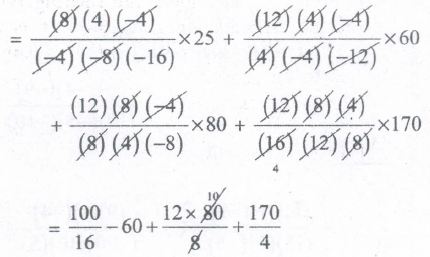
= 6.25 - 60 + 120 + 42.5
y = 108.75
4.
Let x be the marks and y be the number of students
By converting the given series into cumulative frequency distribution, the difference table is as follows.
| x | y | \(\Delta y\) | \(\Delta ^{ 2 }y\) | \(\Delta ^{ 2 }y\) | \(\Delta ^{ 4 }y\) |
| Less than 40 | 31 | ||||
| 42 | |||||
| 50 | 73 | 9 | |||
| 51 | –25 | ||||
| 60 | 124 | -16 | |||
| 35 | 12 | ||||
| 70 | 159 | -4 | |||
| 31 | |||||
| 80 | 190 |
\({ y }_{ \left( x={ x }_{ 0 }+nh \right) }={ y }_{ 0 }+\frac { n }{ n! } \Delta { y }_{ 0 }+\frac { n(n-1) }{ 2! } { \Delta }^{ 2 }{ y }_{ 0 }+\frac { n(n-)(n-2) }{ 3! } { \Delta }^{ 3 }{ y }_{ 0 }+...\)
To find y at x = 45
\(\therefore\) x0+nh = 45 , x0 = 40, h = 10 \(\Rightarrow n=\frac { 1 }{ 2 } \)
y(x = 45) = \(31+\frac { 1 }{ 2 } \times 42+\frac { \frac { 1 }{ 2 } \left( \frac { -1 }{ 2 } \right) }{ 2 } (9)+\cfrac { \frac { 1 }{ 2 } \left( \frac { -1 }{ 2 } \right) \left( \frac { -3 }{ 2 } \right) }{ 6 } \times \left( -25 \right) +\frac { \frac { 1 }{ 2 } \left( \frac { -1 }{ 2 } \right) \left( \frac { -3 }{ 2 } \right) \left( \frac { -5 }{ 2 } \right) }{ 24 } \times \left( -37 \right) \)
= \(31+21-\frac { 9 }{ 8 } -\frac { 25 }{ 16 } -\frac { 37\times 15 }{ 384 } \)
= 47.867 ≅ 48
5.
\(\frac { dy }{ dx } +\frac { 2 }{ y } y\) = x3
The given differential equation is of this form [Divided by x]
\(\frac { dy }{ dx } \)+Py = Q where
P =\(\int { \frac { 2 }{ x } } \) and Q = x3
∴ \(\int { P } dx=\int { \frac { 2 }{ x } dx } \) = 2 log x = log x2
∴ Integrating factor (I. F) =\(e^{ \int { p } dx }=e^{ logx^{ 2 } }\)= x2
Hence the solution is
\(ye^{ \int { p } dx }=\int { Q } .e^{ \int { p.dx } }dx+c\)
⇒ y.x2 = \(\int { { x }^{ 3 }.{ x }^{ 2 } } dx+c\)
⇒ x2y =\(\\ \int { { x }^{ 5 }dx } +c\)
⇒ x2y = \(\frac { { x }^{ 6 } }{ 6 } \) + c
6.
Given marginal cost function is (x2 + xy)dy + (3xy + y2)dx = 0
\(\frac { dy }{ dx } =\frac { -(3xy+{ y }^{ 2 }) }{ { x }^{ 2 }+xy } \) (1)
Put y = vx and \(\frac { dy }{ dx } =v+x\frac { dv }{ dx } \) in (1)
\(v+x\frac { dv }{ dx } =\frac { -(3xvx+{ v }^{ 2 }{ x }^{ 2 }) }{ { x }^{ 2 }+xvx } \)
\(=\frac { -(3v+{ v }^{ 2 }) }{ 1+v } \)
Now, \(x\frac { dv }{ dx } =\frac { -3v-{ v }^{ 2 } }{ 1+v } -v\)
\(=\frac { -3v-{ v }^{ 2 }-v-{ v }^{ 2 } }{ 1+v } \)
\(x\frac { dv }{ dx } =\frac { -4v-{ 2v }^{ 2 } }{ 1+v } \)
\(\frac { 1+v }{ 4v+2{ v }^{ 2 } } dv=\frac { -dx }{ x } \)
On Integration
\(\int { \frac { 1+v }{ 4v+2{ v }^{ 2 } } } =-\int { \frac { dx }{ x } } \)
Now, multiply 4 on both sides
\(\int { \frac { 1+v }{ 4v+2{ v }^{ 2 } } } =-4\int { \frac { dx }{ x } } \)
log (4v+2v2) = −4 logx+logc
4v + 2v2 = \(\frac { c }{ { x }^{ 4 } } \)
x4(4v + 2v2) = c
Replace \(v=\frac { y }{ x } \)
\({ x }^{ 4 }\left( 4\frac { y }{ x } +2\frac { { y }^{ 2 } }{ { x }^{ 2 } } \right) =c\)
\({ x }^{ 4 }\left[ \frac { 4xy+2{ y }^{ 2 } }{ { x }^{ 2 } } \right] \) = c
c = 2x2(2xy + y2) (2)
Cost of producing a pair of shoes = Rs. 12
(i.e) y = 12 when x = 2
c = 8[48 + 144]= 1536
∴ The cost function is x2(2xy + y2) = 768
7.
Slope of the normal at any point P(x, y) = -\(\frac { dx }{ dy } \)
Let Q be (1, 0)
Slope of the normal PQ is \(\frac { { y }_{ 2 }-{ y }_{ 1 } }{ { x }_{ 2 }-{ x }_{ 1 } } \)
i.e, \(\frac { y-0 }{ x-1 } =\frac { y }{ x-1 } \)
∴ \(\frac { dx }{ dy } =\frac { y }{ x-1 } \) ⇒ \(\frac { dx }{ dy } =\frac { y }{ 1-x } \), which is the differential equation
i.e., (1− x)dx = ydy
ഽ(1−x)dx = ഽydy + c
\(x-\frac { { x }^{ 2 } }{ 2 } =\frac { { y }^{ 2 } }{ 2 } +c\) ....(1)
Since it passes through (1,2)
1 - \(\frac { 1 }{ 2 } =\frac { 4 }{ 2 } +c\)
\(c=\frac { 1 }{ 2 } -2=\frac { 4 }{ 2 } +c\)
Put \(c = \frac { -3 }{ 2 } \) in (1)
\(x-\frac { { x }^{ 2 } }{ 2 } =\frac { { y }^{ 2 } }{ 2 } -\frac { 3 }{ 2 } \)
2x − x2 = y2 − 3
⇒ y2 = 2x−x2 + 3, which is the equation of the curve
8.
Let I = \(\int _{ 0 }^{ 1 }{ \frac { x }{ { \left( 1-x \right) }^{ \frac { 3 }{ 4 } } } } dx\)
\(=-\int _{ 0 }^{ 1 }{ \frac { -x }{ { \left( 1-x \right) }^{ \frac { 3 }{ 4 } } } } dx\)
[Multiply and divide by -1]
\(=-\int _{ 0 }^{ 1 }{ \frac { 1-x-1 }{ { \left( 1-x \right) }^{ \frac { 3 }{ 4 } } } } dx\)
[Adding and subtracting 1 in the numberator]
\(=\int _{ 1 }^{ 0 }{ \frac { 1-x-1 }{ { \left( 1-x \right) }^{ \frac { 3 }{ 4 } } } } dx\)
\(\left[ \because \int _{ a }^{ b }{ f\left( x \right) } dx=-\int _{ b }^{ a }{ f\left( x \right) dx } \right] \)
\(=\int _{ 1 }^{ 0 }{ \left( \frac { 1-x }{ { \left( 1-x \right) }^{ \frac { 3 }{ 4 } } } -\frac { 1 }{ { \left( 1-x \right) }^{ \frac { 3 }{ 4 } } } \right) } dx\)
\(=\int _{ 1 }^{ 0 }{ \left( { \left( 1-x \right) }^{ 1-\frac { 3 }{ 4 } }-{ \left( 1-x \right) }^{ -\frac { 3 }{ 4 } } \right) } dx\)
\(=\int _{ 1 }^{ 0 }{ { \left( 1-x \right) }^{ \frac { 1 }{ 4 } }dx-\int _{ 1 }^{ 0 }{ { \left( 1-x \right) }^{ -\frac { 3 }{ 4 } } } } dx\)
\(={ \left[ \frac { { \left( 1-x \right) }^{ \frac { 1 }{ 4 } +1 } }{ -1\left( \frac { 1 }{ 4 } +1 \right) } -\frac { { \left( 1-x \right) }^{ -\frac { 3 }{ 4 } +1 } }{ -1\left( -\frac { 3 }{ 4 } +1 \right) } \right] }_{ 1 }^{ 0 }\)
\(={ \left[ -\frac { { { \left( 1-x \right) }^{ \frac { 5 }{ 4 } } } }{ \frac { 5 }{ 4 } } +\frac { { \left( 1-x \right) }^{ \frac { 1 }{ 4 } } }{ \frac { 1 }{ 4 } } \right] }_{ 1 }^{ 0 }\)
\(={ \left[ -\frac { 4 }{ 5 } { \left( 1-x \right) }^{ \frac { 5 }{ 4 } }+4{ \left( 1-x \right) }^{ \frac { 1 }{ 4 } } \right] }_{ 1 }^{ 0 }\)
\(=-\frac { 4 }{ 5 } \left( { 1 }^{ \frac { 5 }{ 4 } } \right) +4\left( { 1 }^{ \frac { 1 }{ 4 } } \right) -0\)
\(=-\frac { 4 }{ 5 } (1)+4(1)=-\frac { 4 }{ 5 } +4\)
\(=\frac { -4+20 }{ 5 } =\frac { 16 }{ 5 } \)
9.
The mean of the binomial distribution
Ex = \(\overset { n }{ \underset { x=0 }{ \Sigma } } x.p(x)=\overset { n }{ \underset { x=0 }{ \Sigma } } \left( \begin{matrix} n \\ x \end{matrix} \right) { p }^{ x }q^{ n-x }\)
= \(p.\overset { n }{ \underset { x=0 }{ \Sigma } } x.\left( \begin{matrix} n \\ x \end{matrix} \right) { p }^{ x-1 }q^{ n-x }\)
[Take p common]
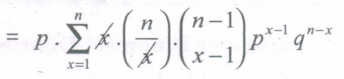
= \(np.\overset { n }{ \underset { x=1 }{ \Sigma } } \left( \begin{matrix} n-1 \\ x-1 \end{matrix} \right) { p }^{ x-1 }q^{ n-x }\)
= np (q +p)n-1 [using binomial theorem]
(x+a)n = \({ x }^{ n }+{ n }_{ { C }_{ 1 } }{ x }^{ n-1 }{ a }^{ 1 }+...+{ a }^{ n }\)
= np(1)n-1 [∵ p+q=1]
= np
∴ Mean = E(x) = np..(1)
Now, E(X2) =\(\overset { n }{ \underset { x=0 }{ \Sigma } } { x }^{ 2 }.\left( \begin{matrix} n \\ x \end{matrix} \right) { p }^{ x }q^{ n-x }\)
=\(\overset { n }{ \underset { x=0 }{ \Sigma } } \{ x(x-1)+x\} \left( \begin{matrix} n \\ x \end{matrix} \right) { p }^{ x }q^{ n-x }\)
=\(\overset { n }{ \underset { x=0 }{ \Sigma } } x(x-1).\left( \begin{matrix} n \\ x \end{matrix} \right) { p }^{ x }q^{ n-x }+{ \Sigma }_{ x }.\left( \begin{matrix} n \\ x \end{matrix} \right) { p }^{ x }q^{ n-x }\)
=\(\overset { n }{ \underset { x=2 }{ \Sigma } } x(x-1)\frac { n(n-1) }{ x(x-1) } \left( \begin{matrix} n-2 \\ n-2 \end{matrix} \right) { p }^{ x-2 }{ q }^{ n-x }\)+\(\Sigma x\left( \begin{matrix} n \\ x \end{matrix} \right) { p }^{ x }q^{ n-x }\)
= \(n(n-1){ p }^{ 2 }\left\{ \Sigma \left( \begin{matrix} n-2 \\ n-2 \end{matrix} \right) { p }^{ x-2 }{ q }^{ n-x } \right\} \) +np (using (1))
= n(n-1)p2 (q+p)n-2 + np
[using binomial theory]
= n(n-1)p2 (1) + np ∴ p+ q = 1
= n(n-1)p2+ np .... (2)
Variance = E(X2) - [E(X)]2
= n(n-1)p2+np-(np)2
[From (1) & (2)]

= np (1-p) = npq [ ∵ p+q = 1⇒ q = 1-p]
∴ Mean = np and variance = npq
10.
Let X denote the length of life of dry battery cells follows normal distribution with mean 12 and SD 3 hours
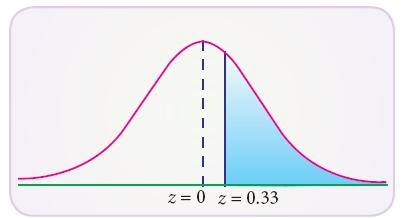
(i) more than 13 hours
P(X > 13)
When X = 13
\(Z=\frac { X-\mu }{ \sigma } =\frac { 13-12 }{ 3 } =0.333\)
P(X > 13) = P(Z > 0.333) = 0.5 – 0.1293 = 0.3707
The expected battery cells life to have more than 13 hours is 125 × 0.3707 = 46.34%
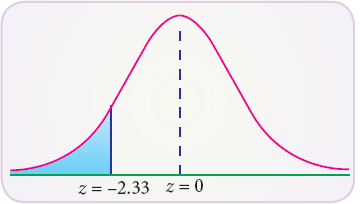
(ii) less than 5 hours
P(X < 5)
When X = 5
\(Z=\frac { X-\mu }{ \sigma } =\frac { 5-12 }{ 3 } =-2.333\)
P(X < 5) = P(Z < –2.333) = P(Z > 2.333)
= 0.5 – 0.4901 = 0.0099
The expected battery cells life to have more than 13 hours is 125 × 0.0099 = 1.23%
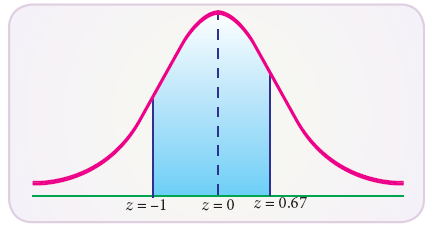
(iii) between 9 and 14 hours
When X = 9
\(Z=\frac { X-\mu }{ \sigma } =\frac { 9-12 }{ 3 } =-1\)
When X = 14
\(Z=\frac { X-\mu }{ \sigma } =\frac { 14-12 }{ 3 } =0.667\)
P(9 < X < 14) = P(–1 < Z < 0.667)
= P(0 < Z < 1) + P(0 < Z < 0.667)
= 0.3413 + 0.2486
= 0.5899
The expected battery cells life to have more than 13 hours is 125 x 0.5899 = 73.73%
11.
Let X be the waiting time of a customer in the queue and it is normally distributed with mean 5 and SD 0.7.
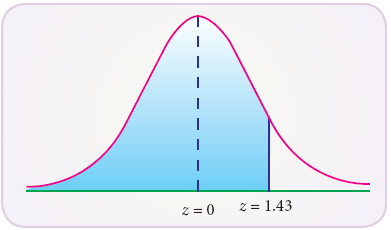
(i) for less than 6 minutes
\(Z=\frac { X-\mu }{ \sigma } =\frac { 6-5 }{ 0.7 } =1.4285\)
P(X < 6) = P(Z < 1.43)
= 0.5 + 0.4236
= 0.9236
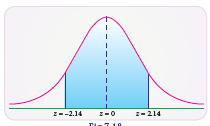
(ii) between 3.5 and 6.5 minutes
When X = 3.5
\(Z=\frac { X-\mu }{ \sigma } =\frac { 3.5-5 }{ 0.7 } =2.1429\)
When X = 6.5
\(Z=\frac { X-\mu }{ \sigma } =\frac { 6.5-5 }{ 0.7 } =2.1429\)
P(3.5 < X < 6.5)
= P (–2.1429 < Z < 2.1429)
= P(0 < Z < 2.1429) + P(0 < Z < 2.1429)
= 2 P(0 < Z < 2.1429)
= 2 x .4838
= 0.9676
12.
Given demand function Pd = 20 - 5x and
Supply function Ps = 4x + 8
Under market equilibrium ps = Pd
⇒ 20-5x = 4x+8
⇒ 20-8 = 4x+5x
⇒ 12 = 9x
\(\Rightarrow x=\frac{\not 12}{\not 9}=\frac{4}{3}\)
When \({ x }_{ 0 }=\frac { 4 }{ 3 } ,{ p }_{ 0 }=20-5\left( \frac { 4 }{ 3 } \right) =20-\frac { 20 }{ 3 } \)
\(=\frac { 60-20 }{ 3 } =\frac { 40 }{ 3 } \)
\(\therefore { p }_{ 0 }{ x }_{ 0 }=\frac { 40 }{ 3 } \times \frac { 4 }{ 3 } =\frac { 160 }{ 9 } \)
Consumer Surplus (CS)
\(=\int _{ 0 }^{ x }{ f(x)dx } -{ p }_{ 0 }{ x }_{ 0 }\)
\(=\int _{ 0 }^{ \frac { 4 }{ 3 } }{ (20-5x)dx } \)
\(={ \left[ 20x-\frac { { 5x }^{ 2 } }{ 2 } \right] }_{ 0 }^{ \frac { 4 }{ 3 } }-\frac { 160 }{ 9 } \)
\(=20\left( \frac { 4 }{ 3 } \right) -\frac { 5 }{ 2 } \left( \frac { 16 }{ 9 } \right) -\frac { 160 }{ 9 } \)
\(=\frac { 80 }{ 3 } -\frac { 40 }{ 9 } -\frac { 160 }{ 9 } \)
\(=\frac { 240-40-160 }{ 9 } =\frac { 40 }{ 9 } \)
\(\therefore CS=\frac { 40 }{ 9 }\)units
Producer's Surplus
\((PS)={ p }_{ 0 }{ x }_{ 0 }-\int _{ 0 }^{ x }{ g(x)dx } \)
\(=\frac { 160 }{ 9 } -\int _{ 0 }^{ \frac { 4 }{ 3 } }{ (4x+8)dx } \)
\(=\frac { 160 }{ 9 } -{ \left[ \frac { { 4x }^{ 2 } }{ 2 } +8x \right] }_{ 0 }^{ \frac { 4 }{ 3 } }\)
\(=\frac { 160 }{ 9 } -\left( 2\left( \frac { 16 }{ 9 } \right) +8\left( \frac { 4 }{ 3 } \right) \right) \)
\(=\frac { 160 }{ 9 } -\left( \frac { 32 }{ 9 } +\frac { 32 }{ 3 } \right) \)
\(=\frac { 160 }{ 9 } -\frac { 32 }{ 9 } -\frac { 32 }{ 3 } \)
\(PS=\frac { 160-32-96 }{ 9 } =\frac { 32 }{ 9 } \)units
13.
We know that, the expected random variable
\(E(X)=\int _{ -\infty }^{ \infty }{ xf(x) } dx\)
\(=\int _{ 100 }^{ \infty }{ { xe }^{ -\frac { x }{ 100 } }dx } \)
\(=\left\{ { \left[ x\left( \frac { { e }^{ \frac { x }{ 100 } } }{ -\frac { 1 }{ 100 } } \right) \right] }_{ 100 }^{ \infty }-\int _{ 100 }^{ \infty }{ \left( \frac { { e }^{ \frac { x }{ 100 } } }{ -\frac { 1 }{ 100 } } \right) dx } \right\} (\because \int { udv=uv-\int { vdu } } )\)
\(=\left[ \left( 10000 \right) \left( { e }^{ -1 } \right) +\left( 10000 \right) \left( { e }^{ -1 } \right) \right] \)
\(=\left[ \left( 10000 \right) \left( 0.3679 \right) +\left( 10000 \right) (0.3679) \right] \)
= 7358 hours
Therefore, the mean life of a radio tube is 7,358 hours.
14.
Given demand equation is \(x=\sqrt { 100-p } \) and
Supply equation is \(x=\frac { p }{ 2 } -10\)
At market equilibrium, \(\sqrt { 100-p } =\frac { p }{ 2 } -10\) Squaring both sides,
\(100-p={ \left( \frac { p }{ 2 } -10 \right) }^{ 2 }\)
\(\frac { { p }^{ 2 } }{ 4 } -10p+p=0\)
\(\frac { { p }^{ 2 } }{ 4 } -9p=0\)
\({ p }^{ 2 }-36p=0\)
p(p-36) = 0
p = 0 or p = 36
Since p cannot be zero, p = 36
\(\therefore \ { x }_{ 0 }=\sqrt { 100-36 } =\sqrt { 64 } =8\)
∴ p0x0 = 36 x 8 = 288
Given demand equation is \(x=\sqrt { 100-p } \)
X2 = 100-P(Squaring both sides)
p = 100-x2
Consumer's Surplus
\(CS=\int _{ 0 }^{ x }{ f(x) } dx-{ p }_{ 0 }{ x }_{ 0 }\)
\(CS=\int _{ 0 }^{ 8 }{ (100-{ x }^{ 2 }) } dx-288\)
\(={ \left[ 100x-\frac { { x }^{ 3 } }{ 3 } \right] }_{ 0 }^{ 8 }-288\)
\(=100(8)-\frac { { 8 }^{ 3 } }{ 3 } -288\)
\(=800-\frac { 512 }{ 3 } -288\)
\(=512-\frac { 512 }{ 3 } \)
\(=\frac { 1536-512 }{ 3 } \)
\(CS=\frac { 1024 }{ 3 } \)units
Supply equation is given as
\(x=\frac { p }{ 2 } -10\)
\(x=\frac { p-20 }{ 2 } \)
2x = p - 20
p = 2x + 20
∴ Producer's surplus
\(PS={ p }_{ 0 }{ x }_{ 0 }-\int _{ 0 }^{ x }{ g(x)dx } \)
\(=288-\int _{ 0 }^{ 8 }{ (2x+20)dx } \)
\(=288-{ \left( \frac { { 2x }^{ 2 } }{ 2 } +20x \right) }_{ 0 }^{ 8 }\)
\(=288-{ \left( { x }^{ 2 }+20x \right) }_{ 0 }^{ 8 }\)
= 288 - (82 + 20(8))
= 288 - (64 + 160)
= 288 - 224
PS = 64 units
15.
Given probability distribution function
\(F(x)\begin{cases} 0,\quad \text{for}\quad x<0 \\ \frac { 1 }{ 2 } ,\quad \text{for}\quad 0\le x<1 \\ 0,\quad \text{for}\quad 1\le x<2\quad \\ \frac { 1 }{ 4 } ,\quad \text{for}\quad 2\le x<4 \\ 0,\quad \text{for}\quad x\ge 4 \end{cases}\)
a) The distribution function F(x) is continuous since it is a step function
We know f'(x) = f(x)
∴ Probability density function
\(F(x)\begin{cases} 0,\quad \text{for}\quad x\le 0 \\ \frac { 1 }{ 2 } ,\quad \text{for}\quad 0\le x<1 \\ 0,\quad \text{for}\quad 1\le x<2\quad \\ \frac { 1 }{ 4 } ,\quad \text{for}\quad 2\le x<4 \\ 0,\quad \text{for}\quad x\ge 4 \end{cases}...(1)\)
(b) (i) Probability that a person will have to wait more than 3 minutes is P(X > 3)
∴ P(X>3) = P(3≤X<4)+P(X≥4)
\(\frac{1}{4}+0=\frac{1}{4}\) [from (1)]
ii) Probability that a person will have to wait less than 3 minutes is P(X < 3)
∴ P(X<3) = P(X≤0)+P(0≤x≤1)+P(1≤x≤2)+P(2≤x≤3)
0 + \(\frac{1}{2}+0+\frac{1}{4}\)[from (1)]
∴ P(X<3) = \(\frac{3}{4}\)
= P(1≤X<2)+P(2≤X<3)
= 0 +\(\frac{1}{4}=\frac{1}{4}\) [from (1)]
16.
Given p.d.f is
\(f(x)=\begin{cases} \begin{matrix} \frac { 1 }{ 16 } { (3+x) }^{ 2 }, & -3\le x\le -1 \end{matrix} \\ \begin{matrix} \frac { 1 }{ 16 } (6-2{ x }^{ 2 }), & -1\le x\le 1 \end{matrix} \\ \begin{matrix} \frac { 1 }{ 16 } { (3-x) }^{ 2 }, & 1\le x\le 3 \end{matrix} \end{cases}\)
Area under the given curve
\(\int _{ -3 }^{ 3 }{ f(c)dx=\int _{ -3 }^{ -1 }{ \frac { 1 }{ 16 } { (3+x) }^{ 2 }+\int _{ -1 }^{ 1 }{ \frac { 1 }{ 16 } (6-2{ x }^{ 2 })dx } } +\int _{ 1 }^{ 3 }{ \frac { 1 }{ 16 } { (3-x) }^{ 2 }dx } } \)
\(=\frac { 1 }{ 16 } { \left[ \frac { (3+x{ ) }^{ 3 } }{ 3 } \right] }_{ -3 }^{ -1 }+\frac { 1 }{ 16 } { \left( 6x-\frac { { 2x }^{ 3 } }{ 3 } \right) }_{ -1 }^{ 1 }+\frac { 1 }{ 16 } { \left( \frac { { (3-x) }^{ 3 } }{ -3 } \right) }_{ 1 }^{ 3 }\)
\(=\frac { 1 }{ 16 } \left[ \left( \frac { { 2 }^{ 3 } }{ 3 } -0 \right) +\left( 6-\frac { 2 }{ 3 } \right) -\left( -6+\frac { 2 }{ 3 } \right) -\frac { 1 }{ 3 } \left( 0-({ 2 }^{ 3 }) \right) \right] \)
\(=\frac { 1 }{ 6 } \left[ \frac { 8 }{ 3 } +\frac { 16 }{ 3 } -\left( \frac { -16 }{ 3 } \right) +\frac { 8 }{ 3 } \right] \)
\(\\ =\frac { 1 }{ 16 } \left[ \frac { 8 }{ 3 } +\frac { 16 }{ 3 } +\frac { 16 }{ 3 } +\frac { 8 }{ 3 } \right] \)
\(=\frac { 1 }{ 16 } \left[ \frac { 8+16+16+8 }{ 3 } \right] \)
\(=\frac { 1 }{ 16 } \times \frac { 48 }{ 3 } =\frac { 1 }{ 16 } \times 16=1\)
Hence, area under the given curve is unity.
17.
\(\eta _{ d }=\frac { p+2{ p }^{ 2 } }{ 100-p-{ p }^{ 2 } } \)
\(\frac { -p }{ x } \frac { dx }{ dp } =\frac { p(2p+1) }{ 100-p-{ p }^{ 2 } } \)
\(\frac { -dx }{ x } =\frac { -(2p+1) }{ { p }^{ 2 }+p-100 } dp\)
\(\int { \frac { dx }{ x } } =\int { \frac { 2p+1 }{ { p }^{ 2 }+p-100 } } dp\)
log x = log(p2 + p = 100) + log k
ஃ x = k(p2 + p −100)
When x = 70, p = 5,
70 = k(25 + 5 − 100)
⇒ k = –1
Hence x = 100 − p − p2
R = px
Revenue = p(100 – p – p2)
18.
19.
\(y=\left| x+3 \right| =\begin{cases} x+3\quad if\quad x\ge -3\quad \\ -(x+3)\quad if\quad x<-3 \end{cases}\)
Required area = \(\int _{ b }^{ a }{ y } dx=\int _{ -6 }^{ 0 }{ y } dx\)
= \(\int _{ -6 }^{ -3 }{y}\ dx+\int _{ -3 }^{ 0 }{ y} dx\)
= \(\int _{ -6 }^{ -3 }{ -(x+3) } dx+\int _{ -3 }^{ 0 }{ (x+3) } dx\)
= \(-{ \left[ \frac { { (x+3) }^{ 2 } }{ 2 } \right] }_{ -6 }^{ -3 }{ +\left[ \frac { { (x+3) }^{ 2 } }{ 2 } \right] }_{ -3 }^{ 0 }\)
\(=-\left[ 0-\frac { 9 }{ 2 } \right] +\left[ \frac { 9 }{ 2 } -0 \right] \)
= 9 sq. units
20.
\(\int { \frac { { 3x }^{ 2 }-2x56 }{ \left( x-1 \right) -\left( { x }^{ 2 }+5 \right) } } dx\)
⇒ 3x2-2x+5 = A (x2+5) + (Bx+c) (x-1)
Putting x =1,
3 - 2+5 = A (1+ 5)
⇒ 6 = A (6)
⇒ A = 1
Putting x = 0,
5 = 5 A - C
⇒ 5 = 5 - C [∵ A = 1]
⇒ C = 5 - 5 ⇒ C = 0
Putting x = -1,
3 + 2+ 5 = A (6) + (C-B) (-2)
⇒ 10 = 6A + 2B - 2C
⇒ 10 = 6 + 2B + 0
⇒ 10 - 6 = 2B ⇒ 4 = 2B
⇒ B = 2
\(=\int { \left( \frac { A }{ x-1 } +\frac { Bx+c }{ { x }^{ 2 }+5 } \right) } dx\)
\(=\int { \left( \frac { 1 }{ x-1 } +\frac { 2x+0 }{ { x }^{ 2 }+5 } \right) } dx\)
\(=\int { \frac { 1 }{ x-1 } } dx+\int { \frac { 2x }{ { x }^{ 2 }+5 } } dx\)
\(=\log { \left| x-1 \right| } +\log { \left| { x }^{ 2 }+5 \right| } +c\)
\(\left[ \because \int { \frac { { f }^{ 1 }(x) }{ f(x) } dx=\log { \left| f\left( x \right) \right| +c } } \right] \)
\(=\log { \left| \left( { x }^{ 2 }+5 \right) \left( x-1 \right) \right| } +c\)
[∵ log m + log n = log mn]
\(=\log { \left| { x }^{ 3 }-{ x }^{ 2 }+5x-5 \right| } +c\)
\(=\frac { { 3x }^{ 2 }-2x+5 }{ \left( x-1 \right) \left( { x }^{ 2 }+5 \right) } =\frac { A }{ (x-1) } +\frac { Bx+C }{ \left( { x }^{ 2 }+5 \right) } \)
21.
Transition probability matrix
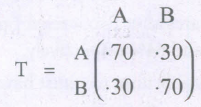
Where A represents the percentage of people using transit system and B represents the percentage of people using metro train.
By the given data
A 60% = .60
and B 40% = ·4
= ((-6)(-7)+(-4)(-3) (-6)(-3)+(-4)(-7))
= (-42+·12 ·18+·28)
= (-54 -46)
\(\therefore\) A = 54%and B = 46%
(i) The percent of Commuters using the transit system after one year is 54% and the percent of commuters using the metro train after one year is 46%
(ii) Equilibrium will be reached in the long run. At equilibrium we must have
(A B) T = (A B)
where A+B = 1
\(\Rightarrow \left( A\quad B \right) \left( \begin{matrix} \cdot 7 & \cdot 3 \\ \cdot 3 & \cdot 7 \end{matrix} \right) =(A\quad B)\)
(-7A +·3B ·3A +.7B) = (A B)
Equaling the entries on both sides, we get
·7A+ ·3B = A
\(\Rightarrow \cdot 7A+\cdot 3(1-A)=A\)
\(\left[ \because A+B=1\Rightarrow B=1-A \right] \)
\(\Rightarrow \cdot 7A+\cdot 3(1-A)=A\)
\(\Rightarrow \cdot 3=A-\cdot 7A+\cdot 3A\)
\(\Rightarrow \cdot 3=A(\cdot 3+\cdot 3)\)
\(\Rightarrow 3=A(\cdot 6)\)
\(\Rightarrow A=\cfrac { \cdot 3 }{ \cdot 6 } =\cfrac { 1 }{ 2 } =\cdot 50\)
\(\therefore\) The percent of commuters using the transit system in the long run is 50%
22.
Let ‘x’ be the number of cars of type C1
Let ‘y’ be the number of cars of type C2
Let ‘z’ be the number of cars of type C3
3x + 2y + 4z = 28
x + y + 2z =13
2x + 2y + z =14
Here \({ \triangle }=\left| \begin{matrix} 3 & 2 & 4 \\ 1 & 1 & 2 \\ 2 & 2 & 1 \end{matrix} \right| =-3\neq 0\)
\({ \triangle }_{ x }=\left| \begin{matrix} 28 & 2 & 4 \\ 13 & 1 & 2 \\ 14 & 2 & 1 \end{matrix} \right| =-6\)
\({ \triangle }_{ y }=\left| \begin{matrix} 3 & 28 & 4 \\ 1 & 1 & 2 \\ 2 & 2 & 1 \end{matrix} \right| =-9\)
\({ \triangle }_{ z }=\left| \begin{matrix} 3 & 2 & 28 \\ 1 & 1 & 13 \\ 2 & 2 & 14 \end{matrix} \right| =-12\)
\(\therefore \) By Cramer’s rule
\(x=\frac { { \triangle }x }{ { \triangle } } =\frac { -6 }{ -3 } =2\)
\(y=\frac { { \triangle }y }{ { \triangle } } =\frac { -9 }{ -3 } =3\)
\(z=\frac { { \triangle }z }{ { \triangle } } =\frac { -12 }{ -3 } =4\)
\(\therefore \) The number of cars of each type which can be produced are 2, 3 and 4.
23.
The matrix equation corresponding to the given system is
\(\left( \begin{matrix} 1 & 1 & 1 \\ 1 & 2 & 3 \\ 1 & 2 & a \end{matrix} \right) \left( \begin{matrix} X \\ Y \\ Z \end{matrix} \right) =\left( \begin{matrix} 6 \\ 10 \\ b \end{matrix} \right) \)
AX = B
| Augmented matrix [A,B] | Elementary Transformation |
| \(\left( \begin{matrix} 1 & 1 & 1 \\ 1 & 2 & 3 \\ 1 & 2 & a \end{matrix}\begin{matrix} 6 \\ 10 \\ b \end{matrix} \right) \) \(\sim \left( \begin{matrix} 1 & 1 & 1 \\ 0 & 1 & 2 \\ 0 & 1 & a-1 \end{matrix}\begin{matrix} 6 \\ 4 \\ b-6 \end{matrix} \right) \) \(\sim \left( \begin{matrix} 1 & 1 & 1 \\ 0 & 1 & 2 \\ 0 & 0 & a-3 \end{matrix}\begin{matrix} 6 \\ 4 \\ b-10 \end{matrix} \right) \) |
\({ R }_{ 2 }\rightarrow { R }_{ 2 }-{ R }_{ 1 }\) \({ R }_{ 3 }\rightarrow { R }_{ 3 }-{ R }_{ 1 }\) |
Case (i) For no solution:
The system possesses no solution only when \(\rho (A)\neq ([A,B])\) which is possible only when a−3 = 0 and b −10 \(\neq \) 0.
Hence for a = 3, b \(\neq \) 10, the system possesses no solution.
Case (ii) For a unique solution:
The system possesses a unique solution only when \(\rho (A)= ([A,B])\)=number of unknowns.
i.e when \(\rho (A)=\rho ([A,B])\) = 3
Which is possible only when a−3 \(\neq \) 0 and b may be any real number as we can observe .
Hence for a \(\neq \) and b \(\in \) R, the system possesses a unique solution.
Case (iii) For an infinite number of solutions:
The system possesses an infinite number of solutions only when
\(\rho (A)=\rho ([A,B])\)
Hence for a = 3, b = 10, the system possesses infinite number of solutions.
24.
The matrix equation corresponding to the given system is
\(\left( \begin{matrix} 1 & 1 & 1 \\ 1 & 2 & 3 \\ 0 & 1 & k \end{matrix} \right) \left( \begin{matrix} X \\ Y \\ Z \end{matrix} \right) =\left( \begin{matrix} 7 \\ 18 \\ 6 \end{matrix} \right) \)
AX = B
| Augmented matrix [A,B] | Elementary Transformation |
|
\(\left( \begin{matrix} 1 & 1 & 1 \\ 1 & 2 & 3 \\ 0 & 1 & k \end{matrix}\begin{matrix} 7 \\ 18 \\ 6 \end{matrix} \right) \) ρ(A) = 2 or 3, ρ([A]) = 3 |
\({ R }_{ 2 }\rightarrow { R }_{ 2 }-{ R }_{ 1 }\) \({ R }_{ 3 }\rightarrow { R }_{ 3 }-{ R }_{ 2 }\) |
For the equations to be inconsistent
\(\rho ([A,B])\neq \rho (A)\)
It is possible if k − 2 = 0.
\(\therefore \) k = 2
25.
Let A represents the percent of people who subscribe the magazine and B represents the percent of people who do not subscribe the magazine.
Given 60% of people subscribe again implies 40% of people do not subscribe. And 25% of people are going to subscribe implies 75% of people are not going to subscribe.
\(\therefore\) Transition probability matrix.
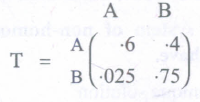
Also, it is given that 40% of those received the order of subscription implies 60% are not going to receive the order.
\(\left( \begin{matrix} \cdot 4 & \cdot 6 \end{matrix} \right) \left( \begin{matrix} \cdot 6 & \cdot 4 \\ \cdot 25 & \cdot 75 \end{matrix} \right) \)
= \(\left( \left( \begin{matrix} \cdot 4 & \cdot 6 \end{matrix} \right) +\left( \cdot 6 \right) \left( \cdot 25 \right) \left( \cdot 4 \right) \left( \cdot 4 \right) +\left( \cdot 6 \right) \left( \cdot 75 \right) \right) \)
= \(\left( \cdot 24+\cdot 15\quad \cdot 16+\cdot 45 \right) =\left( \cdot 39\quad \cdot 61 \right) \)
\(\therefore\) 39% of people who received the current letter can be expected to order a subscription.

12th Standard Syllabus & Materials
12th Standard
TN 12th Computer Applications வலையமைப்பு வடமிடல் Sample Question Papers Study Material - QB365 Set A
NEW12th Standard
TN 12th Computer Applications களப்பெயர் முறைமை (DNS) Sample Question Papers Study Material - QB365 Set A
NEW12th Standard
TN 12th Computer Applications வலையமைப்பு எடுத்துக்காட்டுகள் மற்றும் நெறிமுறைகள் Sample Question Papers Study Material - QB365 Set A
NEW12th Standard
TN 12th Computer Applications கணினி வலையமைப்பு ஓர் அறிமுகம் Sample Question Papers Study Material - QB365 Set A



Tamilnadu Stateboard 12th Standard Subjects

Maths

Chemistry

Physics

Biology

Computer Science
Business Maths and Statistics

Economics

Commerce

Accountancy

History

Computer Applications
Biology
Computer Technology
Computer Applications
Computer Science
Business Maths and Statistics
Commerce
Economics
Maths
Chemistry
Physics
Computer Technology
History
Accountancy

Tamil

English

French
Tamilnadu Stateboard Standards
