
 100% FREE ACCESS
12th Standard Syllabus & Materials
12th Standard
TN 12th Computer Applications மின்னணு தரவு பரிமாற்றம் Sample Question Papers Study Material - QB365 Set A
NEW12th Standard
TN 12th Computer Applications மின் - வணிக பாதுகாப்பு அமைப்புகள் Sample Question Papers Study Material - QB365 Set A
NEW12th Standard
TN 12th Computer Applications மின்னணு செலுத்தல் முறைகள் Sample Question Papers Study Material - QB365 Set A
NEW12th Standard
TN 12th Computer Applications மின் - வணிகம் Sample Question Papers Study Material - QB365 Set A
NEW12th Standard
TN 12th Computer Applications திறந்த மூல கருத்துருக்கள் Sample Question Papers Study Material - QB365 Set A
NEW12th Standard
TN 12th Computer Applications வலையமைப்பு வடமிடல் Sample Question Papers Study Material - QB365 Set A

Published on: 01/03/2021
12th Standard English Medium Business Maths Syllabus Three Mark Important Questions with Answer key - 2021(Public Exam )
Download Tamil Nadu 12th Standard Business Maths and Statistics question papers, model tests, one-mark questions, important questions, and public exam papers in PDF format. Free study materials and answer keys for TN State Board students.
Questions + Answers key
Take MCQ Business Maths and Statistics Test
1.
Compute Fisher's price index number for the following data.
| Commodity | Base Year | Current Year | ||
| Price | Quantity | Price | Quantity | |
| A | 10 | 12 | 12 | 15 |
| B | 7 | 15 | 5 | 20 |
| C | 5 | 24 | 9 | 20 |
| D | 16 | 5 | 14 | 5 |
2.
A die is thrown 120 times and getting 1 or 5 is considered a success. Find the mean and variance of the number of successes.
3.
The probability that an event A happens in one treat of an experiment is 0.4. Three independent treats of the experiment are performed. Find the p!probability that the event A happens at least once.
4.
A random variable X can take all nonnegative integral values and the probabilities that X takes the value r is proportional to aT (0 < ∝ < 1). Find P(X = 0)
5.
For the given pay-off matrix, choose the best alternative for the given states of nature under
(i) Maximin (ii) Minimax princple
| Alternative | States of Nature | ||
| Good | Fair | Bad | |
| A | 100 | 60 | +50 |
| B | 80 | 50 | +10 |
| C | 40 | 20 | +5 |
6.
Evaluate \(\int _{ 1 }^{ 2 }{ \frac { log\quad x }{ { x }^{ 2 } } } dx\)
7.
Evaluate \(\int { \frac { { 8 }^{ 1+x }+{ 4 }^{ 1-x } }{ { 2 }^{ x } } } dx\)
8.
Estimate the population for the year 1995.
| year (x) | 1961 | 1971 | 1981 | 1991 | 2001 |
| population in thousands (y) | 46 | 66 | 81 | 93 | 101 |
9.
From the following data, estimate the population for the year 1986 graphically.
| year | 1960 | 1970 | 1980 | 1990 | 2000 |
| Population (in thousands) | 12 | 15 | 20 | 26 | 33 |
10.
Find the area under the demand curve xy = 1 bounded by the ordinates x = 3, x = 9 and x-axis
11.
Show that the equations 2x - y + z = 7, 3x + y - 5z = 13, x + y + z = 5 are consistent and have a unique solution.
12.
A person wants to invest in one of three alternative investment plans: Stock, Bonds and Debentures. It is assumed that the person wishes to invest all of the funds in a plan. The pay-off matrix based on three potential economic conditions is given in the following table:
| Alternative | Economic conditions | ||
| High growth(Rs.) | Normal growth(Rs.) | Slow growth (Rs.)s | |
| Stocks | 10000 | 7000 | 3000 |
| Bonds | 8000 | 6000 | 1000 |
| Debentures | 6000 | 6000 | 6000 |
Determine the best investment plan using each of following criteria i) Maxmin ii) Minimax.
13.
Determine an initial basic feasible solution of the following transportation problem by north west corner method
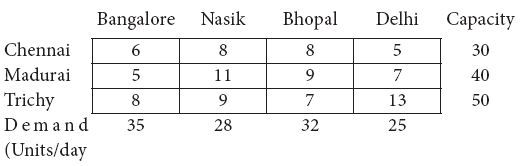
14.
The following figures relates to the profits of a commercial concern for 8 years
| Year | 1986 | 1987 | 1988 | 1989 | 1990 | 1991 | 1992 | 1993 |
| Profit (Rs.) | 15,420 | 15,470 | 15,520 | 21,020 | 26,500 | 31,950 | 35,600 | 34,900 |
Find the trend of profits by the method of three yearly moving averages.
15.
Write a brief note on seasonal variations
16.
If electricity power failures occur according to a Poisson distribution with an average of 3 failures every twenty weeks, calculate the probability that there will not be more than one failure during a particular week.
17.
The probability that a student get the degree is 0.4 Determine the probability that out of 5 students
(i) one will be graduate
(ii) atleast one will be graduate
18.
A fair die is thrown. Find out the expected value of its outcomes.
19.
What are the properties of
(i) discrete random variable and
(ii) continuous random variable?
20.
Explain the terms
(i) probability mass function,
(ii) probability density function and
(iii) probability distribution function.
21.
Determine the cost of producing 200 air conditioners if the marginal cost (is per unit) is C' (x) = \(\frac { { x }^{ 2 } }{ 200 } \) + 4
22.
The marginal cost function is MC = 300 \({ x }^{ \frac { 2 }{ 5 } }\) and fixed cost is zero. Find out the total cost and average cost functions.
23.
Let X be a discrete random variable with the following p.m.f
\(p(x) = \begin{cases}0.3 & \text { for } x =3 \\ 0.2, & \text { for } x = 5 \\ 0.3, & \text { for } x = 8 \\ 0.2, & \text { for} x = 10 \\ 0, & \text { otherwise } \\ \end{cases}\)
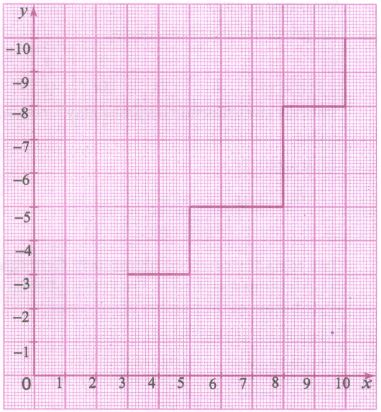
Find and plot the c.d.f. of X.
24.
Show that the equations 2x + y = 5,4x + 2y = 10 are consistent and solve them.
25.
Find the order and degree of the following differential equations.
\(\frac{d^{3} y}{d x^{3}}+3\left(\frac{d y}{d x}\right)^{3}+2 \frac{d y}{d x}=0\)
1.
| Commodity | Base Year | Current Year | ||
| p0 | q0 | p1 | q1 | |
| A | 10 | 12 | 12 | 15 |
| B | 7 | 15 | 5 | 20 |
| C | 5 | 24 | 9 | 20 |
| D | 16 | 5 | 14 | 5 |
| p1q0 | p0q0 | p1q1 | p0q1 |
| 144 | 120 | 180 | 150 |
| 75 | 105 | 100 | 140 |
| 216 | 120 | 180 | 100 |
| 70 | 80 | 70 | 80 |
| 505 | 425 | 530 | 470 |
Fisher's ideal index = \(\sqrt \frac {\sum p_{1}q_{0}\times \sum p_{1}q_{1}}{\sum p_{0}q_{0}\times \sum p_{0}q_{1}} \times 100\)
= \(\sqrt{\frac{505}{425} \times \frac {430}{470}} \times 100\)
\(P^{F}_{01}\) = 115.75
2.
Given n = 20
P(getting 1 or 5) = \(\frac { 2 }{ 6 } \Rightarrow p=\frac { 1 }{ 3 } \)
∴ q = 1 - p = \(1-\frac { 1 }{ 3 } =\frac { 2 }{ 3 } \)
Using Binomial distribution,
Mean = np = 120 \(\times\) \(\frac { 1 }{ 3 } \) = 40
Variance = npq = 40 \(\times\) \(\frac { 2 }{ 3 } =\frac { 80 }{ 3 } \)
3.
p = 0.4, n = 3
q =1 - P = 1 - 0.4 = 0.6
P(X = x) = nCx pxqn-x
P(X≥1) = P(X = 1) + P(X = 2) + P(X = 3)
=3C1 (0.4)1 (0.6)2 + 3C2 (0.4)2 (0.6) + 3C3 (0.4)3 (0.6)0
=3 x \(\left( \frac { 4 }{ 10 } \right) \left( \frac { 36 }{ 100 } \right) +3\left( \frac { 16 }{ 100 } \right) \left( \frac { 6 }{ 100 } \right) +\left( \frac { 64 }{ 1000 } \right) \)
= \(\frac { 1 }{ 1000 } \)(432+288+64) =\(\frac { 784 }{ 1000 } \)
P(X≥1) = 0.784
4.
We have P(X=r)∝αr
⇒P(X = r) = λαr,r = 0,1,2,....
Since sum of all the probabilities in a probability distribution is 1.
P(X = 0)+P(X = 1)+P(P(X = 2)+... = 1
⇒ λα0+λα1+λα2+...= 1
⇒λ(1+α+α2+.....) = 1
⇒\(\lambda(\frac{1}{1-\alpha})\) = 1
⇒ λ = 1 - α
∴ P(X = r) = (1-α)αr, r = 0,1,2,...
Hence P(X=0) = (1-α)α0 = (1-α)(1) = 1-α.
5.
| Alternative | States of Nature | Minimum | Maximum | ||
| Good | Fair | Bad | |||
| A | 100 | 60 | +50 | +50 | 100 |
| B | 80 | 50 | +10 | 10 | 80 |
| C | 40 | 20 | +5 | 5 | 40 |
(i) Max (50, 10, 5) = 50
∴ A is the best alternative under maximin principle
(ii) Min (100, 80,40) = 40
∴ C is the best alternative under minimax principle
6.
Let I = \(\int _{ 1 }^{ 2 }{ \frac { log\quad x }{ { x }^{ 2 } } } dx\)
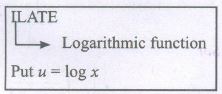
u = log x and dv = \(\frac { 1 }{ { x }^{ 2 } } dx\quad ={ x }^{ -2 }dx\)
\(du=\frac { 1 }{ x } ;v=\frac { { x }^{ -2+1 } }{ { -2+1 } } =\frac { { x }^{ -1 } }{ -1 } =\frac { -1 }{ x } \)
Using integration by parts we get,
ഽu dv = uv - ഽv du
\(\therefore I=\int _{ 1 }^{ 2 }{ \frac { log\quad x }{ { x }^{ 2 } } } dx\)
= \({ \left[ -\frac { 1 }{ x } logx-\int { -\frac { 1 }{ x } .\frac { 1 }{ x } } dx \right] }_{ 1 }^{ 2 }\)
= \({ \left[ -\frac { 1 }{ x } logx+\int { \frac { 1 }{ { x }^{ 2 } } } dx \right] }_{ 1 }^{ 2 }\)
= \({ \left[ -\frac { 1 }{ x } logx-\frac { 1 }{ x } \right] }_{ 1 }^{ 2 }\)
= \(-{ \left[ \frac { 1 }{ x } logx+\frac { 1 }{ x } \right] }_{ 1 }^{ 2 }\)
= \(-\left[ \left( \frac { 1 }{ 2 } log2+\frac { 1 }{ 2 } \right) -\left( 1log1+\frac { 1 }{ { 1 }^{ 1 } } \right) \right] \)
= \(-\left[ \frac { 1 }{ 2 } log2+\frac { 1 }{ 2 } -0-1 \right] \)
\(\left[ \because log1=0 \right] \)
= \(-\left[ \frac { 1 }{ 2 } log2-\frac { 1 }{ 2 } \right] \)
= \(\frac { 1 }{ 2 } -\frac { 1 }{ 2 } log2\)
= \(\frac { 1 }{ 2 } (1-log2)\)
7.
\(\int { \frac { { 8 }^{ 1+x }+{ 4 }^{ 1-x } }{ { 2 }^{ x } } } dx\)
= \(\int { \frac { { \left( { 2 }^{ 3 } \right) }^{ 1+x }+{ \left( { 2 }^{ 2 } \right) }^{ 1-x } }{ { 2 }^{ x } } } dx\)
= \(\int { \frac { { 2 }^{ 3+3x }+{ 2 }^{ 2-2x } }{ { 2 }^{ x } } } dx\)
= \(\int { \frac { { 2 }^{ 3+3x } }{ { 2 }^{ x } } } dx+\int { \frac { { 2 }^{ 2-2x } }{ { 2 }^{ x } } } +dx\)
= ഽ23+3x-xdx + ഽ 22-2x-x dx
= ഽ 22x+3 dx+ ഽ 22-3x dx
= \(\frac { { 2 }^{ 2x+3 } }{ 2log2 } +\frac { { 2 }^{ 2-3x } }{ -3log2 } +c\)
= \(\frac { { 2 }^{ 2x+3-1 } }{ log2 } -\frac { { 2 }^{ 2-3x } }{ 3log2 } +c\)
= \(\frac { { 2 }^{ 2x+2 } }{ log2 } -\frac { { 2 }^{ 2-3x } }{ 3log2 } +c\)
8.
Since 1995 lies at the table of the table, use Newton's backward interpolation formula.
Also, xn + nh ⇒ x 2001 + n (10) = 1995
⇒ 10n = 1995 - 2001 ⇒ n = \(\frac{-6}{10}\) ⇒ n = -0.6
\(\Rightarrow { y }_{ n }+\frac { n }{ n! } \nabla { y }_{ n }+\frac { n(n+1) }{ 2! } { \nabla }^{ 2 }{ y }_{ n }+\frac { n(n+1)(n-2) }{ 3! } { \nabla }^{ 3 }{ (y }_{ n })\)
The difference table is
| x | y | ∇y | ∇2y | ∇3y | ∇4y |
|---|---|---|---|---|---|
| 1961 | 46 | ||||
| 1971 | 66 | 20 | |||
| 1981 | 81 | 15 | -5 | ||
| 1991 | 93 | 12 | -3 | -2 | |
| 2001 | 101 | 8 | -4 | -1 | -3 |
∴ \(y=101+\frac { (0.6) }{ 1! } (8)+\frac { (-0.6)(-0.6+1) }{ 2! } (-4)+\frac { (-0.6)(-0.6+1)(-0.6+2) }{ 3! } (-1)+\frac { (-0.6)(-0.6+1)(-0.6+2)(-0.6+3) }{ 4! } (-3)\)
= 101 - (0.6)8 + \(\frac { (-0.6)(0.4) }{ 2 } (-4)+\frac { (-0.6)(0.4)(1.4) }{ 6 } (-1)+\frac { (0.6)(0.4)(1.4)(2.4)(-3) }{ 24 } \)
= 96.8368
Hence, population for the year 1995 is 96.837 thousands.
9.
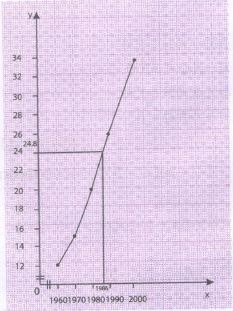
From the graph, it is found that the population for 1986 was 24 thousands.
10.
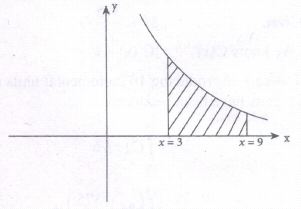
Area \(=\int _{ a }^{ b }{ ydx } \)
\(=\int _{ 3 }^{ 9 }{ \frac { 1 }{ x } dx } \)
\(={ [log\quad x] }_{ 3 }^{ 9 }\)
= log9-log3
\(=log\left( \frac { 9 }{ 3 } \right) \)
A = log 3 sq.units.
11.
The non-homogeneous equation are
2x - y + z = 7, 3x + y - 5z = 13, x + y + z = 5
| Augmented matrix [A,B] |
Elementary Transformation |
|---|---|
| \(\left( \begin{matrix} 2 & -1 & 1 \\ 3 & 1 & -5 \\ 1 & 1 & 1 \end{matrix}\begin{matrix} 7 \\ 13 \\ 5 \end{matrix} \right) \) | |
| \(-\left( \begin{matrix} 1 & 1 & 1 \\ 3 & 1 & -5 \\ 2 & -1 & 1 \end{matrix}\begin{matrix} 5 \\ 13 \\ 7 \end{matrix} \right) \) | \({ R }_{ 1 }\leftrightarrow { R }_{ 3 }\) |
| \(\sim \left( \begin{matrix} 1 & 1 & 1 \\ 0 & -2 & -8 \\ 0 & -3 & -1 \end{matrix}\begin{matrix} 5 \\ -2 \\ -3 \end{matrix} \right) \) | \({ R }_{ 2 }\rightarrow { R }_{ 2 }-3{ R }_{ 1 }\) \({ R }_{ 3 }\rightarrow { R }_{ 3 }-2{ R }_{ 1 }\) |
| \(\sim \left( \begin{matrix} 1 & 1 & 1 \\ 0 & -2 & -8 \\ 0 & 0 & 11 \end{matrix}\begin{matrix} 5 \\ -2 \\ 0 \end{matrix} \right) \) | \({ R }_{ 3 }\rightarrow { R }_{ 3 }-\cfrac { 3 }{ 2 } { R }_{ 2 }\) |
Clearly \(\rho (A)=3\) and \(\rho (A,B)\) = 3 = Number of unknowns
\(\therefore\) The given system is consistent and has unique solution.
12.
| Economic Conditions | |||||
| Alternative | High growth | Normal growth | Slow growth | Minimum payoff | Maximum payoff |
| Stocks | 10000 | 7000 | 3000 | 3000 | 10000 |
| Bonds | 8000 | 6000 | 1000 | 1000 | 8000 |
| Debentures | 6000 | 6000 | 6000 | 6000 | 6000 |
(i) Max (3000, 1000, 6000) = 6000
∴ Debentures is the best using maximin principle
(ii) Max (10000, 8000, 6000) = 6000
∴ Debentures is the best using minimax principle.
13.
First allocation:
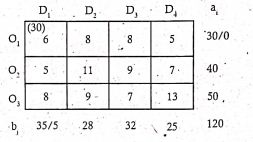
Second allocation:
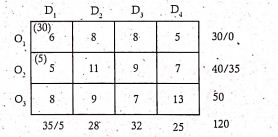
Third allocation:
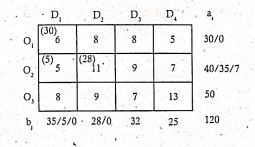
Fourth allocation:
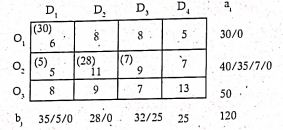
Fifth allocation:
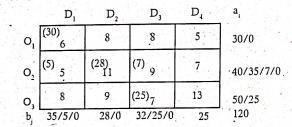
Final allocation:
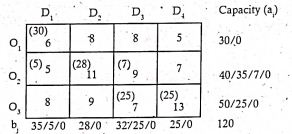
The transportation cost is
\( = (30 \times 6)+(5 \times 5)+(28 \times 11)+ (7 \times 9)+(25 \times 7)+(25 \times 13) \)
= 180 + 25 + 308 + 63 + 175 + 325
= Rs. 1076
14.
| Year X | Profit (Rs) Y | 3-yearly moving total | 3-yearly moving average |
| 1986 | 15420} | - | - |
| 1987 | {15470} | 46410 | 15470 (∴ 46410 / 3) |
| 1988 | {{11520} | 52010 | 17336.666 |
| 1989 | {{21020 | 63040 | 21013.333 |
| 1990 | {{26500 | 79470 | 26490 |
| 1991 | 31950 | 94050 | 31350 |
| 1992 | 35600 | 102450 | 34150 |
| 1993 | 34900 | - | - |
15.
Tendency movements are due to nature, which repeat themselves periodically in every seasons. These variations repeat themselves in less than one year time. It is measured in an interval of time.
Seasonal variations may be influenced by natural force, social customs and traditions.
16.
Given average = λ = \(\frac { 3 }{ 20 } \) = 0.15
P(will not be more than one failure)
= P(X ≤ 1)
= P(X = 0) + P(X = 1)
= \(\frac { { e }^{ -\lambda }.{ \lambda }^{ 0 } }{ 0! } +\frac { { e }^{ -\lambda }.{ \lambda }^{ 1 } }{ 1! } \)
= e-λ (1+λ) =e-0.15 (1+0.15)
= (0.8607) (1.15)
= (0.98981 [e-0.15 =0.8607]
∴ Probability that there will not be more than one failure = 0.98981
17.
Probability of getting a degree p = 0.4
∴ q = 1– p
= 1 - 0.4
= 0.6
(i) P (one will be a graduate) = P(X = 1) = 5C1 (0.4)(0.6)4
= 0.2592
(ii) P ( atleast one will be a graduate) = 1–P (none will be a graduate)
= 1-5C0(P0)(Q)5-0
= 1-5C0(0.4)0(0.6)5
= 1-0.0777
= 0.9222
18.
If the random variable X is the top face of a tossed, fair, six sided die, then the probability mass function of X is
Px (x) = \(\frac{1}{6}\), for x = 1, 2, 3, 4, 5 and 6
The average toss, that is, the expected value of X is
\(E(X)=\sum _{ x }^{ }{ { P }_{ x }(x) } \)
\(E(X)=\left( 1\times \frac { 1 }{ 6 } \right) +\left( 2\times \frac { 1 }{ 6 } \right) +\left( 3\times \frac { 1 }{ 6 } \right) +\left( 4\times \frac { 1 }{ 6 } \right) +\left( 5\times \frac { 1 }{ 6 } \right) +\left( 6\times \frac { 1 }{ 6 } \right) \)
\(=\frac { 1 }{ 6 } (1+2+3+4+5+6)\)
\(=\frac { 7 }{ 2 } \)
= 3.5
Therefore, the expected toss of a fair six sided die is 3.5.
19.
For discrete random variable:
p(xi)≥0∀i and \(\sum _{ i=1 }^{ n }{ p({ x }_{ i }) } =1\) and X takes only
infinite number of values
For Continuous random variable:
f(X)≥0∀x and \(\int _{ -\infty }^{ \infty }{ f(x)dx=1 } \) and X takes
infinite number of values in the interval.
20.
(i) Probability mass function:
If X is a discrete random variable with distinet values x1, x2, xn then the function denoted by px (x) and defined by
PX(x) = p(x)
= {p(x = xi) = pi = p(xi)if x = xi, i = 1, 2,...n
0 if x ≠ xi
Here p(xi)≥0∀i & \(\sum _{ i=1 }^{ n }{ p({ x }_{ i })=1 } \)
(ii) Probability density function:
The probability that a random variable X takes a value in th interval [t1, t2] [open or closed] is given by the integral of a function called the probability density function
\(P({ t }_{ 1 }\le X\le { t }_{ 2 })=\int _{ { t }_{ 1 } }^{ { t }_{ 2 } }{ { f }_{ x }(x)dx } \)
Here f(x) ≥0∀ x and \(\int _{ -\infty }^{ \infty }{ f(x)dx=1 } \)
(iii) Probability distribution function:
Fora discrete distribution, the distribution function of a random variable X is defined as
FX(x) = P(X ≤ x)for all x ∈ R.
21.
Given marginal cost MC = C'(x) = \(\frac { { x }^{ 2 } }{ 200 } +4\)
\(\Rightarrow \int { MC=\int { C'(x)=\int { \left( \frac { { x }^{ 2 } }{ 200 } +4 \right) dx } } } \)
To find the cost of producing 200 air conditioners
\(C=\int _{ 0 }^{ 200 }{ \left( \frac { { x }^{ 2 } }{ 200 } +4 \right) dx } \)
\(={ \left[ \frac { 1 }{ 200 } \times \frac { { x }^{ 3 } }{ 3 } +4x \right] }_{ 0 }^{ 200 }\)
\(={ \left[ \frac { { x }^{ 3 } }{ 600 } +4x \right] }_{ 0 }^{ 200 }\)
\(=\left[ \frac { { (200) }^{ 3 } }{ 600 } +4(200) \right] -0\)
\(=\frac { 8000000 }{ 600 } +800\)
= 13333.33 + 800
= Rs. 14,133.33
Hence, the cost of producing 200 air conditioners is Rs. 14133.33
22.
Given \(MC=300{ x }^{ \frac { 2 }{ 5 } }\)
\(\Rightarrow \frac { dC }{ dx } =300{ x }^{ \frac { 2 }{ 5 } }\)
\(\int { dC } =300\int { { x }^{ \frac { 2 }{ 5 } }dx } \)
\(\Rightarrow C=300\frac { { x }^{ \frac { 2 }{ 5 } +1 } }{ \frac { 2 }{ 5 } +1 } +k\)
\(\Rightarrow C=300\frac { { x }^{ \frac { 7 }{ 5 } } }{ \frac { 7 }{ 5 } } +k\)
\(\Rightarrow C=300\times \frac { 5 }{ 7 } { x }^{ \frac { 7 }{ 5 } }+k\) ...(1)
Given fixed cost is zero ⇒ k = 0
∴(1) becomes,
\(C=\frac { 1500 }{ 7 } { x }^{ \frac { 7 }{ 5 } }+0\Rightarrow C=\frac { 1500 }{ 7 } { x }^{ \frac { 7 }{ 5 } }\)
Average cost function \((AC)=\frac { C }{ x } \)
\(\Rightarrow AC=\frac { 1500 }{ 7 } \frac { { x }^{ \frac { 7 }{ 5 } } }{ x } \)
\(\Rightarrow AC=\frac { 1500 }{ 7 } { x }^{ \frac { 7 }{ 5 } -1 }\)
\(\Rightarrow AC=\frac { 1500 }{ 7 } { x }^{ \frac { 2 }{ 5 } }\)
23.
Given probability mass function is
| X=x | 3 | 5 | 8 | 10 |
| P(X=x) | 0.3 | 0.2 | 0.3 | 0.2 |
∴ The cumulative distribution function Fx(x) is
Fx(0) = 0 if x < 3
Fx(3) = P(X = 3) = 0.3, for 3 ≤x<5
Fx(5) = P(X = 3)+P(X = 5) = 0.3+0.2 = 0.5, for 5≤X<8
Fx(8) = P(X = 3)+P(X+5)+P(X = 8)
= 0.3+0.2+0.3
= 0.8,8≤x<10
Fx(10) = P(X = 3)+P(X = 5)+P(X = 8)+P(X = 10)
= 0.3+0.2+0.3+0.2
= 1 for x ≥10
\(F_{x}(x)= \begin{cases}0, & \text { if } x<3 \\ 0.3, & \text { if } 3 \leq x < 1 \\ 0.5, & \text { if } 5 \leq x < 8 \\ 0.8, & \text { if } 8 \leq x < 10 \\ 1, & \text { if } x ≥ 10 \\ \end{cases}\)
24.
The matrix equation corresponding to the system is
\(\left( \begin{matrix} 2 & 1 \\ 4 & 2 \end{matrix} \right) \left( \begin{matrix} x \\ y \end{matrix} \right) =\left( \begin{matrix} 5 \\ 10 \end{matrix} \right) \)
A X = B
| Matrix A | Augmented matrix [A,B] | Elementary Transformation |
| \(\left( \begin{matrix} 2 & 1 \\ 4 & 2 \end{matrix} \right) \) \(\sim \left( \begin{matrix} 2 & 1 \\ 4 & 2 \end{matrix} \right) \) |
\(\left( \begin{matrix} 2 & 1 & 5 \\ 4 & 2 & 10 \end{matrix} \right) \) \(\sim \left( \begin{matrix} 2 & 1 & 5 \\ 4 & 2 & 10 \end{matrix} \right) \) |
\({ R }_{ 2 }\rightarrow { R }_{ 2 }-{ 2R }_{ 1 }\) |
| \(\rho (A)=1\) | \(\rho ([A,B])=1\) |
\(\rho (A)=\rho ([A,B])=1<\)number of unknowns
\(\therefore \)The given system is consistent and has infinitely many solutions.
Now, the given system is transformed into the matrix equation.
\(\left( \begin{matrix} 2 & 1 \\ 0 & 0 \end{matrix} \right) \left( \begin{matrix} x \\ y \end{matrix} \right) =\left( \begin{matrix} 5 \\ 0 \end{matrix} \right) \)
\(\Rightarrow 2x+y=5\)
Let us take y = k,k \(\in \)R
\(\Rightarrow 2x+k=5\)
\(x=\frac { 1 }{ 2 } (5-k)\)
\(x=\frac { 1 }{ 2 } (5-k),y=k\ for\ all\ k\in R\)
Thus by giving different values for k, we get different solution.
Hence the system has infinite number of solutions.
25.
The highest derivative is third order and its power is one
∴ order : 3,
degree : 1

12th Standard Syllabus & Materials
12th Standard
TN 12th Computer Applications களப்பெயர் முறைமை (DNS) Sample Question Papers Study Material - QB365 Set A
NEW12th Standard
TN 12th Computer Applications வலையமைப்பு எடுத்துக்காட்டுகள் மற்றும் நெறிமுறைகள் Sample Question Papers Study Material - QB365 Set A
NEW12th Standard
TN 12th Computer Applications கணினி வலையமைப்பு ஓர் அறிமுகம் Sample Question Papers Study Material - QB365 Set A
NEW12th Standard
TN 12th Computer Applications PHP-உடன் MySQL-ஐ இணைத்தல் Sample Question Papers Study Material - QB365 Set A



Tamilnadu Stateboard 12th Standard Subjects

Maths

Chemistry

Physics

Biology

Computer Science
Business Maths and Statistics

Economics

Commerce

Accountancy

History

Computer Applications
Biology
Computer Technology
Computer Applications
Computer Science
Business Maths and Statistics
Commerce
Economics
Maths
Chemistry
Physics
Computer Technology
History
Accountancy

Tamil

English

French
Tamilnadu Stateboard Standards
