
 100% FREE ACCESS
12th Standard Syllabus & Materials
12th Standard
TN 12th Maths Applications of Matrices and Determinants Sample Question Papers Study Material - QB365 Set A
NEW12th Standard
TN 12th Computer Applications மின்னணு தரவு பரிமாற்றம் Sample Question Papers Study Material - QB365 Set A
NEW12th Standard
TN 12th Computer Applications மின் - வணிக பாதுகாப்பு அமைப்புகள் Sample Question Papers Study Material - QB365 Set A
NEW12th Standard
TN 12th Computer Applications மின்னணு செலுத்தல் முறைகள் Sample Question Papers Study Material - QB365 Set A
NEW12th Standard
TN 12th Computer Applications மின் - வணிகம் Sample Question Papers Study Material - QB365 Set A
NEW12th Standard
TN 12th Computer Applications திறந்த மூல கருத்துருக்கள் Sample Question Papers Study Material - QB365 Set A

Published on: 27/02/2021
12th Standard English Medium Chemistry Reduced Syllabus Annual Exam Model Question Paper - 2021
Download Tamil Nadu 12th Standard Chemistry question papers, model tests, one-mark questions, important questions, and public exam papers in PDF format. Free study materials and answer keys for TN State Board students.
Questions + Answers key
Take MCQ Chemistry Test
1.
Oxidation of aniline with acidified potassium dichromate give
p-benzo quinone
benzoic acid
benzaldehyde
benzyl alcohol
2.
The sugar unit present in nucleic acid is___________
a hexose
tetrose
pentose
glucose
3.
The feasibility of a redox reaction can be predicted with the help of ______.
Electronegativity
Electrochemical series
Electron affinity
Equivalent conductance
4.
With regard to the strength of acids and bases, Find the incorrect statement among the following.
Strong acid is one that completely dissociates in water
Ka is the dissociation constant
CH3COOH is a weak acid
Smaller the Ka value, greater is the acid strength
5.
Glycol \(\overset { 773K }{ \longrightarrow } \) 'A'. Identify 'A' _______.
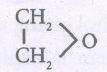
\(\overset { { CH }_{ 3 } }{ \underset { CHO }{ | } } \)
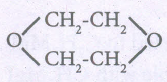
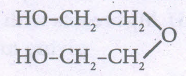
6.
Benzoic acid \(\overset { i){ NH }_{ 3 } }{ \underset { ii)\Delta }{ \longrightarrow } } A\overset { NaOBr }{ \longrightarrow } B\overset { NaN{ O }_{ 2 }/HCl }{ \longrightarrow } \) C 'C' is ______.
anilinium chloride
O – nitro aniline
benzene diazonium chloride
m– nitro benzoic acid
7.
The phenomenon observed when a beam of light is passed through a colloidal solution is_______.
Cataphoresis
Electrophoresis
Coagulation
Tyndall effect
8.
Which of the following fluro compounds is most likely to behave as a Lewis base?
BF3
PF3
CF4
SiF4
9.
S-S bond is present in _______.
H2S2O7
H2SO5
H2S2O6
H2S2O6
10.
A binary solid A+B has a structure with B- ions constituting the lattice and A+ ions occupying 25% tetrahedral holes. Formula of the solid is _______.
A2B
AB2
AB
AB4
11.
Sodium magnesium and aluminum can be obtained from their ore by________.
electro metallurgy
pyro metallurgy
hydro metallurgy
smelting
12.
For a reaction Rate = k[acetone]3/2 then unit of rate constant and rate of reaction respectively is _______.
(mol L-1 S-1),(mol1/2 L1/2 S-1)
(mol-1/2 L1/2 s-1),(mol L-1 s-1)
(mol1/2 L1/2 s-1),(mol L-1 s-1)
(mol L s-1),(mol1/2 L1/2 s)
13.
An excess of silver nitrate is added to 100ml of a 0.01M solution of Pentaaquachlorochromium (III)chloride. The number of moles of AgCl precipitated would be _______.
0.02
0.002
0.01
0.2
14.
The alloy of copper that contain Zinc is________.
Monel metal
Bronze
bell metal
brass
15.
Oxidation state of carbon in its hydrides _______.
+4
-4
+3
+2
16.
Give the uses of mercury button cell.
17.
How will you convert benzaldehyde into the following compounds?
(i) benzophenone
(ii) benzoic acid
(iii) α-hydroxyphenylaceticacid.
18.
Complete the following reactions
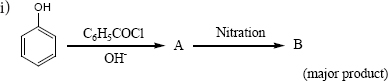
ii) \(C_6H_5-CH_{2}CH(OH)CH(CH_3)_2 \overset{ConH_2SO_4}\longrightarrow\)
19.
What is the difference between a sol and a gel?
20.
When aqueous ammonia is added to CuSO4 solution, the solution turns deep blue due to the formation of tetra ammine copper (II) complex,\({ [Cu({ H }_{ 2 }O)_4] }_{ (aq) }^{ 2+ }+ 4{ NH }_{ 3 }(aq)\rightleftharpoons { [Cu{ ({ NH }_{ 3 }) }_{ 4 }] }_{ (aq) }^{ 2+ }\) among H2O and NH3 Which is stronger Lewis base.
21.
If the rate of a reaction gets doubled as the temperature is increased from 27oC to 37oC. Find the activation energy of reaction?
22.
Give the reason for bleaching action of Cl2.
23.
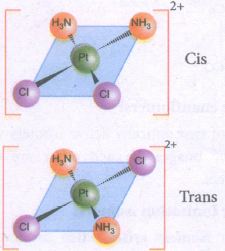
Draw the Cis and trans isomer of MA2B2 type
24.
Name the two steps involved in the extraction of crude metal
25.
What is catenation ? describe briefly the catenation property of carbon.
26.
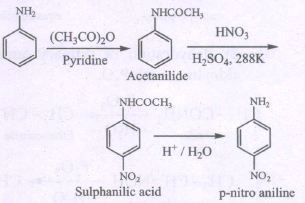
Convert aniline to p-nitro aniline
27.
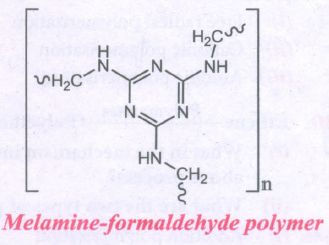
Give the structure of melamine formaldehyde resin.
28.
Justify the presence of keto group in C2 in fructose.
29.
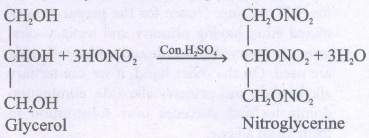
How is nitroglycerine prepared from glycerol?
30.
Explain the process of recharging of lead storage battery.
31.
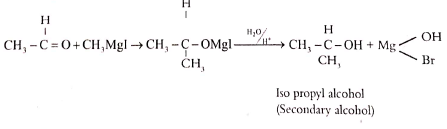
Suggest a suitable reagent to prepare secondary alcohol with identical group using Grignard reagent.
32.
Ksp of Al(OH)3 is 1\(\times\)10-15M. At what pH does 1.0×10⁻³M Al3+ precipitate on the addition of buffer of NH4Cl and NH4OH solution?
33.
Account for the following:
(i) Cobalt (II) is stable in aqueous solution but in the presence of complexing reagents, it is easily oxidised.
(ii) The d1 configuration is very unstable in ions.
34.
Benzene diazonium chloride in aqueous solution decomposes according to the equation \({ C }_{ 6 }{ H }_{ 5 }{ N }_{ 2 }Cl\longrightarrow { C }_{ 6 }{ H }_{ 5 }Cl+{ N }_{ 2 }\)Starting with an initial concentration of 10g L-1, the volume of N2 gas obtained at 50 °C at different intervals of time was found to be as under:
| t(min) | 6 | 12 | 18 | 24 | 30 | \(\infty \) |
| Vol of N2 (ml) | 19.3 | 32.6 | 41.3 | 46.5 | 50.4 | 58.3 |
Show that the above reaction follows the first order kinetics. What is the value of the rate constant?
35.
36.
How will you convert boric acid to boron nitride?
37.
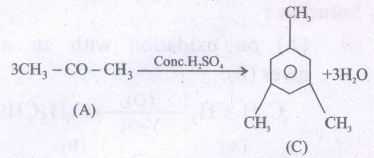
Compound A of molecular formula C3H6O does not reduce Tollens reagent and Fehling's solution. Compound A undergoes Clemmensen reduction to give compound B of molecular formula C3H8. Compound A in the presence of cone.H2SO4 condenses to give an aromatic compound C of molecular formula C9H12. Identify A, B and C. Explain the reactions.
38.
Explain the following
(i) Reactant selectivity
(ii) Transition state selectivity
(iii) Product selectivity
39.
Complete the following reactions
(i) Cr2O72- ⟶
(ii) Cr2O72- + 6I-+ 14H+ ⟶
(iii) Cr2O72-+ 3S2-+ 14H+ ⟶
(iv) Cr2O72- + 3SO2 + 2H+ ⟶
(v) Cr2O72- + 3Sn2+ + 14H+ ⟶
(vi) K2Cr2O7 + 8H2SO4 + 3CH3CH2OH ⟶
(vii) 2MnO4- + 5(COO)2- + 6H+ ⟶
(viii) 2MnO4- + 10I- + 16H+ ⟶
(ix) 2MnO4- + 5S2-+ 16H+ ⟶
(x) 2MnO4- + 5NO2- + 6H+ ⟶
(xi) 2KMnO4 + 3H2SO4 + 5CH3CH2OH ⟶
(xii) 2MnO4- + 5SO32- + 6H+ ⟶
40.
Account for the following:
(i) Reducing character decreases from SO2 to TeO2.
(ii) Xenon forms compounds with fluorine and oxygen only.
41.
What are the general characteristics of solids?
42.
Give the structure for the following compounds.
(i) pentaamminechlorocobalt (III) ion
(ii) Triamminetrinitrito- k N cobalt (III)
(ill) tetraammineaquabromidooobalt(III)nitrate
(iv) Dichloridobisethane-(1,2-diamine) cobalt (lIl) chloride
(v) Tetraamminecopper (lI) sulphate
1.
(a)
p-benzo quinone
2.
(c)
pentose
3.
(b)
Electrochemical series
4.
(d)
Smaller the Ka value, greater is the acid strength
5.
(a)
6.

7.
Scattering of light
8.
BF3 → electron deficient → Lewis acid
PF3 → electron rich → Lewis base
CF4 → neutral → neither Lewis acid nor base
SiF4 → neutral → neither Lewis acid nor base
9.
(d)
H2S2O6
10.
(b)
AB2
11.
(a)
electro metallurgy
12.
Rate = k[A]n
Rate = \(\frac{-\mathrm{d}[\mathrm{A}]}{\mathrm{dt}}\)
unit of rate = \(\frac{mol L^{-1}}{s}\)=mol L-1/s-1
unit of rate constant
\(=\frac{ (mol{ L }^{ -1 }{ S }^{ -1 }) }{ ({ mol }{ L }^{ -1 })^n } \)
= mol1-nLn-1s-1
in the case
rate = k [Acetone]3/2
n = 3/2
= mol1-(3/2)L(3/2)-1s-1
(mol-(1/2) L(1/2) s-1).
13.
The complex is [M(H2O)5Cl]Cl2
1000 ml of 1 M solution of the complex gives 2 moles of Cl- ions 1000 ml of 0.01 M solution of the complex will give
\(\frac{100 ml \times 0.01M \times 2Cl^-}{1000 ml \times 1M}\)
= 0.002 moles of Cl- ions
14.
(d)
brass
15.
(a)
+4
16.
It has higher capacity and longer life. Used in pacemakers, electronic watches, cameras etc.
17.
.JPG)
(ii) benzoic acid
.JPG)
(iii) α - hydroxyphenylaceticacid.
.JPG)
18.
(i) .JPG)
n-Nitro benzoate (Major Product)
(ii) .JPG)
19.
| S.no | Sol | Gel |
| (a) | The liquid state of collidal solution | The solid (or) semi solid stage of a colloidal solution. |
| (b) | Very low viscosity | Very high viscosity |
| (c) | It does not have definite structure. | It possesses definite structure. |
20.
(i) According to Lewis theory a species that donates a pair of electron is called Lewis base.
(ii) Nitrogen more in NH3 is less electro negative than oxygen in water. So the non - bonded electron pair on nitrogen is more available for sharing than a non - bonded electron pair on oxygen atom. So NH3 is a stronger lewis base than H2O.
21.
In \(\frac { { k }_{ 2 } }{ { k }_{ 1 } } =\frac { { E }_{ a } }{ R } \left[ \frac { { T }_{ 2 }-{ T }_{ 1 } }{ { T }_{ 1 }{ T }_{ 2 } } \right] \)
In 2 = \(\frac { { E }_{ a } }{ R } \) \(\left[ \frac { 10 }{ 300\times 310 } \right] \)
Ea = 9300 R In 2
= 53.4 kJ mol-1
22.
(i) Bleaching action of Cl2 is due to its oxidising property.
(ii) In aqueous solution, Cl2 liberates nascent oxygen which brings about the oxidation of coloured substances present in vegetables and organic matter to colourless substances.
\(\mathrm{Cl}_{2}+\mathrm{H}_{2} \mathrm{O} \rightarrow 2 \mathrm{HCl}+\mathrm{[O}]\)
Coloured substance +[O] → colorless substance.
23.
MA2B2
[Pt(NH3)2Cl2]
24.
(i) Conversion of ores into oxides.
(ii) Reduction of metal oxides.
25.
Catenation is an ability of an element to form chain of atoms.
The conditions for catenation.
(a) The valency of element is greater than or equal to two.
(b) Element should have an ability to bond with itself
(c) The self bond must be as strong as Its bond with other elements
(d) Kinetic inertness of catenated compound towards other molecules.
(e) Carbon possesses all the above properties and forms a wide range of compounds with itself and with other elements such as H, O, N, S and halogens.
26.
To get para product, the - NH2 group is protected by acetylation with acetic anhydride. Then, the nitrated product is hydrolysed to form the product.
27.
28.
On oxidation with nitric acid, it gives glycolic acid and tartaric acids which contain smaller number of carbon atoms than in fructose.
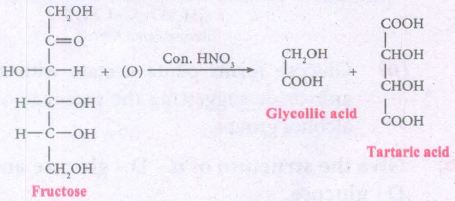
This shows that a keto group is present in C-2.
29.
When glycerol is treated with a well cooled mixture of concentrated sulphuric acid and fuming nitric acid, nitroglycerine is formed.
30.
During recharge process, the role of anode and cathode is reversed and H2SO4 is regenerated.
Oxidation occurs at the cathode ( now act as anode)
\(\stackrel {+2}{{ PbS }O}_{ 4(s) }+2{ H }_{ 2 }O(l)\rightarrow \stackrel{+4}{ Pb }O_{ 2(S) }+{ SO }_{ 4(aq) }^{ 2- }\)
Reduction occurs at the anode (now act as cathode)
\({ PbS }O_{ 4(s) }^{ }+2{ e }^{ - }\rightarrow { Pb }_{ (s) }+{ SO }_{ 4(aq) }^{ 2- }\)
Overall reaction:
\({ 2PbS }O_{ 4(s) }^{ }+2{ H }_{ 2 }O(l)\rightarrow { Pb }_{ (s) }+{ Pb }O_{ 2(S) }+{ 4H }_{ (aq) }^{ + }+{ SO }_{ 4(aq) }^{ 2- }\)
Thus, the overall cell reaction is exactly the reverse of the redox reaction which takes place while discharging
31.
Acetaldehyde - CH3-CHO
32.
\(Al(OH)_{3}\rightleftharpoons Al^{3+}_{(aq)}+3OH^{-}_{(aq)}\)
\(K_{sp}=[Al^{3+}][OH^{-}]^{3}\)
Al(OH)3 precipitates when ionic product > Ksp
Ks = 1.0 \(\times\) 10-15m, [Al3+] = 1.0 \(\times\) 10-3m
1.0 \(\times\) 10-15 = [1.0 \(\times\) 10-3][OH-]3
\(\left[\mathrm{OH}^{-}\right]^3=\frac{1.0 \times 10^{-15}}{1.0 \times 10^{-3}}\)
[OH-]3 = 1.0 \(\times\) 10-12
(or)
[OH-]3 = 10-4M
[H+][OH-] = 10-4M
[H+] = \(\frac{10^{14}}{10^{-4}}\) =10-10
Here,
pH = 10
ie., At pH = 10, Al(OH)3 gets precipitated on the addition of NH4Cl & NH4OH solution.
33.
(i) Cobalt (III) ion has greater tendency to form complexes than cobalt (II) ion. Therefore, Co (II) ion being stable in aqueous solution, changes to Co (III) ion in the presence of complexing reagents and get oxidised.
(ii) Ions of transition metals with d1 configuration tend to lose one electron to acquire d0 configuration that is quite stable. Therefore, such ions (with d1) undergo either oxidation or disproportionation, hence unstable.
34.
For a first order reaction
\(k=\frac { 2.303 }{ t } \log\frac { \left[ { A }_{ 0 } \right] }{ \left[ A \right] } \)
\(k=\frac { 2.303 }{ t } \log\frac { { V }_{ \infty } }{ { V }_{ \infty }-{ V }_{ 1 } } \)
V∞= 58.3 ml.
| t(min) | Vt | V∞=Vt | \(k=\frac { 2.303 }{ t } \log\frac { { V }_{ \infty } }{ { V }_{ \infty }-{ V }_{ t } } \) |
| 6 | 19.3 | 58.3-19.3=39.0 | \(k=\frac { 2.303 }{ 6 } \log\left( \frac { 58.3 }{ 39 } \right) =0.0670\) min-1 |
| 12 | 32.6 | 58.3-32.6=25.7 | \(k=\frac { 2.303 }{ 12 } \log\left( \frac { 58.3 }{ 25.7 } \right) =0.06838\) min-1 |
| 18 | 41.3 | 58.3-41.3=17.0 | \(k=\frac { 2.303 }{ 18 } \log\left( \frac { 58.3 }{ 17 } \right) =0.06838\) min-1 |
| 24 | 46.5 | 58.3-46.5=11.8 | \(k=\frac { 2.303 }{ 24 } \log\left( \frac { 58.3 }{ 11.8 } \right) =0.0666\) min-1 |
| 30 | 50.4 | 58.3 - 50.4 = 7.9 | \(k=\frac{2.303}{30} \log \left(\frac{58.3}{7.9}\right)=0.067\) min-1 |
| Mean value of k = 0.0674 min-1 |
As the rate constants are constant through out it is a first order reaction.
35.
36.
Fusion of urea with B(OH)3' in an atmosphere of ammonia at 800 - 1200 K gives boron nitride.
B(OH)3 + NH3 \(\overset { \Delta }{ \longrightarrow } \) BN+ 3H2O
37.
(i) Compound A of molecular formula C3H6O does not reduce Tollen's reagent and Fehling's solution.
(ii) Compound A undergoes Clemmensen reduction to give compound B of molecular formula C3H8
| Compound | Compound Name | Formula |
| A | Acetone | CH3COCH3 |
| B | Propane |  |
| C | Mesitylen | 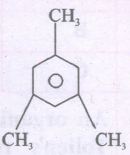 |
38.
(i) Reactant selectivity:
When bulkier molecules in a reactant mixture are prevented from reaching the active sites within the zeolite crystal, this selectivity is called reactant shape selectivity.
(ii) Transition state selectivity:
If the transition state of a reaction is large compared to the pore size of the zeolite, then no product will be formed.
(iii) Product selectivity:
It is encountered when certain product molecules one too big to diffuse out of the zeolite pores.
39.
(i) It oxidises ferrous salts to ferric salts.
Cr2O72- + 6Fe2++ 14H+ ⟶ 2Cr3+ + 6Fe3+ + 7H2O
(ii) It oxidises iodide ions to iodine
Cr2O72- + 6I-+ 14H+ ⟶ 2Cr3+ + 3I2 + 7H2O
(iii) It oxidises sulphide ion to sulphur
Cr2O72- + 3S2-+ 14H+ ⟶ 2Cr3+ + 3S + 7H2O
(iv) It oxidises sulphur dioxide to sulphate ion
Cr2O72- + 3SO2+ 2H+ ⟶ 2Cr3+ + 3SO42- + H2O
(v) It oxidises stannous salts to stannic salt
Cr2O72- + 3Sn2+ + 14H+ ⟶ 2Cr3+ + 3Sn4+ + 7H2O
(vi) It oxidises alcohols to acids
2K2Cr2O7 + 8H2SO4 + 3CH3CH2OH ⟶ 2K2SO4 +2Cr2(SO4)3+ 3CH3COOH + 11H2O
(vii) It oxidises oxalic acid to CO2
2MnO4- + 5(COO)2- + 6H+ ⟶ 2Mn2++ 10CO2 + 8H2O
(viii) It oxidises iodide ions to iodine
2MnO4- + 10I- + 16H+ ⟶ 2Mn2++ 5I2+ 8H2O
(ix) It oxidises sulphide ion to sulphur
2MnO4- + 5S2-+ 16H+ ⟶ 2Mn2++ 5S + 8H2O
(x) It oxidises nitrites to nitrates
2MnO4- + 5NO2- + 6H+ ⟶ 2Mn2++ 5NO3- + 3H2O
(xi) It oxidises alcohols to aldehydes.
2KMnO4 + 3H2SO4 + 5CH3CH2OH ⟶ 2K2SO4 + 2MnSO4 + 5CH3CHO + 8H2O
(xii) It oxidises sulphite to sulphate
2MnO4- + 5SO32- + 6H+ ⟶ 2Mn2+ + 5SO42- + 3H2O
40.
(i) Stability of higher oxidation state decreases down the group from S to Te because stability of lower oxidation state increases down the group from S to Te.
(ii) Fluorine and oxygen are most electronegative and very reactive. So they can ionised noble gases and form compounds.
41.
(i) Solids have definite volume and shape
(ii) Solids are rigid and incompressible
(iii) Solids have strong cohesive forces.
(iv) Their constituents have fixed positions and can only oscillate about their mean positions.
42.
(i) [Co(NH3)5 CI]2+
(ii) [CO(NO2)3(NH3)3]
(iii) [Co(NH3)4H2OBr](NO3)2
(iv) [Co(en)2CI2]CI
(v) [Cu(NH3)4]SO4

12th Standard Syllabus & Materials
12th Standard
TN 12th Computer Applications வலையமைப்பு வடமிடல் Sample Question Papers Study Material - QB365 Set A
NEW12th Standard
TN 12th Computer Applications களப்பெயர் முறைமை (DNS) Sample Question Papers Study Material - QB365 Set A
NEW12th Standard
TN 12th Computer Applications வலையமைப்பு எடுத்துக்காட்டுகள் மற்றும் நெறிமுறைகள் Sample Question Papers Study Material - QB365 Set A
NEW12th Standard
TN 12th Computer Applications கணினி வலையமைப்பு ஓர் அறிமுகம் Sample Question Papers Study Material - QB365 Set A



Tamilnadu Stateboard 12th Standard Subjects

Maths
Chemistry

Physics

Biology

Computer Science

Business Maths and Statistics

Economics

Commerce

Accountancy

History

Computer Applications
Biology
Computer Technology
Computer Applications
Computer Science
Business Maths and Statistics
Commerce
Economics
Maths
Chemistry
Physics
Computer Technology
History
Accountancy

Tamil

English

French
Tamilnadu Stateboard Standards
