
 100% FREE ACCESS
12th Standard Syllabus & Materials
12th Standard
TN 12th Maths Applications of Matrices and Determinants Sample Question Papers Study Material - QB365 Set A
NEW12th Standard
TN 12th Computer Applications மின்னணு தரவு பரிமாற்றம் Sample Question Papers Study Material - QB365 Set A
NEW12th Standard
TN 12th Computer Applications மின் - வணிக பாதுகாப்பு அமைப்புகள் Sample Question Papers Study Material - QB365 Set A
NEW12th Standard
TN 12th Computer Applications மின்னணு செலுத்தல் முறைகள் Sample Question Papers Study Material - QB365 Set A
NEW12th Standard
TN 12th Computer Applications மின் - வணிகம் Sample Question Papers Study Material - QB365 Set A
NEW12th Standard
TN 12th Computer Applications திறந்த மூல கருத்துருக்கள் Sample Question Papers Study Material - QB365 Set A

Published on: 27/02/2021
12th Standard English Medium Chemistry Reduced Syllabus Annual Exam Model Question Paper with Answer key - 2021
Download Tamil Nadu 12th Standard Chemistry question papers, model tests, one-mark questions, important questions, and public exam papers in PDF format. Free study materials and answer keys for TN State Board students.
Questions + Answers key
Take MCQ Chemistry Test
1.
Electrolytic reduction of nitrobenzene in strongly acidic medium gives
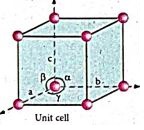
aniline
p - aminophenol
m-nitroaniline
azoxybenzene
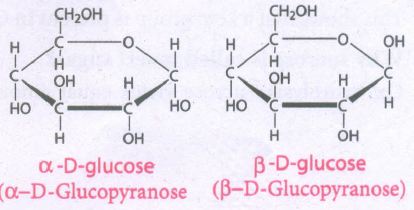
2.
Which contains a long chain ester?
Wax
Cooking oil
Turpentine oil
Cellulose
3.
Debye constants A and B depend on ______.
nature of the solvent
temperature
concentration of the solvent
both nature of the solvent and temperature
4.
Ostwald's dilution law is applicable in the case of the solution of _______.
CH3COOH
NaCI
NaOH
H2SO4
5.
In the sequence of reactions Identify 'C'.
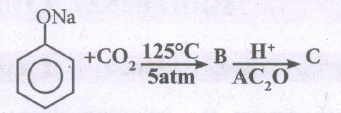
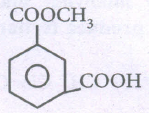
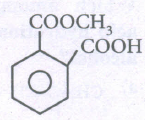
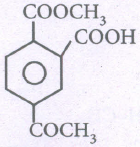
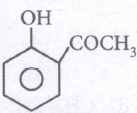
6.
Predict the product Z in the following series of reactions Ethanoic acid \(\overset { { PCI }_{ 5 } }{ \longrightarrow } X\overset { { C }_{ 6 }{ H }_{ 6 } }{ \underset { Anhydrous \ AlCI }-_{3}{ \longrightarrow } } Y\overset { 1){ CH }_{ 3 }MgBr }{ \underset { II){ H }_{ 3 }{ O }^{ + } }{ \longrightarrow } } Z.\)
(CH3)2 C(OH)C6H5
CH3CH(OH)C6H5
CH3CH(OH)CH2- CH3

7.
Match the following
| a | V2O5 | i | High density polyethylene |
| b | Ziegler – Natta | ii | PAN |
| c | Peroxide | iii | NH3 |
| d | Finely divided Fe | iv | H2SO4 |
| A | B | C | D |
| iv | i | ii | iii |
| A | B | C | D |
| i | ii | iv | iii |
| A | B | C | D |
| ii | iii | iv | i |
| A | B | C | D |
| iii | iv | ii | i |
8.
The percentage of pyridine (C5H5N) that forms pyridinium ion (C5H5NH) in a 0.10M aqueous pyridine solution _______.(Kb for C5H5N = 1.7×10⁻⁹) is
0.006%
0.013%
0.77%
1.6%
9.
Helium is used in balloons in the place of hydrogen because it is________.
incombustible
radioactive and detected easily
lighter than hydrogen
both (a) and (c)
10.
Which one of the following statements is wrong about Frenkel defect?
An ion occupies an interstitial position
Anion is much larger in size than the cation
The crystal remains neutral
Non-stoichiometric compound is formed
11.
In Hall-Heroult process ___________act as an anode.
Carbon blocks
hydrogen
copper rods
Zinc rods
12.
Which one of the following complexes is not expected to exhibit isomerism?
[Ni(NH3)4(H2O)2]2+
[Pt(NH3)2Cl2]
[Co(NH3)5SO4]Cl
[FeCl6]3-
13.
Which one of the following is not correct?
La(OH)3 is less basic than Lu(OH)3
In lanthanoid series ionic radius of Ln3+ ions decreases
La is actually an element of transition metal series rather than lanthanide series
Atomic radii of Zr and Hf are same because of lanthanide contract
14.
The compound that is used in nuclear reactors as protective shields and control rods is _________.
Metal borides
metal oxides
Metal carbonates
metal carbide
15.
Give a mathematical expression that relates I cell constant, specific conductance and specific resistance.
16.
Calculate the pH of 0.001M HCl solution
17.
How does the value of rate constant vary with reactant constant.
18.
What is the reaction of Phosphorous with alkali?
19.
Name the metals that are obtained from their oxides using hydrogen as reducing agent.
20.
Name the type of isomerism that occurs in complexes in which both cation and anion are complex ions.
21.
Define unit cell.
22.
Give the structure of CO and CO2.
23.
How are the following compounds obtained from benzene diazonium chloride?
(i) phenol
(ii) ester
(iii) p-hydroxy azo benzene
24.
Give some of the advantages of using food additives.
25.
Give the structure of α - D - glucose and β- D - glucose
26.
How will you prepare phenol (i) From chloro benzene (ii) From benzene sulphonic acid?
27.
Why does the emf of Leclanche cell decrease?
28.
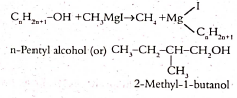
0.44g of a monohydric alcohol when added to methyl magnesium iodide in ether liberates at STP 112 cm3 of methane with PCC the same alcohol form a carbonyl compound that answers silver mirror test. Identify the compound.
29.
Addition of Alum purifies water. Why?
30.
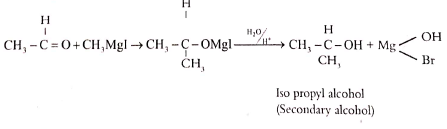
Suggest a suitable reagent to prepare secondary alcohol with identical group using Grignard reagent.
31.
Write the expression for the solubility product of Ca3(PO4)2
32.
Which is the last element in the series of the actinoids? Write the electronic configuration of this element comment on the possible oxidation state of this element.
33.
List the applications of gold.
34.
Benzene diazonium chloride in aqueous solution decomposes according to the equation \({ C }_{ 6 }{ H }_{ 5 }{ N }_{ 2 }Cl\longrightarrow { C }_{ 6 }{ H }_{ 5 }Cl+{ N }_{ 2 }\)Starting with an initial concentration of 10g L-1, the volume of N2 gas obtained at 50 °C at different intervals of time was found to be as under:
| t(min) | 6 | 12 | 18 | 24 | 30 | \(\infty \) |
| Vol of N2 (ml) | 19.3 | 32.6 | 41.3 | 46.5 | 50.4 | 58.3 |
Show that the above reaction follows the first order kinetics. What is the value of the rate constant?
35.
A double salt which contains fourth period alkali metal (A) on heating at 500K gives (B). Aqueous solution of (B) gives white precipitate with BaCl2 and gives a red colour compound with alizarin. Identify A and B.
36.
Assertion: Rate of reaction doubles when the concentration of the reactant is doubles if it is a first order reaction.
Reason: Rate constant also doubles
Codes:
a) Both assertion and reason are true and reason is the correct explanation of assertion.
b) Both assertion and reason are true but reason is not the correct explanation of assertion.
c) Assertion is true but reason is false
d) Both assertion and reason are false.
Both assertion and reason are true and reason is the correct explanation of assertion.
Both assertion and reason are true but reason is not the correct explanation of assertion.
Assertion is true but reason is false
Both assertion and reason are false.
37.
Account for reducing nature of formic acid.
38.
Write the characteristics of adsorption.
39.
Identify A, B, C and D
\(\text { ethanoic acid } \stackrel{\mathrm{SOCl}_{2}}{\longrightarrow} \mathrm{A} \stackrel{\mathrm{Pd} / \mathrm{BaSO}_{4}}{\longrightarrow} \mathrm{B} \stackrel{\mathrm{NaOH}}{\longrightarrow} \mathrm{C} \stackrel {\longrightarrow}{\triangle} \mathrm{D}\)
40.
Complete the following reactions
(i) Cr2O72- ⟶
(ii) Cr2O72- + 6I-+ 14H+ ⟶
(iii) Cr2O72-+ 3S2-+ 14H+ ⟶
(iv) Cr2O72- + 3SO2 + 2H+ ⟶
(v) Cr2O72- + 3Sn2+ + 14H+ ⟶
(vi) K2Cr2O7 + 8H2SO4 + 3CH3CH2OH ⟶
(vii) 2MnO4- + 5(COO)2- + 6H+ ⟶
(viii) 2MnO4- + 10I- + 16H+ ⟶
(ix) 2MnO4- + 5S2-+ 16H+ ⟶
(x) 2MnO4- + 5NO2- + 6H+ ⟶
(xi) 2KMnO4 + 3H2SO4 + 5CH3CH2OH ⟶
(xii) 2MnO4- + 5SO32- + 6H+ ⟶
41.
Give reason for the following :
(i) N2O5 is more acidic than N2O3
(ii) Thermal stability decreases from H2O to H2Te.
(iii) Fluoride ion has higher hydration enthalpy than chloride ion.
42.
Ionic solids, which have anionic vacancies due to metal excess defect, develop colour. Explain with the help of a suitable example.
43.
How are metal carbonyls classified depending on the number of metal atoms?
1.
(b)
p - aminophenol
2.
(a)
Wax
3.
(d)
both nature of the solvent and temperature
4.
(a)
CH3COOH
5.
(b)
6.

7.
(a)
| A | B | C | D |
| iv | i | ii | iii |
8.
C5H5N + H-OH ⇌ C5H5 +NH + OH-
\(\frac { { \alpha }^{ 2 }{ C } }{ 1-\alpha } =K_b\)
\(\alpha\)2C \(\approx\) Kb
\(\alpha = \sqrt {\frac{K_b} C} = \sqrt {\frac{1.7 \times 10^{-9}} {0.1}}\)
\(= \sqrt{1.7} \times 10^{-4}\)
Percentage of dissociation =\(= \sqrt{1.7} \times 10^{-4}\) x 100
= 1.3 x 10-2 = 0.013%
9.
(d)
both (a) and (c)
10.
(d)
Non-stoichiometric compound is formed
11.
(a)
Carbon blocks
12.
Option (a) and (b) -geometrical isomerism is possible
Option (c) - ionization isomerism is possible
Option (d) - no possibility to show either constitutional isomerism or stereo isomerism
13.
(a)
La(OH)3 is less basic than Lu(OH)3
14.
(a)
Metal borides
15.
k = \(\frac{1}{R}.\frac{1}{a}=\frac{1}{ρ}\)
Where K is specific conductance
R is resistance and \(\frac1a\) is cell constant.
ρ is specific resistance.
16.
\(\underset{0.001M}{HCl}\overset{H_{2}O}{\rightleftharpoons }\underset{0.001M}{H_{3}O^{+}}+\underset{0.001M}{Cl^{-}}\)
H3O+ from the auto ionisation of H2O (10-7M) is negligible when compared to the H3O+ from 10-3M HCl.
Hence [H3O+] = 0.001 mol dm-3
pH = -log10 [H3O+]
= -log10(0.001)
= -log10(10-3) = 3
17.
For nth reaction
\(K\alpha \frac { 1 }{ { C }^{ n-1 } } \)
18.
Yellow phosphorus reacts with alkali on boiling in an inert atmosphere liberating phosphine. Phosphorus acts as a reducing agent.
\({ P }_{ 4 }+NaOH+{ H }_{ 2 }O\longrightarrow \underset { Sodiumhypophosphite }{ { 3NaH }_{ 2 }{ PO }_{ 2 } } +\underset { Phosphine }{ { PH }_{ 3 } } \uparrow \)
19.
Iron, Lead and Copper
20.
Coordination isomerism.
21.
(i) A basic repeating structural unit of a crystalline solid is called a unit cell.
(ii) A crystal is consisted of large number of unit cells.
22.
| Oxides of Carbon | Structure | Parameters |
| CO |  |
Three electron pairs are shared between carbon and oxygen. The C-O bond distance is 1.128\(\overset{o}{A}\). |
| CO2 |  |
Equal bond distance for the both C-O bonds. Two C-O sigma bond, It has 3c-4e bond. |
23.
(i) Repl cementby-OH: When the aqueous solution is boiled, phenol is obtained

This is an example of SN1 reaction in which C6H5N2CI initially gives C6H5+ and water is the nudeophile.
(ii) Replacement of RO- (or) RCOO- groups Similarly -N2CI can be replaced acyloxy group by boiling with carboxylic acids.
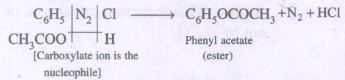
(iii) Diazonlum coupling reaction: Diazonium salt reacts with aromatic amine and phenols to give azo compounds of the general formula.
Ar - N = N - Ar'
This reaction is known as Coupling reaction since all these compounds are intensely coloured and used as dyes, thousands of azodyes have been synthesised by this procedure.

24.
Advantages of food additives :
(i) Uses of preservatives reduce the product spoilage and extend the shelf-life of food.
(ii) Addition of vitamins and minerals reduces the mall nutrient.
(iii) Flavouring agents enhance the aroma of the food.
(iv) Antioxidants prevent the formation of potentially toxic oxidation products of lipids and other food constituents.
25.
26.
(i) From halo arenes(Dows process):
When Chlorobenzene is hydrolysed with 6-8% NaOH at 300 bar and 633K in a closed vessel, sodium phenoxide is formed which on treatment with dilute HCI gives phenol.
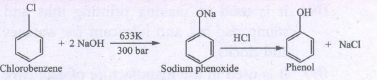
(ii) From benzene sulphonic acid:
Benzene is sulphonated with oleum and the benzene sulphonic acid so formed is heated with molten NaOH at 623K gives sodium phenoxide which on acidification gives phenol.
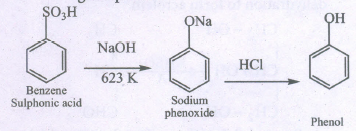
27.
The overall redox reaction in Leclanche cell is
\( \mathrm{Zn}_{(\mathrm{s})}+2 \mathrm{NH}_{4 \text { (aq) }}^{+}+2 \mathrm{MnO}_{2(\mathrm{~s})} \longrightarrow \mathrm{Zn}_{(\mathrm{aq})}^{2+}+\mathrm{MnO}_{2} \mathrm{O}_{3(\mathrm{~s})}+\mathrm{H}_{2} \mathrm{O}(l)+2 \mathrm{NH}_{3} \)
The ammonia produced at the cathode combines with Zn2+ to form a complex ion [Zn (NH3)4]2+(aq). As the reaction proceeds the concentration of NH3 will decrease and the aqueous NH3 will increase which lead to the decrease in the emf of cell.
28.
Mass = 0.44 g
No. of moles = Given Volume/Molar Volume = 112/22400
Molar Mass = 0.44/112 x 22400 = 88g
CnH2n+1 + OH = 88
12n+ (1)(2n+1) + 16 +1 = 88
14n + 18 = 88
14n = 88 - 18
n =70/14 = 5

Pentanoicacid
29.
(i) Purification of drinking water is activated by coagulation of suspended impurities in water by using alums containing \(\mathrm{Al}^{3+}\left(\mathrm{K}_{2} \mathrm{SO}_{4} \mathrm{Al}_{2}\left(\mathrm{SO}_{4}\right)_{3} \cdot 24 \mathrm{H}_{2} \mathrm{O}\right)\) Alum has a negative charge and tends to disperse in water very fast.
(ii) The increased size as well as the lack of repelling charges cause the alum particles to settle down at the bottom or rise up and float in water. After the particles are neutralized, they clump together because of the London dispersive force which are part of vander Waal's forces. The weak inter molecular force arising from quantum induced instantaneous polarisation multi poles in molecules causes even non polar particles to attract each other due to the corelated movements of the electrons in interacting molecules. Then they settle down.
30.
Acetaldehyde - CH3-CHO
31.
\(\mathrm{Ca}_{3}\left(\mathrm{PO}_{4}\right)_{2} \rightleftharpoons 3 \mathrm{Ca}^{2+}_{(aq)}+2 \mathrm{PO}_{4_{(aq)}}^{3-}\\\)
(s) (3s) (2s)
\(K_{sp}=[Ca^{2+}]^{3}[PO_{4}^{3-}]^{2}\)
\(K_{sp}=(3s)^{3}(2s)^{2}\)
\(K_{sp}=27s^{3}.4s^{2}\)
\(K_{sp}=108s^{5}\)
(or)
\(K_{s p} =m^{m} \cdot n^{n} \cdot(s)^{m+n} \)
\(K_{\text {sp }} =3^{3} \cdot 2^{2} \cdot(s)^{3+2} \)
\(K_{s p} =27 \times 4 \times(s)^{5} \)
\(=108(s)^{5}=108 s^{5}\)
32.
Lr Z = 103, is the last element of actinoid series. Its electronic configuration is [Rn]86 5f146d17S2 the possible oxidation state shown by it is +3.
33.
(i) Gold, one of the expensive and precious metals. It is used for coinage, and has been used as standard for monetary systems in some countries.
(ii) It is used extensively in jewellery in its alloy form with copper.
(iii) It is also used in electroplating to cover other metals with a thin layer of gold which are used in watches, artificial limb joints, cheap jewellery, dental fillings and electrical connectors.
(iv) Gold nanoparticles are also used for increasing the efficiency of solar cells and also used an catalysts.
34.
For a first order reaction
\(k=\frac { 2.303 }{ t } \log\frac { \left[ { A }_{ 0 } \right] }{ \left[ A \right] } \)
\(k=\frac { 2.303 }{ t } \log\frac { { V }_{ \infty } }{ { V }_{ \infty }-{ V }_{ 1 } } \)
V∞= 58.3 ml.
| t(min) | Vt | V∞=Vt | \(k=\frac { 2.303 }{ t } \log\frac { { V }_{ \infty } }{ { V }_{ \infty }-{ V }_{ t } } \) |
| 6 | 19.3 | 58.3-19.3=39.0 | \(k=\frac { 2.303 }{ 6 } \log\left( \frac { 58.3 }{ 39 } \right) =0.0670\) min-1 |
| 12 | 32.6 | 58.3-32.6=25.7 | \(k=\frac { 2.303 }{ 12 } \log\left( \frac { 58.3 }{ 25.7 } \right) =0.06838\) min-1 |
| 18 | 41.3 | 58.3-41.3=17.0 | \(k=\frac { 2.303 }{ 18 } \log\left( \frac { 58.3 }{ 17 } \right) =0.06838\) min-1 |
| 24 | 46.5 | 58.3-46.5=11.8 | \(k=\frac { 2.303 }{ 24 } \log\left( \frac { 58.3 }{ 11.8 } \right) =0.0666\) min-1 |
| 30 | 50.4 | 58.3 - 50.4 = 7.9 | \(k=\frac{2.303}{30} \log \left(\frac{58.3}{7.9}\right)=0.067\) min-1 |
| Mean value of k = 0.0674 min-1 |
As the rate constants are constant through out it is a first order reaction.
35.
1. A double salt which contains fourth-period alkali metal (A) is potash alum
K2SO4 Al2(SO4)3 - 24 H₂O
2. On heating potash alum (A) 500 k give anhydrous potash alum (or) burnt alum (B).
\(\mathrm{K}_{2} \mathrm{SO}_{4} \cdot \mathrm{Al}_{2}\left(\mathrm{SO}_{4}\right)_{3} \cdot 24 \mathrm{H}_{2} \mathrm{O} \stackrel{500 \mathrm{~K}}{\longrightarrow} \mathrm{K}_{2} \mathrm{SO}_{4} \cdot \mathrm{Al}_{2}\left(\mathrm{SO}_{4}\right)_{3}+24 \mathrm{H}_{2} \mathrm{O}\)
[Potash alum (A)] [Burnt alum (B)]
3. Aqueous solution of burnt alum, has sulphates ion, potassium ion and aluminium ion. Sulphate ion reacts with BaCl₂ to form a white precipitate of Barium Sulphate
(SO4)2 + BaCl2 → BaSO4 + 2 Cl¯
Aluminium ion reacts with alizarin solution to give a red colour compound.
36.
c) Assertion is true but reason is false
37.
(i) Formic acid (HCOOH) is unique because it contains both an aldehyde group and carboxyl group also.
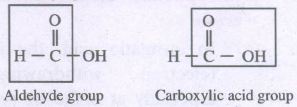
(ii) Hence it can act as a reducing agent. It reduces Fehling's solution Tollen's reagent and decolourises pink coloured KMnO4 solution.
(iii) Whereas in acetic acid, there is no aldehyde group and it cannot act as reducing agent.
(iv) Formic acid reduces ammoniacal silver nitrate solution (Tollen's reagent) to metallic silver.
HCOOH + Ag2O⟶H2O + CO2 + 2Ag↓ (metallic silver)
(v) Formic acid reduces Fehling's solution. It reduces blue coloured cupric ions to red coloured cuprous ions.
\(\mathrm{HCOO}^{-}+2 \mathrm{Cu}^{2+}+5 \mathrm{OH}^{-} \longrightarrow \mathrm{CO}_{3}^{2-}+\mathrm{Cu}_{2} \mathrm{O}+3 \mathrm{H}_{2} \mathrm{O}\\
\quad \quad \quad \quad (blue) \quad \quad \quad \quad \quad \quad \quad \quad \quad \quad \quad (red)\)
38.
Characteristics of adsorption:
(i) Adsorption can occur in all interfacial surfaces i.e. the adsorption can occur in between gas-solid, liquid solid, liquid liquid, solid- solid and gas-liquid.
(ii) Adsorption is always accompanied by decrease in free energy. When ΔG reaches zero, the equilibrium is attained.
(iii) Adsorption is a spontaneous process
(iv) When molecules are adsorbed, there is always a decrease in randomness of the molecules.
We know, ΔG = ΔH - T ΔS where ΔG is Change in Free energy.
ΔH is Change in enthalpy and ΔS- Change in entropy.
Hence, ΔH = ∆G + TΔS
(v) Adsorption is exothermic as there an interaction between adsorbate adsorbent.
39.
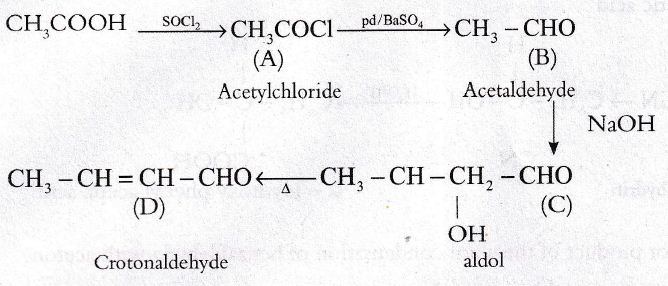
| Compound | Name |
| A | Acetylchloride |
| B | Acetaldehyde |
| C | 3 - Hydroxy butanal |
| D | Crotonaldehyde |
40.
(i) It oxidises ferrous salts to ferric salts.
Cr2O72- + 6Fe2++ 14H+ ⟶ 2Cr3+ + 6Fe3+ + 7H2O
(ii) It oxidises iodide ions to iodine
Cr2O72- + 6I-+ 14H+ ⟶ 2Cr3+ + 3I2 + 7H2O
(iii) It oxidises sulphide ion to sulphur
Cr2O72- + 3S2-+ 14H+ ⟶ 2Cr3+ + 3S + 7H2O
(iv) It oxidises sulphur dioxide to sulphate ion
Cr2O72- + 3SO2+ 2H+ ⟶ 2Cr3+ + 3SO42- + H2O
(v) It oxidises stannous salts to stannic salt
Cr2O72- + 3Sn2+ + 14H+ ⟶ 2Cr3+ + 3Sn4+ + 7H2O
(vi) It oxidises alcohols to acids
2K2Cr2O7 + 8H2SO4 + 3CH3CH2OH ⟶ 2K2SO4 +2Cr2(SO4)3+ 3CH3COOH + 11H2O
(vii) It oxidises oxalic acid to CO2
2MnO4- + 5(COO)2- + 6H+ ⟶ 2Mn2++ 10CO2 + 8H2O
(viii) It oxidises iodide ions to iodine
2MnO4- + 10I- + 16H+ ⟶ 2Mn2++ 5I2+ 8H2O
(ix) It oxidises sulphide ion to sulphur
2MnO4- + 5S2-+ 16H+ ⟶ 2Mn2++ 5S + 8H2O
(x) It oxidises nitrites to nitrates
2MnO4- + 5NO2- + 6H+ ⟶ 2Mn2++ 5NO3- + 3H2O
(xi) It oxidises alcohols to aldehydes.
2KMnO4 + 3H2SO4 + 5CH3CH2OH ⟶ 2K2SO4 + 2MnSO4 + 5CH3CHO + 8H2O
(xii) It oxidises sulphite to sulphate
2MnO4- + 5SO32- + 6H+ ⟶ 2Mn2+ + 5SO42- + 3H2O
41.
N2OS is more acidic than N2O3 because N2O3 is the anhydride of nitrous acid N2O3 dissolves in water to form the unstable acid.
\({ N }_{ 2 }{ O }_{ 3 }+{ H }_{ 2 }O\longrightarrow \underset { unstable }{ { 2HNO }_{ 2 } } \)
On the other hand, N2O5 is the anhydride of nitric acid N2O5 dissolves in water to form nitric acid
\({ N }_{ 2 }O_{ 5 }+{ H }_{ 2 }O\longrightarrow { { 2HNO }_{ 3 } }\)
N2O5 has higher acidic strength than N2O3. Acidic nature depends on oxidation number. Higher the oxidation number greater the tendency of gaining electron.
(ii) Thermal stability of hydrides decrease on moving down the group. This is due to the decrease in the bond dissociation enthalpy (H-E) of hydrides on moving down the group where E = O, S, Se, Te.
(iii) Hydration enthalpy is a measure of energy released when attractions are set up between positive or negative ions and water molecules. These attractions are stronger when the ion is smaller. Since F- ion is smaller than Cl- ion, F- ion process higher hydration enthalpy than Cl- ion.
42.
(i) The colour develops because of the presence of electrons in the 8 anionic sites.
(ii) These electron absorb energy from the visible region of radiation and get excited.
(iii) For example when crystals of NaCl are heated in an atmosphere of sodium vapours, the sodium atoms get deposited on the surface of the crystal and the deposited Na atoms.
(iv) During this process, the Na atoms on the surface lose electrons to form Na+ ions
(v) These electrons get excited by absorbing energy from the visible light and impart yellow colour to the crystals.
43.
Metal carbonyls are classified in two different ways as described below Classification based on the number of metal atoms present.
a. Mononuclear carbonyls
These compounds contain only one metal atom. For example, [Ni(CO)4] - nickel tetracarbonyl is tetrahedral, [Fe(CO)5] - Iron pentacarbonyl is trigonal bipyramidal, and [Cr(CO)6] - Chromium hexacarbonyl is octahedral.
b. Polynuclear carbonyls
Metallic carbonyls containing two or more metal atoms are called polynuclear carbonyls. Polynuclear metal carbonyls may be Homonuclear [Co2(CO)8], [Mn2(CO)10], [Fe3 (CO)12] or heteronuclear [MnCo(CO)9], [MnRe(CO)10] etc.

12th Standard Syllabus & Materials
12th Standard
TN 12th Computer Applications வலையமைப்பு வடமிடல் Sample Question Papers Study Material - QB365 Set A
NEW12th Standard
TN 12th Computer Applications களப்பெயர் முறைமை (DNS) Sample Question Papers Study Material - QB365 Set A
NEW12th Standard
TN 12th Computer Applications வலையமைப்பு எடுத்துக்காட்டுகள் மற்றும் நெறிமுறைகள் Sample Question Papers Study Material - QB365 Set A
NEW12th Standard
TN 12th Computer Applications கணினி வலையமைப்பு ஓர் அறிமுகம் Sample Question Papers Study Material - QB365 Set A



Tamilnadu Stateboard 12th Standard Subjects

Maths
Chemistry

Physics

Biology

Computer Science

Business Maths and Statistics

Economics

Commerce

Accountancy

History

Computer Applications
Biology
Computer Technology
Computer Applications
Computer Science
Business Maths and Statistics
Commerce
Economics
Maths
Chemistry
Physics
Computer Technology
History
Accountancy

Tamil

English

French
Tamilnadu Stateboard Standards
