
 100% FREE ACCESS
12th Standard Syllabus & Materials
12th Standard
TN 12th Maths Applications of Matrices and Determinants Sample Question Papers Study Material - QB365 Set A
NEW12th Standard
TN 12th Computer Applications மின்னணு தரவு பரிமாற்றம் Sample Question Papers Study Material - QB365 Set A
NEW12th Standard
TN 12th Computer Applications மின் - வணிக பாதுகாப்பு அமைப்புகள் Sample Question Papers Study Material - QB365 Set A
NEW12th Standard
TN 12th Computer Applications மின்னணு செலுத்தல் முறைகள் Sample Question Papers Study Material - QB365 Set A
NEW12th Standard
TN 12th Computer Applications மின் - வணிகம் Sample Question Papers Study Material - QB365 Set A
NEW12th Standard
TN 12th Computer Applications திறந்த மூல கருத்துருக்கள் Sample Question Papers Study Material - QB365 Set A

Published on: 27/02/2021
12th Standard English Medium Chemistry Reduced Syllabus Creative Five mark Question with Answer key - 2021(Public Exam )
Download Tamil Nadu 12th Standard Chemistry question papers, model tests, one-mark questions, important questions, and public exam papers in PDF format. Free study materials and answer keys for TN State Board students.
Questions + Answers key
Take MCQ Chemistry Test
1.
An organic compound (A) of molecular formula C7H6O is called as oil of bitter almonds. (A) on oxidation gives (B) of molecular formula C7H6O2 which gives brisk effervescence with NaHCO3 solution. When (A) is refluxed with aqueous alcoholic (KCN) compound (C) is formed. Identify A, B and C and write the equations.
2.
An aromatic compound (A) with molecular formula C7H6O has the smell of bitter almonds. (A) reacts with Cl2 in the absence of catalyst to give (B) and in the presence of catalyst compound (A) reacts with chlorine to give (C). Identify (A), (B) and (C). Explain the reactions.
3.
How do you distinguish formic acid from acetic acid?
4.
Explain the mechanism of Cannizaro reaction.
5.
Explain the classification of hormones.
6.
Explain the classification of polymers based on their structure and mode of synthesis.
7.
An organic compound (A) C6H6O gives violet colour with neutral FeCl3 solution. With NH3 in the presence of anhydrous ZnCI2, (A) gives (B) (C6H7N). (A) with dimethyl sulphate gives (C) (C7H8O). What are (A), (B) and (C)? Explain the reactions.
8.
What are ethers? Write note on simple and mixed ethers with examples.
9.
What happens when ethylamine is treated with
(i) CHCl3/NaOH
(ii) CS2
(iii) C6H5CHO.
10.
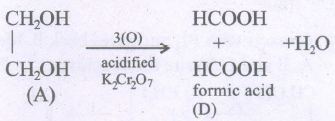
An organic compound A (C2H6O2) liberates hydrogen with metallic sodium. Compound A when heated with anhydrous zinc chloride ultimately gives B (C2H4O) whereas) when heated with cone. phosphoric acid gives C (C4H10O3). A on oxidation with acidified K2Cr2O7 gives compound D (CH2O2). Identify A, B, C and D. Explain the reactions involved.
11.
An organic compound A of molecular formula C3H6O on reduction with LiAlH4 gives B. Compound B gives blue colour in Victor Meyer's test and also forms a chloride C with SOCl2. The chloride on treatment with alcoholic KOH gives D. Identify A, B, C and D and explain the reactions.
12.
Write a note on Freundlich adsorption isotherm.
13.
Explain SHE as a reference electrode.
14.
If E1 = 0.5 V corresponds to Cr3++ 3e- ➝ Cr(s) and E2 = 0.41V corresponds to Cr3++ e- ➝ Cr2+ reactions, calculate the emf (E3) of the reaction Cr2++ 2 e- ➝ Cr(s)
15.
To 1M solution of AgNO3, 0.75 F quantity of current is passed. What is the concentration of the electrolyte, AgNO3 remaining in the solution?
16.
Calculate the pH of 0.001 M HCI solution.
17.
The half life period of first order reactions is 10 mins. What percentage of the reactant will remain after one hour?
18.
For the reaction R - P, the concentration of a reactant changes from 0.03 M to 0.02 M in 25 minutes. Calculate the average rate of reaction using units of time both in minutes and second.
19.
Complete the following reactions
(i) Cr2O72- ⟶
(ii) Cr2O72- + 6I-+ 14H+ ⟶
(iii) Cr2O72-+ 3S2-+ 14H+ ⟶
(iv) Cr2O72- + 3SO2 + 2H+ ⟶
(v) Cr2O72- + 3Sn2+ + 14H+ ⟶
(vi) K2Cr2O7 + 8H2SO4 + 3CH3CH2OH ⟶
(vii) 2MnO4- + 5(COO)2- + 6H+ ⟶
(viii) 2MnO4- + 10I- + 16H+ ⟶
(ix) 2MnO4- + 5S2-+ 16H+ ⟶
(x) 2MnO4- + 5NO2- + 6H+ ⟶
(xi) 2KMnO4 + 3H2SO4 + 5CH3CH2OH ⟶
(xii) 2MnO4- + 5SO32- + 6H+ ⟶
20.
Explain the Deacon's process.
21.
Give a detailed account on allotropes of sulphur.
22.
How can you determine the atomic mass of an unknown metal if you know its density and the dimension of its unit cell? Explain.
23.
What are the various methods by which carbon-di-oxide is prepared?
24.
Explain refining of nickel by mond's process
25.
How are metal carbonyls classified based on the structure?
1.
(i) From the molecular formula, (A) is identified as benzaldehyde and it is called as oil of bitter almonds.
(ii) Benzaldehyde is oxidised to benzoic acid by alkaline permanganate which gives brisk effervescence with NaHCO3.
\(\underset { (A) }{ { C }_{ 6 }{ H }_{ 5 }CHO } \overset { (O) }{ \longrightarrow } \underset { (B) }{ { C }_{ 6 }{ H }_{ 5 } } -COOH\)
(iii) When benzaldehyde is refluxed with aqueous alcoholic KCN, benzoin (C) is formed.
\({ C }_{ 6 }{ H }_{ 5 }CH=O+H-\overset { \underset { || }{ O } }{ C } -{ C }_{ 6 }{ H }_{ 5 }\overset { alc }{\underset{KCN} \longrightarrow } { C }_{ 6 }{ H }_{ 5 }-\underset { \overset { | }{ OH\\ (C) } }{ CH } -\overset { \underset { || }{ O } }{ C } -{ C }_{ 6 }{ H }_{ 5 }\)
| Compound | Compound Name | Formula |
| A | Benzaldehyde | C6H5CHO |
| B | Benzoic acid | C6HsCOOH |
| C | Benzoin | \({ C }_{ 6 }{ H }_{ 5 }CHOH-\overset { \underset { || }{ O } }{ C } -{ C }_{ 6 }{ H }_{ 5 }\) |
2.
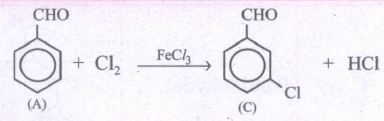
(i) An aromatic compound (A) possess the smell of bitter almonds is benzaldehyde. From the molecular formula (A) is identified as C6H5CHO benzaldehyde.
(ii) Benzaldehyde on treatment with Cl2 in the absence of catalyst gives benzoyl chloride C6HsCOCl and it is (B).
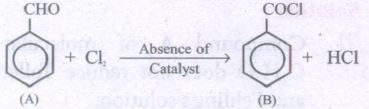
(iii) Benzaldehyde on treatment with C in the presence of catalyst gives m-cblorobenzaldehyde and it is (C).
| Compound | Compound Name | Formula |
| A | Benzaldehyde |  |
| B | Benzoyl chloride |  |
| C | m-Chloro benzaldehyde | 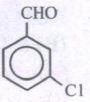 |
3.
| S.No | Formic Acid | Acetic Acid |
| 1 | It reduces Tollen's reagent and Fehling's solution | It does not reduce Tollen's reagent and Fehling's solution |
| 2. | When it is heated above 433K under pressure it gives CO2 & H2 | It is stable to heat. |
| 3. | When it is heated with cone. H2SO4 it gives CO and H2O | It does not react with cone. H2SO4 |
| 4. | It does not react with Cl2 in the presence of P/I2 | It reacts with Cl2 in the presence of P/I2 to from mono, di and tri chi oro acetic acids |
| 5. | It undergoes intramolecular dehydration when treated with P2O5 to give CO and H2O | It undergoes intermolecular dehydration when treated with P2O5 to give acetic anhydride |
| 6. | Calcium salt of formic acid on dry distillation gives formaldehyde | Calcium acetate on dry distillation gives acetone |
| 7. | It contains both aldehyde group and carboxylic acid group. | It contains only carboxylic acid group. |
4.
Cannizaro reaction involves three steps.
Step 1: Attack of OH- on the carbonyl carbons

Step 2: Hydride ion transfer

Step 3: Acid - base reaction
\({ C }_{ 6 }{ H }_{ 5 }-\overset { \underset { || }{ O } }{ C } -OH+{ C }_{ 6 }{ H }_{ 5 }H_{ 2 }{ O }^{ - }+{ Na }^{ + }\overset { Proton }{ \underset { exchange }{ \longrightarrow } } \underset { Sodium\quad benzoate }{ { C }_{ 6 }{ H }_{ 5 }-\overset { \underset { || }{ O } }{ C } -ONa } +\underset { Benzyl \ alcohol }{ { C }_{ 6 }{ H }_{ 5 }{ CH }_{ 2 }OH } \)
Cannizaro reaction is a characteristic of aldehyde having no a - hydrogen
5.
(i) Hormones are classified according to the distance over which they act as, endocrine, paracrine and autocrine hormones.
(ii) Endocrine hormones act on cells distant from the site of their release. Example: insulin and epinephrine are synthesized and released in the bloodstream by specialized ductless endocrine glands.
(iii) Paracrine hormones (alternatively, local mediators) act only on cells close to the cell that released them. For example, interleukin -1 (IL-1) Autocrine hormones act on the same cell that released them. For example, protein growth factor interleukin-2 (IL-2).
6.
(i) Structure:
(a) Linear polymers (long continuous chain) E.g. HDPE, PVC
(b) Branched polymers (one main chain with small chains as branches) E.g. polypropylene, LDPE.
(c) Cross linked polymers (linking of chain polymers) E.g. bakelite, melamine, formaldehyde
(ii) Mode of synthesis:
(a) Addition polymers. Formed by polymerisation of monomers without the elimination of byproduct. E.g. polyethylene, PVC, teflon.
(b) Condensation Polymer formed by the condensation of two or more monomers with the elimination of simple molecules like H2O, NH3, etc., E.g. Nylon:6-6, polyester.
7.
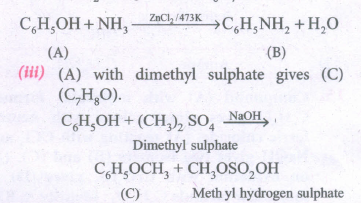
(i) An organic compound (A) C6H6O gives violet colour with neutral FeCl3 solution.
(ii) With NH3 in the presence of anhydrous ZnCI2,(A) gives (B) (C6H7N).
| Compound | Compound Name | Formula |
| A | Phenol | C6H5OH |
| B | Aniline | C6H5NH2 |
| C | Anisole | C6H5OCH3 |
8.
Ethers are a class of organic compound in which an oxygen atom is connected to two alkyl/aryl groups Ethers can be considered as the derivatives of hydrocarbon in which one hydrogen atom is replaced by an alkoxy (-OR) or an aryloxy (-OAr ) group. The general formula of aliphatic ether is CnH2n+2O.
Classification:
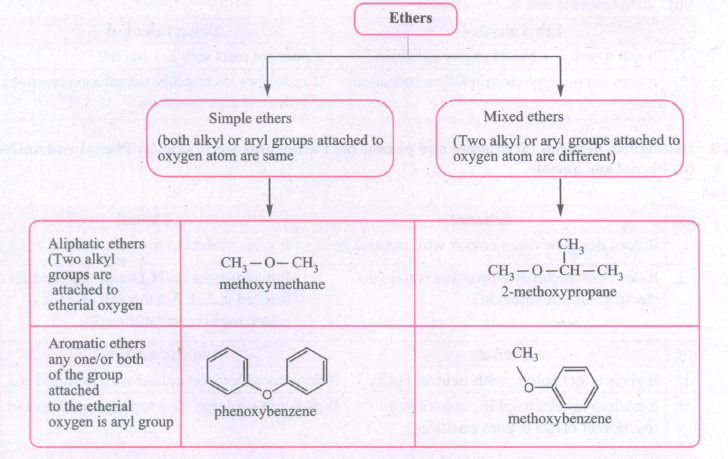
9.
(i) When ethylamines is treated with chloroform and an alkali, carbylamine reaction takes place and a foul smelling substance called carbylamlne (or) alkyl isocyanide is formed.
C2H5NH2 + CHCl3 + 3NaOH ➝ \(\underset { Ethyl \ isocyanide }{ { C }_{ 2 }{ H }_{ 5 }NC+3NaCl+3{ H }_{ 2 }O } \)
(ii) When ethylamine is warmed with CS2 and mercuric chloride, alkyl isothiocyanate having a pungent mustard like odour is obtained. This reaction is called mustard oil reaction.
C2H2NH2 + S = C-S \(\underrightarrow { Hg{ Cl }_{ 2 } } \) C2H5 - N = C = S + H2S
(iii) When ethylamine condense with aromatic aldehyde (benzaldehyde) Schiff's base is formed.
C6H5CHO + H2NC2H5 ➝ \(\underset { Schiffi's \ base \ Benzal-ethylamine }{ { C }_{ 6 }{ H }_{ 5 }CH=N{ C }_{ 2 }{ H }_{ 5 }+{ H }_{ 2 }O } \)
10.
An organic compound A (C2H6O2) liberates hydrogen with metallic sodium.
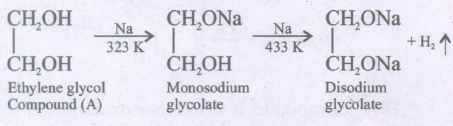
(ii) Compound A when heated with anhydrous zinc chloride ultimately gives B (C2H4O)
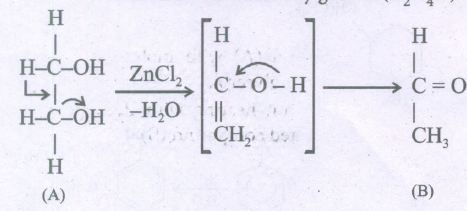
(iii) Compound A when heated with conc. phosphoric acid gives C (C4H10O3).
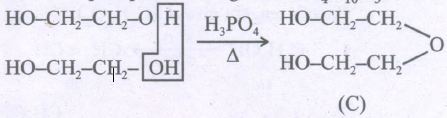
(iv) Compound A on oxidation with acidified K2Cr2O7 gives compound D (CH2O2).
| Compound | Compound Name | Formula |
| A | Ethylene glycol | \(\overset { { CH }_{ 2 }OH }{ \underset { { CH }_{ 2 }OH }{ | } } \) |
| B | Acetaldehyde | CH3-CHO |
| C | Diethylene glycol | \(\overset { HCOOH }{ \underset { HCOOH }{ + } } \) |
| D | Formic acid | 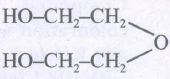 |
11.
(i) Compound (A) is carbonyl compound, it is acetone
(ii) (A) on reduction with LiAlH4 gives (B) it gives blue colour in Victor Meyer'stest.
\({ CH }_{ 3 }-\underset { \overset { || }{ \underset { (A) }{ O } } }{ C } -{ CH }_{ 3 }\overset { { LiAIH }_{ 4 } }{ \underset { \left[ H \right] }{ \longrightarrow } } { CH }_{ 3 }-{ CH }_{ 3 }-\underset { \overset { | }{ \underset { (B) }{ OH } } }{ CH } -{ CH }_{ 3 }\)
(iii) (B) reacts with SOCl2to give (C).
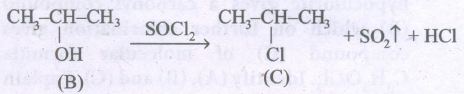
(iv) (C) on treatment with alcoholic KOH, forms (D) by elimination reaction.
\({ CH }_{ 3 }-\underset { \overset { | }{ \underset { (C) }{ Cl } } }{ C } H-{ CH }_{ 3 }\overset { alc.KOH }{ \longrightarrow } \underset { (D) }{ { CH }_{ 3 }CH={ CH }_{ 2 }+HCl } \)
| Compound | Compound Name | Formula |
| A | Acetone | \({ CH }_{ 3 }-\underset { \overset { || }{ O } }{ C } -{ CH }_{ 3 }\) |
| B | Isopropyl alcohol | \({ CH }_{ 3 }-\underset { \overset { | }{ OH } }{ CH } -{ CH }_{ 3 }\) |
| C | Isopropyl chloride | \({ CH }_{ 3 }-\underset { \overset { | }{ Cl } }{ CH } -{ CH }_{ 3 }\) |
| D | Propylene | CH3-CH=CH2 |
12.
Freundlich adsorption isotherm:
According to Freundlinch
\(\frac { x }{ m } =kp^{ \frac { 1 }{ n } }\)
where x is the amount of adsorbate or adsorbed on 'm' gm of adsorbent at a pressure of p. K and n are constants Value is always less than unity.
This equation is applicable for adsorption of gases on solid surfaces. The same equation becomes \(\frac { x }{ m } =Kc^{ \frac { 1 }{ n } }\) when used for adsorption in solutions with c as concentration.
These equation quantitively predict the effect of pressure(or concentration) on the adsorption of gases(or adsorbates) at constant temperature.
Taking log on both sides of equation \(\frac { x }{ m } ={ kp }^{ \frac { 1 }{ n } }\)
\(log\frac { x }{ m } =logK+\frac { 1 }{ n } logP\)
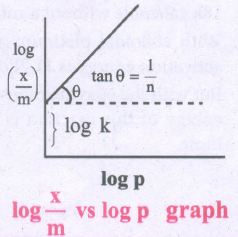
Hence the intercept represents the value of log k and the slope \(\frac { b }{ q } \) gives \(\frac { 1 }{ n } \)
This equation explains the increase of \(\frac { x }{ m } \) with increase in pressure. But experimental values show the deviation at low pressure.
13.
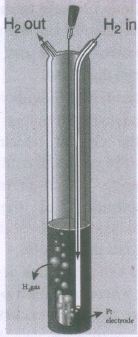
Standard Hydrogen Electrode (SHE) is used as the reference electrode. It has been assigned an arbitrarily emf of zero volt. It consists of a platinum electrode in contact with 1M HCI solution and 1atm hydrogen gas. The hydrogen gas is bubbled through the solution at 25°C. SHE can act as a cathode as well as an anode. The Half cell reactions are given below.
If SHE is used as a cathode, the reduction reactions is
2H+ (aq,1M) + 2e- ⟶ H2 (g, 1 atm) Eo= 0 volt
If SHE is used as an anode, the oxidation reaction is
H2 (g.1 atm) ⟶ 2H+ (aq, 1M) + 2e- Eo= volt
Illustration: Let us calculate the reduction potential of zinc electrode dipped in zinc sulphate solution using SHE.
Step 1: The following galvanic cell is constructed using SHE
Zn(s) | Zn2+ (aq,1M) || H+ (aq, 1M) | H2 (g, 1 atm)|pt(s)
Step 2: The emf of the above galvanic cell is measured using a volt meter. In this case, the measured emf of the above galvanic cell is 0.76V.
Calculation
We know that,
Eocell = (Eoox)Zn|Zn2+ + (Eored)SHE
Eocell = 0.79 and (Eored)SHE = 0V.
Substitute these values in the above equation
⇒ 0.76V = (Eoox) Zn|Zn2+ + 0V
⇒ (Eoox)Zn|Zn2+ = 0.76V
This oxidation potential corresponds to the below mentioned half cell reaction which takes place at the cathode.
Zn ⇾ Zn2+ + 2e- (Oxidation)
The emf for the reverse reaction will give the reduction potential
Zn2+ + 2e- ⇾ Zn; Eo= - 0.76V
∴ (Eoox)Zn2+|Zn = - 0.76V
14.
Given:
E1 = 0.5 V
Cr3++ 3e- ➝ Cr(s).......(1)
E2 = 0.41 V
Cr3++ e- ➝ Cr2+ .....(2)
The required reaction is,
Cr2++ 2 e- ➝ Cr(s)
Then,
Formula:
\({ E }_{ 3 }=\frac { 3{ E }_{ 1 }+{ E }_{ 2 } }{ 2 } \)
Solution:
= \(\frac { 3(0.5)+(0.41) }{ 2 } =\frac { 1.5+0.41 }{ 2 } \)
= 0.955 V
E3 = 0.955 V
15.
Initial concentration of
AgNO3 = 1M= IN
Quantity of current 0.75 F
Formula:
1Faraday = 1equivalent mass
Solution:
For IF current In AgNO3 will be liberated.
For 0.75 F current 0.75 N AgNO3 will be liberated
The concentration of AgNO3 remaining
= 1.0 - 0.75 = 0.25 N
ஃ The concentration of AgNO3 remaining
16.
HCI ⟶ H+ + Cl-. HCI is a strong acid.
[H+] from HCI is very much greater than [H+] from water which is 1 x 10⁻⁷ M.
∴ [H+] = [HCI] = 0.001 M
∴ pH = -log (0.001) = 3.0
∴ That is acidic solution.
17.
Given: Half life period (t1/2) = 10 mins
Formula: \(k=\frac { 2.303 }{ t } \log { \frac { a }{ a-x } } \)
Solution:
\(k=\frac { 0.693 }{ { t }_{ \frac { 1 }{ 2 } } } =\frac { 0.693 }{ 10 } \)
= 0.693 min-1 = 6.93 x 10⁻² min-1
Time taken = 1 hour = 60 minutes
a = 100%
x = ?
\(k=\frac { 2.303 }{ t } log\frac { a }{ a-x } \)
\(=\frac { 2.303 }{ 60 } \) [log 100 - log(a - x)]
log 100 - log(a-x) = \(\frac { 6.93\times { 10 }^{ -2 }\times 60 }{ 2.303 } \)
log 100 - log(a-x) = 1.8060
log (a - x) = log 100 - 1.8060
= 2 - 1.8060
log (a - x) = 0.1940
a - x = Antilog of 0.1949
a - x = 1.563%
18.
Average rate = \(-\frac { \triangle \left( R \right) }{ \triangle t } =-\frac { { \left[ R \right] }_{ 2 }-{ \left[ R \right] }_{ 1 } }{ { t }_{ 2 }-{ t }_{ 1 } } \)
\(=-\frac { 0.02M-0.03M }{ 25min } =\frac { -0.01M }{ 25min } \)
= 4 x 10⁻⁴ M min-1 and
= \(-\frac { -0.01m }{ 25\times 60 } \) = 6.66 x 10⁻⁶ Ms-1
19.
(i) It oxidises ferrous salts to ferric salts.
Cr2O72- + 6Fe2++ 14H+ ⟶ 2Cr3+ + 6Fe3+ + 7H2O
(ii) It oxidises iodide ions to iodine
Cr2O72- + 6I-+ 14H+ ⟶ 2Cr3+ + 3I2 + 7H2O
(iii) It oxidises sulphide ion to sulphur
Cr2O72- + 3S2-+ 14H+ ⟶ 2Cr3+ + 3S + 7H2O
(iv) It oxidises sulphur dioxide to sulphate ion
Cr2O72- + 3SO2+ 2H+ ⟶ 2Cr3+ + 3SO42- + H2O
(v) It oxidises stannous salts to stannic salt
Cr2O72- + 3Sn2+ + 14H+ ⟶ 2Cr3+ + 3Sn4+ + 7H2O
(vi) It oxidises alcohols to acids
2K2Cr2O7 + 8H2SO4 + 3CH3CH2OH ⟶ 2K2SO4 +2Cr2(SO4)3+ 3CH3COOH + 11H2O
(vii) It oxidises oxalic acid to CO2
2MnO4- + 5(COO)2- + 6H+ ⟶ 2Mn2++ 10CO2 + 8H2O
(viii) It oxidises iodide ions to iodine
2MnO4- + 10I- + 16H+ ⟶ 2Mn2++ 5I2+ 8H2O
(ix) It oxidises sulphide ion to sulphur
2MnO4- + 5S2-+ 16H+ ⟶ 2Mn2++ 5S + 8H2O
(x) It oxidises nitrites to nitrates
2MnO4- + 5NO2- + 6H+ ⟶ 2Mn2++ 5NO3- + 3H2O
(xi) It oxidises alcohols to aldehydes.
2KMnO4 + 3H2SO4 + 5CH3CH2OH ⟶ 2K2SO4 + 2MnSO4 + 5CH3CHO + 8H2O
(xii) It oxidises sulphite to sulphate
2MnO4- + 5SO32- + 6H+ ⟶ 2Mn2+ + 5SO42- + 3H2O
20.
(i) In this process a mixture of air and hydrochloric acid is passed up a chamber containing a number of shelves, pumice stones soaked in cuprous chloride are placed.
(ii) Hot gases at about 723 K are passed through a jacket that surrounds the chamber.
\(4 \mathrm{HCl}+\mathrm{O}_{2} \frac{400^{\circ} \mathrm{C}}{\mathrm{Cu}_{2} \mathrm{Cl}_{2}} 2 \mathrm{H}_{2} \mathrm{O}+\mathrm{Cl}_{2} \uparrow\)
The chlorine obtained by this method is dilute and is employed for the manufacture of bleaching powder. The catalysed reaction is,
\(2 \mathrm{Cu}_{2} \mathrm{Cl}_{2}+\mathrm{O}_{2} \rightarrow 2 \mathrm{Cu}_{2} \mathrm{OCl}_{2}\\ \quad \quad \quad \quad \quad \quad \quad \text { cuprous oxychloride } \)
\(\mathrm{Cu}_{2} \mathrm{OCl}_{2}+2 \mathrm{HCl} \rightarrow 2 \mathrm{CuCl}_{2}+\mathrm{H}_{2} \mathrm{O}\\ \quad \quad \quad \quad \quad \quad \quad \quad \quad\text { Cupric chloride } \)
\(2 \mathrm{CuCl}_{2} \rightarrow \mathrm{Cu}_{2} \mathrm{Cl}_{2}+\mathrm{Cl}_{2}\\ \quad \quad \quad \quad \text { cuprous chloride }\)
21.
(a) Rhombic Sulphur (α - Sulphur):
(a) It is yellow in colour.
(b) Its melting point is 385.8K and specific gravity is 2.06
(c) It is stable form of sulphur at room temperature.
(d) It is formed on evaporating the solution of sulphur in CS2.
(e) It in insoluble in water, readily soluble in CS2 and dissolves to some extent in benzene, alcohol and ether.
(b) Monoclinic sulphur \(\left( \beta -sulphur \right) \):
(a) Its melting point is 393K and specific gravity is 1.98
(b) It is prepared by melting rhombic sulphur in a dish and cooling, till crust is formed. Two holes are made in crust and remaining liquid is powered out. On removing crust, colourless needle - shaped crystals of β - sulphur is formed.
(c) Monoclinic sulphur is stable above 369K and below 369K α - sulphur is stable.
(d) At 369K both forms are stable and this temperature is called transition temperature.
(e) Both rhombic and monoclinic sulphur have S8 molecules, these are packed to give different crystal structure S8 form is puckered and has crown shape.
Several other modifications containing 6-20 sulphur atoms per ring are synthesised
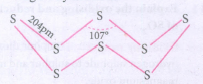
(f) In Cyclo-S6 the ng adopts chair form.
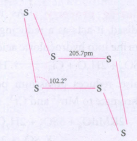
(g) At elevated temperatures (~1000K), S2 is dominant species and is, paramagnetic like O2
22.
(i) By knowing the density of an unknown metal and the dimension of its unit cell, the atomic mass of the metal can be: determined.
(ii) Let 'a' be the edge length of a unit cell of a crystal, 'd' be the density of the metal, 'm' be the atomic mass of the metal and 'z' be the number of atoms in the unit cell.
(iii) Now,
Density of the unit cell
\(=\frac{Mass\ of\ the\ unit\ cell}{Volume\ of\ the\ unit\ cell}\)
\(d=\frac{Z\times m}{a^3}\) ...(1)
[Since, mass of the unit cell = Number of atoms in the unit cell x Atomic mass]
[Volume of the unit cell = (edge length of the cubic unit cell)3]
(iv) From equation (1), We have
\(m=\frac{d\times a^3}{Z}\) ....(2)
(v) Now,
Mass of the metal (M) \(=\frac{Atomic\ mass(M)}{Avogadro's\ number(N_A)}\)
M=\(\frac{d\times a^3 \times N_A}{Z}\)
(vi) From equation (3), we can determine the atomic mass of the unknown metal.
23.
(i) Carbon monoxide can be prepared by the reaction of carbon with limited amount of oxygen.
2C + O2 ⟶ 2CO
(ii) (a) On industrial scale carbon monoxide is produced by the reaction of carbon with air.
(b) The carbon monoxide formed will contain nitrogen gas also and the mixture of nitrogen and carbon monoxide is called producer gas.
(c) \(2C+{ O }_{ 2 }/{ N }_{ 2 }(air)\longrightarrow \underset { Producers \ Gas }{ 2CO } +{ N }_{ 2 }\)
(d) The producer gas is then passed through a solution of copper(I) chloride under pressure which results in the formation of CuCI(CO).2H2O.
(e) At reduced pressures this solution releases the pure carbon monoxide.
(iii) Pure carbon monoxide is prepared by warming methanoic acid with concentrated sulphuric acid which acts as a dehydrating agent.
HCOOH + H2SO4 ⟶ CO + H2O + H2SO4
24.
(i) The impure nickel is heated in a stream of carbon monoxide at around 350 K.
(ii) The nickel reacts with the CO to form a highly volatile nickel tetracarbonyl.
(iii) The solid impurities are left behind
\({ Ni }_{ (s) }+4{ CO }_{ (g) }\longrightarrow { Ni(CO) }_{ 4(g) }\)
(iv) On heating the nickel tetracarbonyl around 460 K, the complex decomposes to give pure metal.
\({ Ni(CO) }_{ 4(g) }\longrightarrow { Ni }_{ (s) }+{ 4CO }_{ (g) }\)
25.
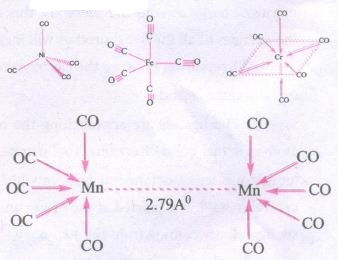
The structures of the binuclear metal carbonyls involve either metal-metal bonds or bridging CO groups, or both. The carbonyl ligands that are attached to only one metal atom are referred to as terminal carbonyl groups, whereas those attached to two metal atoms simultaneously are called bridging carbonyls. Depending upon the structures, metal carbonyls are classified as follows.
Non-bridged metal carbonyls:
These metal carbonyls do not contain any bridging carbonyl ligands. They may be of two types.
(i) Non- bridged metal carbonyls which contain only terminal carbonyls. Examples: [Ni (CO)4], [Fe (CO)5] and [Cr (CO)6]
(ii) Non- bridged metal carbonyls which contain terminal carbonyls as well as Metal- Metal bonds. For examples, The structure of Mn2(CO)10 actually involve only a metal-metal bond, so the formula is more correctly represented as (CO)5Mn-Mn(CO)5
Other examples of this type are, Tc2(CO) 10, and Re2(CO)10.

12th Standard Syllabus & Materials
12th Standard
TN 12th Computer Applications வலையமைப்பு வடமிடல் Sample Question Papers Study Material - QB365 Set A
NEW12th Standard
TN 12th Computer Applications களப்பெயர் முறைமை (DNS) Sample Question Papers Study Material - QB365 Set A
NEW12th Standard
TN 12th Computer Applications வலையமைப்பு எடுத்துக்காட்டுகள் மற்றும் நெறிமுறைகள் Sample Question Papers Study Material - QB365 Set A
NEW12th Standard
TN 12th Computer Applications கணினி வலையமைப்பு ஓர் அறிமுகம் Sample Question Papers Study Material - QB365 Set A



Tamilnadu Stateboard 12th Standard Subjects

Maths
Chemistry

Physics

Biology

Computer Science

Business Maths and Statistics

Economics

Commerce

Accountancy

History

Computer Applications
Biology
Computer Technology
Computer Applications
Computer Science
Business Maths and Statistics
Commerce
Economics
Maths
Chemistry
Physics
Computer Technology
History
Accountancy

Tamil

English

French
Tamilnadu Stateboard Standards
