
 100% FREE ACCESS
12th Standard Syllabus & Materials
12th Standard
TN 12th Maths Applications of Matrices and Determinants Sample Question Papers Study Material - QB365 Set A
NEW12th Standard
TN 12th Computer Applications மின்னணு தரவு பரிமாற்றம் Sample Question Papers Study Material - QB365 Set A
NEW12th Standard
TN 12th Computer Applications மின் - வணிக பாதுகாப்பு அமைப்புகள் Sample Question Papers Study Material - QB365 Set A
NEW12th Standard
TN 12th Computer Applications மின்னணு செலுத்தல் முறைகள் Sample Question Papers Study Material - QB365 Set A
NEW12th Standard
TN 12th Computer Applications மின் - வணிகம் Sample Question Papers Study Material - QB365 Set A
NEW12th Standard
TN 12th Computer Applications திறந்த மூல கருத்துருக்கள் Sample Question Papers Study Material - QB365 Set A

Published on: 27/02/2021
12th Standard English Medium Chemistry Reduced Syllabus Five mark Important Questions - 2021(Public Exam )
Download Tamil Nadu 12th Standard Chemistry question papers, model tests, one-mark questions, important questions, and public exam papers in PDF format. Free study materials and answer keys for TN State Board students.
Questions + Answers key
Take MCQ Chemistry Test
1.
Explain any one method for coagulation.
2.
Write the structure of α-D (+) glucophyranose
3.
4.
KF crystallizes in fcc structure like sodium chloride. Calculate the distance between K+ and F− in KF. (given : density of KF is 248 g cm-3)
5.
The selection of reducing agent depends on the thermodynamic factor: Explain with an example.
6.
On hydrolysis of salts of strong acid and strong base, the solution obtained is neutral. Justify your answer with a suitable example
7.
If a solution has a pH of 7.41, determine its H+ concentration.
8.
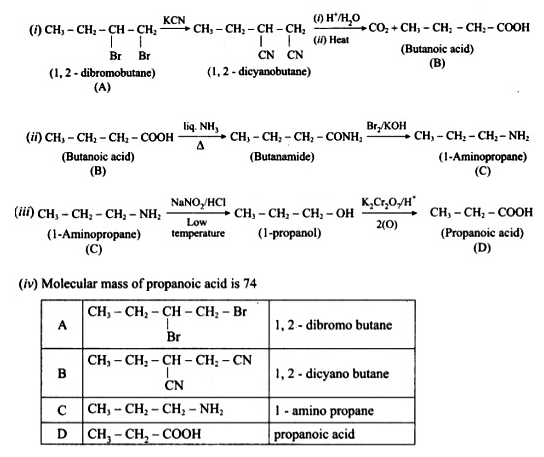
A dibromo derivative (A) on treatment with KCN followed by acid hydrolysis and heating gives a monobasic acid (B) along with liberation of CO2 . (B) on heating with liquid ammonia followed by treating with Br2 /KOH gives (c) which on treating with NaNO2 and HCl at low temperature followed by oxidation gives a monobasic acid (D) having molecular mass 74. Identify A to D.
9.
Write a short note on the oxidation states of 3d series elements.
10.
For the reaction 2A + B ⟶ A2B. The rate = k [A] [B]2 with k = 2.0 x 10⁻⁶ mol? L2 S-1. Calculate the initial rate of the reaction, when [A] = 0.1 mol L-1, [B] = 0.2 mol L-1. Calculate the rate of reaction after [A] is reduced to 0.06 mol L-1
11.
How is sulphuric acid manufacture by contact process?
12.
Mention the uses of helium.
13.
How are silicates classified? Give an example for each type of silicate.
14.
How are metal carbonyls classified depending on the number of metal atoms?
15.
Predict which of the following will be coloured in aqueous solution Ti2+, V3+, Sc4+, Cu+, Sc3+, Fe3+, Ni2+ and Co3+
16.
What is crystal field splitting energy?
17.
Complete the following reaction
\({ CH }_{ 3 }-{ CH }_{ 2 }-{ CH }_{ 2 }-\underset { \overset { || }{ O } }{ C } -{ CH }_{ 3 }\overset { HO-{ CH }_{ 2 }-{ CH }_{ 2 }-OH }{ \underset { { dry }{ HCl} }{ \longrightarrow } } ?\)
18.
Calculate the standard emf of the cell: Cd|Cd2+||Cu2+|Cu and determine the cell reaction. The standard reduction potentials of Cu2+|Cu and Cd2+|Cd are 0.34V and -0.40 volts respectively. Predict the feasibility of the cell reaction.
19.
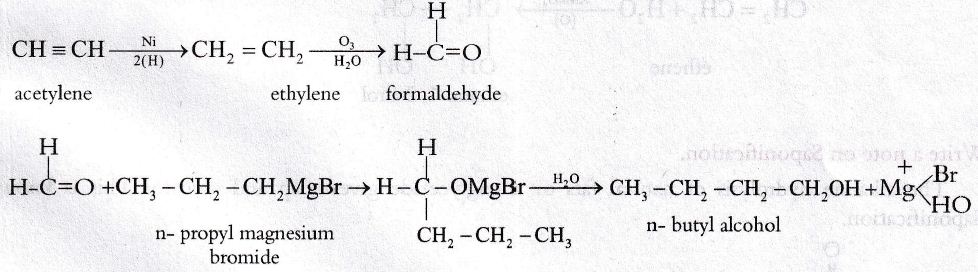
How will you convert acetylene into n-butyl alcohol.
20.
Write the expression for the solubility product of Ca3(PO4)2
21.
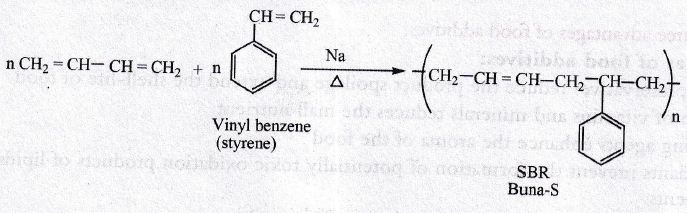
Write a note on co –polymer
22.
Rate constant of a first order reaction is 0.45 sec-1, calculate its half life.
23.
The half life of the homogeneous gaseous reaction SO2Cl2 → SO2 + Cl2 which obeys first order kinetics is 8.0 minutes. How long will it take for the concentration of SO2Cl2 to be reduced to 1% of the initial value?
24.
Out of Lu(OH)3 and La(OH)3 which is more basic and why?
1.
Addition of electrolytes:
A negative ion causes the precipitation of positively charged sol and vice versa. When the valency of ion is high, the precipitation power is increased.
For example, the precipitation power of some cations and anions varies in the following order
\(\mathrm{Al}^{3+}>\mathrm{Ba}^{2+}>\mathrm{Na}^{+} \text {, Similarly }\left[\mathrm{Fe}\left(\mathrm{CN}_{6}\right)\right]^{3-}>\mathrm{SO}_{4}{ }^{2-}>\mathrm{Cl}^{-}\)
The precipitation power of electrolyte is determined by finding the minimum concentration (millimoles/lit) required to cause precipitation of a sol in 2 hours. This value is called flocculation value. The smaller the flocculation value greater will be precipitation.
2.
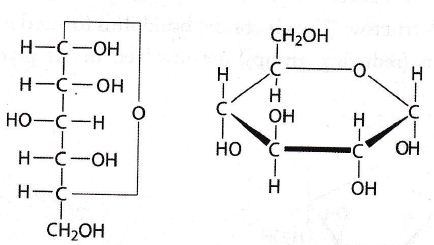
α-D (+) glucophyranose
3.
4.
\(\text { Density }(\rho)=\frac{\mathrm{nM}}{\mathrm{a}^{3} \mathrm{~N}_{\mathrm{A}}} \)
\(\mathrm{n}=4, \mathrm{M}=\text { Molar mass of } \mathrm{KF}=58.1 \mathrm{~g} / \mathrm{mol} \)
\(\rho=2.48 \mathrm{~g} \mathrm{~cm}^{-3} \)
\(\mathrm{~N}_{\mathrm{A}}=6.023 \times 10^{23} \)
\(a^{3} =\frac{n M}{\rho N_{A}}=\frac{4 \times 58.1}{2.48 \times 6.023 \times 10^{23}} \)
\(a^{3} =15.55 \times 10^{-23} \)
\(a^{3} =0.1555 \times 10^{-21} \)
\(a =\sqrt[3]{0.1555 \times 10^{-21}} \)
\(a =0.5375 \times 10^{-7} \mathrm{~cm}=5.375 \times 10^{-8} \mathrm{~cm}=537.5 \mathrm{pm} \)
\(d =\frac{a}{\sqrt{2}}(\text { for fcc }) [\therefore r = \frac{a\sqrt{2}}{4}]\)
\(=\frac{537.5}{1.414}=380.13 \mathrm{pm}\)
\(\therefore\) The distance between K+ and F- in KF = 380.13 pm
5.
(i) The extraction of metals from their oxides can be carried out by using different reducing agents.
(ii) Consider the following reaction
\(\frac{2}{\mathrm{y}} \mathrm{M}_{\mathrm{x}} \mathrm{O}_{\mathrm{y}(\mathrm{s})} \rightarrow \frac{2 \mathrm{x}}{\mathrm{y}} \mathrm{M}_{(s)}+\mathrm{O}_{ 2(\mathrm{~g})}\) (1)
(iii) The above reduction may be carried out with carbon. In this case the reducing agent carbon may be oxidized to either CO or CO2
\(\mathrm{C}+\mathrm{O}_{2} \rightarrow \mathrm{CO}_{2(\mathrm{~g})} \) (2)
\(2 \mathrm{C}+\mathrm{O}_{2} \rightarrow 2 \mathrm{CO}_{(\mathrm{g})} \) (3)
(iv) If CO is used as a reducing agent
\(2 \mathrm{CO}+\mathrm{O}_{2} \rightarrow 2 \mathrm{CO}_{2(\mathrm{~g})}\) (4)
(v) A suitable reducing agent is selected based on the thermodynamics considerations.
(vi) We know that for a spontaneous reaction, the change in free energy (\(\triangle\)G) should be negative.
(vii) Therefore, thermodynamically, the reduction of metal oxide with a given reducing agent can occur if the free energy change for the coupled reaction is negative.
(viii) Hence, the reducing agent is selected in such a way that it provides a large negative \(\triangle\)G value for the coupled reaction.
6.
Let us consider the reaction between NaOH and nitric acid to give sodium nitrate and water.
\(\mathrm{NaOH}_{(\mathrm{aq})}+\mathrm{HNO}_{3(\mathrm{aq})} \longrightarrow \mathrm{NaNO}_{3(\mathrm{aq})}+\mathrm{H}_{2} \mathrm{O}(\mathrm{l})\)
The salt NaNO3 completely dissociates in water to produce Na+ and NO3- ions.
\( \mathrm{NaNO}_{3(\mathrm{aq})} \longrightarrow \mathrm{NO}_{(\mathrm{aq})}^{+}+\mathrm{NO}_{3(\mathrm{aq})}^{-} \)
Water dissociates to a small extent as
\(\mathrm{H}_{2} \mathrm{O}_{(\mathrm{l})} \rightleftharpoons \mathrm{H}_{(\mathrm{aq})}^{+}+\mathrm{OH}_{(\mathrm{aq})}^{-}\)
Since [H+] = [OH-], water is neutral
\({ NO }_{ 3 }^{ - }\) ion is the conjugate base of the strong acid HNO3 and hence it has no tendency to react with H+.
Similarly, Na+ is the conjugate acid of the strong base NaOH and it has no tendency to react with OH-.
It means that there is no hydrolysis. In such cases [H+] = [OH-] pH is maintained and, therefore, the solution is neutral.
7.
pH = -log [H+]
∴ [H+] = antilog [-pH]
= antilog [-7.41]
∴ [H+] = 3.9 x 10⁻⁸ M.
8.
Compound A,B,C and D
9.
(i) The first transition metal Scandium exhibits only +3 oxidation state, but all other transition elements exhibit variable oxidation states by loosing electrons from (n-1)d orbital and ns orbital as the energy difference between them is very small.
(ii) At the beginning of the series, +3 oxidation state is stable but towards the end +2 oxidation state becomes stable.
(iii) The number of oxidation states increases with the number of electrons available, and it decreases as the number of paired electrons increases.
(iv) Hence, the first and last elements show less number of oxidation states and the middle elements with more number of oxidation states.
(v) For example, the first element Sc has only one oxidation state +3; the middle element Mn has six different oxidation states from +2 to +7. The last element Cu shows +1 and +2 oxidation states only.
(vi) The relative stability of different oxidation - states of 3d metals is correlated with the extra stability of half filled and fully filled electronic configurations. Example: Mn2+(3d5) is more stable than Mn4+(3d3).
10.
The initial rate of the reaction is
Rate = k [A] [B] 2
= (2.0 x 10⁻⁶ mol-2 L2 S-1) (0.1 mol L-1)2
= 8.0 x 10⁻⁹ mol-2 L2 s-1
When [A] is reduced from 0.1 mol L-1 to 0.06 mol-1, the concentration of A reacted = (0.1 - 0.06) mol L-1 = 0.04 mol L-1.
∴ The concentration of B reaction
= \(\frac { 1 }{ 2 } \) x 0.04 mol L-1
= 0.02 mol L-1
Then, concentration of B available [B] = (0.2 - 0.02) mol L-1
= 0.18 mol L-1.
After [A] is reduced to 0.06 mol L-1, the rate of the reaction is given by,
Rate = k [A] [B] 2
= (2.0 x 10⁻⁶ mol-2 L2 s-1) (0.06 mol L-1) (0.18 mol L-1)2
= 3.89 mol L-1 s-1.
11.
Manufacture of sulphuric acid by contact process:
The contact process involves the following steps.
(i) Initially sulphur dioxide is produced by burning sulphur or iron pyrites in oxygen/ air.
\(S+{ O }_{ 2 }\longrightarrow { SO }_{ 2 }\)
\({ 4FeS }_{ 2 }+{ 11O }_{ 2 }\longrightarrow { 2Fe }_{ 2 }{ { O }_{ 3 } }+8{ SO }_{ 2 }\)
(ii) Sulphur dioxide formed is oxidised to sulphur trioxide by air in the presence of a catalyst such as V2O5 or platinised asbestos.
(iii) The sulphur trioxide is absorbed in concentrated sulphuric acid and produces oleum (H2S2O7). The oleum is converted into sulphuric acid by diluting it with water.
\(\mathrm{SO}_{3}+\mathrm{H}_{2} \mathrm{SO}_{4} \longrightarrow \mathrm{H}_{2} \mathrm{~S}_{2} \mathrm{O}_{7} \stackrel{\mathrm{H}_{2} \mathrm{O}}{\longrightarrow} 2 \mathrm{H}_{2} \mathrm{SO}_{4}\)
(iv) To maximise the yield the plant is operated at 2 bar pressure and 720 K. The sulphuric acid obtained in this process is over 96 % pure.
12.
(i) Because of its lightness and noninflammability helium is used to filling balloons for meteorological observations.
(ii) Because of its lightness it is used in inflating aeroplane tyres.
(iii) Helium oxygen mixture is used by deep sea divers in preference to nitrogen oxygen mixtures. This prevents bends when a diver comes to the surface.
(iv) A mixture of oxygen and helium is used in the treatment of asthma.
(v) Liquid helium (b.pt 4.2K) is used as cryogenic agent for carrying out various experiments at low temperatures.
(vi)It is used to produce and sustain powerful super conducting magnets of modern NMR Spectrometers and Magnetic Resonance Imaging system (MRI) for clinical diagnosis.
13.
Silicates are classified into various types based on the way in which the tetrahedral units, [SiO4]4- are linked together.
(i) Ortho silicates (Neso silicates):
The simplest silicates which contain discrete [SiO4]4- tetrahedral units are called ortho silicates or nesosilicates.
Examples: Phenacite - Be2SiO4 (Be2+ ions are tetrahedrally surrounded by O2- ions)
(ii) pyro silicate (or) Soro silicates: Silicates:
Which contain [Si2O7]6- ions are called pyro silicates (or) Soro silicates.
Example: Thortveitite - Sc2Si2O7
(iii) Cyclic silicates (or Ring silicates):
Silicates which contain (SiO3)32n- ions which are formed by linking three or more tetrahedral SiO44- units cyclically are called cyclic silicates.
Example: Beryl [Be3Al2 (SiO3)6] (an aluminosilicate with each aluminium is surrounded by 6 oxygen atoms octahedrally)
(iv) Inosilicates: Silicates which contain 'n':
number of silicate units liked by sharing two or more oxygen atoms are called inosilicates.
Example: They are further classified as chain silicates and double chain silicates.
(v) Chain silicates (or pyroxenes):
These silicates contain [(SiO3)n]2n- ions formed: by linking 'n' number of tetrahedral [SiO4]4- units linearly. Each silicate unit shares two of its oxygen atoms with other units.
Example: Spodumene - LiAl(SiO3)2·
(vi) Double chain silicates (or amphiboles):
These silicates contains \(\left[ { Si }_{ 4 }{ O }_{ 11 } \right] _{ n }^{ 6n- }\) ions. In these silicates there are two different types of tetrahedra:
(a) Those sharing 3 vertices
(b) those sharing only 2 vertices.
Example:
Asbestos: These are fibrous and non-combustible silicates.
(vii) Sheet or phyllo silicates:
Silicates which contain \(({ Si }_{ 2 }{ O }_{ 5 })_{ n }^{ 2n- }\) are called sheet or phyllo silicates. In these, Each [SiO4]4- tetrahedron unit shares three oxygen atoms with others and thus by forming two dimensional sheets.
Example: Talc, Mica etc.
(viii) Three dimensional silicates (or tectosilicates):
Silicates in which all the oxygen atoms of [SiO4]4- tetrahedra are shared with other tetrahedra to form three dimensional network are called three dimensional or tectosilicates.
Example: Quartz.
14.
Metal carbonyls are classified in two different ways as described below Classification based on the number of metal atoms present.
a. Mononuclear carbonyls
These compounds contain only one metal atom. For example, [Ni(CO)4] - nickel tetracarbonyl is tetrahedral, [Fe(CO)5] - Iron pentacarbonyl is trigonal bipyramidal, and [Cr(CO)6] - Chromium hexacarbonyl is octahedral.
b. Polynuclear carbonyls
Metallic carbonyls containing two or more metal atoms are called polynuclear carbonyls. Polynuclear metal carbonyls may be Homonuclear [Co2(CO)8], [Mn2(CO)10], [Fe3 (CO)12] or heteronuclear [MnCo(CO)9], [MnRe(CO)10] etc.
15.
(i) Only the ions that have unpaired electrons in d- orbital and in which d - d transition is possible will be coloured.
(ii) The ions in which d - orbitals are empty or completely filled will be colourless as no d -d transition is possible in those configurations.
(iii) From the above ions, it can be easily observed that only Sc3+ has an empty d - orbital and Cu+ has completely filled d-orbitals.
(vi) All other ions, except Sc3+ and Cu+, will be coloured in aqueous solution because of d - d transition.
16.
In an Octahedral complex, the d-orbitals of the central metal ion, divide (1) into two sets of different energies. The separation in energy is the crystal field splitting energy.
The d-orbitals lying along the axes dx2, dy2 and dz2 orbitals will experience strong repulsion and raise in energy to a greater extent than the orbitals with lobes directed between the axes (dxy, dyz, and dzx)Thus the degenerate d-orbitals now split into two sets and the process is called crystal field splitting.
17.

2- Pentanone.
18.
Cell reactions:
Oxidation at anode: \(Cd_{(s)}\rightarrow Cd^{2+}_{(aq)}+2e^{-}\); (E0ox)cd|cd2+ = 0.40V ; (E0)cd|cd2+ = -0.40V
Reduction at cathode: \(Cu^{2+}_{(aq)}+2e^{-}\rightarrow Cu_{(s)} \); (E0red)cu2+|Cu = +0.34V
Adding: \(Cd_{(s)}+Cu^{2+}_{(aq)}\rightarrow Cd^{2+}_{(aq)}+Cu_{(s)}\)
E0cell=(E0ox)+(E0red)
=(-0.4) + 0.34V
= 0.74V.
Emf is +ve, so \(\Delta G\) is -ve, the cell reaction is feasible.
19.
20.
\(\mathrm{Ca}_{3}\left(\mathrm{PO}_{4}\right)_{2} \rightleftharpoons 3 \mathrm{Ca}^{2+}_{(aq)}+2 \mathrm{PO}_{4_{(aq)}}^{3-}\\\)
(s) (3s) (2s)
\(K_{sp}=[Ca^{2+}]^{3}[PO_{4}^{3-}]^{2}\)
\(K_{sp}=(3s)^{3}(2s)^{2}\)
\(K_{sp}=27s^{3}.4s^{2}\)
\(K_{sp}=108s^{5}\)
(or)
\(K_{s p} =m^{m} \cdot n^{n} \cdot(s)^{m+n} \)
\(K_{\text {sp }} =3^{3} \cdot 2^{2} \cdot(s)^{3+2} \)
\(K_{s p} =27 \times 4 \times(s)^{5} \)
\(=108(s)^{5}=108 s^{5}\)
21.
(i) A polymer containing two or more different kinds of monomer units is called a copolymer.
(ii) For example, SBR rubber(Buna-S) contains styrene and butadiene monomer units.
(iii) Copolymers have properties quite different from the homopolymers.
(iv) Mixture of styrene and 1,3 butadiene to form a copolymer (Buna -S)
Preparation of Buna-S:
It is a co-polymer. It is obtained by the polymerisation of buta -1,3 - diene and styrene in the ratio 3: 1 in the presence of sodium.
22.
Given data: Rate constant of a first order reaction (k) = 0.45 sec-1
Formula: \({ t }_{ \frac { 1 }{ 2 } }=\frac { 0.693 }{ k } \)
Solution: \({ t }_{ \frac { 1 }{ 2 } }=\frac { 0.693 }{ k } =\frac { 0.693 }{ 0.45 } \)
Half-life period = 1.54 sec.
23.
\(\mathrm{k}=0.693 / \mathrm{t}_{1 / 2}\)
\(\mathrm{k}=\frac{0.693}{8.0}=0.08 \mathrm{~min}^{-1}\)
For the first order reaction:
\(t =\frac{2.303}{k} \log \frac{\left[A_{0}\right]}{[A]} \)
\(t =\frac{2.303}{0.087} \log \left(\frac{100}{1}\right)=26.47 \log 10^{2} \)
\(t =2 \times 26.47 \log 10 \)
\(t =52.94 \mathrm{~min}\)
24.
La(OH)3 is more basic than Lu(OH)3. Due to lanthanide contraction, the size of Ln3+ ions decreases regularly with increase in atomic number. According to Fajan's rule, decrease in size of Ln3+ ions decreases the basic character between Ln3+ and OH- ion in Ln(OH)3. So La(OH)3 is more basic than Lu(OH)3.

12th Standard Syllabus & Materials
12th Standard
TN 12th Computer Applications வலையமைப்பு வடமிடல் Sample Question Papers Study Material - QB365 Set A
NEW12th Standard
TN 12th Computer Applications களப்பெயர் முறைமை (DNS) Sample Question Papers Study Material - QB365 Set A
NEW12th Standard
TN 12th Computer Applications வலையமைப்பு எடுத்துக்காட்டுகள் மற்றும் நெறிமுறைகள் Sample Question Papers Study Material - QB365 Set A
NEW12th Standard
TN 12th Computer Applications கணினி வலையமைப்பு ஓர் அறிமுகம் Sample Question Papers Study Material - QB365 Set A



Tamilnadu Stateboard 12th Standard Subjects

Maths
Chemistry

Physics

Biology

Computer Science

Business Maths and Statistics

Economics

Commerce

Accountancy

History

Computer Applications
Biology
Computer Technology
Computer Applications
Computer Science
Business Maths and Statistics
Commerce
Economics
Maths
Chemistry
Physics
Computer Technology
History
Accountancy

Tamil

English

French
Tamilnadu Stateboard Standards
