
 100% FREE ACCESS
12th Standard Syllabus & Materials
12th Standard
TN 12th Maths Applications of Matrices and Determinants Sample Question Papers Study Material - QB365 Set A
NEW12th Standard
TN 12th Computer Applications மின்னணு தரவு பரிமாற்றம் Sample Question Papers Study Material - QB365 Set A
NEW12th Standard
TN 12th Computer Applications மின் - வணிக பாதுகாப்பு அமைப்புகள் Sample Question Papers Study Material - QB365 Set A
NEW12th Standard
TN 12th Computer Applications மின்னணு செலுத்தல் முறைகள் Sample Question Papers Study Material - QB365 Set A
NEW12th Standard
TN 12th Computer Applications மின் - வணிகம் Sample Question Papers Study Material - QB365 Set A
NEW12th Standard
TN 12th Computer Applications திறந்த மூல கருத்துருக்கள் Sample Question Papers Study Material - QB365 Set A

Published on: 27/02/2021
12th Standard English Medium Chemistry Reduced Syllabus Five mark Important Questions with Answer key - 2021(Public Exam )
Download Tamil Nadu 12th Standard Chemistry question papers, model tests, one-mark questions, important questions, and public exam papers in PDF format. Free study materials and answer keys for TN State Board students.
Questions + Answers key
Take MCQ Chemistry Test
1.
Discuss the mechanism of aldol condensation.
2.
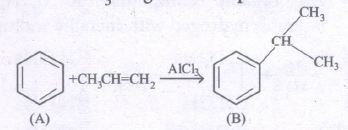
An aromatic hydrocarbon A reacts with propene in the presence of anhydrous AlCl3 to give a compound B with a molecular formula C9H12 Further compound B undergoes oxidation in the, presence of air to give hydrogen peroxide C. Compound C decomposes in HCI acid solution to give compound D and acetone. Identify A, B, C and D. Explain the reactions.
3.
Give the special characteristics of enzyme catalysed reactions.
4.
To one molar solution of a trivalent metal salt, electrolysis was carried out and 0.667 M was the concentration remaining after electrolysis. Calculate the quantity of electricity passed.
5.
6.
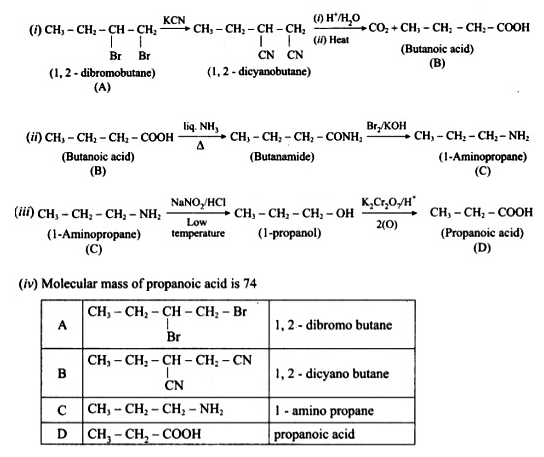
A dibromo derivative (A) on treatment with KCN followed by acid hydrolysis and heating gives a monobasic acid (B) along with liberation of CO2 . (B) on heating with liquid ammonia followed by treating with Br2 /KOH gives (c) which on treating with NaNO2 and HCl at low temperature followed by oxidation gives a monobasic acid (D) having molecular mass 74. Identify A to D.
7.
The conversion of molecules x to y follows second order kinetics. Its concentration of x is increased to three times how will it affect the rate of formation of y?
For the reaction x ➝ y as it follows second order kinetics wherefore the rate of formation of y?
8.
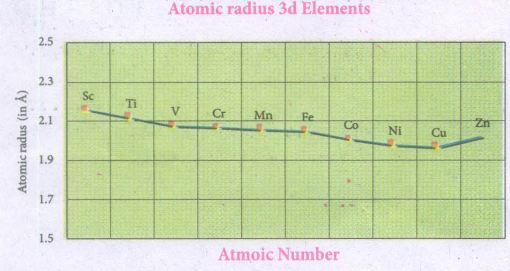
Why is there a variation of atomic and ionic size as we move from Sc to Zn?
9.
Explain the bleaching action of Chlorine.
10.
Give a detailed account on allotropes of sulphur.
11.
How can you determine the atomic mass of an unknown metal if you know its density and the dimension of its unit cell? Explain.
12.
Explain refining of titanium by Van-Arkel method.
13.
What are the salient feature of crystal field theory?
14.
On the basis of VB theory explain the nature of bonding in [Co(C2O4)3]3-
15.
Give the limitations of Ellingham diagram.
16.
The activation energy of a reaction is 22.5 k Cal mol-1 and the value of rate constant at 40°C is 1.8 x 10⁻⁵s-1. Calculate the frequency factor, A.
17.
Deduce the oxidation number of oxygen in hypofluorous acid – HOF.
18.
Sodium metal crystallizes in bcc structure with the edge length of the unit cell 4.3 x 10⁻⁸ cm. Calculate the radius of sodium atom.
19.
Write the structure of the major product of the aldol condensation of benzaldehyde with acetone.
20.
Phenol is distilled with Zn dust followed by friedel – crafts alkylation with prophyl chloride to give a compound B, B on oxidation gives (c) Indentify A,B and C.
21.
9.2\(\times\)1012 litres of water is available in a lake. A power reactor using the electrolysis of water in the lake, produces electricity at the rate of 2\(\times\)106 Cs−1 at an appropriate voltage. How many years would it take to completely electrolyse the water in the lake. Assume that there is no loss of water except due to electrolysis.
22.
Write a note on catalytic poison
23.
Will a precipitate be formed when 0.150 L of 0.1M Pb(NO3)2 and 0.100L of 0.2 M NaCl are mixed? \(K_{sp}\ (PbCl_{2})=1.2\times10^{-5}\).
24.
How is terylene prepared?
25.
Describe the variable oxidation state of 3d series elements.
1.
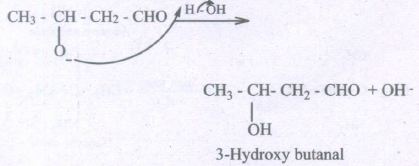
This reaction is catalysed by base. The carbanion generated is nucleophilic in nature. Hence it can bring about nucleophilic attack on carbonyl group
Step 1: The carbanion is formed as the a-hydrogen atom is removed as a proton by the base

Step 2: The carbanion attacks the carbonyl carbon of another unionised aldehyde molecule
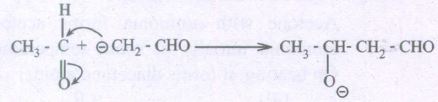
Step 3: The alkoxide ion formed is protonated by water to give 'aldol'.
2.
(i) An aromatic hydrocarbon A reacts with propene in the presence of anhydrous AICl3 to give a compound B.
(ii) Compound B undergoes oxidation in the presence of air and hydrogen peroxide to give C.
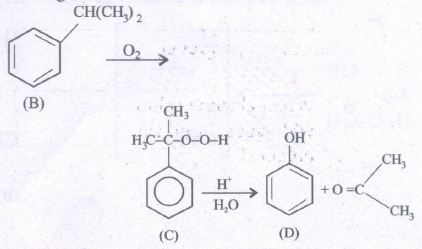
(iii) Compound C decomposes in HCI acid solution to give compound D and acetone. Identify A, B, C and D. Explain the reactions.
| Compound | Compound Name | Formula |
| A | Benzene | C6H6 |
| B | Cumene | 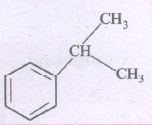 |
| C | Cumene hydroperoxide | 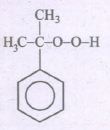 |
| D | Phenol | C6H5OH |
3.
(i) Effective and efficient conversion is the special characteristic of enzyme catalysed reactions. An enzyme may transform a million molecules of reactant in a minute
For Eg: \({ 2H }_{ 2 }{ O }_{ 2 }\longrightarrow { 2H }_{ 2 }O+{ O }_{ 2 }\)
For this reaction, the activation energy is 18k cal/mole without a catalyst With colloidal platinum as a, catalyst the activation energy is 11.7kcal /mole. But with the enzyme catalyst the activation energy of this reaction is less than 2kcal/ mole.
(ii) Enzyme catalysis is highly specific in nature.
(iii) Enzyme catalysed reaction has maximum rate at optimum temperature
(iv) The rate of enzyme catalysed reactions varies with the pH of the system. The rate is maximum at a pH called optimum pH.
(v) Enzymes can be inhibited i.e. poisoned activity of an enzyme is decreased and destroyed by a poison. The physiological action of drugs is related to their inhibiting action.
(vi) Catalytic activity of enzymes is increased by coenzymes or activators.
4.
Given: Initial concentration of the solution = 1 M
The concentration remaining after electrolysis = 0.667 M
Solution:
∴ The amount deposited = 1 - 0.667 M
= 0.333 M
1F = Faraday = 3 x 0.333 M
= 0.999M
= 1M
∴1 Faraday current is used.
5.
6.
Compound A,B,C and D
7.
Rate = k [x]2 = ka2
[x] = a mol-1
If the concentration of x is in cross three time, then
(x) = 3a mol L-1
Rate = R(3a)2 = 9 ka2
Hence, the rate of formation will increase by 9 times.
8.
(i) It is generally expected a steady decrease in atomic radius along a period as the nuclear charge increases and the extra electrons are added to the same sub shell.
(ii) But for the 3d transition elements, the expected decrease in atomic radius is observed from Sc to V, thereafter up to Cu the atomic radius nearly remains the same.
(iii) As we move from Sc to Zn in 3d series the extra electrons are added to the 3d orbitals, the added 3d electrons only partially shield the increased nuclear charge and hence the effective nuclear charge increases slightly.
(iv) However, the extra electrons added to the 3d sub shell strongly repel the 4s electrons and these two forces are operated in opposite direction and as they tend to balance each other, it leads to constancy in atomic radii.
(v) At the end of the series, d - orbitals of Zinc contain 10 electrons in which the repulsive interaction between the electrons is more than the effective nuclear charge and hence, the orbitals slightly expand and atomic radius slightly increases.
9.
Oxidising and bleaching action:
Chlorine is a strong oxidising and bleaching agent because of the nascent oxygen.
\({ H }_{ 2 }O+{ Cl }_{ 2 }\longrightarrow Hcl+\underset { Hypo\ chlorous \ acid }{ HOCl } \)
HOCI \(\longrightarrow \) HCI + (0)
Colouring matter + Nascent oxygen - 7 Colourless oxidation product.
The bleaching of chlorine is permanent. It oxidises ferrous salts to ferric, sulphites to sulphates and hydrogen sulphide to sulphur.
2FeCl2 + Cl2 \(\longrightarrow \) 2FeCl3
Cl2 + H2O \(\longrightarrow \)HCI + HOCI
2FeSO4 + H2SO4 + HOCI \(\longrightarrow \)Fe2 (SO4)3 + HCI + H2O
Overall reaction
2FeSO4 + H2SO4 + Cl2 \(\longrightarrow \) Fe2(SO4)3 + 2HCI
Cl2 + H2O \(\longrightarrow \) HCI + HOCI
Na2SO3 + HOCI\(\longrightarrow \) Na2SO4 + HCI
Overall reaction
Na2SO3 + H2O+Cl2 \(\longrightarrow \) Na2SO4 + 2HCI
Cl2 + H2S\(\longrightarrow \)2HCI + S
10.
(a) Rhombic Sulphur (α - Sulphur):
(a) It is yellow in colour.
(b) Its melting point is 385.8K and specific gravity is 2.06
(c) It is stable form of sulphur at room temperature.
(d) It is formed on evaporating the solution of sulphur in CS2.
(e) It in insoluble in water, readily soluble in CS2 and dissolves to some extent in benzene, alcohol and ether.
(b) Monoclinic sulphur \(\left( \beta -sulphur \right) \):
(a) Its melting point is 393K and specific gravity is 1.98
(b) It is prepared by melting rhombic sulphur in a dish and cooling, till crust is formed. Two holes are made in crust and remaining liquid is powered out. On removing crust, colourless needle - shaped crystals of β - sulphur is formed.
(c) Monoclinic sulphur is stable above 369K and below 369K α - sulphur is stable.
(d) At 369K both forms are stable and this temperature is called transition temperature.
(e) Both rhombic and monoclinic sulphur have S8 molecules, these are packed to give different crystal structure S8 form is puckered and has crown shape.
Several other modifications containing 6-20 sulphur atoms per ring are synthesised
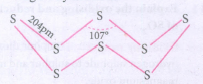
(f) In Cyclo-S6 the ng adopts chair form.
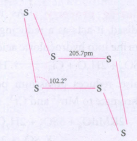
(g) At elevated temperatures (~1000K), S2 is dominant species and is, paramagnetic like O2
11.
(i) By knowing the density of an unknown metal and the dimension of its unit cell, the atomic mass of the metal can be: determined.
(ii) Let 'a' be the edge length of a unit cell of a crystal, 'd' be the density of the metal, 'm' be the atomic mass of the metal and 'z' be the number of atoms in the unit cell.
(iii) Now,
Density of the unit cell
\(=\frac{Mass\ of\ the\ unit\ cell}{Volume\ of\ the\ unit\ cell}\)
\(d=\frac{Z\times m}{a^3}\) ...(1)
[Since, mass of the unit cell = Number of atoms in the unit cell x Atomic mass]
[Volume of the unit cell = (edge length of the cubic unit cell)3]
(iv) From equation (1), We have
\(m=\frac{d\times a^3}{Z}\) ....(2)
(v) Now,
Mass of the metal (M) \(=\frac{Atomic\ mass(M)}{Avogadro's\ number(N_A)}\)
M=\(\frac{d\times a^3 \times N_A}{Z}\)
(vi) From equation (3), we can determine the atomic mass of the unknown metal.
12.
(i) Van-Arkel method is based on the thermal decomposition of metal compounds which lead to the formation of pure metals.
(ii) Titanium and zirconium can be purified, using this method.
(iii) For example, the impure titanium metal is heated in an evacuated vessel with iodine at a temperature of 550 K to form the volatile titanium tetra-iodide(Til4)
(iv) The impurities are left behind, as they do not react with iodine
\({ Ti }_{ (s) }+{ 2I }_{ 2(s) }\longrightarrow { Til }_{ 4 }(vapour)\)
(v) The volatile titanium tetraiodide vapour is passed over a tungsten filament at a temperature around 1800 K.
(vi) The titanium tetraiodide is decomposed and pure titanium is deposited on the filament
(vii) The iodine is reused.
\({ Til }_{ 4 }(vapour)\longrightarrow { { Ti }_{ (s) } }+{ 2I }_{ 2(s) }\)
13.
Valance bond theory helps us to visualize the bonding in complexes. However, it has limitations as mentioned above. Hence Crystal Field Theory to explain some of the properties, like colour, magnetic behavior, etc., This theory I was originally used to explain the nature of bonding in ionic crystals. Later on, it is used to explain the properties of transition metals and their complexes. The salient features of this theory are as follows.
(i) Crystal Field Theory (CFT) assumes that the bond between the ligand and the central metal atom is purely ionic. i.e. the bond is formed due to the electrostatic attraction between the electron rich ligand and the electron deficient metal.
(ii) In the coordination compounds, the central metal atom/ion and the ligands are considered as point charges (in case of I charged metal ions or ligands) or electric dipoles (in case of neutral metal atoms or ligands).
(iii) According to crystal field theory, the complex formation is considered as the following series of hypothetical steps.
Step 1: In an isolated gaseous state, all the five d orbitals of the central metal ion are degenerate. Initially, the ligands form a spherical field of negative charge around the metal. In this filed, the energies of all the five d orbitals will increase due to the repulsion between the electrons of the metal and the ligand.
Step 2: The ligands are approaching the metal atom in actual bond directions. To illustrate this let us consider an octahedral field, in which the I central metal ion is located at the origin and the six ligands are coming from the +x, -x, +y, -y, +z and -z directions as shown below.
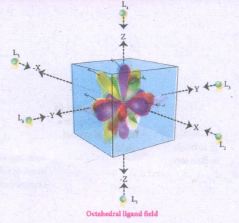
As shown in the figure, the orbitals lying along the axes dx2-y2 and dz2 orbitals will experience strong repulsion and raise in energy to a greater extent than the orbitals with lobes directed between the axes (dxy, dyz, and dzx). Thus the degenerate d orbitals now split into two sets and the process is called crystal field splitting.
Step 3: Up to this point the complex formation would not be favored. However, when the ligands approach further, there will be an attraction between the negatively charged electron and the positively charged metal ion, that results in a net decrease in energy. This decrease in energy is the driving force for the complex formation.
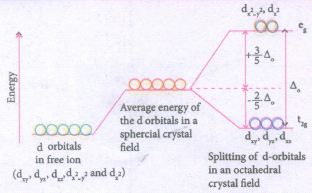
Crystal field splitting in octahedral complexes: During crystal field splitting in octahedral field, in order to maintain the average energy of the orbitals (barycentre) constant, the energy of the orbitals dx2-y2 and d z2 (represented as eg orbitals) will increase by 3/5 \({ \triangle }_{ o }\) while that of the other three orbitals dxy ' dyz and dzx (represented as t2g orbitals) decrease by 2/5 \({ \triangle }_{ o }\) , Here, \({ \triangle }_{ o }\) represents the crystal field splitting energy in the octahedral field.
14.
In \(\left[\mathrm{Co}\left(\mathrm{C}_{2} \mathrm{O}_{4}\right)_{3}\right]^{3-}\) Cobalt is in +3 oxidation state
\(\mathrm{Co}=[\mathrm{Ar}] 3 \mathrm{~d}^{7} 4 \mathrm{~s}^{2} \)
\(\mathrm{Co}^{3+}=3 \mathrm{~d}^{6} 4 \mathrm{~s}^{\circ}\)
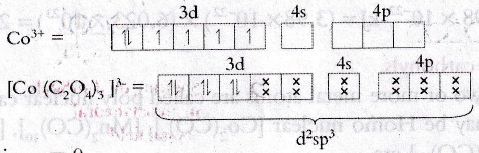
It is diamagnetic; n = 0
d2sp3 hybridisation; μs = 0
15.
(i) Ellingham diagram is constructed based only on thermodynamic considerations. It gives information about the thermodynamic feasibility of a reaction. It does not tell anything about the rate of the reaction. More over, it does not give any idea about the possibility of other reactions that might be taking place.
(ii) The interpretation of \(\triangle\)G is based on the assumption that the reactants are in equilibrium with the product which is not always true.
16.
\(\mathrm{k}=\mathrm{Ae}^{-\mathrm{E}_{\mathrm{a}} / \mathrm{RT}}\)
\(\log \mathrm{k}=\frac{-\mathrm{E}_{\mathrm{a}}}{2.303 \mathrm{RT}}+\log \mathrm{A} \text { (or) } \log \mathrm{A}=\log \mathrm{k}+\frac{\mathrm{E}_{\mathrm{a}}}{2.303 \mathrm{RT}}\)
\(\mathrm{k}=1.8 \times 10^{-5} \mathrm{~s}^{-1} ;\)
\(\mathrm{Ea}=22.5 \mathrm{k} \mathrm{Cal} \mathrm{mol}^{-1}=22500 \mathrm{Cal} \mathrm{mol}^{-1} \)
\(\log A=\log \left(1.8 \times 10^{-5}\right)+\frac{22500}{2.303 \times 1.987 \times 313} \)
\(=\log 1.8-5 \log {10}+15.71 \)
\(=0.2553-5+15.71 \)
\(\log A=10.9653 \)
\(A=\text { Antilog } 10.9653 \)
\(=9.232 \times 10^{10} \text { collisions } \mathrm{s}^{-1} \text {. }\)
17.
Oxidation number of F = -1
Oxidation number of H = +1
Oxidation number of O in HOF =x
(+1) + x + (-1) = 0
x = 0
Oxidation number of O in HOF = 0
18.
For bcc structure \((r)=\frac{\sqrt{3}}{4} a\)
a = 4.3 \(\times\) 10-8 cm, r = ?
\(=\frac{1.732 \times 4.3 \times 10^{-8}}{4}\)
\(r=1.86 \times 10^{-8} \mathrm{~cm}\)
19.
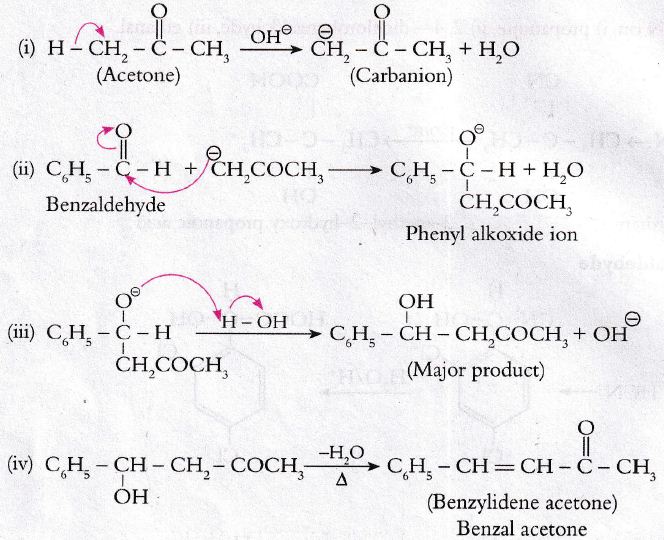
20.
\(\underset {Phenol} {\mathrm{C}_{6} \mathrm{H}_{5} \mathrm{OH}}+\mathrm{Zn}(\text { dust }) \rightarrow \underset {benzene(A)} {\mathrm{C}_{6} \mathrm{H}_{6}}+\mathrm{ZnO}\)
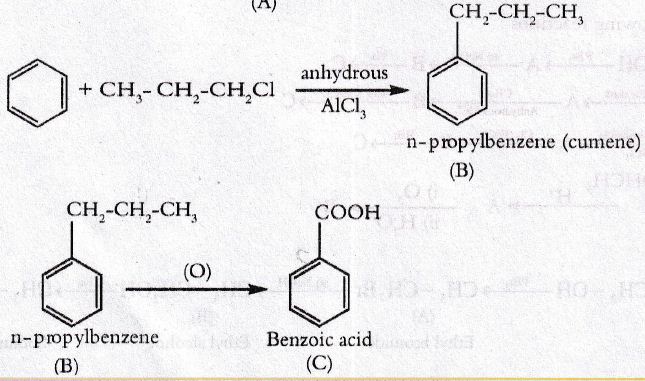
21.
Hydrolysis of water
At anode:
\(2H_{2}O\rightarrow 4H^{+}+O_{2}+4e^{-}\) ..... (1)
At cathode:
\(2H_{2}O+2e^{-}\rightarrow H_{2}+2OH^{-}\) ....(2)
Overall reaction
\(6H_{2}O\rightarrow 4H^{+}+4OH^{-}+2H_{2}+O_{2}\)
(or)
Equation (1) +(2) \(x^2 \Rightarrow 2H_{2}O\rightarrow 2H_{2}+O_{2}\)
\(\therefore\) According to faradays Law of electrolysis, to electrolyse two mole of Water (36g ≃ 36 mL of H2O), 4F charge is required alternatively, when 36 mL of water is electrolysed, the charge generated = \(4\times 96500\)C.
\(\therefore\) When the whole water which is available on the lake is completely electrolysed the amount of charge generated is equal to \(\frac{4\times96500\quad C}{36 \quad mL}\times9\times10^{12}L\)
\(=\frac{4\times96500\times9\times10^{12}}{36\times10^{-3}}C\)
= \(96500\times10^{15}C\)
\(\therefore\) Given that in 1 second, \(2\times10^{6}\) C is generated therefore, the time required to generate \(96500 \times 10^{15}\) C is = \(\frac{1\quad S}{2\times 10^{6}C}\times 96500 \times10^{15}C\)
=\(48250 \times 10^{9} S\)
\(\therefore\) Number of years = \(\frac{48250 \times 10^{9}}{365 \times 24 \times 60 \times 60}\)
=\(1.5299 \times 10^{6}\) years
1 year = 365 days
= 365\(\times\)24 hours
= 365\(\times\)24\(\times\)60 min
= 365\(\times\)24\(\times\)60\(\times\)60 sec.
22.
(i) Certain substances when added to a catalysed reaction decreases or completely destroys the activity of catalyst and they are often known as catalytic poisons.
For example,
(ii) In the reaction, 2SO2 + O2 ⟶ 2SO3 with a Pt catalyst, the poison is As2O3
(iii) i.e., As2O3 destroys the activity of Pt. As2O3 blocks the activity of the catalyst. So, the activity is lost.
23.
When two are more solution are mixed, the resulting concentrations are different from the original.
\(\text { Molarity }=\frac{n}{\mathrm{~V}} \text { (or) } \mathrm{n}=\text { Molarity } \times \mathrm{v} \)
Total Volume of the mixture = 0.15 + 0.1
= 0.25 L
\(\underset{0.1M}{Pb(NO_{3})_{2}}\rightleftharpoons \underset{0.1M}{Pb^{2+}}+2\underset{0.2M}{2NO^{-}_{3}}\)
nPb2+ \(=0.1\times0.15=0.015 \ mol\)
\([Pb^{2+}]_{mix}= \frac{n}{v} = \frac{0.1\times0.15}{0.25}=0.06M\)
\(\underset{0.2M}{NaCl}\rightleftharpoons \underset{0.2M}{Na^{+}}+\underset{0.2M}{Cl^{-}}\)
\(\mathrm{n}_{\mathrm{Cl^-}}=0.2 \times 0.1=0.02 \mathrm{~mol} \)
\(\left[\mathrm{Cl}^{-}\right]_{\text {mix }}=\frac{0.02}{0.25}=0.08 \mathrm{M} \)
\(\therefore Ionic \ Product =\left[\mathrm{Pb}^{2+}\right]\left[\mathrm{Cl}^{-}\right]^{2} \)
\(=0.06 \times(0.08)^{2} \)
\(IP =3.84 \times 10^{-4}\)
\(\therefore 3.84 \times 10^{-4}>1.2 \times 10^{-5}\)
(or) \(\mathrm{IP}>\mathrm{K}_{\mathrm{sp}}\)
\(\therefore\) PbCl2 will be precipitated.
24.
(i) Monomers :Ethylene glycol and terepathalic acid (or) dimethyl terephthalate.
(ii) Catalyst : Zinc acetate and antimony trioxide.
(iii) Temperature : 500 K
(iv) Product : Terylene

(v) Uses : blending with cotton or wool fibres and as glass reinforcing materials in safety helmets
25.
(i) The first transition metal Scandium exhibits only +3 oxidation state, but all other transition elements exhibit variable oxidation states by loosing electrons from (n-1)d orbital and ns orbital as the energy difference between them is very small. At the beginning of the series, +3 oxidation state is stable but towards the end +2 oxidation state becomes stable. The first and last elements show less number of oxidation states and the middle elements with more number of oxidation states
(ii) For example, the first element Sc has only one oxidation state +3; the middle element Mn has six different oxidation states from +2 to +7. The last element Cu shows +1 and +2 oxidation states only.

12th Standard Syllabus & Materials
12th Standard
TN 12th Computer Applications வலையமைப்பு வடமிடல் Sample Question Papers Study Material - QB365 Set A
NEW12th Standard
TN 12th Computer Applications களப்பெயர் முறைமை (DNS) Sample Question Papers Study Material - QB365 Set A
NEW12th Standard
TN 12th Computer Applications வலையமைப்பு எடுத்துக்காட்டுகள் மற்றும் நெறிமுறைகள் Sample Question Papers Study Material - QB365 Set A
NEW12th Standard
TN 12th Computer Applications கணினி வலையமைப்பு ஓர் அறிமுகம் Sample Question Papers Study Material - QB365 Set A



Tamilnadu Stateboard 12th Standard Subjects

Maths
Chemistry

Physics

Biology

Computer Science

Business Maths and Statistics

Economics

Commerce

Accountancy

History

Computer Applications
Biology
Computer Technology
Computer Applications
Computer Science
Business Maths and Statistics
Commerce
Economics
Maths
Chemistry
Physics
Computer Technology
History
Accountancy

Tamil

English

French
Tamilnadu Stateboard Standards
