
 100% FREE ACCESS
12th Standard Syllabus & Materials
12th Standard
TN 12th Maths Applications of Matrices and Determinants Sample Question Papers Study Material - QB365 Set A
NEW12th Standard
TN 12th Computer Applications மின்னணு தரவு பரிமாற்றம் Sample Question Papers Study Material - QB365 Set A
NEW12th Standard
TN 12th Computer Applications மின் - வணிக பாதுகாப்பு அமைப்புகள் Sample Question Papers Study Material - QB365 Set A
NEW12th Standard
TN 12th Computer Applications மின்னணு செலுத்தல் முறைகள் Sample Question Papers Study Material - QB365 Set A
NEW12th Standard
TN 12th Computer Applications மின் - வணிகம் Sample Question Papers Study Material - QB365 Set A
NEW12th Standard
TN 12th Computer Applications திறந்த மூல கருத்துருக்கள் Sample Question Papers Study Material - QB365 Set A

Published on: 27/02/2021
12th Standard English Medium Chemistry Reduced Syllabus One mark Important Questions with Answer key - 2021(Public Exam )
Download Tamil Nadu 12th Standard Chemistry question papers, model tests, one-mark questions, important questions, and public exam papers in PDF format. Free study materials and answer keys for TN State Board students.
Questions + Answers key
Take MCQ Chemistry Test
1.
The polymer used in making blankets (artificial wool) is _______.
polystyrene
PAN
polyester
polythene
2.
An example of anti-fertility drug is ____________.
novestrol
seldane
salvarsan
Chloramphenicol
3.
Natural rubber has _______.
alternate cis- and trans-configuration
random cis- and trans-configuration
all cis-configuration
all trans-configuration
4.
Drugs that bind to the receptor site and inhibit its natural function are called _______.
antagonists
agonists
enzymes
molecular targets
5.
α -D (+) Glucose and β-D (+) glucose are ______.
Epimers
Anomers
Enantiomers
Conformational isomers
6.
Which of the following statement is correct?
Ovalbumin is a simple food reserve in egg-white
Blood proteins thrombin and fibrinogen are involved in blood clotting
Denaturation makes protein more active
Insulin maintains the sugar level of in the human body
7.
The pyrimidine bases present in DNA are ______.
Cytosine and Adenine
Cytosine and Guanine
Cytosine and Thiamine
Cytosine and Uracil
8.
The correct statement regarding RNA and DNA respectively is ______.
the sugar component in RNA is an arabinos and the sugar component in DNA is ribose
the sugar component in RNA is 2’-deoxyribose and the sugar component in DNA is arabinose
the sugar component in RNA is an arabinose and the sugar component in DNA is 2’-deoxyribose
the sugar component in RNA is ribose and the sugar component in DNA is 2’-deoxyribose
9.
The central dogma of molecular genetics states that the genetic information flows from______.
Amino acids Protein DNA
DNA Carbohydrates Proteins
DNA RNA Proteins
DNA RNA Carbohydrates
10.
Ammonium salt of benzoic acid is heated strongly with and the product so formed is reduced and then treated with NaNO2 / HCl at low temperature. The final compound formed is _______.
Benzene diazonium chloride
Benzyl alcohol
Phenol
Nitrosobenzene
11.
IUPAC name for the amine
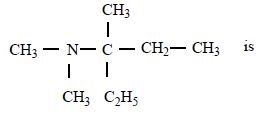
3 – Bimethylamino – 3 – methyl pentane
3 (N,N – Triethyl) – 3- amino pentane
3 – N,N – trimethyl pentanamine
N,N – dimethyl – 3- methyl - pentan - 3 amine
12.
Which of the following amines does not undergo acetylation?
t – butylamine
ethylamine
diethylamine
triethylamine
13.
14.
The product formed by the reaction an aldehyde with a primary amine ________.
carboxylic acid
aromatic acid
schiff ’s base
ketone
15.
The method by which aniline cannot be prepared is _________.
degradation of benzamide with Br2 / NaOH
potassium salt of phthalimide treated with chlorobenzene followed by hydrolysis with aqueous NaOH solution.
reduction of Nitrobenzene with LiAlH4
reduction of nitrobenzene by Sn / HCl
16.
Carboxylic acids have higher boiling points than aldehydes, ketones and even alcohols of comparable molecular mass. It is due to their ________.
more extensive association of carboxylic acid via van der Waals force of attraction
formation of carboxylate ion
formation of intramolecular H-bonding
formation of intermolecular H – bonding
17.
Which one of the following reaction is an example of disproportionation reaction.
Aldol condensation
cannizaro reaction
Benzoin condensation
none of these
18.
CH3Br \(\overset { KCN }{ \longrightarrow } (A)\overset { { H }_{ 2 }{ O }^{ + } }{ \longrightarrow } (B)\overset { { PCl }_{ 5 } }{ \longrightarrow } \) (C) product (c) is ______.
acetylchloride
chloro acetic acid
\(\alpha\)- chlorocyano ethanoic acid
none of these
19.
Predict the product Z in the following series of reactions Ethanoic acid \(\overset { { PCI }_{ 5 } }{ \longrightarrow } X\overset { { C }_{ 6 }{ H }_{ 6 } }{ \underset { Anhydrous \ AlCI }-_{3}{ \longrightarrow } } Y\overset { 1){ CH }_{ 3 }MgBr }{ \underset { II){ H }_{ 3 }{ O }^{ + } }{ \longrightarrow } } Z.\)
(CH3)2 C(OH)C6H5
CH3CH(OH)C6H5
CH3CH(OH)CH2- CH3

20.
Reaction of acetone with one of the following reagents involves nucleophilic addition followed by elimination of water. The reagent is _______.
Grignard reagent
Sn / HCl
hydrazine in presence of slightly acidic solution
hydrocyanic acid
21.
Among the following ethers which one will produce methyl alcohol on treatment with hot HI?
(H3C)3C-O-CH3
(CH3-)2-CH-CH2-O-CH3
CH3-(CH2)3-O-CH3
CH3-CH2-\(\underset { \overset { | }{ { CH }_{ 3 } } }{ CH } \)-O-CH3
22.
HO CH2 CH2 – OH on heating with periodic acid gives ______.
methanoic acid
Glyoxal
methanol
CO2
23.
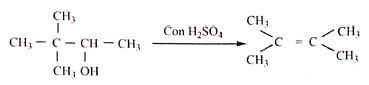
(CH3)3-C-CH(OH) CH3 \(\overset { con{ H }_{ 2 }{ SO }_{ 4 } }{ \longrightarrow } \)X (major product)
(CH3)3 CCH = CH2
(CH3)2C = C (CH3)2
CH2= C(CH3)CH2-CH2- CH3
CH2= C (CH3) - CH2- CH2- CH3
24.
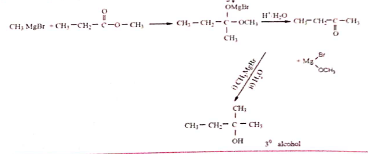
Which of the following compounds on reaction with methyl magnesium bromide will give tertiary alcohol.
benzaldehyde
propanoic acid
methyl propanoate
acetaldehyde
25.
Adsorption of a gas on solid metal surface is spontaneous and exothermic, then ______.
ΔH increases
ΔS increases
ΔG increases
ΔS decreases
26.
Statement : To stop bleeding from an injury, ferric chloride can be applied. Which comment about the statement is justified?
It is not true, ferric chloride is a poison.
It is true, Fe3+ ions coagulate blood which is a negatively charged sol
It is not true; ferric chloride is ionic and gets into the blood stream.
It is true, coagulation takes place because of formation of negatively charged sol with Cl-.
27.
A gas X at 1 atm is bubbled through a solution containing a mixture of 1MY- and 1MZ- at 25oC. If the reduction potential of Z>Y>X, then_____.
Y will oxidize X and not Z
Y will oxidize Z and not X
Y will oxidize both X and Z
Y will reduce both X and Z
28.
The number of electrons delivered at the cathode during electrolysis by a current of 1A in 60 seconds is ____. (charge of electron = 1.6 ×10⁻¹⁹C )
6.22 ×10²³
6.022 ×10²⁰
3.75 ×10²⁰
7.48 ×10²³
29.
The dissociation constant of a weak acid is 1 × 10⁻³. In order to prepare a buffer solution with a pH = 4, the [Acid]/[Salt] ratio should be _______.
4:3
3:4
10:1
1:10
30.
pH of a saturated solution of Ca(OH)2 is 9. The Solubility product (Ksp) of Ca(OH)2 _______.
0.5 × 10⁻¹⁵
0.25 × 10⁻¹⁰
0.125 × 10⁻¹⁵
0.5 × 10⁻¹⁰
31.
For the reaction \({ N }_{ 2 }{ O }_{ 5 }\left( g \right) \longrightarrow { 2NO }_{ 2 }\left( g \right) +\frac { 1 }{ 2 } { O }_{ 2 }\left( g \right) \) value of rate of disappearance of N2O5 is given as 6.5 x 10⁻² mol L-1s-1. The rate of formation of NO2 and O2 is given respectively as_____.
(3.25 x 10⁻² mol L-1s-1) and (1.3 x 10⁻² mol L-1s-1)
(1.3 x 10⁻² mol L-1s-1) and (3.25 x 10⁻² mol L-1s-1)
(1.3 x 10⁻¹ mol L-1s-1) and (3.25 x 10⁻² mol L-1s-1)
None of these
32.
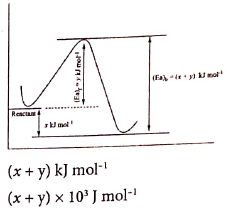
In a reversible reaction, the enthalpy change and the activation energy in the forward direction are respectively −x kJ mol-1 and y kJ mol-1. Therefore, the energy of activation in the backward direction is _______.
(y-x) kJ mol-1
(x+y) J mol-1
(x-y) KJ mol-1
(x+y) x 103J mol-1
33.
The radius of an atom is 300pm, if it crystallizes in a face centered cubic lattice, the length of the edge of the unit cell is ________.
488.5pm
848.5pm
884.5pm
484.5pm
34.
A zero order reaction X ⟶ Product, with an initial concentration 0.02M has a half life of 10 min. if one starts with concentration 0.04M, then the half life is
10 s
5 min
20 min
cannot be predicted using the given information
35.
Solid CO2 is an example of ________.
Covalent solid
metallic solid
molecular solid
ionic solid
36.
Formula of tris(ethane-1, 2-diamine)iron(II)phosphate _______.
[Fe(CH3-CH(NH2)2)3](PO4)3
[Fe(H2N-CH2-CH2-NH2)3](PO4)
[Fe(H2N-CH2-CH2-NH2)3](PO4)2
[Fe(H2N-CH2-CH2-NH2)3]3(PO4)2
37.
A magnetic moment of 1.73BM will be shown by one among the following.
TiCl4
[CoCl6]4-
[Cu(NH3)4]2+
[Ni(CN)4]2-
38.
The most common oxidation state of actinoids is _______.
+2
+3
+4
+6
39.
Permanganate ion changes to ________ in acidic medium.
MnO42−
Mn2+
Mn3+
MnO2
40.
The magnetic moment of Mn2+ ion is _______.
5.92BM
2.80BM
8.95BM
3.90BM
41.
The compound that is used in nuclear reactors as protective shields and control rods is _________.
Metal borides
metal oxides
Metal carbonates
metal carbide
42.
Which of these is not a monomer for a high molecular mass silicone polymer?
Me3SiCl
PhSiCl3
MeSiCl3
Me2SiCl2
43.
Among the following the correct order of acidity is ________.
HClO2 < HClO < HClO3 < HClO4
HClO4 < HClO2 < HClO < HClO3
HClO3 < HClO4 < HClO2 < HClO
HClO < HClO2 < HClO3 < HClO4
44.
Which one of the following compounds is not formed?
XeOF4
XeO3
XeF2
NeF2
45.
On hydrolysis, PCl3 gives________.
H3PO3
PH3
H3PO4
POCl3
46.
Which of the following metals has the largest abundance in the earth’s crust?
Aluminium
Calcium
Magnesium
Sodium
47.
Which of the following is not true with respect to Ellingham diagram?
Free energy changes follow a straight line. Deviation occurs when there is a phase change.
The graph for the formation of CO2 is a straight line almost parallel to free energy axis.
Negative slope of CO shows that it becomes more stable with increase in temperature.
Positive slope of metal oxides shows that their stabilities decrease with increase in temperature.
48.
49.
Which one of the following is not feasible
Zn(s) + Cu2+(aq) \(\rightarrow\) Cu(s) + Zn2+(aq)
Cu(s)+ Zn2+(aq)\(\rightarrow\) Zn(s) + Cu2+(aq)
Cu(s) + 2Ag+(ag)\(\rightarrow\) 2Ag(s) + Cu2+(aq)
Fe(s) + Cu2+(aq) \(\rightarrow\) Cu(s)+ Fe2+(aq)
50.
Which one of the following reaction represents calcinations?
\(2Zn+{ O }_{ 2 }\rightarrow 2ZnO\)
\(2ZnS+3O_{ 2 }\rightarrow 2ZnO+2SO_{ 2 }\)
\(MgCO_{ 3 }\rightarrow MgO+CO_{ 2 }\)
Both (a) and (c)
1.
(b)
PAN
2.
(a)
novestrol
3.
(c)
all cis-configuration
4.
(a)
antagonists
5.
(b)
Anomers
6.
(c)
Denaturation makes protein more active
7.
(c)
Cytosine and Thiamine
8.
(d)
the sugar component in RNA is ribose and the sugar component in DNA is 2’-deoxyribose
9.
(c)
DNA RNA Proteins
10.
(b)
Benzyl alcohol
11.
(d)
N,N – dimethyl – 3- methyl - pentan - 3 amine
12.
(d)
triethylamine
13.
(d)
14.
(c)
schiff ’s base
15.
(b)
potassium salt of phthalimide treated with chlorobenzene followed by hydrolysis with aqueous NaOH solution.
16.
(d)
formation of intermolecular H – bonding
17.
(b)
cannizaro reaction
18.

19.

20.
(c)
hydrazine in presence of slightly acidic solution
21.

22.
(c)
methanol
23.
(CH3)2C = C (CH3)2
24.
25.
ΔS is -ve
26.
(b)
It is true, Fe3+ ions coagulate blood which is a negatively charged sol
27.
Z is tie strongest oxidising agent (High SRP)
X is the strongest reducing agent (Low SRP)
28.
Q = It
= 1A x 60s = 60 C
96500 C charge = 6.023 x 10²³ electrons
60 C charge \(= \frac{6.023 \times 10^{23}}{96500}\times 60\)
= 3.744 x 10²⁰ electrons
29.
Ka = 1 × 10⁻³
pH = 4
[Acid]/[Salt] = ?
pH = pKa + log [Acid]/[Salt]
4 = -log10 (1 x 10⁻³) + log [Acid]/[Salt]
4 = 3 + log [Acid]/[Salt]
1 = log10 [Acid]/[Salt]
[Acid]/[Salt] = 101
i.e., [Acid]/[Salt] = 1/10
1 : 10
30.
Ca(OH)2 ⇌ Ca2+ + 2OH-
Given that pH = 9
pOH = 14 - 9 = 5
[pOH = - log10 [OH]]
[OH-] = 10 [pOH]
[OH] = 10-5 M
Ksp = [Ca2+] [OH-]
= 10-5/2 x (10-5)2 = 0.5 x 10⁻¹⁵
31.
Rate \(=\frac { d\left[ { N_2O_5 } \right] }{ dt } =\frac { 1 }{ 2 } =\frac { d\left[ { NO}_{ 2 } \right] }{ dt } =\frac { 2d\left[ { O }_{ 2 } \right] }{ dt } \)
Given that \(=\frac { d\left[ { N_2O_5 } \right] }{ dt } \) =6.5 x 10⁻² mol L-1 s-1
\(=\frac { d\left[ { NO}_{ 2 } \right] }{ dt }\) =2 x 6.5 x 10-2 = 1.3 x 10⁻¹ mol L-1 s-1
\(=\frac { d\left[ { O}_{ 2 } \right] }{ dt }\)\(=\frac{6.5 \times 10^{-2}}{2}\) = 3.25 x 10⁻² mol L-1s-1
32.
33.
let edge length = a
\(\sqrt{2a} = 4r\)
\(a = \frac{4 \times 300}{\sqrt {2}}\)
a = 600 x 1.414
a = 848.4 pm
34.
for n ≠ 1 t1/2 = \(\frac{2^{n-1} -1}{(n- 1) k[A_{0}]^{-1}}\)
for n = 0; t1/2 = \(\frac{1}{2 k[A_{0}]^{-1}}\)
t1/2 = \(\frac{[A_{0}]}{2 k}\)
t1/2 α [A0] ...(1)
Given [A0] = 0.002 M; t1/2 = 10 min
[A0] = 0.04M; t1/2 = ?
Substitute in (1)
10 min α 0.02 M...(2)
t1/2 α 0.04M ....(3)
(3)(2)
⇒ t1/2 / 10 min
= 0.04 M/0.02 M
t1/2 = 2 x 10 min = 20 min
35.
Lattice points are occupied by CO2 molecules
36.
[Fe(H2N-CH2-CH2-NH2)3]3(PO4)2
[Fe(en)3]2+(\(PO_{4}^{3-}\))
37.
Ti4+ (d0 ⇒ 0BM)
Co2+ (d7 spain free ⇒ t2g5, e2g; n = 3; μ = 3.9BM)
Cu2+ (d9 Low spain ⇒ t2g6, e3g; n = 1; μ = 1.732BM)
Ni2+ (d8 Low spain ⇒ t2g6, e2g; n = 2; μ = 2.44 BM)
38.
(b)
+3
39.
MnO-4 + 8H+ + 5e- → Mn2+ + 4H2O
40.
Mn2+ ⇒ 3d5 contains 5 unpaired electrons
n = 5,
\( \sqrt{n(n+ 2)} \) BM
\(= \sqrt{5(5+ 2)} = \sqrt{35} = 5.92 BM\)
41.
(a)
Metal borides
42.
(a)
Me3SiCl
43.
(d)
HClO < HClO2 < HClO3 < HClO4
44.
(d)
NeF2
45.
(a)
H3PO3
46.
(a)
Aluminium
47.
(b)
The graph for the formation of CO2 is a straight line almost parallel to free energy axis.
48.
(c)
49.
(b)
Cu(s)+ Zn2+(aq)\(\rightarrow\) Zn(s) + Cu2+(aq)
50.
(c)
\(MgCO_{ 3 }\rightarrow MgO+CO_{ 2 }\)

12th Standard Syllabus & Materials
12th Standard
TN 12th Computer Applications வலையமைப்பு வடமிடல் Sample Question Papers Study Material - QB365 Set A
NEW12th Standard
TN 12th Computer Applications களப்பெயர் முறைமை (DNS) Sample Question Papers Study Material - QB365 Set A
NEW12th Standard
TN 12th Computer Applications வலையமைப்பு எடுத்துக்காட்டுகள் மற்றும் நெறிமுறைகள் Sample Question Papers Study Material - QB365 Set A
NEW12th Standard
TN 12th Computer Applications கணினி வலையமைப்பு ஓர் அறிமுகம் Sample Question Papers Study Material - QB365 Set A



Tamilnadu Stateboard 12th Standard Subjects

Maths
Chemistry

Physics

Biology

Computer Science

Business Maths and Statistics

Economics

Commerce

Accountancy

History

Computer Applications
Biology
Computer Technology
Computer Applications
Computer Science
Business Maths and Statistics
Commerce
Economics
Maths
Chemistry
Physics
Computer Technology
History
Accountancy

Tamil

English

French
Tamilnadu Stateboard Standards
