
 100% FREE ACCESS
12th Standard Syllabus & Materials
12th Standard
TN 12th Computer Applications மின்னணு தரவு பரிமாற்றம் Sample Question Papers Study Material - QB365 Set A
NEW12th Standard
TN 12th Computer Applications மின் - வணிக பாதுகாப்பு அமைப்புகள் Sample Question Papers Study Material - QB365 Set A
NEW12th Standard
TN 12th Computer Applications மின்னணு செலுத்தல் முறைகள் Sample Question Papers Study Material - QB365 Set A
NEW12th Standard
TN 12th Computer Applications மின் - வணிகம் Sample Question Papers Study Material - QB365 Set A
NEW12th Standard
TN 12th Computer Applications திறந்த மூல கருத்துருக்கள் Sample Question Papers Study Material - QB365 Set A
NEW12th Standard
TN 12th Computer Applications வலையமைப்பு வடமிடல் Sample Question Papers Study Material - QB365 Set A

Published on: 27/02/2021
12th Standard English Medium Chemistry Reduced Syllabus Public Exam Model Question Paper - 2021
Download Tamil Nadu 12th Standard Chemistry question papers, model tests, one-mark questions, important questions, and public exam papers in PDF format. Free study materials and answer keys for TN State Board students.
Questions + Answers key
Take MCQ Chemistry Test
1.
CH3NO2+6[H] \(\underrightarrow { X? } \) CH3NH2+2H2O. 'X' is
Sn/HCI
Zn/NH4CI
Glucose + NaOH
Na3A5O3/NaOH
2.
Carbohydrates are
polyhydroxy aldehydes
polyhydroxy ketones
polyhydroxy acids
both (a) and (b)
3.
1 mho is equal to ______.
1 siemen
1 second
1 ohm
none of the above
4.
The conjugate base of HCIO is ________.
ClO-
Cl-
H2ClO+
CIO
5.
1-Propanol and 2- propanol can be best distinguished by ______.
oxidation with KMnO4 followed by reaction with Fehling solution
oxidation with acidic dichromate followed by reaction with Fehling solution
oxidation by heating with copper followed by reaction with Fehling solution
oxidation with concentrated H2SO4 followed by reaction with Pehling solution
6.
7.
Which one of the following characteristics are associated with adsorption?
\(\Delta\)G and \(\Delta\)H are negative but \(\Delta\)S is positive
\(\Delta\)G and \(\Delta\)S are negative but \(\Delta\)H is positive
\(\Delta\)G is negative but \(\Delta\)H and \(\Delta\)S are positive
\(\Delta\)G, \(\Delta\)H and \(\Delta\)S all are negative.
8.
Which of the following can act as Lowery – Bronsted acid well as base?
HCl
SO42−
HPO42−
Br-
9.
Pick the wrong one among the following
F2 - Yellow
Br2 - Red
Cl2 - Colourless
I2- Violet
10.
Schottky defects contains _______.
Cation vacancies only
Cation vacancies and interstitial cations
Equal number of cation and anion vacancies
Anion vacancies and interstitial anions
11.
Name the process by which elements such as germanium, silicon and gallium are refined.
Vapour phase method
Electrolytic refining
Zone refining
Van-Arkel method
12.
In a homogeneous reaction A⟶B+C+D, the initial pressure was P0 and after time t it was P expression for rate constant in terms of P0, P and t will be _____.
\(k=\left( \frac { 2.303 }{ t } \right) \log\left( \frac { 2{ P }_{ 0 } }{ { 3P }_{ 0 }-P } \right) \)
\(k=\left( \frac { 2.303 }{ t } \right) \log\left( \frac { { 2P }_{ 0 } }{ { P }_{ 0 }-P } \right) \)
\(k=\left( \frac { 2.303 }{ t } \right) \log\left( \frac { 3{ P }_{ 0 }-P }{ 2P_{ 0 } } \right) \)
\(k=\left( \frac { 2.303 }{ t } \right) \log\left( \frac { 2{ P }_{ 0 } }{ { 3P }_{ 0 }-2P } \right) \)
13.
Which one of the following will give a pair of enantiomorphs?
[Cr(NH3)6][Co(CN)6]
[Co(en)2Cl2]Cl
[Pt(NH3)4][PtCl4]
[Co(NH3)4Cl2]NO2
14.
Among the transition metals of 3d series, the one that has highest negative \(\left( \frac { M^{ 2+ } }{ M } \right) \) standard electrode potential is _______.
Ti
Cu
Mn
Zn
15.
The geometry at which carbon atom in diamond are bonded to each other is _______.
Tetrahedral
hexagonal
Octahedral
none of these
16.
What is a electro chemical cell?
17.
What is the action of HCN on
(i) propanone
(ii) 2,4-dichlorobenzaldehyde
iii) ethanal
18.
What happens when a colloidal sol of Fe(OH)3 and As2S3 are mixed?
19.
20.
The decomposition reaction of ammonia gas on platinum surface has a rate constant R = 2.5 x 10⁻⁴mol L-1. What is the order of the reaction.
21.
Although \(\triangle\)H of fluorine is less negative than that of chlorine, but fluorine is a stronger oxidising agent than chlorine, why?
22.
Discuss the process of roasting with suitable example.
23.
Define coordination number.
24.
25.
What are point defects?
26.
Write a note on zeolites.
27.
What is catenation ? describe briefly the catenation property of carbon.
28.
An organic compound 'A' on reduction gives compound 'B' which on reaction with trichloromethane and caustic potash forms 'C'. Compound 'C' on catalytic reduction given N-methyl benzenamine. Identify A, B and C and write the reactions involved.
29.
Name two water soluble vitamins, their sources, function and diseases caused due to their deficiency in diet.
30.
Write the preparation of neoprene and give its use.
31.
Halo alkane are easily prepared from alcohols while alkyl halides cannot be prepared from phenol. Justify.
32.
Write the electrochemical cell for the overall cell reaction.
Zn(S)+2AgNO3 ⟶ 2Ag(S) +Zn(NO3)2
33.
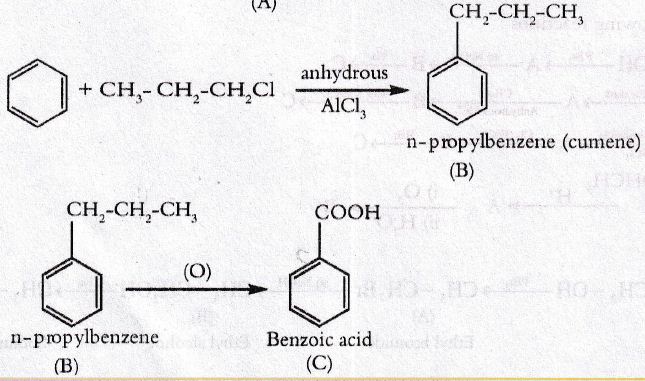
Phenol is distilled with Zn dust followed by friedel – crafts alkylation with prophyl chloride to give a compound B, B on oxidation gives (c) Indentify A,B and C.
34.
Suggest a suitable reagent to prepare secondary alcohol with identical group using Grignard reagent.
35.
Solubility product of Ag2CrO4 is \(1\times10^{-12}\). What is the solubility of Ag2CrO4 in 0.01M AgNO3 solution?
36.
Explain the oxidising property of KMnO4 in alkaline medium.
37.
What is coupling of reaction? How is it useful in metallurgy?
38.
An organic compound (A) with molecular formula C3H6O undergoes iodoform reaction. Two molecules of compound (A) react with dry HCI to give compound (B) (C6H10O). Compound (B) reacts with one more molecule of compound (A) to give compound (C) (C9H14O). Identify (A), (B) and (C). Explain the reactions.
39.
Write a note on phase transfer catalysis.
40.
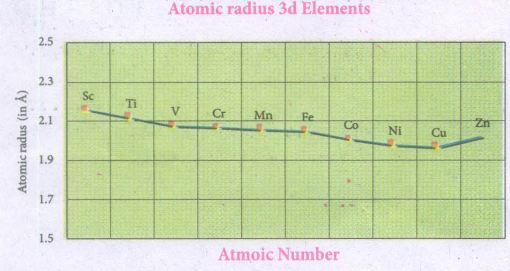
Why is there a variation of atomic and ionic size as we move from Sc to Zn?
41.
Explain the structure of inter halogen compounds
42.
Write note on impurity defect?
43.
What is meant by stability of a co-ordination compound in solution? State the factors which govern stability of complexes.
1.
(a)
Sn/HCI
2.
(d)
both (a) and (b)
3.
(a)
1 siemen
4.
(a)
ClO-
5.
(c)
oxidation by heating with copper followed by reaction with Fehling solution
6.
(d)
7.
Adsorption leads to decrease in randomnes (entropy).i.e, ΔS < 0 for the adsorption to occur, ΔG slhould be -ve. We know that ΔG = ΔH - TΔS if ΔS is -ve, TΔS is +ve.It means that ΔG will become negative only when ΔH is -ve and ΔH > TΔS.
8.
HPO42− can have the ability to accept a proton to form H2PO4-
It can also have the ability to donate a proton to form PO4-3
9.
(c)
Cl2 - Colourless
10.
(c)
Equal number of cation and anion vacancies
11.
(c)
Zone refining
12.
| A | ⟶ | B | C | D | |
| Initial rate (M s-1) | a | 0 | 0 | 0 | |
| Reaction number | x | - | - | - | - |
| After time t | (a - x) | x | x | x | |
| Total number of moles | = (a + 2x) |
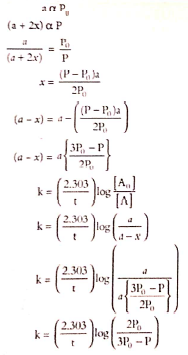
13.
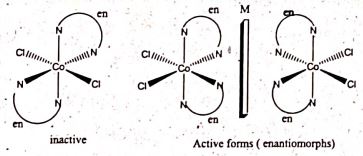
Complexes given in other options (a), (c) and (d) have symmetry elements and hence they are optically inactive.
14.
(a)
Ti
15.
(a)
Tetrahedral
16.
Electrochemical cell is a device which interconverts chemical into electrical energy and vice versa. It consists of two separate electrodes which are in contact with an electrolyte solution.
17.
.JPG)
(ii) 2,4-dichlorobenzaldehyde.
.JPG)
(iii) ethanal
.JPG)
18.
(i) Neutralisation of chargers of ion will taken place and hence precipitation will take place (ie) Fe3+ and S2- ion changes are neutralized. No new compounds are formed.
(ii) Fe(OH)3 is a positive Sol
(iii) As2S3 is a negative Sol
19.
20.
The order of the reaction is zero.
21.
This is due to,
(i) Lowbond dissociation enthalpy of F-F-bond
(ii) High hydration enthalpy of F-.
22.
Sulphide ores are generally roasted in reverberatory furnace in free supply of air below its melting point. Ore changes to oxide with larger surface area and volatile impurities are removed.
\(2ZnS+{ 3O }_{ 2 }\overset { \Delta }{ \longrightarrow } 2ZnO+{ 2SO }_{ 2 }\)
\(2PbS+{ 3O }_{ 2 }\overset { \Delta }{ \longrightarrow } pbO+{ 2SO }_{ 2 }\)
23.
Coordination number is the number of co-ordinate bonds formed by the ligands with the central metal atom.
24.
25.
The imperfection occurs due to missing atoms, displaced atoms or extra atoms, is named as a point defect. Such defects arise due to imperfect packing during the original crystallisation or they may arise from thermal vibrations of atoms at elevated temperatures.
26.
(i) Zeolites are three-dimensional crystalline solids containing Al, Si and O in their regular three dimensional framework.
(ii) They are hydrated sodium alumino silicates with general formula Na2O(AI2O3).·x(SiO2)·yH2O
(x = 2 to 10; y = 2 to 6).
(iii) Zeolites have porous structure in which the monovalent sodium ions and water molecules are loosely held.
(iv) The Si and Al atoms are tetrahedrally coordinated with each other through shared oxygen atoms.
(v) Zeolites are similar to clay minerals but they differ in their crystalline structure.
(vi) Zeolites have a three dimensional crystalline structure looks like a honeycomb consisting of a network of interconnected tunnels and cages.
(vii) Water molecules moves freely in and out of these pores but the zeolite framework remains rigid
(viii) Another special aspect of this structure is that the pore/channel sizes are nearly uniform, allowing the crystal to act as a molecular sieve.
27.
Catenation is an ability of an element to form chain of atoms.
The conditions for catenation.
(a) The valency of element is greater than or equal to two.
(b) Element should have an ability to bond with itself
(c) The self bond must be as strong as Its bond with other elements
(d) Kinetic inertness of catenated compound towards other molecules.
(e) Carbon possesses all the above properties and forms a wide range of compounds with itself and with other elements such as H, O, N, S and halogens.
28.
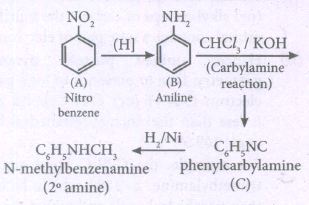
(i) A - C6H5NO2 - Nitro benzene
(ii) B - C6H5NH2 - Aniline
(iii) C - C6H5NC - Phenyl Carbylamine
29.
| Vitamin | Sources | Functions | Deficiency Disease |
|---|---|---|---|
|
Vitamin B12 |
Egg, Meat, Fish | Co-enzyme in amino acid metabolism, Red blood cells maturation | Pernicious Anaemia |
| Vitamin C (Ascorbic acid) | Citrus fruits (Orange, Lemon etc ... ), Tomato Arnla, Leafy Vegetables | Coenzyme in Antioxidant, building of collagen | Scurvy (bleeding gums) |
30.
The free radical polymeristion of the monomer, 2-c Woro buta -1,3-diene( chloroprene) gives neoprene.

It is superior to rubber and resistant to chemical action.
Uses: It is used in the manufacture of chemical containers, conveyer belts
31.
(i) Alcohols are weakly basic in nature so easily in presence of strong acids.
(ii) Due to the presence of +ve charge on the oxygen atom, C-O in protonated alcohols became weak hence easily cleaved by halide ions to form alkyl halides.
(iii) Where as phenols are much weaker bases due to delocalisation of the lone pair of electrons on the oxygen atom due to resonance and so are not easily protonated.
(iv) The C-O bond in phenols has some double bond character; hence not easily cleaved by halide ions to form respective alkyl halides.
32.
Zn(S)+2AgNO3 ⟶ 2Ag(S) +Zn(NO3)2
Zn(s)|Znaq 2+||Agaq+|Ag(s)
Anode Half cell Cathode Half cell
In this cell reaction, Zn is oxidised to Zn2+ and Ag2+ is reduced to Ag.
33.
\(\underset {Phenol} {\mathrm{C}_{6} \mathrm{H}_{5} \mathrm{OH}}+\mathrm{Zn}(\text { dust }) \rightarrow \underset {benzene(A)} {\mathrm{C}_{6} \mathrm{H}_{6}}+\mathrm{ZnO}\)
34.
Acetaldehyde - CH3-CHO
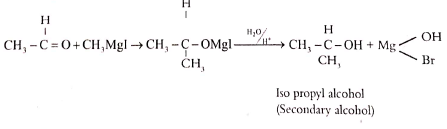
35.
\(\mathrm{Ag}_{2} \mathrm{CrO}_{4(\mathrm{~s})} \rightleftharpoons 2 \mathrm{Ag}_{(\mathrm{aq})}^{+}+\mathrm{CrO}_{4{(\mathrm{aq})}}^{2-}\\ \quad s \quad \quad \quad \quad \quad 2s \quad \quad \quad \quad s\)
\(\left[\mathrm{Ag}^{+}\right]=2 \mathrm{~s}+0.01 \)
\(\simeq 0.01 \)
\((\because 2 s<<0.01) \)
\(\left[\mathrm{CrO}_{4}^{2-}\right]=\mathrm{S} \)
\(\mathrm{AgNO}_{3(\mathrm{~s})} \rightleftharpoons \mathrm{Ag}_{(\mathrm{aq})}^{+}+\mathrm{NO}_{3_{(\mathrm{aq})}}^{-}\\ 0.01M \quad \quad 0.01M \quad \quad 0.01M \quad\)
\(\mathrm{K}_{\mathrm{sp}}=\left[\mathrm{Ag}^{+}\right]^{2}\left[\mathrm{CrO}_{4}^{2-}\right] \)
\(1 \times 10^{-12}=(0.01)^{2}(\mathrm{~s}) \)
\(\mathrm{S}=\frac{1 \times 10^{-12}}{10^{-4}}=1 \times 10^{-8} \mathrm{M}\)
36.
In acid medium:
In the presence of dilute sulphuric acid, potassium permanganate acts as a very strong oxidising agent. Permanganate ions is converted into Mn2+ ion.
MnO4- + 8H+ + 5e- ⟶ Mn2+ + 4H2O
The oxidising nature of potassium permanganate (permanganate ion) in acid medium is illustrated in the following examples.
It oxidises ferrous salts to ferric salts.
2MnO4 + 10Fe2++ 16H+ ⟶ 2Mn2+ + 10Fe3+ + 8H2O
37.
(i) If value of \(\triangle\)G is fur any reaction then to make such reaction spontaneous it is coupled with another reaction of large negative \(\triangle\)G value, so that the sum of two \(\triangle\)G becomes negative. This is known as coupling of reaction.
(ii) In the metallurgy, thermodynamically infeasible reaction is coupled with a reaction which has more negative G, so that net \(\triangle\)G become negative.
38.
(i) Compound (A) with molecular formula C3H6O that undergoes iodoform reaction is CH3COCH3 (A) (acetone).
(ii) Two molecules of (A) react with dry HCl to give compound (B).

(iii) Compound (B) reacts with (A) to give compound (C).
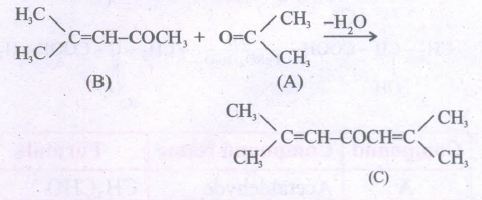
| Compound | Compound Name | Formula |
| A | Acetone | 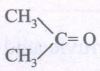 |
| B | Mesityl oxide | 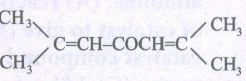 |
| C | Phorone | 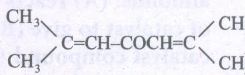 |
39.
(i) Suppose the reactant of a reaction is present in one solvent and the other reactant is present in an another solvent.
(ii) The reaction between them is very slow, if the solvents are immisible.
(iii) As the solvents from separate phases the reactants have to migrate across the boundary to react.
(iv) But migration of reactants across the boundary is not easy. For such situations a third solvent is added which is miscible with both.
(v) So, the phase boundary is eliminated reactants freely mix and react fast.
(vi) But for large scale production of any product, use of a third solvent is not convenient as it may be expensive.
(vii) For such problems phase transfer catalysis provides a simple solution, which avoides the use of solvents.
(viii) It directs the use a phase transfer catalyst (a phase transfer reagent) to facilitate transport of a reactant in one solvent to the other solvent where the second reactant is present.
(ix) As the reactants are now brought together they rapidly react and form the product.
40.
(i) It is generally expected a steady decrease in atomic radius along a period as the nuclear charge increases and the extra electrons are added to the same sub shell.
(ii) But for the 3d transition elements, the expected decrease in atomic radius is observed from Sc to V, thereafter up to Cu the atomic radius nearly remains the same.
(iii) As we move from Sc to Zn in 3d series the extra electrons are added to the 3d orbitals, the added 3d electrons only partially shield the increased nuclear charge and hence the effective nuclear charge increases slightly.
(iv) However, the extra electrons added to the 3d sub shell strongly repel the 4s electrons and these two forces are operated in opposite direction and as they tend to balance each other, it leads to constancy in atomic radii.
(v) At the end of the series, d - orbitals of Zinc contain 10 electrons in which the repulsive interaction between the electrons is more than the effective nuclear charge and hence, the orbitals slightly expand and atomic radius slightly increases.
41.
| TYPE | EXAMPLE | SHAPE | DIAGRAM | HYBRIDISATION |
|---|---|---|---|---|
| AX | ClF | Linear |  |
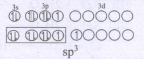 |
| AX3 | ClF3 | Bipyramidal (without lone pair it is T-shaped) |
 |
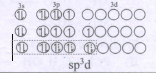 |
| AX5 | IF5 | Octahedral (without lone pair it is square pyramidal) |  |
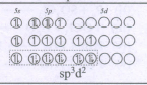 |
| AX7 | IF7 | Pentagonal bipyramidal |  |
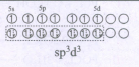 |
42.
(i) The defects in ionic solids is by adding impurity ions.
(ii) If the impurity ions are in different valance state from that of host, vacancies are created in the crystal lattice of the host.
(iii) For example, addition of CdCl2 to silver chloride yields solid solutions where the divalent cation Cd2+ occupies the position of Ag+.
(iv) This will disturb the electrical neutrality of the crystal.
(v) In order to maintain the same, proportional number of Ag+ ions leaves the lattice.
(vi) This produces a cation vacancy in the lattice, such kind of crystal defects are called impurity defects.
43.
The stability of a complex or co-ordination compound refers to the extent up to which it exists in a solution as co-ordination sphere.
(i) Change on the central metal ion: Greater the charge on the central metal ion, greater the stability of complex.
(ii) Nature of the metal ion: Group 3 and 6 and inner transition elements form stable complexes when donor atoms of the ligands are N, O and F. The elements after group 6 of the transition metals form stable complex when the donor atoms of the ligands are the heavier members of N, O and F family.
(iii) Basic nature of the ligands: Greater the basic strength, greater is the stability of the complex.
(iv) Presence of chelate rings: Its presence increases the stability of the complex. it is called chelate effect. It is maximum for the 5 and 6 membered rings.
(v) Effect of multidentate cyclic ligand: If the ligands are IT multidentate and cyclic without any steric effect the stability of the complex get increased.

12th Standard Syllabus & Materials
12th Standard
TN 12th Computer Applications களப்பெயர் முறைமை (DNS) Sample Question Papers Study Material - QB365 Set A
NEW12th Standard
TN 12th Computer Applications வலையமைப்பு எடுத்துக்காட்டுகள் மற்றும் நெறிமுறைகள் Sample Question Papers Study Material - QB365 Set A
NEW12th Standard
TN 12th Computer Applications கணினி வலையமைப்பு ஓர் அறிமுகம் Sample Question Papers Study Material - QB365 Set A
NEW12th Standard
TN 12th Computer Applications PHP-உடன் MySQL-ஐ இணைத்தல் Sample Question Papers Study Material - QB365 Set A



Tamilnadu Stateboard 12th Standard Subjects

Maths
Chemistry

Physics

Biology

Computer Science

Business Maths and Statistics

Economics

Commerce

Accountancy

History

Computer Applications
Biology
Computer Technology
Computer Applications
Computer Science
Business Maths and Statistics
Commerce
Economics
Maths
Chemistry
Physics
Computer Technology
History
Accountancy

Tamil

English

French
Tamilnadu Stateboard Standards
