
 100% FREE ACCESS
12th Standard Syllabus & Materials
12th Standard
TN 12th Computer Applications மின்னணு தரவு பரிமாற்றம் Sample Question Papers Study Material - QB365 Set A
NEW12th Standard
TN 12th Computer Applications மின் - வணிக பாதுகாப்பு அமைப்புகள் Sample Question Papers Study Material - QB365 Set A
NEW12th Standard
TN 12th Computer Applications மின்னணு செலுத்தல் முறைகள் Sample Question Papers Study Material - QB365 Set A
NEW12th Standard
TN 12th Computer Applications மின் - வணிகம் Sample Question Papers Study Material - QB365 Set A
NEW12th Standard
TN 12th Computer Applications திறந்த மூல கருத்துருக்கள் Sample Question Papers Study Material - QB365 Set A
NEW12th Standard
TN 12th Computer Applications வலையமைப்பு வடமிடல் Sample Question Papers Study Material - QB365 Set A

Published on: 27/02/2021
12th Standard English Medium Chemistry Reduced Syllabus Public Exam Model Question Paper with Answer key - 2021
Download Tamil Nadu 12th Standard Chemistry question papers, model tests, one-mark questions, important questions, and public exam papers in PDF format. Free study materials and answer keys for TN State Board students.
Questions + Answers key
Take MCQ Chemistry Test
1.
Electrolytic reduction of nitrobenzene in strongly acidic medium gives
aniline
p - aminophenol
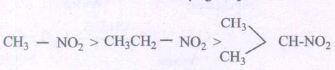
m-nitroaniline
azoxybenzene
2.
Denaturation does not involve
breaking up of H-bonding in proteins
the loss of biological action of enzyme
the loss of secondary structure
loss of primary structure of proteins
3.
Using the data given below find out the strongest reducing agent ______.
\({ E }_{ { Cr }_{ 2 }{ O }_{ 7 }^{ 2- } }^{ o }{ Cr }^{ 3+ }=1.33V{ ,E }_{ { Cl }_{ 2 }{ / }{ Cl }^{ - } }^{ o }=1.36V\)
\({ E }_{ { Mn }O_{ 4 }^{ - } }^{ 0 }/{ Mn }^{ 2+ }=1.51V,{ E }_{ { Cr }^{ 3+ }/Cr }^{ o }=-0.74V\)
Cr
Cr3+
Cl-
Mn2+
4.
The common name for 4-hydroxy toluene is ________.
p-cresol
m-cresol
resoricinol
catechol
5.
An aqueous solution with pH value zero is _______.
acidic
basic
amphoteric
neutral
6.
If x is the amount of adsorb ate and m is the amount of adsorbent, which of the following relations is not related to adsorption process?
x/m = f(P) at constant T
x/m = f(T) at constant P
P = f(T) at constant x/m
x/m = PT
7.
MY and NY3, are insoluble salts and have the same Ksp values of 6.2 × 10⁻¹³ at room temperature. Which statement would be true with regard to MY and NY3?
The salts MY and NY3 are more soluble in 0.5M KY than in pure water
The addition of the salt of KY to the suspension of MY and NY3 will have no effect on their solubility’s
The molar solubility of MY and NY3 in water are identical
The molar solubility of MY in water is less than that of NY3
8.
The ionisation energy of Ga is higher than that of Al because of_________
more effective nuclear charge of Ga
smaller atomic size of Ga
larger size of Ga
both (a) and (b)
9.
Iodine crystals are ________.
covalent
ionic
metallic
molecular
10.
The blistered appearance of Cu obtained from the reverberatory furnace is due to evolution of________.
CO2 gas
SO2 gas
NO2
Due to evaporation of volatile materials
11.
The addition of a catalyst during a chemical reaction alters which of the following quantities?
Enthalpy
Activation energy
Entropy
Internal energy
12.
13.
The magnetic moment of Mn2+ ion is _______.
5.92BM
2.80BM
8.95BM
3.90BM
14.
The repeating unit in silicone is_______.
SiO2
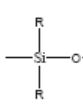
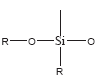
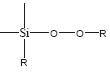
15.
Define conductance. Give its unit
16.
How will you convert benzaldehyde into the following compounds?
(i) benzophenone
(ii) benzoic acid
(iii) α-hydroxyphenylaceticacid.
17.
What happens when a colloidal sol of Fe(OH)3 and As2S3 are mixed?
18.
A lab assistant prepared a solution by adding a calculated quantity of HCl gas 250C to get a solution with [H3O+] = 4\(\times\)10-5M. Is the solution neutral (or) acidic (or) basic.
19.
For the reaction Cl2 (g) + 2NO (g) ⟶ 2NOCI(g)
The rate law is expressed as rate = K[Cl2] [NO]2
What is the overall order of this reaction?
20.
How would you account for the following? The electron gain enthalpy with negative sign is less for oxygen than that of sulphur.
21.
What are anionic & cationic complex? Give an example.
22.
Give the structure of CO and CO2.
23.
Write a note on acidic nature of nitro alkanes.
24.
Write the monomers of the following sugars and explain how they are linked.
(i) Sucrose
(ii) Maltose
(iii) Lactose
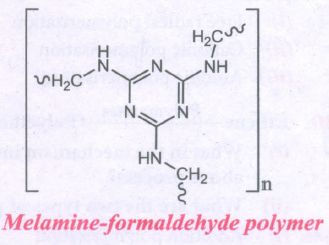
25.
Give the structure of melamine formaldehyde resin.
26.
What are the oxidation products of glycerol?
27.
Show that SHE can act both as a anode as well as cathode.
28.
What is the pH of an aqueous solution obtained by mixing 6 gram of acetic acid and 8.2 gram of sodium acetate and making the volume equal to 500 ml. (Given: Ka for acetic acid is \(1.8\times10^{-5}\))
29.
Draw the major product formed when 1-ethoxyprop-1-ene is heated with one equivalent of HI.
30.
Give reason for the following:
(i) Compounds of transition elements are generally coloured,
(ii) MnO is basic while Mn2O7 is acidic.
(iii) Calculate the magnetic moment of a divalent ion in aqueous medium if its atomic number is 26.
31.
What is vapour phase method?
32.
Give any three characteristics of ionic crystals.
33.
A hydride of 2nd period alkali metal (A) on reaction with compound of Boron (B) to give a reducing agent (C). Identify A, B and C.
34.
How does NH3 react with the following?
(i) HCHO
(ii) CH3CHO
(iii) C6H5CHO
(iv) CH3COCH3
35.
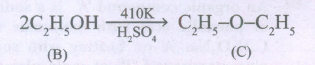
An organic compound (A) molecular formula CH2O reacts with CH3MgI to give compound (B). Compound (B) liberates Hydrogen with metallic sodium. Compound (B) in the presence of Con. H2SO4 at 410 K on dehydration to give compound (C) molecular formula C4H10O. Identify (A), (B) and (C). Explain the above reactions.
36.
Write the characteristics of catalysts.
37.
How are materials classified based on their magnetic properties?
38.
Explain the structure of inter halogen compounds
39.
An element with molar mass 2.7 x 10⁻² kg mol forms a cubic unit cell with edge length 405 pm. If its density is 2.7 x 10³ kg m-3, What is the nature of the cubic unit cell?
40.
For the complex [NiCI4]2- write (i) the IUPAC name (ii) The hybridisation type (iii) The shape of the complex
41.
The time for half change in a first order decomposition of a substance A is 60 seconds. Calculate the rate constant. How much of A will be left after 180 seconds?
42.
Assertion: p – N, N – dimethyl amino benzaldehyde undergoes benzoin condensation
Reason: The aldehydic (-CHO) group is meta directing.
Codes:
A) if both assertion and reason are true and reason is the correct explanation of assertion.
B) if both assertion and reason are true but reason is not the correct explanation of assertion.
C) assertion is true but reason is false
D) both assertion and reason are false
if both assertion and reason are true and reason is the correct explanation of assertion.
if both assertion and reason are true but reason is not the correct explanation of assertion.
assertion is true but reason is false
both assertion and reason are false
1.
(b)
p - aminophenol
2.
(d)
loss of primary structure of proteins
3.
(a)
Cr
4.
(a)
p-cresol
5.
(a)
acidic
6.
(d)
x/m = PT
7.
Addition of salt KY (having a common ion Y-) decreases the solubility of MY and NY3 due to common ion effect.
Option (a) and (b) are wrong
For salt MY, MY ⇌ M+ + Y-
Ksp = (s) (s)
6.2 × 10-13 = s2
\(\therefore\) s = \(\sqrt{6.2 \times 10^{-13}} = 10^{-7}\)
For salt NY3,
NY3 ⇌ N3+ + 3Y-
Ksp = (s) (3s)3
Ksp = 27s4
\(s = (\frac{6.2 \times 10^{-13}}{27})^{1/4}\)
s = 10-4
The molar solubility of MY in water is less than of NY3
8.
(d)
both (a) and (b)
9.
(d)
molecular
10.
(b)
SO2 gas
11.
A catalyst provides a new path to the reaction with low activation energy. i.e., it lowers the activation energy.
12.
(d)
13.
Mn2+ ⇒ 3d5 contains 5 unpaired electrons
n = 5,
\( \sqrt{n(n+ 2)} \) BM
\(= \sqrt{5(5+ 2)} = \sqrt{35} = 5.92 BM\)
14.
(b)
15.
The reciprocal of the resistance \((\frac{l}{R})\) gives the conductance of an electrolytic solution. The SI unit of conductance is Siemen (S).
16.
.JPG)
(ii) benzoic acid
.JPG)
(iii) α - hydroxyphenylaceticacid.
.JPG)
17.
(i) Neutralisation of chargers of ion will taken place and hence precipitation will take place (ie) Fe3+ and S2- ion changes are neutralized. No new compounds are formed.
(ii) Fe(OH)3 is a positive Sol
(iii) As2S3 is a negative Sol
18.
[H3O+] = 4 \(\times\) 10-5M
pH = - log10[H3O+]
pH=-log10[4 \(\times\) 10-5]
pH = -log10[4] - log10[10-5] log10 10 = 1
pH = -log 4 + 5log1010
= 5 - log 4
= 5 - 0.6021
=4.3979
Since pH is less than 7, the solution is acidic.
19.
Overall order of this reaction = 1+ 2 = 3
20.
(i) The electron gain enthalpy for oxygen is less negative because of its small size due to which the electron repulsions in the relatively small 2p-subshell are comparatively large.
(ii) Hence the Incoming electrons are not accepted with the same ease as in case of sulphur as it has relatively large size.
21.
(i) An anionic complex compound contains a complex anion and simple cation.
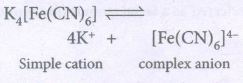
(ii) A cationic complex contains complex cation and simple anion
.JPG)
22.
| Oxides of Carbon | Structure | Parameters |
| CO |  |
Three electron pairs are shared between carbon and oxygen. The C-O bond distance is 1.128\(\overset{o}{A}\). |
| CO2 |  |
Equal bond distance for the both C-O bonds. Two C-O sigma bond, It has 3c-4e bond. |
23.
Acidic nature of nitro alkanes:
(i) The α -H atom of 10 & 20 nitroalkanes show acidic character because of the eIectron with drawing effect of NO2 group.
(ii) These are more acidic than aldehydes, ketones, ester and cyanides.
(iii) Nitroalkanes dissolve in NaOH solution to form a salt.
(iv) Aci - nitro derivatives are more acidic than nitro form.
(v) When the number of alkyl group attached to α carbon increases, acidity decreases, due to +1 effect of alkyl groups
24.
(i) Sucrose: D - glucose and D - fructose linked by α. - 1, 2 glycosidic bond.
(ii) Maltose: Two molecules of α. - D - glucose linked by α. - 1, 4 glycosidic bond.
(iii) Lactose: f3 - D - glucose and f3 - D galactose linked by β - 1, 4 glycosidic bond
25.
26.
Glycerol can give rise to a variety of oxidation products depending on the nature of the oxidising agent used for oxidation.
(i) Oxidation of glycerol with dil. HNO3 gives glyceric acid and tartronic acid.
(ii) Oxidation of glycerol with Cone. HNO3 gives mainly glyceric acid.
(iii) Oxidation of glycerol with bismuth nitrate gives as meso oxalic acid.
(iv) Oxidation of glycerol with Br/H2O (or) NaOBr (or) Fenton reagent (FeSO4 + H2O2) gives a mixture of glyceraldehyde I and dihydroxy acetone (This mixture is named as glycerose).
27.
(i) When it is placed on the right-hand side of the zinc electrode, the hydrogen electrode reaction is,
2H++ 2e- ➝ H2
The electrons flow to the SHE and it acts as the cathode.
(ii) When the SHE is placed on the left hand side, the electrode reaction is
H2 ➝ 2H++ 2e-
The electrons flow to the copper electrode and the hydrogen electrode acts as the anode.
28.
According to Henderson – Hasselbalch equation,
\(pH=pK_{a}+\log\frac{[salt]}{[acid]}\)
\(p{K_{a}}=-\log K_{a}=-\log(1.8\times10^{-5})=4.74\)
[Salt]=\(\frac{\text {Number of moles of sodium acetate}}{\text {Volume of the solution (litre)}}\)
Number of moles of sodium acetate =\(\frac{\text {mass of sodium acetate}}{\text {molar mass of sodium acetate}}\)
\(=\frac{8.2}{82}=0.1\)
\(\therefore [Salt]=\frac{0.1\ mole}{1/2 \ Litre}=0.2M\)
\([acid]=\frac{(\frac{mass \ of \ CH_{3}COOH}{molar \ mass \ of \ CH_{3}COOH})}{\text{Volume of solution in litre}}\)
=\(\frac{(\frac{6}{60})}{\frac{1}{2}}\)=0.2 M
\(\therefore pH=4.74+log\frac{(0.2)}{(0.2)}\)
pH = 4.74 + log1
pH = 4.74 + 0 = 4.74
29.

30.
(i) The colour of the transition elements is due to the d-d transition.
(ii) Since the oxidation state and polarising power of Mn in Mn2O7 is higher, it is acidic in nature
(iii) μ = \(\sqrt{n(n+2)}=\sqrt{4(4+2)}\)
= 4.90 BM
31.
(i) Vapour phase method, the metal is treated with a suitable reagent which can form a volatile compound with the metal.
(ii) Then the volatile compound is decomposed to give the pure metal.
(iii) Vapour phase method is used for refining nickel.
32.
(i) Ionic solids have high melting points.
(ii) These solids do not conduct electricity, because the ions are fixed in their lattice positions.
(iii) They are hard so strong external force can change the relative positions of ions.
33.
A hydride of 2nd period alkali metal (A) is lithium hydride (LiH).
Lithium hydride (A) reacts with diborane (B) to give lithium borohydride (C) which is acts as a reducing agent.
B2H6 + 2 LiH \(\xrightarrow[]{ether}\) 2 LiBH4
[Diborane (B)] [Lithium hydride (A)] [Lithium borohydride (C)]
Result:
| Compound | Formula | Name |
| A | LiH | Lithium hydride |
| B | B2H6 | Diborane |
| C | LiBH4 | Lithium borohydride |
34.
(i) NH3 with HCHO:
Formaldehyde forms hexamethylene tetramine with NH3.
6HCHO + 4NH3 ➝ (CH2)6N4 + 6Hp
(ii) NH3 with CH3CHO:
Acetaldehyde reacts with NH3 to form aldimine.
\(CH_{ 3 }CHO+{ NH }_{ 3 }\longrightarrow { H }_{ 3 }C-\overset { \underset { | }{ { NH }_{ 2 } } }{ \underset { \overset { | }{ H } }{ C } } -OH\overset { -{ H }_{ 2 }O }{ \longrightarrow } \underset { aldimine }{ CH_{ 3 }-CH=NH } \)
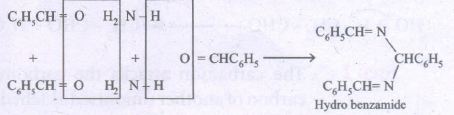
(iii) NH3 with C6H5CHO:
Benzaldehyde undergoes condensation with ammonia to form hydrobenzamide
(iv) NH3 with CH3CO - CH3:
Acetone with ammonia forms acetone ammonia initially at room temperature. On heating, it forms diacetone amine
\({ H }_{ 3 }C-\overset { \underset { | }{ { CH }_{ 3 } } }{ C } =O+{ HNH }_{ 2 }\longrightarrow \underset { acetone \ ammonia }{ CH_{ 3 }-\overset { \underset { | }{ { CH }_{ 3 } } }{ \underset { \overset { | }{ { NH }_{ 2 } } }{ C } } -{ OH }_{ 2 } } \)
\({ CH }_{ 3 }-\overset { \underset { | }{ { CH }_{ 3 } } }{ \underset { \overset { | }{ { NH }_{ 2 } } }{ C } } -OH+{ CH }_{ 3 }-\underset { \overset { || }{ O } }{ C } -{ CH }_{ 3 }
\overset { high \ temp }{ \underset { -{ H }_{ 2 }O }{ \longrightarrow } } \underset {Diacetone \ amine}{{ CH }_{ 3 }-\overset { \underset { | }{ { CH }_{ 3 } } }
{ \underset { \overset { | }{ { NH }_{ 3 } } }{ C } } -{ CH }_{ 2 }}-\underset { \overset { || }{ O } }{ C } -{ CH }_{ 3 }\)
35.
(i) An Organic compound (A) with molecular formula CH2O is formaldehyde (HCHO).
(ii) Formaldehyde reacts with CH3MgI to give compound (B) ethanol.

(iii) Ethanol on dehydration with cone. H2SO4 at 410K gives compound (C)
| Compound | Compound Name | Formula |
| A | Formaldehyde | HCHO |
| B | Ethanol | C2H5OH |
| C | Diethyl ether | C2H5-O-C2H5 |
36.
(i) For a chemical reaction, catalyst is needed in very small quantity.
(ii) There may be some physical changes, but the catalyst remains unchanged in mass and chemical composition in a chemical reaction.
(iii) A catalyst itself cannot initiate a reaction.
(iv) A solid catalyst will be more effective if it is taken in a finely divided form.
(v) A catalyst are specific in nature.
(vi) In an equilibrium reaction, presence of catalyst reduces the time for attainment of equilibrium and hence it does not affect the position of equilibrium and the value of equilibrium constant.
(vii) A catalyst is highly effective at a particular temperature called as optimum temperature.
(viii) Presence of a catalyst generally does not change the nature of products
37.
On the basis of magnetic properties, materials can be broadly classified as
(a) paramagnetic materials
(b) diamagnetic materials, besides these there are ferromagnetic and antiferromagnetic materials
(i) Materials with no elementary magnetic dipoles are diamagnetic, in other words a species with all paired electrons exhibits diamagnetism.
(ii) This kind of materials are repelled by the magnetic field because the presence of external magnetic field, a magnetic induction is introduced to the material which generates weak magnetic field that oppose the applied field
(iii) Paramagnetic solids having unpaired electrons possess magnetic dipoles which are isolated from one another.
(iv) In the absence of external magnetic field, the dipoles are arranged at random and hence the solid shows no net magnetism.
(v) But in the presence of magnetic field, the dipoles are aligned parallel to the direction of the applied field and therefore, they are attracted by an external magnetic field.
(vi) Ferromagnetic materials have domain structure and in each domain the magnetic dipoles are arranged.
(vii) But the spin dipoles of the adjacent domains are randomly oriented.
(viii) Some transition elements or ions with unpaired d electrons show ferromagnetism.
38.
| TYPE | EXAMPLE | SHAPE | DIAGRAM | HYBRIDISATION |
|---|---|---|---|---|
| AX | ClF | Linear |  |
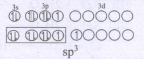 |
| AX3 | ClF3 | Bipyramidal (without lone pair it is T-shaped) |
 |
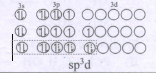 |
| AX5 | IF5 | Octahedral (without lone pair it is square pyramidal) |  |
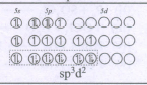 |
| AX7 | IF7 | Pentagonal bipyramidal |  |
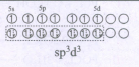 |
39.
Density of the element, d = 2.7 x 10³ kg m-3
Molar mass, M = 2.7 x 10⁻² kg mol-1
Edge length, a = 405 pm
= 405 x 10-12 m
= 4.05 x 10⁻¹⁰ m
Avogadro's number, NA= 6.022 x 10²³ mol-1
\(\therefore d=\frac { Z\times M }{ { a }^{ 3 }\times { N }_{ A } } \)
\(\Rightarrow Z=\frac { d\times { a }^{ 3 }{ N }_{ A } }{ M } \)
\(=\frac { 2.7\times { 10 }^{ 3 }kg\quad { m }^{ -3 }{ (4.05\times { 10 }^{ -10 }m) }^{ 3 }\times 6.022\times { 10 }^{ 23 }{ mol }^{ -1 } }{ 2.7\times { 10 }^{ -2 }kg\quad { mol }^{ -1 } } \)
= 4.004 = 4.
This implies that four atoms of the element are present per unit cell. Hence the unit cell is face centred cubic.
40.
(i) [NiCI4]2-
IUPAC name - Tetrachloridonickelate (II) ion
(ii) Ni2+ = 3d8,4s0
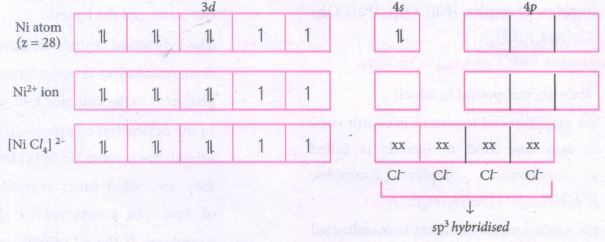
Cl- being a weak field ligand cannot pair up the unpaired electron. So, it is sp3 hybridised, and it has tetrahedral geometry.
41.
(i) Order of the reaction =1; \(\mathrm{t}_{1 / 2}=60 \mathrm{~s} ; \mathrm{k}=?\)
\(\mathrm{k}=\frac{0.6932}{\mathrm{t}_{\frac{1}{2}}} \)
\(=\frac{0.6932}{60} \)
\(k =1.155 \times 10^{-2} \mathrm{~s}^{-1}\)
(ii) \(\left[\mathrm{A}_{0}\right]=100 \% ; \mathrm{t}=180 \mathrm{~s} ;[\mathrm{A}]=? ; \mathrm{k}=1.155 \times 10^{-2} \mathrm{~s}^{-1}\)
For first order reaction
\(\mathrm{k}=\frac{2.303}{\mathrm{t}} \log \frac{\left[\mathrm{A}_{0}\right]}{[\mathrm{A}]} \)
\(1.155 \times 10^{-2} =\frac{2.303}{180} \log \left(\frac{100}{[A]}\right) \)
\(\frac{0.01155 \times 180}{2.303} =\log \left(\frac{100}{[A]}\right) \)
\(0.9027 =\log 100-\log [\mathrm{A}] \)
\(\log [\mathrm{A}] =\log 100-0.9027 \)
\(\log [A]=2-0.9027 \)
\(\log [A]=1.0972 \)
[A] = antilog of (1.0972)
[A] =12.51 %
42.

B) if both assertion and reason are true but reason is not the correct explanation of assertion.

12th Standard Syllabus & Materials
12th Standard
TN 12th Computer Applications களப்பெயர் முறைமை (DNS) Sample Question Papers Study Material - QB365 Set A
NEW12th Standard
TN 12th Computer Applications வலையமைப்பு எடுத்துக்காட்டுகள் மற்றும் நெறிமுறைகள் Sample Question Papers Study Material - QB365 Set A
NEW12th Standard
TN 12th Computer Applications கணினி வலையமைப்பு ஓர் அறிமுகம் Sample Question Papers Study Material - QB365 Set A
NEW12th Standard
TN 12th Computer Applications PHP-உடன் MySQL-ஐ இணைத்தல் Sample Question Papers Study Material - QB365 Set A



Tamilnadu Stateboard 12th Standard Subjects

Maths
Chemistry

Physics

Biology

Computer Science

Business Maths and Statistics

Economics

Commerce

Accountancy

History

Computer Applications
Biology
Computer Technology
Computer Applications
Computer Science
Business Maths and Statistics
Commerce
Economics
Maths
Chemistry
Physics
Computer Technology
History
Accountancy

Tamil

English

French
Tamilnadu Stateboard Standards
