
 100% FREE ACCESS
12th Standard Syllabus & Materials
12th Standard
TN 12th Computer Applications மின்னணு தரவு பரிமாற்றம் Sample Question Papers Study Material - QB365 Set A
NEW12th Standard
TN 12th Computer Applications மின் - வணிக பாதுகாப்பு அமைப்புகள் Sample Question Papers Study Material - QB365 Set A
NEW12th Standard
TN 12th Computer Applications மின்னணு செலுத்தல் முறைகள் Sample Question Papers Study Material - QB365 Set A
NEW12th Standard
TN 12th Computer Applications மின் - வணிகம் Sample Question Papers Study Material - QB365 Set A
NEW12th Standard
TN 12th Computer Applications திறந்த மூல கருத்துருக்கள் Sample Question Papers Study Material - QB365 Set A
NEW12th Standard
TN 12th Computer Applications வலையமைப்பு வடமிடல் Sample Question Papers Study Material - QB365 Set A

Published on: 27/02/2021
12th Standard English Medium Chemistry Reduced Syllabus Three mark Important Questions - 2021(Public Exam )
Download Tamil Nadu 12th Standard Chemistry question papers, model tests, one-mark questions, important questions, and public exam papers in PDF format. Free study materials and answer keys for TN State Board students.
Questions + Answers key
Take MCQ Chemistry Test
1.
Account for the following
i. Aniline does not undergo Friedel – Crafts reaction
ii. Diazonium salts of aromatic amines are more stable than those of aliphatic amines
iii. pKb of aniline is more than that of methylamine
iv. Gabriel phthalimide synthesis is preferred for synthesising primary amines.
v. Ethylamine is soluble in water whereas aniline is not
vi. Amines are more basic than amides
vii.Although amino group is o – and p – directing in aromatic electrophilic substitution reactions, aniline on nitration gives a substantial amount of m – nitroaniline.
2.
Explain common ion effect with an example.
3.
Write the postulates of Werner’s theory.
4.
Explain zone refining process with an example.
5.
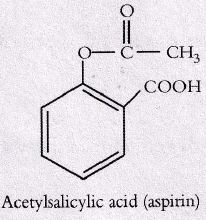
Write the structural formula of aspirin.
6.
A gas phase reaction has energy of activation 200 kJ mol-1. If the frequency factor of the reaction is 1.6 x 10¹³s-1. Calculate the rate constant at 600 K.(e-40.09 = 3.8 x 10-48)
7.
For a reaction x + y + z\(\longrightarrow \) products the rate law is given by rate =k[x]3/2[y]1/2. What is the overall order of the reaction and what is the order of the reaction with respect to z.
8.
Calculate the number of unpaired electrons in Ti3+ , Mn2+ and calculate the spin only magnetic moment.
9.
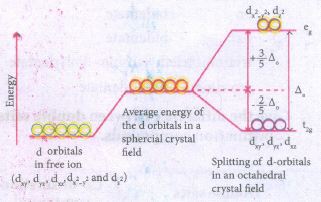
In an octahedral crystal field, draw the figure to show splitting of d orbitals
10.
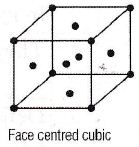
Calculate the number of atoms in a fcc unit cell.
11.
How will you prepare chlorine in the laboratory?
12.
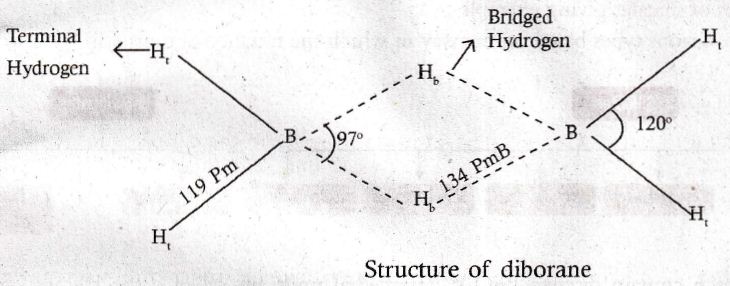
Describe the structure of diborane.
13.
Addition of Alum purifies water. Why?
14.
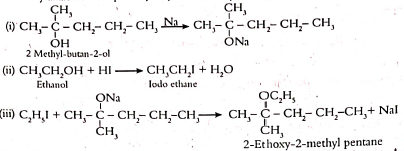
Write the chemical equation for Williamson synthesis of 2-ethoxy – 2- methyl pentane starting from ethanol and 2 – methyl pentan -2-ol.
15.
0.1M NaCl solution is placed in two different cells having cell constant 0.5 and 0.25 cm-1 respectively. Which of the two will have greater value of specific conductance.
16.
What are reducing and non – reducing sugars?
17.
Calculate the extent of hydrolysis and the pH of 0.1 M ammonium acetate Given that \(K_{a}=K_{b}=1.8\times10^{-5}\)
18.
What are the uses of potassium dichromate?
19.
(i) Name the transition metal
(a) Which is used in the manufacture of sulphuric add.
(b) That is used in Haber's process.
(c) That have light sensitive properties and act as valuable source in photo graphic industry.
(ii) Write the equations which are involved in the oxidation of hydrogen sulphide to sulphur by KMnO4 solution.
20.
Write chemical equations for the reactions involved in the manufacture of potassium permanganate from pyrolusite ore.
21.
Why do noble gases form compounds with fluorine and oxygen only?
22.
Describe the structure of diamond.
23.
Copper and silver lie low in the electrochemical series and yet they are found in the combined state as sulphides in nature. Comment.
24.
Explain calcination with an example.
25.
Explain the variation in E0M3+/M2+ 3d series.
1.
Aniline does not undergo Friedel - Craft's reaction:
Aniline does not undergo Friedel - Craft's reaction (alkylation and acetylation). Aniline is basic in nature and it donates its lone pair of electrons to the lewis acid AlCl3 to form an adduct which inhibits further electrophilic substitution reaction.
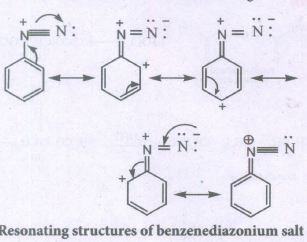
Diazonium salts of aromatic amines are more stable than those of aliphatic amines:
This is due to resonance
Resonance Structure:
The stability of arene diazonium salt is due to the dispersal of the positive charge over the benzene ring.
pKb of aniline is more than that of methylamine:
pKb - methylamine -3.35
pKb - aniline -9.376
In aniline the lone pair of electrons on N - atom is delocalized over the benzene ring. So, the electron density on the N - atom decreases. In methylamine + 1 effect to CH3 group increases the electron density on the nitrogen atom Hence aniline is a weaker base than methylamine. Due to this, the pKb value for aniline is more than that of methylamine.
(iv) Gabriel phthalimide synthesis is preferred for synthesising primary amines:
In this method alkyl halides react with pottassium phthalimide to give pure primary amine by nucleophilic substitution. In contrast, Aniline (Aromatic primary amine) can not be prepared by this method because Aryl halides do not undergo nucleophilic substitution with the anion formed by phthalimide. Therefore, this method used for the Aliphatic primary. amines only. Aryl halides do not undergo SN2 mechanism with the ion formed by the phthalimide.
(v) Ethylamine is soluble in water whereas aniline is not:
(a) Ethylamine is soluble in water, as it can form intermolecular H - bonds with water molecules. In aqueous solution, the substituted ammonium cation get stabilized not only by electron releasing (+I) effect of the alkyl group but also by solvation with water molecules. The greater the size of the ion, the lower will be the solvation.
(b) Amiline doesn't form H - bond with water to a very large extent due to the presence of a large hydrophobic -C6H5 group.
(vi) Amines are more basic than amides:
This is because, in amides, the carbonyl group is highly electro negative It has a greater power to attract the electrons towards it. It makes the lone pair of electrons on amide nitrogen (-CONH2) less available to accept a proton.
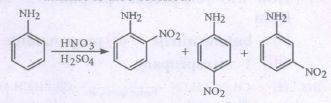
(vii) Although amino group is o - and p - directing in aromatic electrophilic substitution reactions, aniline on nitration gives a substantial amount of m - nitro aniline:
In strong acid medium, aniline is protonated to form anilinium ion which is m - directing and hence m - nitro aniline is formed.
2.
(i) The dissociation of a weak acid (CH3COOH) is suppressed in the presence of a salt (CH3COONa) containing an ion common to the weak electrolyte. It is called the common ion effect.
(ii) Consider the dissociation of a weak acid, acetic acid whose ionisation is incomplete.
CH3COOH(aq) ⇌ H+(aq) + CH3COO-(aq)
(iii) If the salt sodium acetate with common ion CH3COO- is added to the above equilibrium, it dissociates completely increasing.
CH3COONa(aq)⟶Na+(aq) + CH3COO-(aq)
(iv) Hence, the overall concentration of CH3COO- is increased, and the acid dissociation equilibrium is disturbed.
(v) So, in order to maintain the equilibrium, the excess CH3COO- ions combines with H+ ions to produce much more unionized CH3COOH i.e, the equilibrium will shift towards the left. In other words, the dissociation of CH3COOH is suppressed.
3.
Most of the elements exhibit, two types of valence namely primary valence and secondary valence and each element tend to satisfy both the valences.
The primary valence is referred the oxidation state of the metal atom.
The secondary valence as the coordination number. For example, according to Werner, the primary and secondary valences of cobalt are 3 and 6 respectively.
The primary valence of a metal ions ae always satisfied by negative ions.
For example in the complex CoCI3.6NH3. The primary valence of Co is +3 and is satisfied by 3CI- ions.
The secondary valence is satisfied by negative ions, neutral molecules, positive ions or the combination of these.
For example, in CoCl3.6NH3 complex primary valence of cobalt +3 and it is satisfied by 3 CI-.
The secondary valence of cobalt is 6 and is satisfied by six neutral ammonia molecules. where as in CoCI6.NH3.
Secondary valence of Co = 5{It is satisfied five neutral molecules and a Cl- ion}
According to Werner, there are two spheres of attraction around a metal atom/ion in a complex.
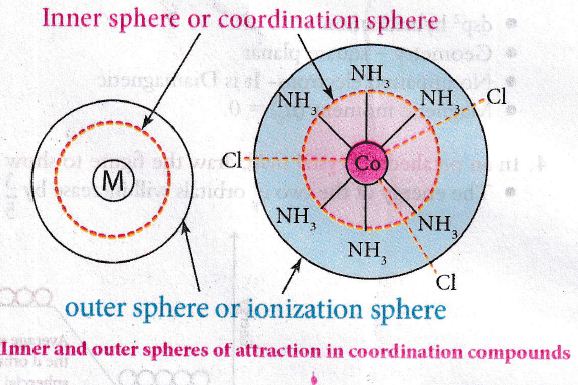
The inner /coordination sphere:
The groups present in this sphere are firmly attached to the metal.
The outer sphere / ionisation sphere:
The groups present in this sphere are loosely bound to the central metal ion and hence can be separated into ions upon dissolving the complex in a suitable solvent.
The primary valencies are non-directional. while the secondary valencies are directional.
The geometry of the complex is determined by the special arrangement of the groups which satisfy the secondary valence.
| Secondary valence | Geometry |
| 4 | Tetrahedral / Square planar |
| 6 | Octahedral |
4.
Zone refining :
1. Zone refining method is based on the principles of fractional crystallisation.
2. When an impure metal is melted and allowed to solidify, the impurities will prefer to be in the molten region. In this process the impure metal is taken in the form of a rod.
3. One end of the rod is heated using a mobile induction heater which results in melting of the metal on that portion of the rod.
4. When the heater is slowly moved to the other end the pure metal crystallises while the impurities will move on to the adjacent molten zone.
5. As the heater moves further away, the molten zone containing impurities also moves along with it.
6. The process is repeated several times by moving the heater in the same direction again and again to get pure metal.
7. This process is carried out in an inert gas atmosphere to prevent the oxidation of metals.
8. Elements such as germanium (Ge), silicon (Si) and galium (Ga) that are used as semiconductor are refined using this process.
5.
Aspirin is o-acetyl salicylic acid
6.
Ea = 200 kJ mol-1=200 \(\times\) 103J mol-1
A = 1.6 \(\times\) 1013s-1; T = 600 K; R = 8.314 JK mol-1
\(k=A{ e }^{ -\left( \frac { Ea }{ RT } \right) }\)
\(k=1.6\times { 10 }^{ 13 }{ s }^{ -1 }{ e }^{ -\left( \frac { 200\times 10^3}{ 8.314 \times 600 } \right) }\)
\(k=1.6\times { 10 }^{ 13 }{ s }^{ -1 }{ e }^{ -\left( 40.09 \right) }\)
\(k=1.6\times { 10 }^{ 13 }\times 3.8\times { 10 }^{ -18 }{ s }^{ -1 }\)
\(k=6.08\times { 10 }^{ -5 }{ s }^{ -1 }\)
7.
Reaction rate = k[x]3/2[y]1/2
(i) Over all order of reaction = (3/2 + 1/2)=2
i.e., second order reaction.
(ii) Since the rate expression does not contain the concentration of z, the reaction is zero order with respect to z.
8.
Electronic configuration of Ti = 3d24s2
Electronic configuration of Ti3+ =3d1
Hence number of unpaired electron = 1
Spin only magnetic moment \((\mu)=\sqrt{\mathrm{n}(\mathrm{n}+2)}\)
= \(\sqrt{1(1+2)} \)
= \(\sqrt{3}\)
=1.732 BM
Electronic configuration of \(\mathrm{Mn}=3 \mathrm{~d}^{5} 4 \mathrm{~s}^{2}\)
Electronic configuration of \(\mathrm{Mn}^{2+}=3 \mathrm{~d}^{5}\)
Hence number of unpaired electrons = 5
Spin only magnetic moment
\((\mu) =\sqrt{5(5+2)}\)
= 5.92 BM
9.
The energy of the two eg orbitals will increase by \(\frac{3}{5} \Delta_{O}\) and that of the three t2g will decrease by (2/5) \(\Delta_{O}\)
10.
Number of atoms in a fcc unit cell = \(\frac{N_{c}}{8}+\frac{N_{f}}{2}=\frac{8}{8}+\frac{6}{2}=1+3=4\)
11.
Chlorine is prepared by the action of conc. sulphuric acid on chlorides in presence of manganese dioxide
4NaCl + MnO2 + 4H2SO4 \(\longrightarrow \)Cl2+ MnCl2 +4NaHSO4 + 2H2O
12.
(i) In diborane two BH2 units are linked by two bridged hydrogens.
(ii) It has eight B-H bonds.
(iii) Diborane has only 12 valance electrons.
(iv) The four terminal B-H- bonds is "2c - 2e" bond (two centre - two electron bond.)
(v) Two three centred B - H - B bonds two electrons each. "(3c - 2e)"
(vi) In diborane, the boron is "sp3" hybridised
(vii) Three of the four "sp3" hydridised orbitals contains single electron and the fourth orbital is empty.
13.
(i) Purification of drinking water is activated by coagulation of suspended impurities in water by using alums containing \(\mathrm{Al}^{3+}\left(\mathrm{K}_{2} \mathrm{SO}_{4} \mathrm{Al}_{2}\left(\mathrm{SO}_{4}\right)_{3} \cdot 24 \mathrm{H}_{2} \mathrm{O}\right)\) Alum has a negative charge and tends to disperse in water very fast.
(ii) The increased size as well as the lack of repelling charges cause the alum particles to settle down at the bottom or rise up and float in water. After the particles are neutralized, they clump together because of the London dispersive force which are part of vander Waal's forces. The weak inter molecular force arising from quantum induced instantaneous polarisation multi poles in molecules causes even non polar particles to attract each other due to the corelated movements of the electrons in interacting molecules. Then they settle down.
14.
15.
\(\kappa=\mathrm{C}\left(\frac{l}{\mathrm{~A}}\right)\) (or) k = 1/R.l/A
Where, C - Conductance
\(\frac{l}{A} \Rightarrow\) Cell constant (or)
Sp. Conductance \(\propto\) Cell constant
Sp. Conductance \(\propto\) Concentration
1. Sp. Conductance = concentration x cell constant
i) \(\kappa=0.1 \times 0.5=0.05=5 \times 10^{-2} \mathrm{Scm}^{-1}\)
ii) \(\kappa=0.1 \times 0.25=0.025=2.5 \times 10^{-2} \mathrm{Scm}^{-1}\)
2. So the first case will have greater specific conductance with cell constant 0.05.
16.
i) Reducing sugars:
1. Sugars which reduce Tollen's reagent or Fehling's solution or Benedict's solution are called reducing sugars.
2. These contain either α - hydroxyl ketone or cyclical hemi acetal or hemi ketal or structures in equilibrium with open chain forms having a free- CHO or C=O group.
3. E.g. a) All monosaccharide's like D - glucose, D - fructose (aldoses and ketoses)
b) Sugars like Lactose and maltose except sucrose.
ii) Non - reducing sugars:
1. Sugars which do not reduce either Tollen's reagent, Fehling's solution or Benedict's solution are called non-reducing sugars.
2. They contain a stable acetal or ketal structures which cannot be opened into a free carbonyl group.
E.g. Sucrose, starch, cellulose, glycogen, dextrin etc.
17.
\(h=\sqrt{K_{h}}=\sqrt{\frac{K_{w}}{K_{a}K_{b}}}=\sqrt{\frac{1\times10^{-14}}{1.8\times10^{-5}\times{1.8\times10^{-5}}}}\)
\(= \frac{1 \times10^{-7}}{1.8\times10^{-5}}\)
=\(0.7453\times10^{-2}\)
\(pH=\frac{1}{2}pK_{w}+\frac{1}{2}pK_{a}-\frac{1}{2}pK_{b}\)
Given that \(K_{a}=K_{b}=1.8\times10^{-5}\)
if Ka = Kb, then, pKa = pKb
\(\therefore pH= \frac{1}{2}pK_{w}=\frac{1}{2}(14)=7\)
pH = 7
18.
(i) It is used as a strong oxidizing agent
(ii) It is used in dyeing and printing.
(iii) It used in leather tanneries for chrome tanning.
(iv) It is used in quantitative analysis for the estimation of iron compounds and iodides.
19.
(i) (a) Vanadium
(b) Iron
(c) Silver
(ii) H2S ⟶ 2H++ S2-
[MnO4- + 8H+ + 5e- ⟶ Mn2+ + 4H2O] x 2
[S2- ⟶ S + 2e-] x 5
______________________________________
2MnO4- + 5S2- + 16H+⟶ 2Mn2+ + 5S + 8H2O
_______________________________________
20.
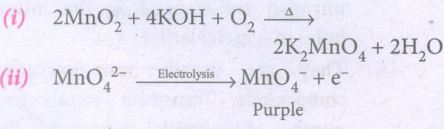
21.
(i) Both fluorine and oxygen have very high electron affinities and can easily cause the excitation of the electrons from 5p orbital to 5d orbital of xenon.
(ii) The unpaired electrons thus formed can take up electrons from oxygen or fluorine to form compounds.
(iii) Thus xenon has low ionisation energy and it can form compounds with strong oxidising agents (high E.A) like F2 and O2·
22.
(i) Diamond is very hard.
(ii) The carbon atoms in diamond are sp3 hybridised and bonded to four neighbouring carbon atoms by a bonds with a C-C bond length of 1.54 Å.
(iii) This results in a tetrahedral arrangement around each carbon atom that extends to the entire lattice.
(iv) Since all four valance electrons of carbon are involved in bonding there is no free electrons for conductivity.
(v) Being the hardest element, it used for sharpening hard tools, cutting glasses, making bores and rock drilling.
23.
(i) At higher temperature, the reaction between copper and sulphur becomes feasible.
(ii) So they combine together and copper exists as copper sulphides in nature.
(iii) Besides this due to high polarising power of copper and silver ions, their sulphides are more stable.
24.
(i) Calcination is the process in which the concentrated ore is strongly heated in the absence of air.
(ii) During this process, the water of crystallisation present in the hydrated oxide escapes as moisture.
(iii) Any organic matter (if present) also get expelled leaving behind a porous ore.
(iv) This method can also be carried out with 4 limited supply of air.
(v) During calcination of carbonate ore carbon dioxide is expelled.
\(Pb{ CO }_{ 2 }\overset { \Delta }{ \longrightarrow } PbO+{ CO }_{ 2 }\uparrow \)
25.
(i) In transition series, as we move down from Ti to Zn, the standard reduction potential E0M2+/M3 value is approaching towards less negative value and copper has a positive reduction potential, i. e. elemental copper is more stable than Cu2+.
(ii) E0M2+/M value for manganese and zinc are more negative than regular trend. It is due to extra stability arises due to the half filled d5 configuration in Mn2+ and completely filled d10 configuration in Zn2+.
(iii) The standard electrode potential for the M3+/M2+ half cell gives the relative stability between M3+ and M2+.
(iv) The high reduction potential of Mn3+/Mn2+ indicates Mn2+ is more stable than Mn3+.
(v) Mn3+ has a 3d4 configuration while that of Mn2+ is 3d5. The extra stability associated with a half filled d sub-shell makes the reduction of Mn3+ very feasible \(\left[\mathrm{E}^{\circ}=+1.51 \mathrm{~V}\right]\).

12th Standard Syllabus & Materials
12th Standard
TN 12th Computer Applications களப்பெயர் முறைமை (DNS) Sample Question Papers Study Material - QB365 Set A
NEW12th Standard
TN 12th Computer Applications வலையமைப்பு எடுத்துக்காட்டுகள் மற்றும் நெறிமுறைகள் Sample Question Papers Study Material - QB365 Set A
NEW12th Standard
TN 12th Computer Applications கணினி வலையமைப்பு ஓர் அறிமுகம் Sample Question Papers Study Material - QB365 Set A
NEW12th Standard
TN 12th Computer Applications PHP-உடன் MySQL-ஐ இணைத்தல் Sample Question Papers Study Material - QB365 Set A



Tamilnadu Stateboard 12th Standard Subjects

Maths
Chemistry

Physics

Biology

Computer Science

Business Maths and Statistics

Economics

Commerce

Accountancy

History

Computer Applications
Biology
Computer Technology
Computer Applications
Computer Science
Business Maths and Statistics
Commerce
Economics
Maths
Chemistry
Physics
Computer Technology
History
Accountancy

Tamil

English

French
Tamilnadu Stateboard Standards
