
 100% FREE ACCESS
12th Standard Syllabus & Materials
12th Standard
TN 12th Computer Applications மின்னணு தரவு பரிமாற்றம் Sample Question Papers Study Material - QB365 Set A
NEW12th Standard
TN 12th Computer Applications மின் - வணிக பாதுகாப்பு அமைப்புகள் Sample Question Papers Study Material - QB365 Set A
NEW12th Standard
TN 12th Computer Applications மின்னணு செலுத்தல் முறைகள் Sample Question Papers Study Material - QB365 Set A
NEW12th Standard
TN 12th Computer Applications மின் - வணிகம் Sample Question Papers Study Material - QB365 Set A
NEW12th Standard
TN 12th Computer Applications திறந்த மூல கருத்துருக்கள் Sample Question Papers Study Material - QB365 Set A
NEW12th Standard
TN 12th Computer Applications வலையமைப்பு வடமிடல் Sample Question Papers Study Material - QB365 Set A

Published on: 27/02/2021
12th Standard English Medium Chemistry Reduced Syllabus Three mark Important Questions with Answer key - 2021(Public Exam )
Download Tamil Nadu 12th Standard Chemistry question papers, model tests, one-mark questions, important questions, and public exam papers in PDF format. Free study materials and answer keys for TN State Board students.
Questions + Answers key
Take MCQ Chemistry Test
1.
Derive an expression for Ostwald’s dilution law.
2.
Explain briefly the collision theory of bimolecular reactions.
3.
Write short note on metal excess and metal deficiency defect with an example.
4.
Explain zone refining process with an example.
5.
How will you convert benzaldehyde into the following compounds?
(i) benzophenone
(ii) benzoic acid
(iii) α-hydroxyphenylaceticacid.
6.
Calculate the pH of 0.1M CH3COOH solution. Dissociation constant of acetic acid is \(1.8\times10^{-5}\).
7.
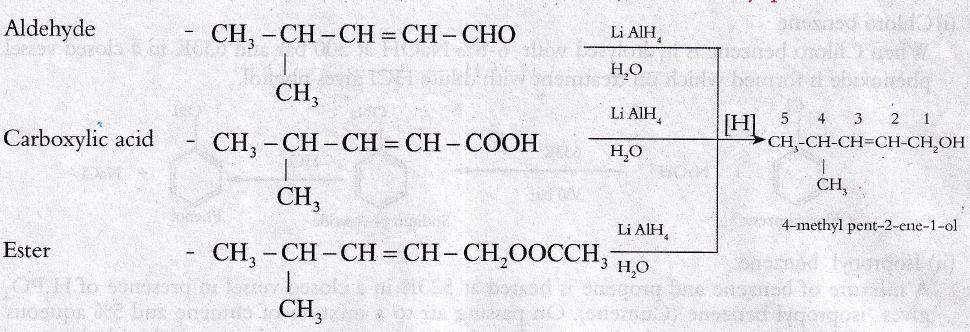
Write the structure of the aldehyde, carboxylic acid and ester that yield 4- methylpent -2-en-1-ol.
8.
Why carbohydrates are generally optically active.
9.
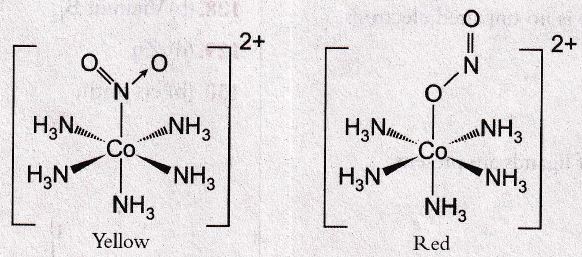
What is linkage isomerism? Explain with an example.
10.
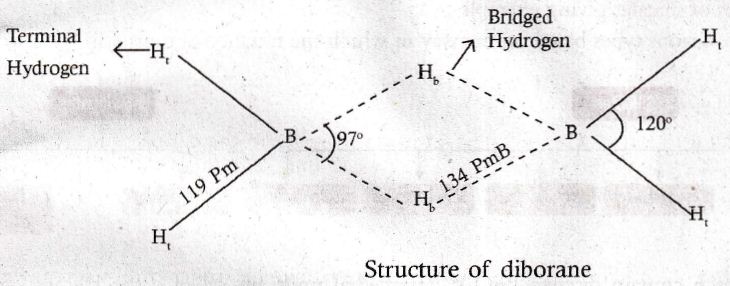
Describe the structure of diborane.
11.
Addition of Alum purifies water. Why?
12.
Can Fe3+ oxidises Bromide to bromine under standard conditions?
Given: \({ E }_{ { Fe }^{ 3+ }|{ Fe }^{ 2+ } }^{ 0 }=0.771V\); \(\\ { E }^{0}_{ { Br }_{ 2 }|{ Br }^{ - } }=1.09V\).
13.
What are the uses of potassium dichromate?
14.
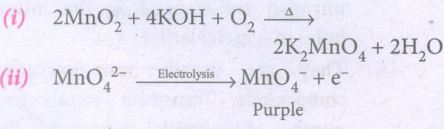
Write chemical equations for the reactions involved in the manufacture of potassium permanganate from pyrolusite ore.
15.
Prove that the time required for the completion \({ \frac { 3 }{ 4 } }^{ th }\) of the reaction of a first order is twice the time required for the completion of a half of the reaction.
16.
Explain the commercial method of preparation of nitric acid.
17.
Classify the following solids in different categories based on the nature of intermolecular force operating in them: Potassium sulphate, tin, benzene, urea, ammonia, water, zinc sulphide, graphite, rubidium, argon, silicon carbide.
18.
How is CO2 manufactured?
19.
How is aluminum chloride prepared from aluminum?
20.
What is auto-reduction?
21.
Explain alkali leaching in the extraction of aluminum.
22.
Explain Bonding is metal carbonyls.
23.
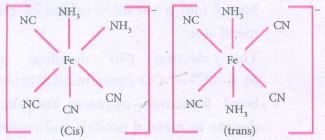
Draw the structures of geometrical isomers of [Fe(NH3)2 (CN)4]-
24.
Which is more stable? Fe3+ or Fe2+? Why ?
25.
Write the reason for the anomalous behaviour of Nitrogen.
1.
(i) Ostwald's dilution law relates the dissociation constant of the weak acid (Ka) with its degree of dissociation (α) and the concentration (c).
where \(\alpha=\frac{\text { Number of moles dissociated }}{\text { Total number of moles }}\)
(ii) The dissociation of acetic acid can be represented as
\(\mathrm{CH}_{3} \mathrm{COOH} \rightleftharpoons \mathrm{H}^{+}+\mathrm{CH}_{3} \mathrm{COO}^{-}\)
The dissociation constant of acetic acid is,
\({ K }_{ a }=\frac { \left[ { H }^{ + } \right] \left[ { CH }_{ 3 }COO^{ - } \right] }{ \left[ { CH }_{ 3 }COOH \right] } \) ........(1)
| CH3COOH | H+ | CH3COO- | |
| Initial number of moles | 1 | - | - |
| Degree of dissociation of CH3COOH | α | - | - |
| Number of moles at equilibrium | 1-α | α | α |
| Equilibrium concentration | (1-α)C | αC | αC |
Substituting the equilibrium concentration in equation (1)
\({ K }_{ a }=\cfrac { \left( \alpha C \right) \left( \alpha C \right) }{ \left( 1-\alpha \right) C } \)
\({ K }_{ a }=\cfrac { { \alpha }^{ 2 }C }{ 1-\alpha } \) .......(2)
(iii) We know that weak acid dissociates only to a very small extent compared to one, a is so small and hence in the denominator (1 - α) ⋍1. The above expression (2) now becomes,
ka =a2C \(\Rightarrow { \alpha }^{ 2 }=\cfrac { { k }_{ a } }{ C } \) ; \(\alpha =\sqrt { \cfrac { { K }_{ a } }{ C } } \)
(iv) When dilution increases, the degree of dissociation of weak electrolyte also increases. This is called Ostwald's dilution law
Also \(;\left[\mathrm{H}^{+}\right]=\alpha \mathrm{C}\) and \(\left[\mathrm{H}^{+}\right]=\left(\sqrt{\frac{\mathrm{K}_{\mathrm{a}}}{\mathrm{C}}}\right) \mathrm{C}=\sqrt{\frac{\mathrm{K}_{\mathrm{a}} \mathrm{C}^{2}}{\mathrm{C}}}=\sqrt{\mathrm{K}_{\mathrm{a}} \cdot \mathrm{C}}\)
Similarly for a weak base
\(\begin{aligned} & \mathrm{K}_{\mathrm{b}}=\alpha^2 \mathrm{C} ; \quad \therefore \alpha=\sqrt{\frac{\mathrm{k}_{\mathrm{b}}}{\mathrm{C}}}, \\ \end{aligned}\)
\(\begin{aligned} & {\left[\mathrm{OH}^{-}\right] \alpha \mathrm{C}=\sqrt{\frac{\mathrm{K}_{\mathrm{b}}}{\mathrm{C}}} \times \mathrm{C}=\sqrt{\frac{\mathrm{K}_{\mathrm{b}} \mathrm{C}^2}{\mathrm{C}}}=\sqrt{\mathrm{K}_{\mathrm{b}} \mathrm{C}}} \end{aligned}\)
2.
(i) Collision theory is based on the kinetic theory of gases. According to this theory, a chemical reaction occurs as a result of collisions between the reacting molecules.
(ii) Let us understand this theory by considering the following reaction.
A2(g) + B2(g) ⟶ 2AB(g)
(iii) If we consider that, the reaction between A2 and B2 molecules proceeds through collisions between them, then the rate would be proportional to the number of collisions per second.
(iv) Rate ∝ number of molecules colliding per litre per second (collision rate).
(v) The number of collisions is directly proportional to the concentration of both A2 and B2.
Collison rate ∝ [A2][B2]
Collision rate = Z [A2][B2]
(vi) Where, Z is a constant
(vii) A fraction of effective collisions (f) is given by the following expression
\(f={ e }^{ \frac { { -E }_{ a } }{ RT } }\)
(xiv) This fraction of collisions is further reduced due to orientation factor i.e., even if the reactant collides with sufficient energy, they will not react unless the orientation of the reactant molecules is suitable for the formation of the transition state.
(viii) The diagram illustrates the importance of proper alignment of molecules which leads to reaction.
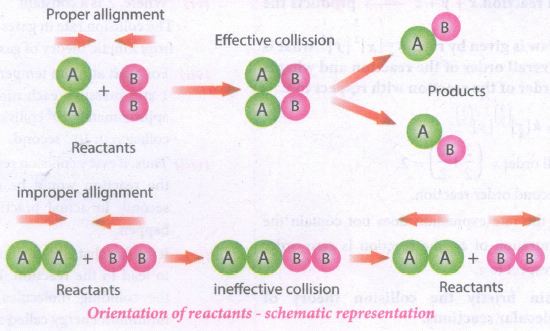
(ix) The fraction of effective collisions (f) having proper orientation is given by the steric factor p.
⇒ Rate = p x f x collision rate
\(\Rightarrow Rate=p\times { e }^{ \frac { -Ea }{ RT } }\times Z\left[ { A }_{ 2 } \right] \left[ { B }_{ 2 } \right] \quad ...(1)\)
As per the rate law,
Rate = \(k=\left[ { A }_{ 2 } \right] \left[ { B }_{ 2 } \right] \quad ...(2)\)
Where k is the rate constant
On comparing equation (1) and (2), the rate constant k is
\(k=pZ{ e }^{ \frac { -Ea }{ RT } }\)
3.
Metal excess defect:
(i) It arises due to the presence of more number of metal ions as compared to anions.
(ii) Examples: NaCl, KCl
(iii) The electrical neutrality of the crystal can be maintained by the presence of anionic vacancies equal to the presence of extra cation.
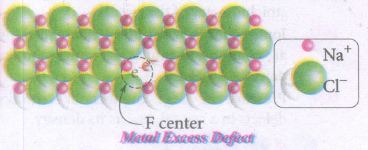
(iii) For example, when NaCI crystals are heated in the presence of sodium vapour, Na+ ions are formed and are deposited on the surface of the crystal.
(iv) Chloride ions (Cl-) diffuse to the surface from the lattice point and combines with Na+ ion.
(v) The electron lost by the sodium vapour diffuse into the vacancy created by the Cl- ions.
(vi) Such anionic vacancies which are occupied by unpaired electrons are called F centers. Hence, the formula of NaCl can be written as Na1+xCl.
Metal deficiency defect:
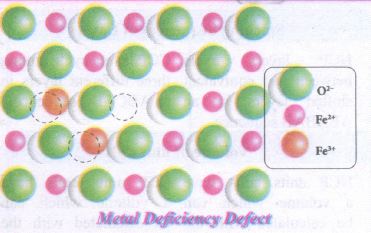
(i) Metal deficiency defect arises due to the presence of less number of cations than the anions. This defect is observed in a crystal in which, the cations have variable oxidation states.
(ii) For example, In FeO crystal, some of the Fe2+ ions are missing from the crystal lattice. To maintain the electrical neutrality, twice the number of other Fe2+ ions in the crystal is oxidized to Fe3+ ions. In such cases, overall number of Fe2+ and Fe3+ ions is less than the O2- ions.
4.
Zone refining :
1. Zone refining method is based on the principles of fractional crystallisation.
2. When an impure metal is melted and allowed to solidify, the impurities will prefer to be in the molten region. In this process the impure metal is taken in the form of a rod.
3. One end of the rod is heated using a mobile induction heater which results in melting of the metal on that portion of the rod.
4. When the heater is slowly moved to the other end the pure metal crystallises while the impurities will move on to the adjacent molten zone.
5. As the heater moves further away, the molten zone containing impurities also moves along with it.
6. The process is repeated several times by moving the heater in the same direction again and again to get pure metal.
7. This process is carried out in an inert gas atmosphere to prevent the oxidation of metals.
8. Elements such as germanium (Ge), silicon (Si) and galium (Ga) that are used as semiconductor are refined using this process.
5.
.JPG)
(ii) benzoic acid
.JPG)
(iii) α - hydroxyphenylaceticacid.
.JPG)
6.
pH=-log[H+]
For weak acids,
\(= \sqrt{k_a \times C}\)
=\(\sqrt{1.8\times10^{-5}\times0.1}\)
=\(1.34 \times10^{-3}\) M
\(pH=-\log(1.34\times10^{-3})\)
= 3-log1.34
= 3-0.1271
= 2.8729 \(\simeq\) 2.87
7.
8.
(i) Almost all carbohydrates are optically active as they contain one or more chiral carbons.
(ii) The number of optical isomers depends upon the number of chiral carbons (ie) 2n isomers, where n = total number of chiral carbons.
(iii) Glucose has \(4{ }^{\star} \)C; ∴ It has 24 =16 isomers.
9.
(i) This is also called as salt isomerism.
(ii) This type of isomers arises when an ambidentate ligand is bonded to the central metal atom/ion through either of its two different donor atoms. In the below mentioned examples, the nitrite ion is bound to the central metal ion Co3+ through a nitrogen atom in one complex and through oxygen atom in other complex.
\(\left[\mathrm{Co}\left(\mathrm{NH}_{3}\right)_{5}\left(\mathrm{NO}_{2}\right)\right]^{2+}\)
10.
(i) In diborane two BH2 units are linked by two bridged hydrogens.
(ii) It has eight B-H bonds.
(iii) Diborane has only 12 valance electrons.
(iv) The four terminal B-H- bonds is "2c - 2e" bond (two centre - two electron bond.)
(v) Two three centred B - H - B bonds two electrons each. "(3c - 2e)"
(vi) In diborane, the boron is "sp3" hybridised
(vii) Three of the four "sp3" hydridised orbitals contains single electron and the fourth orbital is empty.
11.
(i) Purification of drinking water is activated by coagulation of suspended impurities in water by using alums containing \(\mathrm{Al}^{3+}\left(\mathrm{K}_{2} \mathrm{SO}_{4} \mathrm{Al}_{2}\left(\mathrm{SO}_{4}\right)_{3} \cdot 24 \mathrm{H}_{2} \mathrm{O}\right)\) Alum has a negative charge and tends to disperse in water very fast.
(ii) The increased size as well as the lack of repelling charges cause the alum particles to settle down at the bottom or rise up and float in water. After the particles are neutralized, they clump together because of the London dispersive force which are part of vander Waal's forces. The weak inter molecular force arising from quantum induced instantaneous polarisation multi poles in molecules causes even non polar particles to attract each other due to the corelated movements of the electrons in interacting molecules. Then they settle down.
12.
(i) The half cell reactions are :
\(2Br^{-} \rightarrow Br_{2}+2e^{-}\) \(E^{0}_{ox}=-1.09V\) ...(1)
\(2Fe^{3+}+2e^{-}\rightarrow2Fe^{2+}\) \(E_{\mathrm{Fe}^{3+} / \mathrm{Fe}^{2+}}^{0}=+0.771V\) ..(2)
(ii) Adding (1) of (2) :
\(2Fe^{3+}+2Br^{-}\rightarrow 2Fe^{2+}+Br_{2}\) \(E^{0}_{cell}=?\) ...(3)
\(E^{0}_{cell}=E^{0}_{ox}+E_{\mathrm{Fe}^{3+} / \mathrm{Fe}^{2+}}^{0}\)
= (-1.09 + 0.771)V
= -0.319V
(iii) E0cell is – ve; \(\Delta G\) is +ve and the cell reaction is non spontaneous.
(iv) Hence Fe3+ cannot oxidises Br- to Br2.
13.
(i) It is used as a strong oxidizing agent
(ii) It is used in dyeing and printing.
(iii) It used in leather tanneries for chrome tanning.
(iv) It is used in quantitative analysis for the estimation of iron compounds and iodides.
14.
15.
\({ t }_{ \frac { 3 }{ 4 } }=\frac { 2.303 }{ K } \log { \frac { { \left[ R \right] }_{ 0 } }{ \frac { 1 }{ 4 } { \left[ R \right] }_{ 6 } } } \)
\({ t }_{ \frac { 3 }{ 4 } }=\frac { 2.303 }{ K } \log 4\)
\(=\frac { 2.303\times 0.6021 }{ K } =\frac { 1.386 }{ K } \)
\(=2\times \frac { 0.693 }{ K } \)
\(=2{ t }_{ \frac { 1 }{ 2 } }\)
16.
Commercial method of preparation
(i) Nitric acid prepared in large scales using Ostwald's process. In this method ammonia from Haber's process is mixed about 10 times, of air.
(ii) This mixture is preheated and passed into the catalyst chamber where they come in contact with platinum gauze.
(iii) The temperature rises to about 1275 K and the metallic gauze brings about the rapid catalytic oxidation of ammonia resulting in the formation of NO, which then oxidised to nitrogen dioxide.
\({ 4NH }_{ 3 }+{ 5O }_{ 2 }\longrightarrow 4NO+6{ H }_{ 2 }O+120KJ\)
\(2NO+{ O }_{ 2 }\longrightarrow { 2NO }_{ 2 }\)
(iv) The nitrogen dioxide produced is passed through a series of adsorption towers. It reacts with water to give nitric acid. Nitric acid formed is bleached by blowing air.
\({ 6NO }_{ 2 }+3{ H }_{ 2 }O\longrightarrow { 4HNO }_{ 3 }+2NO+{ H }_{ 2 }O\)
17.
(i) Covalent Solids: Silicon carbide, graphite.
(ii) Molecular Solids: Urea, benzene, ammonia, water and argon.
(iii) Ionic Solids: Zinc sulphide, potassium sulphate.
(iv) Metallic solids: Rubidium and tin.
18.
(i) On industrial scale it is produced by burning coke in excess of air
2CO + O2 ⟶ 2CO2 [H = 394 kJ mol-1]
(ii) Calcination of lime produces carbon dioxide as by product.
CaCO3 ⟶ CaO + CO2
19.
(i) When aluminium metal or aluminium hydroxide is treated with hydrochloric acid, aluminium trichloride is formed.
(ii) The reaction mixture is evaporated to obtain hydrated aluminium chloride.
2Al + 6HCl ⟶ 2AICl3 + 3H2
Al(OH)3 + 3HCl ⟶ AlCl3 + 3H2O
20.
(i) Simple roasting of some of the ores give the crude metal. In such cases, the use of and hydrogen which does not rust and gives reducing agents is not necessary.
(ii) For example, mercury is obtained by Write the chemical composition of the roasting of its ore cinnabar (HgS)
\(Hg{ S }_{ (s) }+{ O }_{ 2(g) }\longrightarrow { Hg }_{ (I) }+{ SO }_{ 2 }\uparrow \)
21.
(i) In this method, the ore is treated with aqueous alkali to form a soluble complex.
(ii) Bauxite, an important ore of aluminum is heated with a solution of sodium hydroxide or sodium carbonate in the temperature range 470 - 520 K at 35 atm to form soluble sodium meta-aluminate leaving behind the impurities, iron oxide and titanium oxide.
\({ Al }_{ 2 }{ O }_{ 3(s) }+2NaO{ H }_{ (aq) }+3{ H }_{ 2 }{ O }_{ (l) }\longrightarrow 2Na[Al({ OH })_{ 4 }]_{ (aq) }\)
(iii) The hot solution is decanted, cooled, and diluted. This solution is neutralised by passing CO2 gas, to the form hydrated Al2O3 precipitate
\(2Na\left[ Al\left( OH \right) _{ 4 } \right] _{ (aq) }+{ CO }_{ 2(g) }\longrightarrow { Al }_{ 2 }{ { O }_{ 3 }.x{ H }_{ 2 }O_{ (s) }+2NaHCO_{ 3(aq) } }\)
(iii) The precipitate is filtered off and heated around 1670 K to get pure alumina Al2O3
22.
Thus in metal carbonyls, electron density moves from ligand to metal through sigma bonding and from metal to ligand through pi bonding, this synergic effect accounts for strong M \(\longleftarrow \) CO bond in metal carbonyls.
23.
24.
(i) Fe3+ - electronic configuration - [Ar] 3d5
(ii) It has exactly half-filled stable electronic configuration.
(iii) Fe2+ - electronic configuration -[Ar]3d6
(iv) It has only partially filled d-orbitals.
Hence Fe3+ is more stable than Fe2+.
25.
(i) Its small size
(ii) Its high electronegativity
(iii) Its high ionisation energy
(iv) Non-availability of d-orbital in the valence shell.
(v) Rather inert
(vi) High bond energy

12th Standard Syllabus & Materials
12th Standard
TN 12th Computer Applications களப்பெயர் முறைமை (DNS) Sample Question Papers Study Material - QB365 Set A
NEW12th Standard
TN 12th Computer Applications வலையமைப்பு எடுத்துக்காட்டுகள் மற்றும் நெறிமுறைகள் Sample Question Papers Study Material - QB365 Set A
NEW12th Standard
TN 12th Computer Applications கணினி வலையமைப்பு ஓர் அறிமுகம் Sample Question Papers Study Material - QB365 Set A
NEW12th Standard
TN 12th Computer Applications PHP-உடன் MySQL-ஐ இணைத்தல் Sample Question Papers Study Material - QB365 Set A



Tamilnadu Stateboard 12th Standard Subjects

Maths
Chemistry

Physics

Biology

Computer Science

Business Maths and Statistics

Economics

Commerce

Accountancy

History

Computer Applications
Biology
Computer Technology
Computer Applications
Computer Science
Business Maths and Statistics
Commerce
Economics
Maths
Chemistry
Physics
Computer Technology
History
Accountancy

Tamil

English

French
Tamilnadu Stateboard Standards
