
 100% FREE ACCESS
12th Standard Syllabus & Materials
12th Standard
TN 12th Computer Applications மின்னணு தரவு பரிமாற்றம் Sample Question Papers Study Material - QB365 Set A
NEW12th Standard
TN 12th Computer Applications மின் - வணிக பாதுகாப்பு அமைப்புகள் Sample Question Papers Study Material - QB365 Set A
NEW12th Standard
TN 12th Computer Applications மின்னணு செலுத்தல் முறைகள் Sample Question Papers Study Material - QB365 Set A
NEW12th Standard
TN 12th Computer Applications மின் - வணிகம் Sample Question Papers Study Material - QB365 Set A
NEW12th Standard
TN 12th Computer Applications திறந்த மூல கருத்துருக்கள் Sample Question Papers Study Material - QB365 Set A
NEW12th Standard
TN 12th Computer Applications வலையமைப்பு வடமிடல் Sample Question Papers Study Material - QB365 Set A

Published on: 27/02/2021
12th Standard English Medium Chemistry Reduced Syllabus Two mark Important Questions - 2021(Public Exam )
Download Tamil Nadu 12th Standard Chemistry question papers, model tests, one-mark questions, important questions, and public exam papers in PDF format. Free study materials and answer keys for TN State Board students.
Questions + Answers key
Take MCQ Chemistry Test
1.
What is angle of deviation due to reflection?
2.
The resistance of a conductivity cell is measured as 190 Ω using 0.1M KCl solution (specific conductance of 0.1M KCl is 1.3 Sm-1). When the same cell is filled with 0.003 M sodium chloride solution, the measured resistance is 6.3KΩ. Both these measurements are made at a particular temperature. Calculate the specific and molar conductance of NaCl solution.
3.
Calculate the concentration of OH- in a fruit juice which contains \(2\times10^{-3}\) M, H3O+ ion. Identify the nature of the solution.
4.
Formation of water due to the reaction of H2 and O2 in the presence of Cu proceeds as follows. Steps in the reaction H2 + 1/2O2 → H2O can be given as
5.
The mechanism of Fridel crafts reaction is given below
\({ C }_{ 6 }{ H }_{ 5 }+{ { CH }_{ 3 }Cl\overset { anhydrous\\ \quad { Alcl }_{ 3 } }{ \longrightarrow } }{ C }_{ 6 }{ H }_{ 5 }{ CH }_{ 3 }+HCl\)
6.
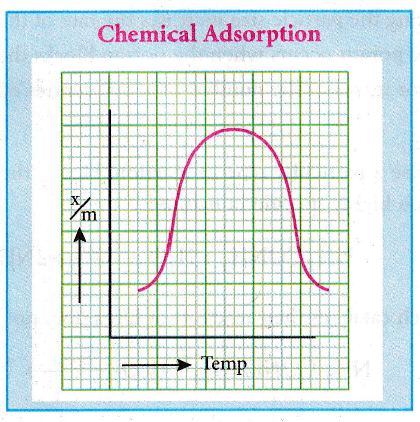
In case of chemisorption, why adsorption first increases and then decreases with temperature?
7.
Write down the possible isomers of the C4H9NO2 give their IUPAC names.
8.
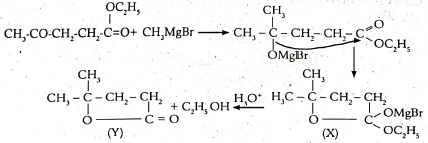
Identify X and Y.
\({ CH }_{ 3 }CO{ CH }_{ 2 }{ CH }_{ 2 }COO{ C }_{ 2 }{ H }_{ 5 }\overset { { CH }_{ 3 }MgBr }{ \longrightarrow } X\overset { { H }_{ 3 }{ O }^{ + } }{ \longrightarrow } Y\)
9.
Name one substance which can act as both analgesic and antipyretic.
10.
Which chemical is responsible for the antiseptic properties of dettol.
11.
Name the Vitamins whose deficiency cause i) rickets ii) scurvy
12.
The concentration of hydroxide ion in a water sample is found to be 2.5 × 10⁻⁶M. Identify the nature of the solution.
13.
Account for the acidic nature of HClO4 in terms of Bronsted – Lowry theory, identify its conjugate base.
14.
Consider the oxidation of nitric oxide to form NO2
2NO(g) + O2(g) ➝2NO2(g)
(a). Express the rate of the reaction in terms of changes in the concentration of NO,O2 and NO2.
(b). At a particular instant, when [O2] is decreasing at 0.2 mol L−1s−1 at what rate is [NO2] increasing at that instant?
15.
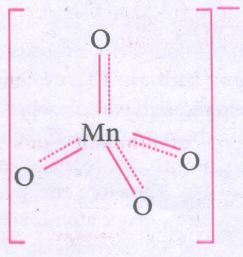
Draw the structure of permanganate ion.
16.
Many industrial processes use transition metal or their compounds as catalyst. Why?
17.
How is SO2 an air pollutant?
18.
Give two uses of nitric acid.
19.
Give the formula of chlorosilazanes. Explain its preparation from SiCI4.
20.
Write the reaction of diboranes with water and alkali.
21.
Calculate the magnetic moment of Fe3+ ion (Atomic no. of Fe = 26)
22.
Write ionic equation for the reaction between Cr2O7-2 ions and Fe2+ ions in acidic medium.
23.
Identify the ligand and the central metal in the Co-ordination compound. [Co(NH3)4Cl6]CI
24.
Name some elements that occur as native elements.
25.
Give an example for the complexes possessing co-ordination number 8 and 7
26.
Write the IUPAC name of [Ag(NH3)2]Cl.
27.
Give the names of two complexes which are used in medicines.
28.
Complete the following.
a. 3MnO42- + 4H+ ⟶?
b. C6H5CH3 \(\overset { acidified }{ \underset { KMnO_{ 4 } }{ \longrightarrow } } \)?
c. MnO4- + Fe2+ ⟶?
d. KMnO4 \(\overset { \triangle }{ \underset { Red\ hot }{ \longrightarrow } } \) ?
e. Cr2O72- + 6I- + 14H+ ⟶?
f. Na2Cr2O7 + 2KCl ⟶?
29.
Give an example of coordination compound used in medicine and two examples of biologically important coordination compounds.
30.
Write the formula for the co-ordination compounds.
31.
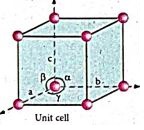
Define unit cell.
32.
Give the oxidation state of halogen in the following.
a) OF2
b) O2F2
c) Cl2O3
d) I2O4
33.
What is catenation ? describe briefly the catenation property of carbon.
34.
Out of coke and CO, which is better reducing agent for the reduction of ZnO? Why?
35.
What is the role of quick lime in the extraction of Iron from its oxide Fe2O3?
36.
Identify compounds A, B and C in the following sequence of reactions.
i) \({ C }_{ 6 }{ H }_{ 5 }NO_{ 2 }\overset { Fe/HCL }{ \longrightarrow } A\overset { HN{ O }_{ 2 } }{ \underset { 273K }{ \longrightarrow } } B\overset { { C }_{ 6 }{ H }_{ 5 }OH }{ \longrightarrow } C\)
ii) \({ C }_{ 6 }{ H }_{ 5 }N_{ 2 }cl\overset { CuCN }{ \longrightarrow } A\overset { H_{ 2 }O/H^{ + } }{ \longrightarrow } B\overset { NH_3 }{ \longrightarrow } C\)
iii) \({ C }{ H }_{ 3 }{ C }{ H }_{ 2 }I\overset { NaCN}{ \longrightarrow } A\overset {OH^-}{ \underset {Partial hydrolysis}{ \longrightarrow } } B\overset {NaOH+Br_2 }{ \longrightarrow } C\)
iv) \({ C }{ H }_{ 3 }NH_{ 2 }\overset { CH_3 Br }{ \longrightarrow } A\overset { CH_{ 3 }COCl}{ \longrightarrow } B\overset { B_2H_6 }{ \longrightarrow } C\)
v) \({ C }_{ 6 }{ H }_{ 5 }NH_{ 2 }\overset { (CH_{ 3 }CO)_{ 2 }O }{ \underset { Pyridine }{ \longrightarrow } } A\overset { HNO_{ 3 } }{ \underset { H_{ 2 }SO_{ 4 },288K }{ \longrightarrow } } B\overset { { H }_{ 2 }O/{ H }^{ + } }{ \longrightarrow C } \)
vi)
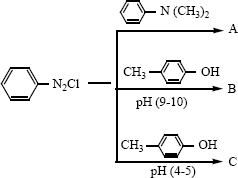
vii) \({ C }{ H }_{ 3 }CN_{ 2 }NC\overset { HgO }{ \longrightarrow } A\overset { H_{ 2 }O }{ \longrightarrow } B\overset { i) NaN{ O }_{ 2 }/HCL }{ \underset { ii){ H }_{ 2 }O }{ \longrightarrow } } \)
37.
What happens when
i. 2 – Nitropropane boiled with HCl
ii. Nitrobenezene undergo electrolytic reduction in strongly acidic medium.
iii. Oxidation of tert – butylamine with KMnO4
iv. Oxidation of acetoneoxime with trifluoroperoxy acetic acid
38.
Write a short note on peptide bond.
39.
Describe briefly allotropism in p- block elements with specific reference to carbon.
40.
Can we use nucelophiles such as NH3,CH3O - for the Nucleophilic substitution of alcohols
41.
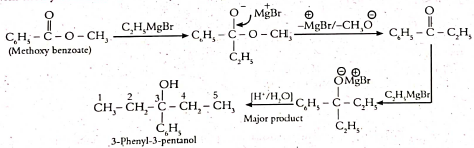
What is the major product obtained when two moles of ethyl magnesium bromide is treated with methyl benzoate followed by acid hydrolysis.
42.
Which of 0.1M HCl and 0.1 M KCl do you expect to have greater \(\stackrel{0}{\Lambda}_{\mathrm{m}}\)and why?
43.
Describe the electrolysis of molten NaCl using inert electrodes
44.
What are food preservatives?
45.
Explain the effect of catalyst on reaction rate with an example.
46.
Describe the graphical representation of first order reaction.
47.
Derive integrated rate law for a zero order reaction A\(\longrightarrow \) product.
48.
What are inner transition elements?
49.
Distinguish between hexagonal close packing and cubic close packing.
1.
The angle between the incident and deviated light ray is called angle of deviation of the light ray.
2.
Given that
κ = 1.3 Sm-1 (for 0.1M KCl solution)
R = 190 Ω
\(\kappa = \frac{1}{R}(\frac{l}{A})\)
κ . R =\((\frac{l}{A})\) = (1.3 Sm-1) (190Ω)
= 247 m-1
\(\kappa_{(NaCl)} = \frac{1}{R_{(NaCl)}} (\frac{l}{A})\)
\(= \frac{1}{6.3 K\Omega}(247 m^{-1})\) (6.3KΩ = 6.3 x 10³Ω)
= 39.2 x 10⁻³ Sm-1
\(\Lambda_m = \frac{\kappa \times 10^{-3} mol^{-1} m^3}{M}\)
\(=\frac{39.2 \times 10 ^{-3}(Sm^{-1})10^-3 (mol^{-1} m^3)}{0.003}\)
\(\Lambda_m\) = 13.04 \(\times\) 10-3 Sm2 mol-1
3.
Given that H3O+ = \(2\times10^{-3}M\)
\(K_{w}=[H_{3}O^{+}][OH^{-}]\)
\(\therefore [OH^{-}]=\frac{K_{w}}{[H_{3}O^{+}]}=\frac{1\times10^{-14}}{2\times10^{-3}}=0.5\times10^{-11}M\)
\(2\times10^{-3} >>0.5\times10^{-11}\)
i.e., [H3O+]>>[OH-], hence the juice is acidic in nature
4.
2Cu + \(\frac{1}{2}\)O2 → Cu2O
It is an intermediate.
Cu2O + H2 → H2O + 2Cu
5.
The action of catalyst is explained as follows
CH3Cl + AlCl3 → [CH3 ]+[AlCl4]-
It is an intermediate.
C6H6 + [CH3+][AlCl4]- → C6H5CH3 + AlCl3 + HCl
6.
In chemical adsorption, \(\frac { x }{ m } \) increases with rise in temperature and then decreases. The increase illustrates the requirement of activation of the surface for adsorption is due to fact that formation of activated complex requires certain energy. The decrease at high temperature is due to desorption, as the kinetic energy of the adsorbate increases.
7.
| Isomerism | Structural formula of isomers |
| Chain isomerism: They differ in the length of carbon chain. |
.JPG) |
| Position isomerism: They differ in the position of nitro group. |
.JPG) |
| Functional isomerism: Nitroalkanes exhibit functional isomerism with alkylnitrites |
\( \mathrm{CH}_{3} \mathrm{CH}_{2} \mathrm{CH}_{2} \mathrm{CH}_{2}-\mathrm{NO}_{2} \text { and } \mathrm{CH}_{3} \mathrm{CH}_{2} \mathrm{CH}_{2} \mathrm{CH}_{2}-\mathrm{O}-\mathrm{N}=\mathrm{O}\\ \quad 1 - nitrobutane \quad \quad \quad \quad \quad \quad \quad butyl \ nitrite\) |
8.
9.
Aspirin (o - acetyl salicylic acid) - is a substance which lowers body temperature and also reduces body pain. So it acts as both analgesic and antiphyretic.
10.
Dettol is a mixture of chloroxylenol and terpineol which imparts antiseptic properties to it.
11.
i) Rickets - Vitamin - D (Cholecalciferol - (D3) Ergocalciferol - (D2)
ii) Scurvy (bleeding gums) - vitamin - C (Ascorbic acid)
12.
1. If \(\left[\mathrm{OH}^{-}\right]>1 \times 10^{-7} \mathrm{M}\), the solution is basic. \(2.5 \times 10^{-6} \mathrm{M}>1 \times 10^{-7} \mathrm{M}\)
2. \(\therefore\) The solution is basic.
13.
\(\mathrm{HClO}_{4} \rightleftharpoons \mathrm{H}^{+}+\mathrm{ClO}_{4}^{-}\)
Bronsted Acid Proton Conjugate Base
HClO4 can donate a proton. Therefore HClO4 is an acid. Its conjugate base is ClO4-
14.
a) \(Rate=\frac { -1 }{ 2 } \frac { d[NO] }{ dt } =\frac { -d[{ O }_{ 2 }] }{ dt } =\frac { 1 }{ 2 } \frac { d\left[ { NO }_{ 2 } \right] }{ dt } \)
b) \(\frac { -d\left[ { O }_{ 2 } \right] }{ dt } =\frac { 1 }{ 2 } \frac { d\left[ { NO }_{ 2 } \right] }{ dt } \)
\(\frac { d[{ NO }_{ 2 }] }{ dt } =2 \times\left( \frac { -d\left[ { O }_{ 2 } \right] }{ dt } \right) =2\times 0.2 \ { mol \ L }^{ -1 }{ s }^{ -1 }\)
= 0.4 mol L-1s-1
15.
Permanganate ion has tetrahedral geometry in which the central Mn7+ is Sp3 hybridised.
16.
Transition metal has energetically available d orbitals that can accept electrons from reactant molecule or metal can form bond with reactant molecule using its d electrons. For example, in the catalytic hydrogenation of an alkene, the alkene bonds to an active site by using its π electrons with an empty d orbital of the catalyst.
17.
(i) SO2 present in the atmosphere dissolves in rain water and causes acid rain.
(ii) Acid rain destroys buildings, inhibits plant growth and also causes eye irritation in human.
18.
(i) Nitric acid is used as a oxidising agent and in the preparation of aqua regia.
(ii) Salts of nitric acid are used in photography (AgNO3) and gun powder for fire arms (NaNO3)·
19.
Chlorosilazanes is Cl3Si - NH - SiCl3.Silicon tetrachloride undergoes ammonolysis to form chlorosilazanes.
\(2Si{ Cl }_{ 4 }+{ NH }_{ 3 }\overset { 330K }{ \underset { Ether }{ \longrightarrow } } { Cl }_{ 3 }Si-NH-Si{ Cl }_{ 3 }\).
20.
Diboranes reacts with water and alkali to give boric acid and metaborates respectively.
B2H6+ 6H2O ⟶ 2H3BO3 + 6H2
B2H6+ 2NaOH + H2O ⟶ 2NaBO2 + 6H2
21.
Fe3+ has the electronic configuration
[Ar] 4s0 3d5
It is 5 unpaired electron
μ = \(\sqrt{n(n+2)}\)
= \(\sqrt{5(5+2)}\) = \(\sqrt{35}\) = 5.9 BM
22.
Cr2O72- + 14H+ + 6Fe2+ ⟶ 2Cr3+ + 6Fe3+ + 7H2O
23.
Ligands NH3 AND Cl-
Central metal Co (in cationic complex).
24.
Copper, Silver, Gold and Platinum
25.
(i) Complex with co-ordination number 8 - Cu2 [ZrF8].
(ii) Complex with co-ordination number 7 - (NH4)3[ZrF7].
26.
Diammine silver (I) Chloride.
27.
(i) EDTA is used in the treatment of lead poisoning
(ii) Cis-platin[Pt(NH3)2Cl2] is used in the treatment of cancer.
28.
a. 3MnO42- + 4H+ ⟶ 2MnO4- + MnO2 + 2H2O
(Manganate ion) (Permanganate ion) Manganese dioxide
b. C6H5CH3 \(\overset { acidified }{ \underset { KMnO_{ 4 } }{ \longrightarrow } } \) C6H5COOH
Toluene Benzoic Acid
c. 2MnO4- + 10Fe2++16H+ \(\underrightarrow { { 8H }^{ + } } \) 2Mn2++ 10Fe3+ + 8H2O
d. 2KMnO4 \(\overset { \triangle }{ \underset { Red\ hot }{ \longrightarrow } } \) K2MnO4 + MnO2 + O2
(Potassium Permanganate) (Potassium Manganate)
e. Cr2O72- + 6I- + 14H+ \(\underrightarrow { { (O) }}\) 2Cr3+ + 3I2 + 7H2O
(Iodide ion) Iodine
f. Na2Cr2O7 + 2KCl ⟶ K2Cr2O7 + 2NaCl
(Sodium dichromate) (Potassium dichromate)
29.
Medicinal uses
(i) Ca-EDTA chelate, is used in the treatment of lead and radioactive poisoning.
(ii) That is for removing lead and radioactive metal ions from the body.
(iii) Cis-platin is used as an antitumor drug in cancer treatment.
Biological Importance compounds:-
(i) Fe2+ - porphyrin complex: It plays an important role in carrying oxygen from lungs to tissues and tissue carbon dioxide from to lungs.
(ii) Chlorophyll - useful in photosynthesis in plants.
30.
a) potassiumhexacyanidoferrate(II) - Potassiumhexacyanidoferrate(II) - K4[Fe(CN)6]
b) Pentacarbonyliron(0) - [Fe(CO)5]
c) Pentaamminenitrito −kNcobalt(III)ion - [Co(NH3)5(NO2)]2+
d) Hexaamminecobalt(III) Sulphate - [CO(NH3)6](SO4)3
e) Sodiumtetrafluoridodihydroxidochromate(III) - Na2[CrF4(OH)2]
31.
(i) A basic repeating structural unit of a crystalline solid is called a unit cell.
(ii) A crystal is consisted of large number of unit cells.
32.
(a) OF2
+ 2 + 2(x) = 0
+2 = -2x
2 x = -2 ⇒ x = -1
(b) O2F2
2(+1) + 2x = 0
2x = -2
x = -1
(c) Cl2O3
2(x) + 3(-2) = 0
2x = +6
x = +3
(d) I2O4
2(x) + 4(-2) = 0
2x = +8
x = +4
33.
Catenation is an ability of an element to form chain of atoms.
The conditions for catenation.
(a) The valency of element is greater than or equal to two.
(b) Element should have an ability to bond with itself
(c) The self bond must be as strong as Its bond with other elements
(d) Kinetic inertness of catenated compound towards other molecules.
(e) Carbon possesses all the above properties and forms a wide range of compounds with itself and with other elements such as H, O, N, S and halogens.
34.
Ellingham diagram for the formation of ZnO and CO2 intersects around 1200 K. Above this temperature ZnO lies above Carbon which indicates Carbon is the better reducing agent CO is more effective reducing agent only below 983 K.
35.
In this extraction, a basic flux, quick lime (CaO) is used, since the silica gangue present in the ore is acidic in nature. The quick lime combines with it to form calcium silicate (slag).
CaO(s) + Sio2(s) ⟶ CaSio3(s)
Flux Gangue Slag
36.
.JPG)
.JPG)
.JPG) +CO2
+CO2
.JPG)
.JPG)
.JPG)
.JPG)
37.
i) 2 - nitro propane is boiled with HCI:
.JPG)
It gives acetone.
ii) Nitrobenzene on electrolytic reduction in strongly acidic medium:
.JPG)
It gives aniline, phenyl hydroxylamine and p - amino phenol
iii) Oxidation of text – butylamine with KMnO4:
.JPG)
It gives 2 - methyl - 2- nitro propane is obtained.
iv) Oxidation of acetoneoxime with trifluoroperoxy acetic acid.
.JPG)
It gives 2 - nitro propane.
38.
(i) The amino acids are linked covalently by peptide bonds. The carboxyl group of the first amino acid react with the amino group of the second amino acid to give an amide linkage between these amino acids. This amide linkage is called peptide bond. The resulting compound is called a dipeptide. Addition an another amino acid to this dipeptide a second peptide bond results in tripeptide.
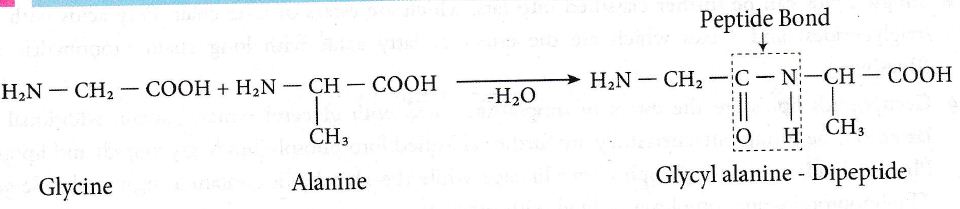
(ii) Thus we can generate tetra peptide, penta peptide etc... When you have more number of amino acids linked this way you get a polypeptide. If the number of amino acids are less it is called as a polypeptide, if it has large number of amino acids (and preferably has a function) then it is called a protein.
(iii) The amino end of the peptide is known as N - terminal or amino terminal while the carboxy end is called C-terminal or carboxy terminal. In general protein sequences are written from N-Terminal to C-Terminal.The atoms other than the side chains (R-groups) are called main chain or the back bone of the polypeptide.
39.
Allotropism:
1. Some elements exist in more than one crystalline or molecular forms in the same physical state
(a) In Greek "allos" means ⇒ Another
(b) "trope" means ⇒ Change
2. The different forms of an element are called allotropes.
Allotropy of carbon:
Carbon exists as diamond, graphite, fullerenes, carbon nanotubes and graphene.
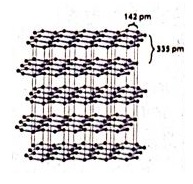
Graphite:
1. Graphite is the most stable allotropic form of carbon at normal temperature and pressure.
2. It is soft and conducts electricity.
3. It is composed of flat two dimensional sheets of carbon atoms.
4. Each sheet is a hexagonal.
5. It is "sp2" hybridised.
6. C-C bond length is 1.41 Å
7. Each C-atom forms three σ bonds with three neighbouring carbon atoms using three of its valence electrons and the fourth electron present in the unhybridised p-orbital form a π-bond.
8. The successive C-sheets are held together by weak Vander Waals forces.
9 The distance successive sheet is 3.40 Å.
10. It is used as a lubricant either on its own or as a graphited oil.
Diamond:
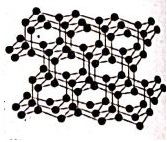
1. It is very hard.
2. It is "sp3" hybridised.
3. C-C bond length is 1.54 Å
4. It is used for sharpening hard tools, cutting glasses, making bores and rock drilling.
Fullerenes:
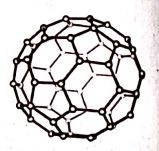
1. These allotropes are discrete molecules such as \(C_{32}, C_{50}, C_{60}, C_{70}, C_{76}\) etc.
2. It has cage like structure
3. The C60 molecules have a "soccer" ball like structure and is called buckminster fullerene or buckyballs.
4. It has a fused ring structure consists of 20 six membered rings and 12 five membered ring.
5. Each carbon atom is "sp2" hybridised.
6. It has three σ bonds and a delocalised π bond giving aromatic character to these molecules.
7. The C-C bond distance is 1.44 Å
8. The C=C bond distance is 1.38 Å.
Carbon nanotubes:
1. Carbon nanotubes, another recently discovered allotropes, have graphite like tubes with fullerene ends.
2. Along the axis, these nanotubes are stronger than steel and conduct electricity.
3. These have many applications in nanoscale electronics, catalysis, polymers and medicine.
Graphene:
It has a single planar sheet of "sp2" hybridised carbon atoms that are densely packed in a "honeycomb crystal" lattice.
40.
Yes, we can use nucleophiles such as NH3, CH3O- for the nucleophilic substitution of alcohol.
Example
\(\mathrm{C}_{2} \mathrm{H}_{5} \mathrm{OH}+\mathrm{NH}_{3} \rightarrow \mathrm{C}_{2} \mathrm{H}_{5} \mathrm{NH}_{2}+\mathrm{H}_{2} \mathrm{O} \)
\(\mathrm{C}_{2} \mathrm{H}_{5} \mathrm{OH}+\mathrm{CH}_{2} \mathrm{~N}_{2} \rightarrow \mathrm{C}_{2} \mathrm{H}_{5} \mathrm{OCH}_{3}+\mathrm{N}_{2}\)
41.
42.
(i) The Conductance of HCl will be more, because H+ ion has the maximum mobility of all the ions due to its smallest size and mass.
(ii) At \(25^{0} \mathrm{C}: \mathrm{H}^{+}=36.23 \mathrm{~m}^{2} \mathrm{~S}^{-1} \mathrm{~V}^{-1}\)
(iii) The conductance depends upon
1) Nature of electrolyte
2) Concentration
3) Mobility of ion
4) Temperature
43.
(i) The electrolytic cell consists of two iron electrodes dipped in molten sodium chloride and they are connected to an external DC power supply via a key as shown in the figure. The electrode which is attached to the negative end of the power supply is called the cathode, and the one which attached to the positive end is called the anode. Once the key is closed, the external DC power supply drives the electrons to the cathode and at the same time pull the electrons from the anode.
Cell reactions:
Na+ ions are attracted towards cathode, where they combines with the electrons and reduced to liquid sodium.
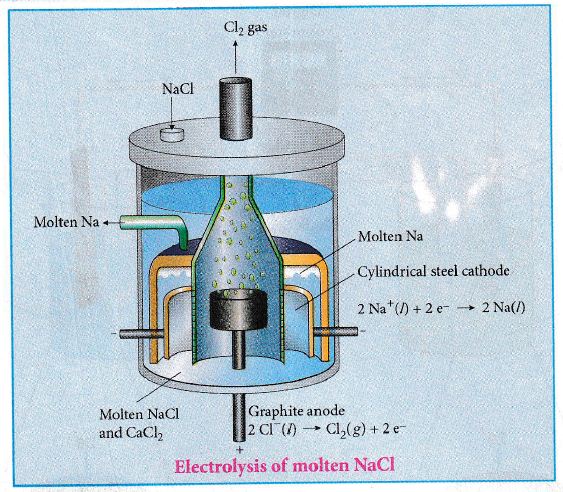
Cathode (reduction)
\(N a_{(l)}^{+}+e^{-} \rightarrow N a_{(l)} \quad ; \quad E^{0}=-2.71 V\)
Similarly, Cl- ions are attracted towards anode where they lose their electrons and oxidised to chlorine gas.
Anode (oxidation)
2CI-(l) ⟶ CI2(g) + 2e- E0 = -1.36V
The overall reaction is
2Na+(l) + 2Cl-(l)➝ 2Na(l) + Cl2(g) ; E° = - 4.07V
(ii) The negative E° value shows that the above reaction is a non-spontaneous one.
(iii) Hence, we have to supply a voltage greater than 4.07V to cause the electrolysis of molten NaCI.
(iv) In electrolytic cell, oxidation occurs at the anode and reduction occur at the cathode as in a galvanic cell.
(v) But the sign of the electrodes is the reverse i.e., in the electrolytic cell cathode is -ve and anode is +ve.
44.
(i) Preservatives are chemicals added to food which are capable of inhibiting, retarding or arresting the process of fermentation, acidification or other decomposition of food by the growth of micro organisms (or)
(ii) Chemical substances which are added to food that prevents the spoilage of food materials by destroying the food - spoiling micro-organisms are called food preservatives.
(iii) Eg: sodium benzoate, NaCl, Acetic acid Sodium metabisulphite, potassium meta bisulphite etc.
45.
(i) A catalyst is substance which alters the rate of a reaction without itself undergoing any permanent chemical change. They may participate in the reaction, but again regenerated and the end of the reaction. In the presence of a catalyst, the energy of activation is lowered and hence, greater number of molecules can cross the energy barrier and change over to products, thereby increasing the rate of the reaction.
(ii) The reaction between KMnO4 and H2SO4 and oxalic acid is catalysed by MnSO4 and increases the rate of oxidation of C2O42- by MnO4-.
46.
A Reaction whose rate depends on the reactant concentration raised to the first power is called a first order reaction. For a first order reaction,
A ⟶ product
Rate law can be expressed as
Rate = k[A]-1
\(\frac { -d\left[ A \right] }{ \left[ A \right] } =k dt\) ...(1)
Integrate the above equation between the limits of time t = 0 and time equal to t, while the concentration varies from the initial: concentration [Ao] to [A] at the later time.
\(\int _{ { [A }_{ 0 }] }^{ [A] }{ \frac { -d\left[ A \right] }{ \left[ A \right] } } =k\int _{ 0 }^{ t }{ dt } \)
\({ \left( -In\left[ A \right] \right) }_{ \left[ { A }_{ 0 } \right] }^{ \left[ A \right] }=k{ \left( t \right) }_{ 0 }^{ t }\)
\(-In\left[ A \right] -\left( In\left[ { A }_{ 0 } \right] \right) =k\left( t-0 \right) \)
\(-In\left[ A \right] -\left( In\left[ { A }_{ 0 } \right] \right) =kt\)
\(In\left( \frac { \left[ { A }_{ 0 } \right] }{ \left[ A \right] } \right) =kt\) ...(2)
This equation is in natural logarithm. To convert it into usual logarithm with base 10, we have to multiply the term by 2.303.
\(2.303\quad log\left( \frac { \left[ { A }_{ 0 } \right] }{ \left[ A \right] } \right) =kt\)
\(k=\frac { 2.303 }{ t } log\left( \frac { \left[ { A }_{ 0 } \right] }{ \left[ A \right] } \right) \) ...(3)
Equation (2) can be written in the form
y = mx+c as below
In [A0]-In[A] = kt
In[A] = In[A0]-kt
⇒ y = c + mx
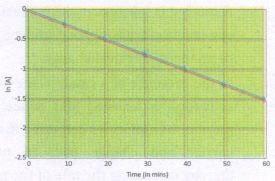
If we follow the reaction by measuring the concentration of the reactants at regular time interval 't' a plot of In[A] against 't' yields a straight line with a negative slope. From this, the rate constant is calculated.
47.
A reaction in which the rate is independent of the concentration of the reactant over a wide range of concentration is called a zero order reaction.
Let us consider the following by hypothetical zero order reaction.
A⟶ product
The rate law can be written as,
Rate = k[A]0
\(\frac { -d\left[ A \right] }{ dt } =k(1)\ \ \ \therefore \left( { \left[ A \right] }^{ 0 }=1 \right) \)
\(\Rightarrow -d\left[ A \right] =kdt\)
Integrate the above equation between the limits of [A0] at zero time and [A] at some later time 't',
\(-\int _{ \left[ { A }_{ 0 } \right] }^{ \left[ A \right] }{ d\left[ A \right] } =k\int _{ 0 }^{ t }{ dt } \)
\(-{ \left( \left[ A \right] \right) }_{ \left[ { A }_{ 0 } \right] }^{ \left[ A \right] }=k{ \left( t \right) }_{ 0 }^{ t }\)
[A0] - [A] = kt
\(k=\frac { \left[ { A }_{ 0 } \right] -\left[ A \right] }{ t } \)
Straight line equation y = mx + c
ie., \(\left[ A \right] =-kt+\left[ { A }_{ 0 } \right] \)
⇒ y = c + mx
A plot [A] vs time gives a straight line with a slope of -k and y intercept of [A0]
48.
(i) The elements in which the extra electron enters (n-2) f orbitals are called f-block elements. These elements are called as inner transition elements because they form a transition. Series within the transition elements.
(ii) The f-block elements are also called as rare earth elements. They are divided into lanthanoid series (4f block elements) and actinoid series (5f block elements).
49.
| hcp structure | ccp structure | |
| 1. | This is 'aba' pattern of arrangement. | This is 'abc' pattern of arrangement. |
| 2. | The spheres can be arranged so as to fit into the depression in such a way that the third layer is directly over a first layer. | The third layer may be placed over the second layer in such a way that all the spheres of the third layer fit in octahedral voids. |
| 3. | The tetrahedral voids of the second layer are covered by the spheres of the third layer. | This arrangement of the third layer is different from other two layers and the stacking of layers continued. |
| 4. | 6 spheres are present | 4 spheres are present |

12th Standard Syllabus & Materials
12th Standard
TN 12th Computer Applications களப்பெயர் முறைமை (DNS) Sample Question Papers Study Material - QB365 Set A
NEW12th Standard
TN 12th Computer Applications வலையமைப்பு எடுத்துக்காட்டுகள் மற்றும் நெறிமுறைகள் Sample Question Papers Study Material - QB365 Set A
NEW12th Standard
TN 12th Computer Applications கணினி வலையமைப்பு ஓர் அறிமுகம் Sample Question Papers Study Material - QB365 Set A
NEW12th Standard
TN 12th Computer Applications PHP-உடன் MySQL-ஐ இணைத்தல் Sample Question Papers Study Material - QB365 Set A



Tamilnadu Stateboard 12th Standard Subjects

Maths
Chemistry

Physics

Biology

Computer Science

Business Maths and Statistics

Economics

Commerce

Accountancy

History

Computer Applications
Biology
Computer Technology
Computer Applications
Computer Science
Business Maths and Statistics
Commerce
Economics
Maths
Chemistry
Physics
Computer Technology
History
Accountancy

Tamil

English

French
Tamilnadu Stateboard Standards
