
 100% FREE ACCESS
12th Standard Syllabus & Materials
12th Standard
TN 12th Computer Applications மின்னணு தரவு பரிமாற்றம் Sample Question Papers Study Material - QB365 Set A
NEW12th Standard
TN 12th Computer Applications மின் - வணிக பாதுகாப்பு அமைப்புகள் Sample Question Papers Study Material - QB365 Set A
NEW12th Standard
TN 12th Computer Applications மின்னணு செலுத்தல் முறைகள் Sample Question Papers Study Material - QB365 Set A
NEW12th Standard
TN 12th Computer Applications மின் - வணிகம் Sample Question Papers Study Material - QB365 Set A
NEW12th Standard
TN 12th Computer Applications திறந்த மூல கருத்துருக்கள் Sample Question Papers Study Material - QB365 Set A
NEW12th Standard
TN 12th Computer Applications வலையமைப்பு வடமிடல் Sample Question Papers Study Material - QB365 Set A

Published on: 27/02/2021
12th Standard English Medium Chemistry Reduced Syllabus Two mark Important Questions with Answer key - 2021(Public Exam )
Download Tamil Nadu 12th Standard Chemistry question papers, model tests, one-mark questions, important questions, and public exam papers in PDF format. Free study materials and answer keys for TN State Board students.
Questions + Answers key
Take MCQ Chemistry Test
1.
What are promoters? Give an example.
2.
Gelatin acts as a protective colloid. Explain.
3.
What are main impurities in a colloidal solution?
4.
Define adsorption isotherm.
5.
Define electrochemical equivalent.
6.
Name the anode, cathode and electrolyte used in lithium - ion Battery
7.
What is the principle used in secondary batteries to regenerate the original reactants?
8.
Explain the function of a salt bridge in an electrochemical cell.
9.
Account for the following : For a strong electrolyte molar conductivity decreases as concentration increases
10.
Define conductance. Give its unit
11.
Why is aqueous solution of FeCl3 acidic?
12.
What are the two types of buffer? Give an example for each.
13.
Derive the relation between f and R for a spherical mirror.
14.
Calculate the concentration of OH- in a fruit juice which contains \(2\times10^{-3}\) M, H3O+ ion. Identify the nature of the solution.
15.
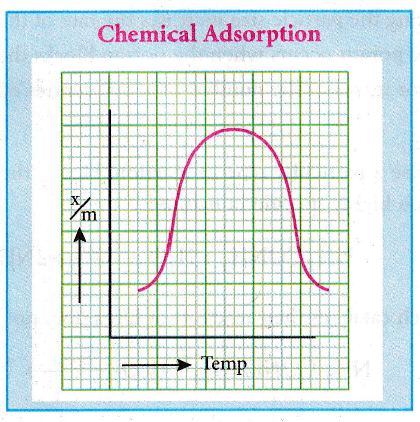
In case of chemisorption, why adsorption first increases and then decreases with temperature?
16.
Name one substance which can act as both analgesic and antipyretic.
17.
Name the Vitamins whose deficiency cause i) rickets ii) scurvy
18.
What are the conditions for alloy formation?
19.
If the rate of a reaction gets doubled as the temperature is increased from 27oC to 37oC. Find the activation energy of reaction?
20.
The reaction A + 2B ⟶ C obeys the rate equation. Rate = \(K{ \left[ A \right] }^{ \frac { 1 }{ 2 } }{ \left[ B \right] }^{ \frac { 3 }{ 2 } }\) What is the order of the reaction?
21.
What is the study of chemical kinetics used for?
22.
Account for the following:
(i) O-O bond lengths in ozone molecule are identical.
(ii) Most of the reactions in fluorine are exothermic.
23.
How is ammonia prepared in the lab?
24.
In CaF2 crystal, Ca2+ ions are present in arrangement. Calculate the number of F- ions in the unit cell.
25.
Aluminium crystallises in a fee structure. Atomic radius of the metal is 125 pm. What is the length of the side of the unit cell of the metal?
26.
What is the total number of atoms per unit cell in a face - centered cubic structure (fcc)?
27.
Name the two important ores of Boron.
28.
CuSO4 on mixing with NH3 (1:4 ratio) does not give test for Cu2+ ions but gives test for SO42-ions why?
29.
What is burnt alum?
30.
Why Zn2+ salts are white while Ni2+ salts are coloured?
31.
Write ionic equation for the reaction between Cr2O7-2 ions and Fe2+ ions in acidic medium.
32.
What is calcination? Give example.
33.
What are Co-ordination isomers? Give examples
34.
Name some elements that occur as native elements.
35.
Give reason for the following: Optical isomerism is not shown by square planar complexes.
36.
Write the IUPAC name of the complex.
37.
Give an example of coordination compound used in medicine and two examples of biologically important coordination compounds.
38.
Write the formula for the co-ordination compounds.
39.
What is catenation ? describe briefly the catenation property of carbon.
40.
What is the role of quick lime in the extraction of Iron from its oxide Fe2O3?
41.
Draw the major product formed when 1-ethoxyprop-1-ene is heated with one equivalent of HI.
42.
Why is anode in galvanic cell considered to be negative and cathode positive electrode?
43.
Derive integrated rate law for a zero order reaction A\(\longrightarrow \) product.
44.
Justify the position of lanthanoids and actinoids in the periodic table.
45.
Give the uses of helium.
46.
What happens when
i. 2 – Nitropropane boiled with HCl
ii. Nitrobenezene undergo electrolytic reduction in strongly acidic medium.
iii. Oxidation of tert – butylamine with KMnO4
iv. Oxidation of acetoneoxime with trifluoroperoxy acetic acid
47.
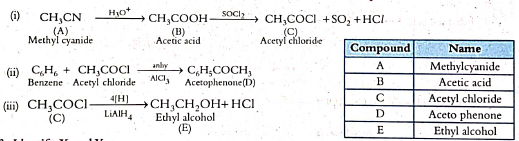
A Compound (A) with molecular formula C2H3N on acid hydrolysis gives (B) which reacts with thionylchloride to give compound(C). Benzene reacts with compound (C) in presence of anhydrous AlCl3 to give compound(D). Compound (D) on reduction with Zn/Hg and Conc.HCl gives (E). Identify (A), (B), (C) (D) and (E). Write the equations.
48.
Discuss the Lowry – Bronsted concept of acids and bases.
49.
Differentiate crystalline solids and amorphous solids.
1.
(i) A substance which, though itself not a catalyst, promotes the activity of a catalyst is called a promotor.
(ii) Eg: In the Haber's process for the synthesis of ammonia, traces of molybdenum increase the activity of finely divided iron which acts as acatalyst.
\({ N }_{ 2 }+{ 3H }_{ 2 }\overset { Fe }{ \underset { +mo }{ \leftrightharpoons } } { 2NH }_{ 3 }\)
2.
Gold sol is a lyophobic colloid which are readily precipitates with small amount of electrolytes. But they can be stabilised by the addition of small amount of lyophillic colloid like gelatin. Thus gelatin acts as a protective colloid for gold sol.
3.
The main impurities present in a colloidal solutions are electrolytes.
4.
A plot between the amount of adsorbate adsorbed and pressure or concentration of adsorbate at constant temperature is called adsorption isotherms.
5.
The electrochemical equivalent is defined as the amount of substance deposited or liberated at the electrode by a charge of 1 coulomb.
m = z (If I = 1 ampere and t = second).
6.
(i) Anode: Porous graphite
(ii) Cathode: Transition metal oxide such as CoO2
(iii) Electrolyte: Lithium salt in an organic solvent
7.
Electrochemical reactions which take place in a galvanic cell may be reversed by applying potential slightly greater than the emf generated by the cell. This principle is used in secondary batteries to regenerate the original reactants.
8.
The main functions of the salt bridge are
(i) To complete the electrical circuit by the allowing only ions to flow from one solution to other without mixing the two solutions.
(ii) To maintain electrical neutrality of the solution in the two half cells.
9.
(i) For a strong electrolyte, at high concentration, the number of constituent ions of the electrolyte in a given volume is high and hence the attractive force between the oppositely charged ions is also high.
(ii) Moreover the ions also experience a viscous drag due to greater solvation.
(iii) These factors attribute for the low molar conductivity at high concentration.
10.
The reciprocal of the resistance \((\frac{l}{R})\) gives the conductance of an electrolytic solution. The SI unit of conductance is Siemen (S).
11.
FeCl3 when dissolved in water gives strong acid HCl and a weak base Fe(OH)3 A strong acid ionises completely so concentration of H+ ion becomes much greater than OH- ion. So, aqueous solution of FeCl3 is acidic.
12.
(i) Acidic buffer solution: a solution containing a weak acid and its salt.
Example: Solution containing acetic acid and sodium acetate
(ii) Basic buffer solution: a solution containing a weak base and its salt.
Example: Solution containing NH4OH and NH4Cl.
13.
(i) C be the centre of curvature of the mirror.
(ii) Consider a light ray parallel to the principal axis is incident on the mirror at M and passes through the principal focus F after reflection. An.
(iii) The line CM is the normal to the mirror at M. Let i be the angle of incidence and the same will be the angle of reflection.
(iv) If MP is the perpendicular from M on the principal axis, then from the geometry.
(v) The angles ∠MCP = i and ∠MFP = 2i
(vi) From right -angle triangles ΔMCP and ΔMFP,
\(tani=\cfrac { PM }{ PC } \) and \(tan2i=\cfrac { PM }{ PF } \)
(vii) As the angles are small, tan i≈i
\(i=\cfrac { PM }{ PC } \) and \(2i=\cfrac { PM }{ PF } \)
(viii) Simplifying
\(2\cfrac { PM }{ PC } =\cfrac { PM }{ PF } ;2PF=PC\)
14.
Given that H3O+ = \(2\times10^{-3}M\)
\(K_{w}=[H_{3}O^{+}][OH^{-}]\)
\(\therefore [OH^{-}]=\frac{K_{w}}{[H_{3}O^{+}]}=\frac{1\times10^{-14}}{2\times10^{-3}}=0.5\times10^{-11}M\)
\(2\times10^{-3} >>0.5\times10^{-11}\)
i.e., [H3O+]>>[OH-], hence the juice is acidic in nature
15.
In chemical adsorption, \(\frac { x }{ m } \) increases with rise in temperature and then decreases. The increase illustrates the requirement of activation of the surface for adsorption is due to fact that formation of activated complex requires certain energy. The decrease at high temperature is due to desorption, as the kinetic energy of the adsorbate increases.
16.
Aspirin (o - acetyl salicylic acid) - is a substance which lowers body temperature and also reduces body pain. So it acts as both analgesic and antiphyretic.
17.
i) Rickets - Vitamin - D (Cholecalciferol - (D3) Ergocalciferol - (D2)
ii) Scurvy (bleeding gums) - vitamin - C (Ascorbic acid)
18.
(i) According to Hume-Rothery rule to, form a substitute alloy the difference between the atomic radii of solvent and solute is less than 15%.
(ii) Both the solvent and solute must have the same crystal structure and valence and their electro negativity difference must be close to zero.
19.
In \(\frac { { k }_{ 2 } }{ { k }_{ 1 } } =\frac { { E }_{ a } }{ R } \left[ \frac { { T }_{ 2 }-{ T }_{ 1 } }{ { T }_{ 1 }{ T }_{ 2 } } \right] \)
In 2 = \(\frac { { E }_{ a } }{ R } \) \(\left[ \frac { 10 }{ 300\times 310 } \right] \)
Ea = 9300 R In 2
= 53.4 kJ mol-1
20.
Order of the reaction = \(\frac { 1 }{ 2 } +\frac { 3 }{ 2 } =\frac { 4 }{ 2 } =2\)
The reaction is second order.
21.
The study of chemical kinetics helps us
(i) To determine the rate of a chemical reaction.
(ii) In optimizing the process conditions of industrial manufacturing processes.
22.
(i) The two O-O bond lengths are identical due to resonance.
(ii) Due to the strong bond formation with other elements.
23.
Ammonia is prepared in the laboratory by heating an ammonium salt with a base.
\({ 2NH }_{ 4 }^{ + }+{ OH }^{ - }\longrightarrow { 2NH }_{ 3 }+{ H }_{ 2 }O\)
\({ 2NH }_{ 4 }Cl+CaO\longrightarrow { CaCl }_{ 2 }+{ 2NH }_{ 3 }+{ H }_{ 2 }O\)
24.
No. of Ca2+ ions per unit cell
= 8 x \(\frac{1}{8}+6\times \frac{1}{2}\)
= 1 + 3 = 4
Hence No. of F- ions per unit cell = 2 x 4 = 8
25.
The length of the side of the unit cell of the metal is 353.55 pm.
For fee unit cell, a =(2√2) x r
= 2 x 1.414 x 125
= 353.55pm.
26.
Total number of atoms per unit cell in a fcc structure = 4 atoms.
27.
(i) Borax - Na2[B4O5.(OH)4].8H2O
(ii) Kernite - Na2[B4O5(OH)4]·2H2O
28.
It is because when NH3 coordinates to Cu2+ ions and it forms the complex [Cu (NH3)4]SO4 copper ions are present in coordination sphere, therefore they are non-ionisable whereas SO42- ions are counter ions which are ionisable.
29.
On heating to 475 K potash alum loses water of hydration and swells up. The swollen mass is known as burnt alum.
30.
(i) Ni2+ (3d8) - has two unpaired electrons, promotion of d orbital by absorption of energy possible - shows colour.
(ii) Zn2+ (3d10) - has no unpaired electron, no promotion of d orbitals possible - shows white colour.
31.
Cr2O72- + 14H+ + 6Fe2+ ⟶ 2Cr3+ + 6Fe3+ + 7H2O
32.
The conversion of ore into metal oxide (oxidation) is called calcination. It is the process in which the ore is subjected to the action of heat at high temperature in the absence of air below its melting point. Example
\({ CaCO }_{ 3 }(limestone)\longrightarrow CaO+{ CO }_{ 2 }\uparrow \)
\({ MgCO }_{ 3 }\left( Magnesite \right) \longrightarrow { MgO }+{ CO }_{ 2 }\uparrow \)
33.
Isomers that arises in the coordination compounds having both the cation and anion as complex ions. The interchange of one or more ligands between the cationic and the anionic coordination entities result in different isomers.
(i) [Cr(NH3)5CN] [Co(NH3) (CN)5] and [Co(NH3)5CN] [Cr(NH3)( CN)5]
(ii) [Pt(NH3)4] [Pd(CI)4] and [Pd(NH3)4] [Pt(Cl)4]
34.
Copper, Silver, Gold and Platinum
35.
Square planar complexes do not show optical isomerism because they contain a plane of symmetry.
36.
Sodium tetrafluoridodihydroxychromate (III) Na[CrF4(H2O)2]
37.
Medicinal uses
(i) Ca-EDTA chelate, is used in the treatment of lead and radioactive poisoning.
(ii) That is for removing lead and radioactive metal ions from the body.
(iii) Cis-platin is used as an antitumor drug in cancer treatment.
Biological Importance compounds:-
(i) Fe2+ - porphyrin complex: It plays an important role in carrying oxygen from lungs to tissues and tissue carbon dioxide from to lungs.
(ii) Chlorophyll - useful in photosynthesis in plants.
38.
a) potassiumhexacyanidoferrate(II) - Potassiumhexacyanidoferrate(II) - K4[Fe(CN)6]
b) Pentacarbonyliron(0) - [Fe(CO)5]
c) Pentaamminenitrito −kNcobalt(III)ion - [Co(NH3)5(NO2)]2+
d) Hexaamminecobalt(III) Sulphate - [CO(NH3)6](SO4)3
e) Sodiumtetrafluoridodihydroxidochromate(III) - Na2[CrF4(OH)2]
39.
Catenation is an ability of an element to form chain of atoms.
The conditions for catenation.
(a) The valency of element is greater than or equal to two.
(b) Element should have an ability to bond with itself
(c) The self bond must be as strong as Its bond with other elements
(d) Kinetic inertness of catenated compound towards other molecules.
(e) Carbon possesses all the above properties and forms a wide range of compounds with itself and with other elements such as H, O, N, S and halogens.
40.
In this extraction, a basic flux, quick lime (CaO) is used, since the silica gangue present in the ore is acidic in nature. The quick lime combines with it to form calcium silicate (slag).
CaO(s) + Sio2(s) ⟶ CaSio3(s)
Flux Gangue Slag
41.

42.
Anodic oxidation:
The electrode at which the oxidation occurs is called the anode. In Daniel cell, the oxidation take place at zinc electrode, i.e., zinc is oxidised to Zn2+ ions and the electrons. The Zn2+ ions enters the solution and the electrons enter the zinc metal, then flow through the external wire and then enter the copper strip. Electrons are liberated at zinc electrode and hence it is negative (-ve).
\({ Zn }_{ (s) }\longrightarrow { Zn }^{ 2+ }{ _{ (aq) } }+ 2{ e }^{ - } \) (loss of electron-oxidation)
Cathodic reduction:
The electrons flow through the circuit from zinc to copper, where the Cu2+ ions in the solution accept the electrons, get reduced to copper and the same get deposited on the electrode. Here, the electrons are consumed and hence it is positive (+ve).
\({ Cu }^{ 2+ }_{ (aq) }+{ 2e }^{ - }\longrightarrow { Cu }_{ (s) } \)(gain of electron-reduction)
43.
A reaction in which the rate is independent of the concentration of the reactant over a wide range of concentration is called a zero order reaction.
Let us consider the following by hypothetical zero order reaction.
A⟶ product
The rate law can be written as,
Rate = k[A]0
\(\frac { -d\left[ A \right] }{ dt } =k(1)\ \ \ \therefore \left( { \left[ A \right] }^{ 0 }=1 \right) \)
\(\Rightarrow -d\left[ A \right] =kdt\)
Integrate the above equation between the limits of [A0] at zero time and [A] at some later time 't',
\(-\int _{ \left[ { A }_{ 0 } \right] }^{ \left[ A \right] }{ d\left[ A \right] } =k\int _{ 0 }^{ t }{ dt } \)
\(-{ \left( \left[ A \right] \right) }_{ \left[ { A }_{ 0 } \right] }^{ \left[ A \right] }=k{ \left( t \right) }_{ 0 }^{ t }\)
[A0] - [A] = kt
\(k=\frac { \left[ { A }_{ 0 } \right] -\left[ A \right] }{ t } \)
Straight line equation y = mx + c
ie., \(\left[ A \right] =-kt+\left[ { A }_{ 0 } \right] \)
⇒ y = c + mx
A plot [A] vs time gives a straight line with a slope of -k and y intercept of [A0]
44.
(i) The actual position of Lanthanides in the periodic table is at group number 3 and period number 6. However, in the sixth period after lanthanum, the electrons are preferentially filled in inner 4f sub shell and these fourteen elements following lanthanum show similar chemical properties.
(ii) Similarly the fourteen elements following actinium resemble in their physical and chemical properties. Hence they are placed separately bottom of the modern periodic table.
45.
(i) Helium is used to provide inert atmosphere in electric-arc welding of metals.
(ii) Helium has lowest boiling point hence used in cryogenics.
(iii) It is much less denser than air and hence used for filling air balloons.
46.
i) 2 - nitro propane is boiled with HCI:
.JPG)
It gives acetone.
ii) Nitrobenzene on electrolytic reduction in strongly acidic medium:
.JPG)
It gives aniline, phenyl hydroxylamine and p - amino phenol
iii) Oxidation of text – butylamine with KMnO4:
.JPG)
It gives 2 - methyl - 2- nitro propane is obtained.
iv) Oxidation of acetoneoxime with trifluoroperoxy acetic acid.
.JPG)
It gives 2 - nitro propane.
47.
48.
(i) An acid is defined as a substance that has a tendency to donate a proton to another substance and base is a substance that has a tendency to accept a proton form other substance.
(ii) In other words, an acid is a proton donor and a base is a proton acceptor.
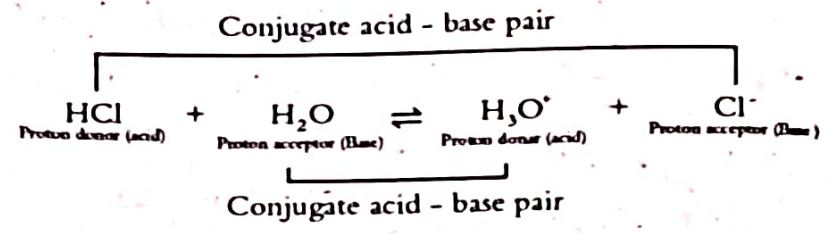
(iii) When hydrogen chloride is dissolved in water, it donates a proton to the later. Thus, HCI behaves as an acid and H2O is base. The proton transfer from the acid to base can be represented as
HCI + H2O ⇌ H3O+ + Cl-
(iv) When ammonia is dissolved in water, it accepts a proton from water. In this case, ammonia (NH3) acts as a base and H2O is acid. The reaction is represented as
H2O + NH3 ⇌ NH4+ + OH-
(v) Let us consider the reverse reaction following equilibrium.
\(\underset { proton\ donar\\ \quad \quad \ (acid) }{ HCl } +\underset { Proton\ acceptor\\ \quad \quad \quad \quad (base) }{ { H }_{ 2 }O } \leftrightharpoons \underset { Proton\ donar\\ \quad \quad \quad \quad \ (acid) }{ { H }_{ 2 }{ O }^{ + } } +\underset { Proton\ acceptor\\ \quad \quad \quad \quad \ (base) }{ { Cl }^{ - } } \)
H3O+ donates a proton to Cl- to form HCI i.e., the products also behave as acid and base.
(vi) In general, Lowry - Bronsted (acid - base) reaction is represented as
Acid1 + Base2 ⇌ Acid2 + Base1
(vii) The species that remains after the donation of a proton is a base (Base1) and is called the conjugate base of the Bronsted acid (Acid1). In other words, chemical species that differ only by a proton are called conjugate acid - base pairs.
49.
| S. No | Crystalline Solids | Amorphous Solids |
| 1. | Long range orderly arrangement of constituents. | Short range, random arrangement of constituents. |
| 2. | Definite shape | Irregular shape |
| 3. | Anisotropic in nature | They are "isotropic" like liquids |
| 4. | They are true solids | They are considered as pseudo solids (or) super cooled liquids |
| 5. | Definite Heat of fusion | Heat of fusion is not definite |
| 6. | They have sharp melting points. | Gradually soften over a range of temperature and so can be moulded. |
| 7. | Eg: NaCl, diamond etc. | Eg: Rubber, plastics, glass etc. |

12th Standard Syllabus & Materials
12th Standard
TN 12th Computer Applications களப்பெயர் முறைமை (DNS) Sample Question Papers Study Material - QB365 Set A
NEW12th Standard
TN 12th Computer Applications வலையமைப்பு எடுத்துக்காட்டுகள் மற்றும் நெறிமுறைகள் Sample Question Papers Study Material - QB365 Set A
NEW12th Standard
TN 12th Computer Applications கணினி வலையமைப்பு ஓர் அறிமுகம் Sample Question Papers Study Material - QB365 Set A
NEW12th Standard
TN 12th Computer Applications PHP-உடன் MySQL-ஐ இணைத்தல் Sample Question Papers Study Material - QB365 Set A



Tamilnadu Stateboard 12th Standard Subjects

Maths
Chemistry

Physics

Biology

Computer Science

Business Maths and Statistics

Economics

Commerce

Accountancy

History

Computer Applications
Biology
Computer Technology
Computer Applications
Computer Science
Business Maths and Statistics
Commerce
Economics
Maths
Chemistry
Physics
Computer Technology
History
Accountancy

Tamil

English

French
Tamilnadu Stateboard Standards
