
 100% FREE ACCESS
12th Standard Syllabus & Materials
12th Standard
TN 12th Maths Applications of Matrices and Determinants Sample Question Papers Study Material - QB365 Set A
NEW12th Standard
TN 12th Computer Applications மின்னணு தரவு பரிமாற்றம் Sample Question Papers Study Material - QB365 Set A
NEW12th Standard
TN 12th Computer Applications மின் - வணிக பாதுகாப்பு அமைப்புகள் Sample Question Papers Study Material - QB365 Set A
NEW12th Standard
TN 12th Computer Applications மின்னணு செலுத்தல் முறைகள் Sample Question Papers Study Material - QB365 Set A
NEW12th Standard
TN 12th Computer Applications மின் - வணிகம் Sample Question Papers Study Material - QB365 Set A
NEW12th Standard
TN 12th Computer Applications திறந்த மூல கருத்துருக்கள் Sample Question Papers Study Material - QB365 Set A

Published on: 13/05/2022
QB365 provides detailed and simple solution for every Creative Questions in class 12 Chemistry Subject. It will helps to get more idea about question pattern in every Creative questions with solution.
latest Creative QuestionsDownload Tamil Nadu 12th Standard Chemistry question papers, model tests, one-mark questions, important questions, and public exam papers in PDF format. Free study materials and answer keys for TN State Board students.
Questions + Answers key
Take MCQ Chemistry Test1.
Show the formation of a peptide bond with an equation.
2.
Outline the classification of carbohydrates giving example for each.
3.
List the importance of proteins in biological processes.
4.
Elucidate the structure of fructose.
5.
Give the uses of carbohydrates.
1.
(i) The bond formed between two amino acids by the elimination of a water molecule is called peptide linkage or bond
(ii) The amino group of one amino acid and a carboxyl group of other amino acid undergoes condensation to remove a water molecule and it results in the formation of bond.

(iii) The product formed by linking amino acid molecules through peptide linkages is called a peptide.
(iv) In peptide formation the two different amino acid molecules may react in one of the two ways.
\({ NH }_{ 2 }-{ CH }_{ 2 }-COOH+{ H }_{ 2 }N-\overset { \underset { | }{ { CH }_{ 3 } } }{ CH } -COOH\longrightarrow { H }_{ 2 }N-{ CH }_{ 2 }-CO-NH-\overset { \underset { | }{ { CH }_{ 3 } } }{ CH } -COOH\)
\({ H }_{ 2 }N-\underset { Alanine }{ \overset { \underset { | }{ \overset { Glycine }{ { CH }_{ 3 } } } }{ CH } } -COOH+{ H }_{ 2 }N-\underset { Glycine }{ { CH }_{ 2 } } -COOH\longrightarrow \underset { Alanyl\quad glycine\quad (Dipeptide) }{ { H }_{ 2 }N-\overset { \underset { | }{ { CH }_{ 3 } } }{ CH } -CO-NH } -{ CH }_{ 2 }COOH\)
2.
Carbohydrates are polyhydroxy aldehydes or polyhydroxy ketones.
The carbohydrates may be summarised as below.
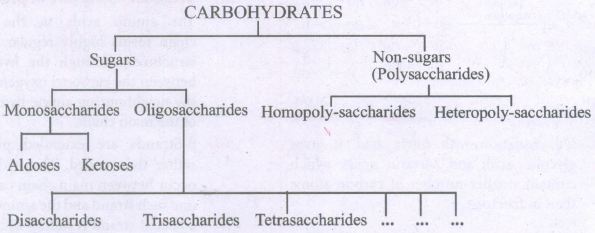
(i) Sugar: They are sweet crystalline substance and soluble in water.
(a) Monosaccharides: They are polyhydroxy aldehydes (or) polyhydroxy ketones.
Aldoses - Carbohydrates containing aldehyde group. Eg: Glucose
Ketoses - Carbohydrates containing ketone group. Eg: Fructose.
(b) Oligosaccharides: They are sugars that yield two to ten monosaccharide molecules on hydrolysis.
Disaccharides: They are sugars which on hydrolysis give two molecules of same or different monosaccharides. Eg: Sucrose, maltose.
\(\underset { Sucrose }{ { C }_{ 12 }{ H }_{ 22 }{ O }_{ 11 } } +{ H }_{ 2 }O\longrightarrow \underset { Glucose }{ { C }_{ 6 }{ H }_{ 12 }{ C }_{ 6 } } +\underset { Frutose }{ { C }_{ 6 }{ H }_{ 12 }{ O }_{ 6 } } \)
Trisaccharides: They are sugars which gives three molecules of monosaccharides on hydrolysis
Eg: Raffinose
\(\underset { Raffinose }{ { C }_{ 18 }{ H }_{ 32 }{ O }_{ 16 } } +{ 2H }_{ 2 }O\longrightarrow \underset { Gialactose }{ { C }_{ 6 }{ H }_{ 12 }{ O }_{ 6 } } +\underset { Glucose }{ { C }_{ 6 }{ H }_{ 12 }{ O }_{ 6 } } +\underset { Frutose }{ { C }_{ 6 }{ H }_{ 12 }{ O }_{ 6 } } \)
(ii) Non-sugars (or) Polysaccharides:
They are non-sugars which involve a large number of monosaccharide units linked to each other by oxide bridges. These bridges are called glycosidic linkages. Eg: starch, cellulose.
\(\underset { Starch }{ \left( { C }_{ 6 }{ H }_{ 10 }{ O }_{ 5 } \right) _{ n } } +n{ H }_{ 2 }O\overset { { H }^{ + } }{ \longrightarrow } \underset { Glucose }{ { nC }_{ 6 }{ H }_{ 12 }{ O }_{ 6 } } \)
3.
Importance of proteins:
Proteins are the functional units of living things : play vital role in all biological processes
(i) All biochemical reactions occur in the living systems are catalysed by the catalytic proteins called enzymes.
(ii) Proteins such as keratin, collagen acts as structural back bones.
(iii) Proteins are used for transporting molecules (Haemoglobin), organelles (Kinesins) in the cell and control the movement of molecules in and out of the cells (Transporters).
(iv) Antibodies help the body to fight various diseases
(v) Proteins are used as messengers to coordinate many functions. Insulin & glucagon controls the glucose level in the blood.
(vi) Proteins act as receptors that detect presence of certain signal molecules and activate the proper response.
(vii) Proteins are also used to store metals such as iron (Ferritin) etc.
4.
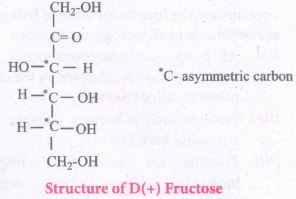
Structure of fructose: Fructose is the sweetest of all known sugars. It is readily soluble in water. Fresh solution of fructose has a specific rotation -1330 which changes to - 920 at equilibrium due to mutarotation. Similar to glucose, the structure of fructose is deduced from the following facts.
(i) Elemental analysis and molecular weight determination of fructose show that it has the molecular formula C6H12O6.
(ii) Fructose on reduction with HI and red phosphorus gives a mixture of n - hexane (major product) and 2 - iodohexane (minor product). This reaction indicates that the six carbon atoms in fructose are in a straight chain.

(ii) Fructose reacts with NH2OH and HCN. It shows the presence of carbonyl groups in the molecule of fructose.
(iv) Fructose reacts with acetic anhydride in the presence of pyridine to form penta acetate. This reaction indicates the presence of five hydroxyl groups in a fructose molecule. ,
(v) Fructose is not oxidized by bromine water. This rules out the possibility of presence of an aldehyde (-CHO) group.
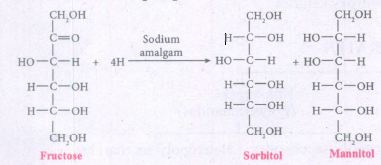
(vi) Partial reduction of fructose with sodium amalgam and water produces mixtures of sorbitol and mannitol which are epimers at second carbon. New asymmetric carbon is formed at C-2. This confirms the presence of keto group.
(vii) On oxidation with nitric acid, it gives glycolic acid and tartaric acids which contain smaller number of carbon atoms than in fructose.
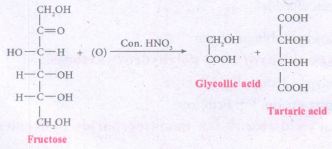
This shows that a keto group is present in C-2. It also shows the presence of 10 alcoholic groups at C- 1 and C- 6
5.
Importance of carbohydrates:
(i) Carbohydrates, widely distributed in plants and animals, acts mainly as energy sources and structural polymers.
(ii) Carbohydrate is stored in the body as glycogen and in plant as starch.
(iii) Carbohydrates such as cellulose which is the primary components of plant cell wall, is used to make paper, furniture (wood) and cloths (cotton)
(iv) Simple sugar glucose serves as an instant source of energy.
(v) Ribose sugars are one of the components of nucleic acids.
(vi) Modified carbohydrates such as hyaluronate (glycosaminoglycans) act as shock absorber and lubricant.

12th Standard Syllabus & Materials
12th Standard
TN 12th Computer Applications வலையமைப்பு வடமிடல் Sample Question Papers Study Material - QB365 Set A
NEW12th Standard
TN 12th Computer Applications களப்பெயர் முறைமை (DNS) Sample Question Papers Study Material - QB365 Set A
NEW12th Standard
TN 12th Computer Applications வலையமைப்பு எடுத்துக்காட்டுகள் மற்றும் நெறிமுறைகள் Sample Question Papers Study Material - QB365 Set A
NEW12th Standard
TN 12th Computer Applications கணினி வலையமைப்பு ஓர் அறிமுகம் Sample Question Papers Study Material - QB365 Set A



Tamilnadu Stateboard 12th Standard Subjects

Maths
Chemistry

Physics

Biology

Computer Science

Business Maths and Statistics

Economics

Commerce

Accountancy

History

Computer Applications
Biology
Computer Technology
Computer Applications
Computer Science
Business Maths and Statistics
Commerce
Economics
Maths
Chemistry
Physics
Computer Technology
History
Accountancy

Tamil

English

French
Tamilnadu Stateboard Standards



