
 100% FREE ACCESS
12th Standard Syllabus & Materials
12th Standard
TN 12th Maths Applications of Matrices and Determinants Sample Question Papers Study Material - QB365 Set A
NEW12th Standard
TN 12th Computer Applications மின்னணு தரவு பரிமாற்றம் Sample Question Papers Study Material - QB365 Set A
NEW12th Standard
TN 12th Computer Applications மின் - வணிக பாதுகாப்பு அமைப்புகள் Sample Question Papers Study Material - QB365 Set A
NEW12th Standard
TN 12th Computer Applications மின்னணு செலுத்தல் முறைகள் Sample Question Papers Study Material - QB365 Set A
NEW12th Standard
TN 12th Computer Applications மின் - வணிகம் Sample Question Papers Study Material - QB365 Set A
NEW12th Standard
TN 12th Computer Applications திறந்த மூல கருத்துருக்கள் Sample Question Papers Study Material - QB365 Set A

Published on: 02/06/2021
QB365 provides detailed and simple solution for every Book back Questions in class 12 Chemistry Subject. It will helps to get more idea about question pattern in every book back questions with solution.
Download Tamil Nadu 12th Standard Chemistry question papers, model tests, one-mark questions, important questions, and public exam papers in PDF format. Free study materials and answer keys for TN State Board students.
Questions + Answers key
Take MCQ Chemistry Test1.
What is angle of deviation due to reflection?
2.
Heat of adsorption is greater for chemisorptions than physisorption. Why?
3.
Name one substance which can act as both analgesic and antipyretic.
4.
Write the Zwitter ion structure of alanine
5.
The concentration of hydroxide ion in a water sample is found to be 2.5 × 10⁻⁶M. Identify the nature of the solution.
6.
Write the IUPAC names for the following complexes.
7.
Explain why fluorine always exhibit an oxidation state of -1?
8.
What is catenation ? describe briefly the catenation property of carbon.
9.
What is the role of quick lime in the extraction of Iron from its oxide Fe2O3?
10.
Arrange the following in the increasing order of their boiling point and give a reason for your ordering
(i) Butan – 2- ol, Butan -1-ol, 2 –methylpropan -2-ol
(ii) Propan -1-ol, propan -1,2,3-triol, propan -1,3 – diol, propan -2-ol
11.
State Faraday’s Laws of electrolysis
12.
Explain the effect of catalyst on reaction rate with an example.
13.
Justify the position of lanthanoids and actinoids in the periodic table.
14.
Give any three characteristics of ionic crystals.
15.
Write short notes on the following
i. Hofmann’s bromide reaction
ii. Ammonolysis
iii. Gabriel phthalimide synthesis
iv. Schotten – Baumann reaction
v. Carbylamine reaction
vi. Mustard oil reaction
vii. Coupling reaction
viii. Diazotisation
ix. Gomberg reaction
1.
The angle between the incident and deviated light ray is called angle of deviation of the light ray.
2.
In Chemisorptions the molecules are held on the surface by attractive forces by formation of chemical bonds. As strong bond is formed nearly 400 kJ / mol is given out as heat of adsorption chemical bonds are much stronger, whereas the Vander Waal's forces in physisorption is weaker.
3.
Aspirin (o - acetyl salicylic acid) - is a substance which lowers body temperature and also reduces body pain. So it acts as both analgesic and antiphyretic.
4.
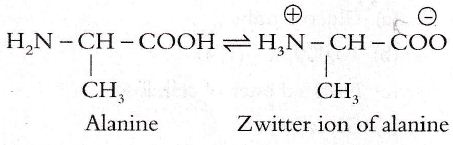
5.
1. If \(\left[\mathrm{OH}^{-}\right]>1 \times 10^{-7} \mathrm{M}\), the solution is basic. \(2.5 \times 10^{-6} \mathrm{M}>1 \times 10^{-7} \mathrm{M}\)
2. \(\therefore\) The solution is basic.
6.
i) Na2[Ni(EDTA)] - Sodium 2, 2', 2",2'" - (ethane-1,2 diyldinitrilo tetraacetatonickelate)(II)
ii) [Ag(CN)2]- - Dicyanido-kC-argentate (I) ion
iii) [CO(en)3]2(SO4)3 - Tris (ethane 1, 2 diamine)cobalt (III) sulphate
iv) [CO(ONO)(NH3)5]2+ - Pentaamminenitrito - KO cobalt (III) ion
v) [Pt(NH3)2Cl(NO2)] - Diammainechloridonitro - kN - platinum (II)
7.
(i) Fluorine is most electronegative atom.
(ii) It has only one unpaired electron.
8.
Catenation is an ability of an element to form chain of atoms.
The conditions for catenation.
(a) The valency of element is greater than or equal to two.
(b) Element should have an ability to bond with itself
(c) The self bond must be as strong as Its bond with other elements
(d) Kinetic inertness of catenated compound towards other molecules.
(e) Carbon possesses all the above properties and forms a wide range of compounds with itself and with other elements such as H, O, N, S and halogens.
9.
In this extraction, a basic flux, quick lime (CaO) is used, since the silica gangue present in the ore is acidic in nature. The quick lime combines with it to form calcium silicate (slag).
CaO(s) + Sio2(s) ⟶ CaSio3(s)
Flux Gangue Slag
10.
(i) 2-methyl propan-2-o1 < Butan-2-ol < Butan-1-ol
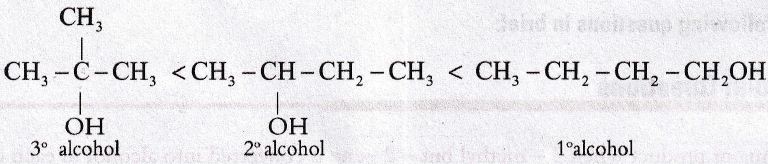
(ii) propan-2-ol < propan-1-ol < propan -1,3- diol < propan-1,2,3-triol
11.
First law:
The mass of the substance (m) liberated at an electrode during electrolysis is directly proportional to the quantity of charge (Q) passed through the cell.
m α Q \(\left[\because \mathrm{I}=\frac{\mathrm{Q}}{\mathrm{t}} \Rightarrow \mathrm{Q}=\mathrm{It}\right]\)
m α It
m = ZIt
Where Z = electro chemical equivalent of the substance
I = current
t = time of passage of current
Second law:
When the same quantity of charge is passed through the solutions of different electrolytes, the amount of substances liberated at the respective electrodes are directly proportional to their electrochemical equivalents.
m α Z
\(\frac{m_{1}}{Z_{1}}=\frac{m_{2}}{Z_{2}}\)
m = mass of the metal deposited
Z = electro chemical equivalent
12.
(i) A catalyst is substance which alters the rate of a reaction without itself undergoing any permanent chemical change. They may participate in the reaction, but again regenerated and the end of the reaction. In the presence of a catalyst, the energy of activation is lowered and hence, greater number of molecules can cross the energy barrier and change over to products, thereby increasing the rate of the reaction.
(ii) The reaction between KMnO4 and H2SO4 and oxalic acid is catalysed by MnSO4 and increases the rate of oxidation of C2O42- by MnO4-.
13.
(i) The actual position of Lanthanides in the periodic table is at group number 3 and period number 6. However, in the sixth period after lanthanum, the electrons are preferentially filled in inner 4f sub shell and these fourteen elements following lanthanum show similar chemical properties.
(ii) Similarly the fourteen elements following actinium resemble in their physical and chemical properties. Hence they are placed separately bottom of the modern periodic table.
14.
(i) Ionic solids have high melting points.
(ii) These solids do not conduct electricity, because the ions are fixed in their lattice positions.
(iii) They are hard so strong external force can change the relative positions of ions.
15.
Hoffmann's bromide reaction:
When Amides are treated with bromine in the presence of aqueous or ethanolic solution of KOH, primary amines with one carbon atom less than the parent amides are obtained.
\(\underset { \quad \quad \quad amide\\ R=Alkyl(or)Aryl }{ R-\overset { \underset { || }{ O } }{ C } -{ NH }_{ 2 } } \overset { { Br }_{ 2 }/KOH }{ \longrightarrow } \underset { Primary\quad amine }{ R-{ NH }_{ 2 }+{ K }_{ 2 }{ CO }_{ 3 } } +KBr+{ H }_{ 2 }O\)
(ii) Hoffmann's ammonolysis:
When Alkyl halides (or) benzylhalides are heated with alcoholic ammonia in a sealed tube, mixtures of 1°, 2° and 3° amines and quaternary ammonium salts are obtained.
\( { CH }_{ 3 }-Br\overset { \ddot { N } { H }_{ 3 } }{ \underset { \Delta }{ \longrightarrow } } \underset { { 1 }^{ 0 }-amine }{ { CH }_{ 3 }-\ddot { N } { H }_{ 2 } } \overset { { CH }_{ 3 }-Br }{ \longrightarrow } \underset { { 3 }^{ o }-amine }{ \left( { CH }_{ 3 } \right) _{ 2 }\ddot { N } H } \overset { { CH }_{ 3 }Br }{ \longrightarrow } \underset { 3^{ o }-amine }{ \left( { { CH }_{ 3 } } \right) _{ 3 }\ddot { N } } \overset { CH_{ 3 }Br }{ \longrightarrow } \underset { Quartenary \ ammonium\ bromide }{ \left( { CH }_{ 3 } \right) _{ 4 }\overset { + }{ N } { Br }^{ - } } \)
This is a nucleophilic substitution, the halide ion of alkyl halide is substituted by the -NH2 group. The product primary amine so formed can also has a tendency to act as a nucleophile and hence if excess alkyl halide is taken, further nucleophilic substitution takes place leading to the formation of quarternary ammonium salt. However, if the process is carried out with excess ammonia, primary amine is obtained as the major product. The order of reactivity of alkylhalides with amines
RI > RBr > RCl
(iii) Gabriel phthalimide synthesis:
Gabriel synthesis is used for the preparation of Aliphatic primary amines. Phthalimide on treatment with ethanolic KOH forms potassium salt of phthalimide which on heating with alkyl halide followed by alkaline hydrolysis gives primary amine. Aniline cannot be prepared by this method because the arylhalides do not undergo nucleophilic substitution with the anion formed by phthalimide.
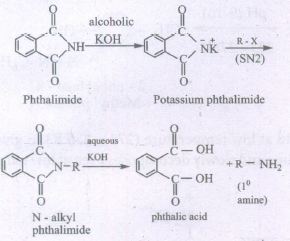
(iv) Schotten - Baumann reaction :
Aniline reacts with benzoylchloride (C6H5COCI) in the presence of NaOH to give N - phenyl benzamide. This reaction is known as Schotten - Baumann reaction. The acylation and benzoylation are nucleophilic substitutions.
\(\underset { Aniline }{ { C }_{ 6 }{ H }_{ 5 }-{ NH }_{ 2 } } +\underset { Benzoyl\quad chloride }{ { C }_{ 6 }{ H }_{ 5 }-\overset { \underset { || }{ O } }{ C } -Cl } \overset { Pyridine }{ \longrightarrow } \underset { N-phenyl\quad benzamide }{ { C }_{ 6 }{ H }_{ 5 }-NH-\overset { \underset { || }{ O } }{ C } -{ C }_{ 6 }{ H }_{ 5 } } +HCl\)
(v) Carbylamine reaction :
Aliphatic (or) aromatic primary amines react with: chloroform and alcoholic KOH to give isocyanides (carbylamines), which has an unpleasant smell. This reaction is known as carbylamines test. This test used to identify the primary amines.
\(\underset { Ethylamine }{ { C }_{ 2 }{ H }_{ 5 }-{ NH }_{ 2 } } +\underset { Chloroform }{ { CHCl }_{ 3 }+3KOH } \longrightarrow \underset { Ethylisocyanide }{ { C }_{ 2 }{ H }_{ 5 }-NC } +3KCl+3{ H }_{ 2 }O\)
(vi) Mustard oil reaction:
(a) When primary amines are treated with carbon disulphide (CS2), N - alkyldithio carbonic acid is formed which on subsequent treatment with HgCI2, gives an alkyl isothiocyanate.
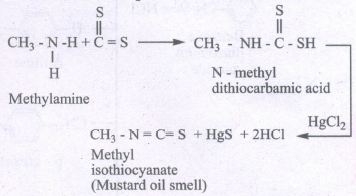
(b) When aniline is treated with carbon disulphide, or heated together, S-diphenylthio urea is formed, which on boiling with strong HCI, phenyl isothiocyanate (phenyl mustard oil), is formed.
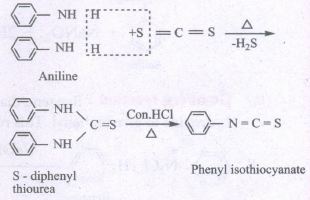
These reactions are known as Hofmann - Mustard oil reaction. This test is used to identify the primary amines.
(vii) Coupling reactions (or) p-hydroxyazobenzene, p-aminoazobenzene, 2-phenyl azo-4-methyl phenol:
Benzene diazonium chloride reacts with electron rich aromatic compounds like phenol, aniline to form brightly coloured azo compounds. Coupling generally occurs at the para position. If para position is occupied then coupling occurs at the ortho position. Coupling tendency is enhanced if an electron donating group is present at the para - position to -N2CI- group. This is an electrophilic substitution.
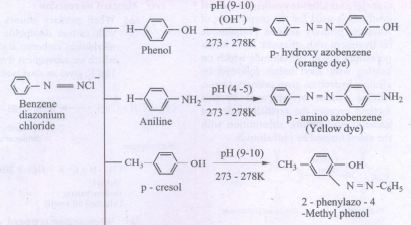
Aryl fluorides and iodides cannot be prepared by direct halogenation and the cyano group cannot be introduced by nucleophilic substitution of chlorine in chlorobenzene. For introducing such a halide group. cyano group -OH, NO2, etc.. benzenediazonium chloride is a very good intermediate Diazo compounds obtained from the coupling reactions of diazonium salts are coloured and are used as dyes.
(viii) Diazotisation :
Aniline reacts with nitrous acid at low temperature (273 - 278 K) to give benzene. Diazonium chloride which is stable for a short time and slowly decomposes even at low temperatures.This reaction is known as diazotization
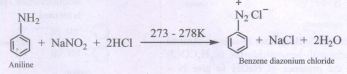
(ix) Gomberg reaction :
Benzene diazonium chloride reacts with benzene in the presence of sodium hydroxide to give biphenyl. This reaction in known as the Gomberg reaction


12th Standard Syllabus & Materials
12th Standard
TN 12th Computer Applications வலையமைப்பு வடமிடல் Sample Question Papers Study Material - QB365 Set A
NEW12th Standard
TN 12th Computer Applications களப்பெயர் முறைமை (DNS) Sample Question Papers Study Material - QB365 Set A
NEW12th Standard
TN 12th Computer Applications வலையமைப்பு எடுத்துக்காட்டுகள் மற்றும் நெறிமுறைகள் Sample Question Papers Study Material - QB365 Set A
NEW12th Standard
TN 12th Computer Applications கணினி வலையமைப்பு ஓர் அறிமுகம் Sample Question Papers Study Material - QB365 Set A



Tamilnadu Stateboard 12th Standard Subjects

Maths
Chemistry

Physics

Biology

Computer Science

Business Maths and Statistics

Economics

Commerce

Accountancy

History

Computer Applications
Biology
Computer Technology
Computer Applications
Computer Science
Business Maths and Statistics
Commerce
Economics
Maths
Chemistry
Physics
Computer Technology
History
Accountancy

Tamil

English

French
Tamilnadu Stateboard Standards



