
 100% FREE ACCESS
12th Standard Syllabus & Materials
12th Standard
TN 12th Computer Applications மின்னணு தரவு பரிமாற்றம் Sample Question Papers Study Material - QB365 Set A
NEW12th Standard
TN 12th Computer Applications மின் - வணிக பாதுகாப்பு அமைப்புகள் Sample Question Papers Study Material - QB365 Set A
NEW12th Standard
TN 12th Computer Applications மின்னணு செலுத்தல் முறைகள் Sample Question Papers Study Material - QB365 Set A
NEW12th Standard
TN 12th Computer Applications மின் - வணிகம் Sample Question Papers Study Material - QB365 Set A
NEW12th Standard
TN 12th Computer Applications திறந்த மூல கருத்துருக்கள் Sample Question Papers Study Material - QB365 Set A
NEW12th Standard
TN 12th Computer Applications வலையமைப்பு வடமிடல் Sample Question Papers Study Material - QB365 Set A

Published on: 13/05/2022
QB365 provides detailed and simple solution for every Book back Questions in class 12 Chemistry Subject. It will helps to get more idea about question pattern in every book back questions with solution.
latest Book back QuestionsDownload Tamil Nadu 12th Standard Chemistry question papers, model tests, one-mark questions, important questions, and public exam papers in PDF format. Free study materials and answer keys for TN State Board students.
Questions + Answers key
Take MCQ Chemistry Test1.
A conductivity cell has two platinum electrodes separated by a distance 1.5 cm and the cross sectional area of each electrode is 4.5 sq cm. Using this cell, the resistance of 0.5 N electrolytic solution was measured as 15 Ω. Find the specific conductance of the solution.
2.
The mechanism of Fridel crafts reaction is given below
\({ C }_{ 6 }{ H }_{ 5 }+{ { CH }_{ 3 }Cl\overset { anhydrous\\ \quad { Alcl }_{ 3 } }{ \longrightarrow } }{ C }_{ 6 }{ H }_{ 5 }{ CH }_{ 3 }+HCl\)
3.
When aqueous ammonia is added to CuSO4 solution, the solution turns deep blue due to the formation of tetra ammine copper (II) complex,\({ [Cu({ H }_{ 2 }O)_4] }_{ (aq) }^{ 2+ }+ 4{ NH }_{ 3 }(aq)\rightleftharpoons { [Cu{ ({ NH }_{ 3 }) }_{ 4 }] }_{ (aq) }^{ 2+ }\) among H2O and NH3 Which is stronger Lewis base.
4.
Why Gd3+ is colourless?
5.
Arrange the following in order of increasing molar conductivity
(i) Mg[Cr(NH3)(Cl)5]
(ii) Cr(NH3)5Cl]3[CoF6]2
(iii) [Cr(NH3)3Cl3]
6.
Chalcogens belongs to p-block. Give reason.
7.
Write a note on Fisher tropsch synthesis.
8.
Can we use nucelophiles such as NH3,CH3O - for the Nucleophilic substitution of alcohols
9.
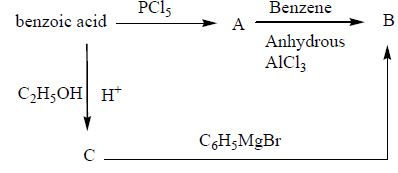
Identify A, B and C
10.
What are food preservatives?
11.
Explain the effect of catalyst on reaction rate with an example.
12.
13.
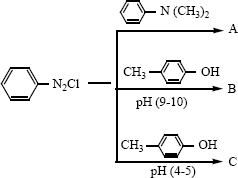
Identify compounds A, B and C in the following sequence of reactions.
i) \({ C }_{ 6 }{ H }_{ 5 }NO_{ 2 }\overset { Fe/HCL }{ \longrightarrow } A\overset { HN{ O }_{ 2 } }{ \underset { 273K }{ \longrightarrow } } B\overset { { C }_{ 6 }{ H }_{ 5 }OH }{ \longrightarrow } C\)
ii) \({ C }_{ 6 }{ H }_{ 5 }N_{ 2 }cl\overset { CuCN }{ \longrightarrow } A\overset { H_{ 2 }O/H^{ + } }{ \longrightarrow } B\overset { NH_3 }{ \longrightarrow } C\)
iii) \({ C }{ H }_{ 3 }{ C }{ H }_{ 2 }I\overset { NaCN}{ \longrightarrow } A\overset {OH^-}{ \underset {Partial hydrolysis}{ \longrightarrow } } B\overset {NaOH+Br_2 }{ \longrightarrow } C\)
iv) \({ C }{ H }_{ 3 }NH_{ 2 }\overset { CH_3 Br }{ \longrightarrow } A\overset { CH_{ 3 }COCl}{ \longrightarrow } B\overset { B_2H_6 }{ \longrightarrow } C\)
v) \({ C }_{ 6 }{ H }_{ 5 }NH_{ 2 }\overset { (CH_{ 3 }CO)_{ 2 }O }{ \underset { Pyridine }{ \longrightarrow } } A\overset { HNO_{ 3 } }{ \underset { H_{ 2 }SO_{ 4 },288K }{ \longrightarrow } } B\overset { { H }_{ 2 }O/{ H }^{ + } }{ \longrightarrow C } \)
vi)
vii) \({ C }{ H }_{ 3 }CN_{ 2 }NC\overset { HgO }{ \longrightarrow } A\overset { H_{ 2 }O }{ \longrightarrow } B\overset { i) NaN{ O }_{ 2 }/HCL }{ \underset { ii){ H }_{ 2 }O }{ \longrightarrow } } \)
14.
Write a short note on peptide bond.
1.
l = 1.5 cm = 1.5 × 10⁻²m
A = 4.5 cm2 = 4.5 × (10-4)m2
R = 15Ω
\(\kappa = \frac{1}{R}(\frac{l}{A})\)
\(\kappa = \frac{1}{15\Omega}\times\frac{1.5\times10^{-2}m}{4.5\times10^{-4}m^2}\)
= 2.22 ohm-1 m-1
= 2.22 Sm-1
2.
The action of catalyst is explained as follows
CH3Cl + AlCl3 → [CH3 ]+[AlCl4]-
It is an intermediate.
C6H6 + [CH3+][AlCl4]- → C6H5CH3 + AlCl3 + HCl
3.
(i) According to Lewis theory a species that donates a pair of electron is called Lewis base.
(ii) Nitrogen more in NH3 is less electro negative than oxygen in water. So the non - bonded electron pair on nitrogen is more available for sharing than a non - bonded electron pair on oxygen atom. So NH3 is a stronger lewis base than H2O.
4.
In Gd+3 there are 64 electrons. Hence electronic configuration will be [Xe]4f7 5d1 6s2. Hence no electrons are there in outer d - orbital. Due to this it is colourless.
5.
(i) \(\mathrm{Mg}\left[\mathrm{Cr}\left(\mathrm{NH}_{3}\right) \mathrm{Cl}_{5}\right]^{2-} \rightleftharpoons \mathrm{Mg}^{2+}+\left[\mathrm{Cr}\left(\mathrm{NH}_{3}\right) \mathrm{Cl}_{5}\right]^{2-} (2 ions)\)
(ii) \(\begin{aligned}
{\left[\mathrm{Cr}\left(\mathrm{NH}_3\right)_5 \mathrm{Cl}_3\left[\mathrm{CoF}_6\right]_2 \rightleftharpoons 3\right.} & {\left[\mathrm{Cr}\left(\mathrm{NH}_3\right)_5 \mathrm{Cl}\right]^{2+} } \\
& (5 \text { ions })
\end{aligned}\)\(+2\left[\mathrm{CoF}_6\right]^{3-}\)
(iii) \(\left[\mathrm{Cr}\left(\mathrm{NH}_{3}\right)_{3} \mathrm{Cl}_{3}\right]= \text{ No ions}\)
If no of ions increases, molar conductivity increases molar conductivity of the complex also INCREASES.
\(\therefore\) The order of the given compound is
[Cr(NH3)3Cl3]<Mg[Cr(NH3)3Cl3] < [Cr(NH3)5Cl3] [CoF6]2
(No ion) (2 ions) (5 ions)
6.
(i) The Chalcogens belong to group (16).
(ii) The group consists of elements: Oxygen, Sulphur, Selenium, Tellurium and Polonium.
(iii) These are ore forming elements as most of the ores are oxides and sulphides.
(iv) Chalcos meaning 'ore formers'.
7.
The reaction of CO with hydrogen at a pressure of less than 50 atm using metal catalysts at 500 - 700 K yields saturated and unsaturated hydrocarbons.
\(nCO+(2n+1){ H_2 }\longrightarrow C_{ n }{ H }_{ (2n+2) }+{ nH }_{ 2 }O\)
\(nCO+2n{ H }_{ 2 }\longrightarrow { C }_{ n }{ H }_{ 2n }+{ nH }_{ 2 }O\)
8.
Yes, we can use nucleophiles such as NH3, CH3O- for the nucleophilic substitution of alcohol.
Example
\(\mathrm{C}_{2} \mathrm{H}_{5} \mathrm{OH}+\mathrm{NH}_{3} \rightarrow \mathrm{C}_{2} \mathrm{H}_{5} \mathrm{NH}_{2}+\mathrm{H}_{2} \mathrm{O} \)
\(\mathrm{C}_{2} \mathrm{H}_{5} \mathrm{OH}+\mathrm{CH}_{2} \mathrm{~N}_{2} \rightarrow \mathrm{C}_{2} \mathrm{H}_{5} \mathrm{OCH}_{3}+\mathrm{N}_{2}\)
9.
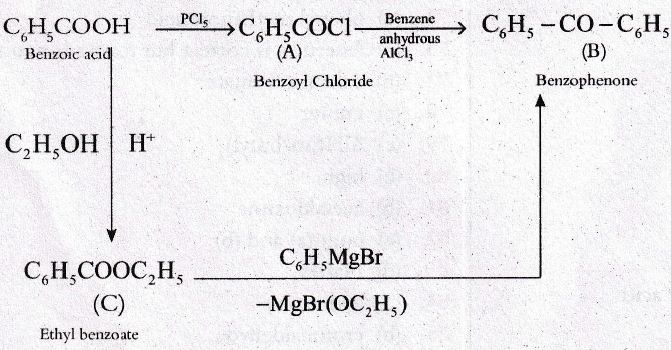
| Compound | Name |
| A | Benzoyl Chloride |
| B | Benzophenone |
| C | Ethylbenzoate |
10.
(i) Preservatives are chemicals added to food which are capable of inhibiting, retarding or arresting the process of fermentation, acidification or other decomposition of food by the growth of micro organisms (or)
(ii) Chemical substances which are added to food that prevents the spoilage of food materials by destroying the food - spoiling micro-organisms are called food preservatives.
(iii) Eg: sodium benzoate, NaCl, Acetic acid Sodium metabisulphite, potassium meta bisulphite etc.
11.
(i) A catalyst is substance which alters the rate of a reaction without itself undergoing any permanent chemical change. They may participate in the reaction, but again regenerated and the end of the reaction. In the presence of a catalyst, the energy of activation is lowered and hence, greater number of molecules can cross the energy barrier and change over to products, thereby increasing the rate of the reaction.
(ii) The reaction between KMnO4 and H2SO4 and oxalic acid is catalysed by MnSO4 and increases the rate of oxidation of C2O42- by MnO4-.
12.
13.
.JPG)
.JPG)
.JPG) +CO2
+CO2
.JPG)
.JPG)
.JPG)
.JPG)
14.
(i) The amino acids are linked covalently by peptide bonds. The carboxyl group of the first amino acid react with the amino group of the second amino acid to give an amide linkage between these amino acids. This amide linkage is called peptide bond. The resulting compound is called a dipeptide. Addition an another amino acid to this dipeptide a second peptide bond results in tripeptide.
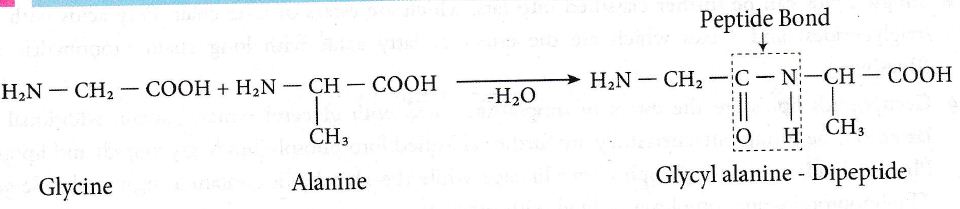
(ii) Thus we can generate tetra peptide, penta peptide etc... When you have more number of amino acids linked this way you get a polypeptide. If the number of amino acids are less it is called as a polypeptide, if it has large number of amino acids (and preferably has a function) then it is called a protein.
(iii) The amino end of the peptide is known as N - terminal or amino terminal while the carboxy end is called C-terminal or carboxy terminal. In general protein sequences are written from N-Terminal to C-Terminal.The atoms other than the side chains (R-groups) are called main chain or the back bone of the polypeptide.

12th Standard Syllabus & Materials
12th Standard
TN 12th Computer Applications களப்பெயர் முறைமை (DNS) Sample Question Papers Study Material - QB365 Set A
NEW12th Standard
TN 12th Computer Applications வலையமைப்பு எடுத்துக்காட்டுகள் மற்றும் நெறிமுறைகள் Sample Question Papers Study Material - QB365 Set A
NEW12th Standard
TN 12th Computer Applications கணினி வலையமைப்பு ஓர் அறிமுகம் Sample Question Papers Study Material - QB365 Set A
NEW12th Standard
TN 12th Computer Applications PHP-உடன் MySQL-ஐ இணைத்தல் Sample Question Papers Study Material - QB365 Set A



Tamilnadu Stateboard 12th Standard Subjects

Maths
Chemistry

Physics

Biology

Computer Science

Business Maths and Statistics

Economics

Commerce

Accountancy

History

Computer Applications
Biology
Computer Technology
Computer Applications
Computer Science
Business Maths and Statistics
Commerce
Economics
Maths
Chemistry
Physics
Computer Technology
History
Accountancy

Tamil

English

French
Tamilnadu Stateboard Standards



