
 100% FREE ACCESS
12th Standard Syllabus & Materials
12th Standard
TN 12th Computer Applications மின்னணு தரவு பரிமாற்றம் Sample Question Papers Study Material - QB365 Set A
NEW12th Standard
TN 12th Computer Applications மின் - வணிக பாதுகாப்பு அமைப்புகள் Sample Question Papers Study Material - QB365 Set A
NEW12th Standard
TN 12th Computer Applications மின்னணு செலுத்தல் முறைகள் Sample Question Papers Study Material - QB365 Set A
NEW12th Standard
TN 12th Computer Applications மின் - வணிகம் Sample Question Papers Study Material - QB365 Set A
NEW12th Standard
TN 12th Computer Applications திறந்த மூல கருத்துருக்கள் Sample Question Papers Study Material - QB365 Set A
NEW12th Standard
TN 12th Computer Applications வலையமைப்பு வடமிடல் Sample Question Papers Study Material - QB365 Set A

Published on: 02/06/2021
QB365 provides detailed and simple solution for every Book back Questions in class 12 Chemistry Subject. It will helps to get more idea about question pattern in every book back questions with solution.
Download Tamil Nadu 12th Standard Chemistry question papers, model tests, one-mark questions, important questions, and public exam papers in PDF format. Free study materials and answer keys for TN State Board students.
Questions + Answers key
Take MCQ Chemistry Test1.
How will you convert benzaldehyde into the following compounds?
(i) benzophenone
(ii) benzoic acid
(iii) α-hydroxyphenylaceticacid.
2.
What is the difference between a sol and a gel?
3.
Which sweetening agent are used to prepare sweets for a diabetic patient?
4.
Identify the order for the following reactions
(i) Rusting of Iron
(ii) Radioactive disintegration of 92U238
(iii) 2A+3B⟶ products ;rate = k[A]1/2[B]2
5.
Classify the following ligands based on the number of donor atoms.
a) NH3
b) en
c) ox2-
d) pyridine
6.
7.
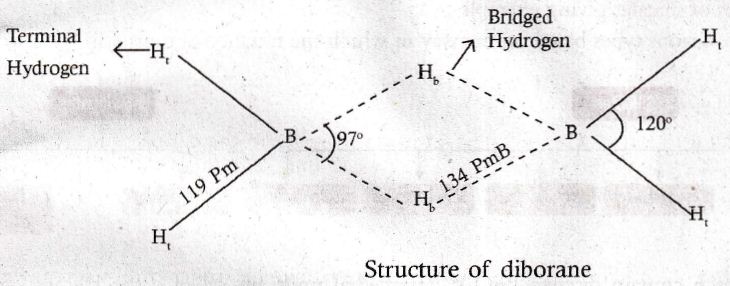
Describe the structure of diborane.
8.
Explain the electrometallurgy of aluminium.
9.
Calculate the percentage efficiency of packing in case of body centered cubic crystal.
10.
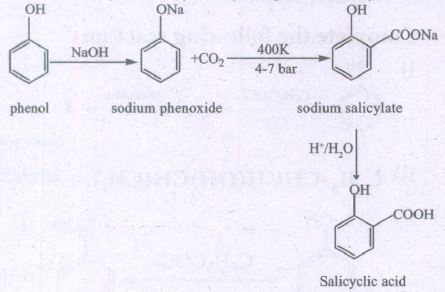
Write Kolbe’s reaction.
11.
Identify A,B,and C
CH3- NO2 \(\overset { { L }_{ 1 }{AlH }_{ 4 } }{ \underset { {} }{ \longrightarrow } }\) A \(\overset { { 2CH_3 }{Ch_2Br } }{ \underset { {} }{ \longrightarrow } }\) B \(\overset { {H}_{ 2 }{SO}_{ 4 } }{ \underset { {} }{ \longrightarrow } } \) C
12.
Why is AC current used instead of DC in measuring the electrolytic conductance?
13.
What are reducing and non – reducing sugars?
14.
Calculate the pH of 1.5\(\times\)10-3 M solution of Ba(OH)2
15.
Explain the variation in E0M3+/M2+ 3d series.
1.
.JPG)
(ii) benzoic acid
.JPG)
(iii) α - hydroxyphenylaceticacid.
.JPG)
2.
| S.no | Sol | Gel |
| (a) | The liquid state of collidal solution | The solid (or) semi solid stage of a colloidal solution. |
| (b) | Very low viscosity | Very high viscosity |
| (c) | It does not have definite structure. | It possesses definite structure. |
3.
(i) Sucralose is used as sugar substituent like Sorbitol, Xylitol and Mannitol. All these have sweetness. They are metabolised without the influence of insulin.
(ii) Artificial sweetening agents like Aspartarne, Alitame and Saccharin are also used. These have negligible nutritional value.
Example : Saccharin,Aspartame, Sucralose, Alitame
4.
(i) First order reaction
(ii) First order reaction
(iii) \(\frac{1}{2}+2=2 \frac{1}{2}\); Pseudo first order reaction
5.
| Ligand | Type of Ligand | Number of donor atoms |
| NH3 | monodentate ligand | 1 |
| en | bidentate ligand | 2 |
| ox2- | bidentate ligand | 2 |
| pyridine | monodentate ligand | 1 |
6.
7.
(i) In diborane two BH2 units are linked by two bridged hydrogens.
(ii) It has eight B-H bonds.
(iii) Diborane has only 12 valance electrons.
(iv) The four terminal B-H- bonds is "2c - 2e" bond (two centre - two electron bond.)
(v) Two three centred B - H - B bonds two electrons each. "(3c - 2e)"
(vi) In diborane, the boron is "sp3" hybridised
(vii) Three of the four "sp3" hydridised orbitals contains single electron and the fourth orbital is empty.
8.
1. This process is called as Hall-Heroult process.
Cathode: In this method, electrolysis is carried out in an iron tank lined with carbon which acts as the cathode.
Anode: The carbon blocks immersed in the electrolyte acts as a anode.
Eletrolyte: A 20% solution of alumina, obtained from the bauxite ore is mixed with molten Cryolite and is taken in the electrolysis chamber.
2. About 10% calcium chloride is also added to the solution.
3. Here Calcium chloride helps to lower the melting point of the mixture.
Temperature: The fused mixture is maintained at a temperature of above 1270 K.
4. The chemical reactions involved in this process as follows
(a) Ionisaiton of alumina: \({ A }l_{ 2 }{ O }_{ 3 }\longrightarrow { 2Al }^{ 3+ }+{ 3O }^{ 2- }\)
(b) Reaction at cathode: \(2{ Al }^{ 3+ }_{(melt)}+{ 6e }^{ - }\longrightarrow { Al }_{ (l) }\)
(c) Reaction at anode: \(6{ O }^{2-}_{(melt)}\longrightarrow { 3O }_{ 2 }+{ 12e }^{ - }\)
5. Since carbon acts as anode the following reaction also takes place
(a) \({ C }_{ (s) }+{ O }^{ 2- }_{(melt)}\longrightarrow CO+{ 2e }^{ - }\)
(b) \({ C }_{ (s) }+{ 2O }^{ 2- }_{(melt)}\longrightarrow { CO }_{ 2 }+{ 4e }^{ - }\)
6. Due to the above two reactions, anodes are slowly consumed during the electrolysis.
7. The pure aluminium is formed at the cathode. The net electrolysis reaction can be written as
\({ 4Al }^{ 3+ }_{(melt)}+{ 6O }^{ 2- }_{(melt)}+{ 3C }_{ (s) }\longrightarrow { 4Al }_{ (l) }+{ 3CO }_{ 2(g) }\)
9.
In bcc unit cell, ΔABC
AC2 = AB2 + BC2
\(AC=\sqrt { { AB }^{ 2 }+{ BC }^{ 2 } } \)
\(\\ AC=\sqrt { { a }^{ 2 }+{ a }^{ 2 } } =\sqrt { { 2a }^{ 2 } } =\sqrt { 2 } a\)

In ΔACG
AG2 = AC2 + CG2
\(AG=\sqrt { { AC }^{ 2 }+{ CG }^{ 2 } } \)
\(AG=\sqrt { { \left( \sqrt { 2a } \right) }^{ 2 }+{ a }^{ 2 } } \)
\(AG=\sqrt { { 2a }^{ 2 }+{ a }^{ 2 } } =\sqrt { { 3a }^{ 2 } } \)
\(AG=\sqrt { 3a } \)
\(\sqrt { 3 } a=4r\)
\(r=\frac { \sqrt { 3 } }{ 4 } a\)
∴ Volume of the sphere with radius 'r' \(=\frac { 4 }{ 3 } { \pi r }^{ 3 }\)
\(=\frac{4}{3}\pi { \left( \frac { \sqrt { 3 } }{ 4 } a \right) }^{ 3 }\)\(=\frac { \sqrt { 3 } }{ 16 } \pi { a }^{ 3 }\)
Number of spheres belong to a unit cell in BCC arrangement is equal to two and hence the total volume of all spheres.
(i) Packing fraction = \(=\frac{Total \quad volume \quad occupied \quad by \quad spheres \quad in \quad a \quad unit \quad cell}{volume \quad of \quad the \quad unit \quad cell}\times100\)
\(\therefore\)Volume of all spheres \(=2\times \left( \frac { \sqrt { 3 } \pi { a }^{ 3 } }{ 16 } \right) =\frac { \sqrt { 3 } \pi { a }^{ 3 } }{ 8 } \)
Packing fraction \(=\frac { \left( \frac { \sqrt { 3 } \pi { a }^{ 3 } }{ 8 } \right) }{ ({ a }^{ 3 }) } \times 100\)
\(=\frac { \sqrt { 3 } \pi }{ 8 } \times 100\)
\(\\ =\sqrt { 3 } \pi \times 12.5\)
= 1.732 x 3.14 x 12.5
= 68%
10.
In this reaction, phenol is first converted into sodium phenoxide which is more reactive than phenol towards electrophilic substitution reaction with CO2, Treatment of sodium phenoxide with CO2 at 400 K, 4-7 bar pressure followed by acid hydrolysis gives salicylic acid.
11.

12.
(a) If we apply DC current through the conductivity cell, it will lead to the electrolysis of the solution taken in the cell.
(b) So, AC current is used for this measurement to prevent electrolysis.
13.
i) Reducing sugars:
1. Sugars which reduce Tollen's reagent or Fehling's solution or Benedict's solution are called reducing sugars.
2. These contain either α - hydroxyl ketone or cyclical hemi acetal or hemi ketal or structures in equilibrium with open chain forms having a free- CHO or C=O group.
3. E.g. a) All monosaccharide's like D - glucose, D - fructose (aldoses and ketoses)
b) Sugars like Lactose and maltose except sucrose.
ii) Non - reducing sugars:
1. Sugars which do not reduce either Tollen's reagent, Fehling's solution or Benedict's solution are called non-reducing sugars.
2. They contain a stable acetal or ketal structures which cannot be opened into a free carbonyl group.
E.g. Sucrose, starch, cellulose, glycogen, dextrin etc.
14.
Considering Ba(OH)2 to be a strong base:
\(\text { Normality } =\text { Molarity } \times \text { Acidity } \)
\(=1.5 \times 10^{-3} \times 2\)
\({\left[\mathrm{OH}^{-}\right] } =3 \times 10^{-3} \)
\(\mathrm{pOH} =-\log _{10}[\mathrm{OH}^-] \)
\(=-\log _{10}\left(3 \times 10^{-3}\right) \)
\(=-\left[\log _{10} 3+3 \log 10\right] \)
= 3-log 3
= 3-0.4771
= 2.5229
\(\mathrm{pH} =14-\mathrm{pOH} \)
= 14-2.5229
pH = 11.4771 = 11.48
15.
(i) In transition series, as we move down from Ti to Zn, the standard reduction potential E0M2+/M3 value is approaching towards less negative value and copper has a positive reduction potential, i. e. elemental copper is more stable than Cu2+.
(ii) E0M2+/M value for manganese and zinc are more negative than regular trend. It is due to extra stability arises due to the half filled d5 configuration in Mn2+ and completely filled d10 configuration in Zn2+.
(iii) The standard electrode potential for the M3+/M2+ half cell gives the relative stability between M3+ and M2+.
(iv) The high reduction potential of Mn3+/Mn2+ indicates Mn2+ is more stable than Mn3+.
(v) Mn3+ has a 3d4 configuration while that of Mn2+ is 3d5. The extra stability associated with a half filled d sub-shell makes the reduction of Mn3+ very feasible \(\left[\mathrm{E}^{\circ}=+1.51 \mathrm{~V}\right]\).

12th Standard Syllabus & Materials
12th Standard
TN 12th Computer Applications களப்பெயர் முறைமை (DNS) Sample Question Papers Study Material - QB365 Set A
NEW12th Standard
TN 12th Computer Applications வலையமைப்பு எடுத்துக்காட்டுகள் மற்றும் நெறிமுறைகள் Sample Question Papers Study Material - QB365 Set A
NEW12th Standard
TN 12th Computer Applications கணினி வலையமைப்பு ஓர் அறிமுகம் Sample Question Papers Study Material - QB365 Set A
NEW12th Standard
TN 12th Computer Applications PHP-உடன் MySQL-ஐ இணைத்தல் Sample Question Papers Study Material - QB365 Set A



Tamilnadu Stateboard 12th Standard Subjects

Maths
Chemistry

Physics

Biology

Computer Science

Business Maths and Statistics

Economics

Commerce

Accountancy

History

Computer Applications
Biology
Computer Technology
Computer Applications
Computer Science
Business Maths and Statistics
Commerce
Economics
Maths
Chemistry
Physics
Computer Technology
History
Accountancy

Tamil

English

French
Tamilnadu Stateboard Standards



