
 100% FREE ACCESS
12th Standard Syllabus & Materials
12th Standard
TN 12th Computer Applications மின்னணு தரவு பரிமாற்றம் Sample Question Papers Study Material - QB365 Set A
NEW12th Standard
TN 12th Computer Applications மின் - வணிக பாதுகாப்பு அமைப்புகள் Sample Question Papers Study Material - QB365 Set A
NEW12th Standard
TN 12th Computer Applications மின்னணு செலுத்தல் முறைகள் Sample Question Papers Study Material - QB365 Set A
NEW12th Standard
TN 12th Computer Applications மின் - வணிகம் Sample Question Papers Study Material - QB365 Set A
NEW12th Standard
TN 12th Computer Applications திறந்த மூல கருத்துருக்கள் Sample Question Papers Study Material - QB365 Set A
NEW12th Standard
TN 12th Computer Applications வலையமைப்பு வடமிடல் Sample Question Papers Study Material - QB365 Set A

Published on: 13/05/2022
QB365 provides detailed and simple solution for every Book back Questions in class 12 Chemistry Subject. It will helps to get more idea about question pattern in every book back questions with solution.
latest Book back QuestionsDownload Tamil Nadu 12th Standard Chemistry question papers, model tests, one-mark questions, important questions, and public exam papers in PDF format. Free study materials and answer keys for TN State Board students.
Questions + Answers key
Take MCQ Chemistry Test1.
Give three uses of emulsions.
2.
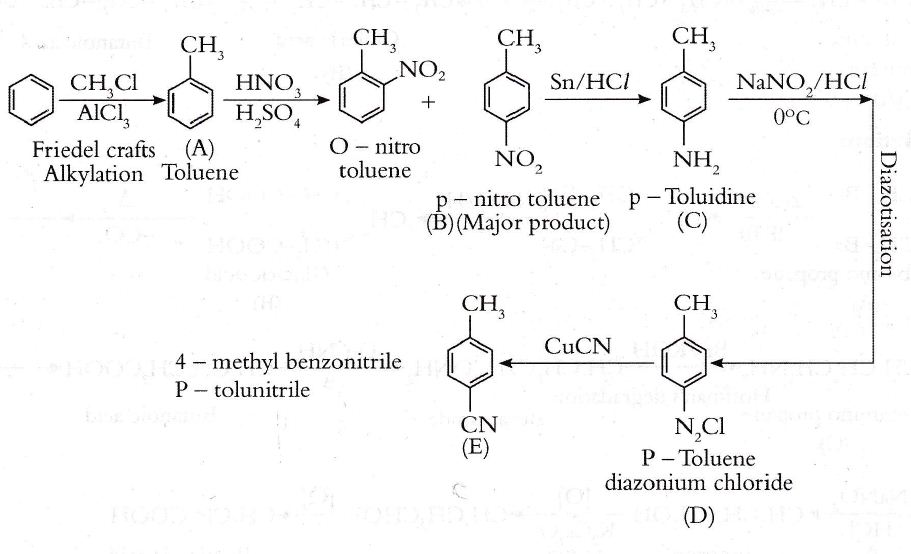
Identify A to E in the following sequence of reactions

\(\overset { {CH_3} {CL} }{ \underset { {AlCl}_3 }{ \longrightarrow } }\) A \(\overset { {HNO_3}/ {H_2So_4} }{ \underset { {} }{ \longrightarrow } }\) B \(\overset { {Sn} /{HCL} }{ \underset {{} }{ \longrightarrow } }\) (C) \(\overset { {NaNo_2}/ {HCL} }{ \underset { {O^o}C }{ \longrightarrow } }\) D \(\overset { {CuCN} }{ \underset { {}}{ \longrightarrow } }\) E
3.
The time for half change in a first order decomposition of a substance A is 60 seconds. Calculate the rate constant. How much of A will be left after 180 seconds?
4.
Explain the principle of electrolytic refining with an example.
5.
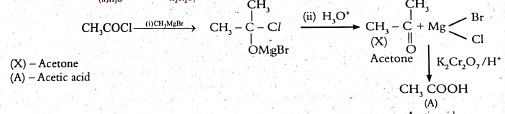
What will be the product (X and A) for the following reaction acetylchloride \(\frac{\text { i) } \mathrm{CH}_{3} \mathrm{MgBr}}{\text { ii) } \mathrm{H}_{3} \mathrm{O}^{+}}{\longrightarrow} \mathrm{X} \stackrel{\text { acid } \mathrm{K}_{2} \mathrm{Cr}_{2} \mathrm{O}_{7}}{\longrightarrow}\) A
6.
What is crystal field stabilization energy (CFSE)?
7.
Give two equations to illustrate the chemical behaviour of phosphine.
8.
Write a note on zeolites.
9.
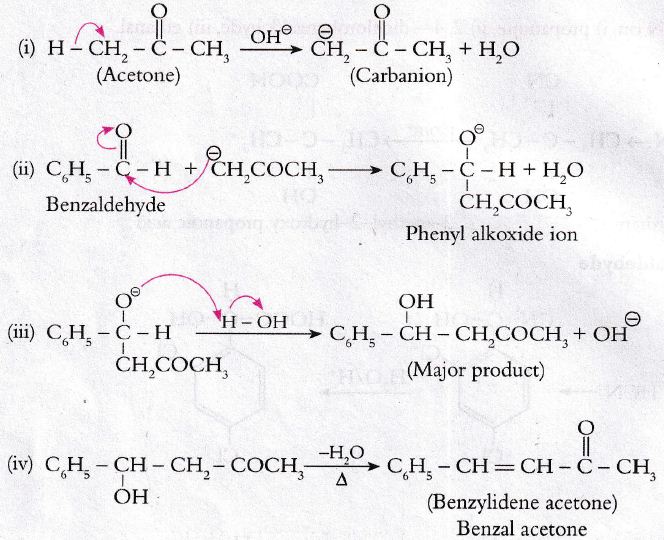
Write the structure of the major product of the aldol condensation of benzaldehyde with acetone.
10.
Calculate the standard emf of the cell: Cd|Cd2+||Cu2+|Cu and determine the cell reaction. The standard reduction potentials of Cu2+|Cu and Cd2+|Cd are 0.34V and -0.40 volts respectively. Predict the feasibility of the cell reaction.
11.
A saturated solution, prepared by dissolving CaF2(s) in water, has \([Ca^{2+}]=3.3\times10^{-4}M\). What is the Ksp of CaF2?
12.
Write a note on co –polymer
13.
14.
Which is stronger reducing agent Cr2+ or Fe2+?
15.
If NaCl is doped with 10-2 mol percentage of strontium chloride, what is the concentration of cation vacancy?
1.
(i) Emulsions are used in food industries. Food stuff like milk, cream, butter, etc., are emulsions.
(ii) Emulsions are very common in pharmaceutical industries. Many medicines are produced in the form of emulsions. Ex: Milk of magnesia is used for stomach troubles. Many lotions and ointments are emulsions.
(iii) Non ionic emulsions are most popular due to their low toxicity.
(iv) Cationic emulsions have anti microbial properties.
(v) In agriculture industry emulsions are used as delivery vehicles for insecticides, fungicides and pesticides.
(vi) In cosmetics, emulsions are the delivery vehicles for many hair and skin conditioning agents.
(v) The blood, protoplasm in plant and animal cells and fats in intestines are emulsions.
2.
3.
(i) Order of the reaction =1; \(\mathrm{t}_{1 / 2}=60 \mathrm{~s} ; \mathrm{k}=?\)
\(\mathrm{k}=\frac{0.6932}{\mathrm{t}_{\frac{1}{2}}} \)
\(=\frac{0.6932}{60} \)
\(k =1.155 \times 10^{-2} \mathrm{~s}^{-1}\)
(ii) \(\left[\mathrm{A}_{0}\right]=100 \% ; \mathrm{t}=180 \mathrm{~s} ;[\mathrm{A}]=? ; \mathrm{k}=1.155 \times 10^{-2} \mathrm{~s}^{-1}\)
For first order reaction
\(\mathrm{k}=\frac{2.303}{\mathrm{t}} \log \frac{\left[\mathrm{A}_{0}\right]}{[\mathrm{A}]} \)
\(1.155 \times 10^{-2} =\frac{2.303}{180} \log \left(\frac{100}{[A]}\right) \)
\(\frac{0.01155 \times 180}{2.303} =\log \left(\frac{100}{[A]}\right) \)
\(0.9027 =\log 100-\log [\mathrm{A}] \)
\(\log [\mathrm{A}] =\log 100-0.9027 \)
\(\log [A]=2-0.9027 \)
\(\log [A]=1.0972 \)
[A] = antilog of (1.0972)
[A] =12.51 %
4.
1. The crude metal is refined by electrolysis. It is carried out in an electrolytic cell
Anode : Impure metal to be refined with dilute acid.
Cathode : Thin strips of pure metal
Electrolyte : Aqueous solution of the salts of the metal with dilute acid.
2. The metal dissolves from the anode, pass into the solution.
3. At the same amount of metal ions from the solution will be deposited at the cathode.
4. During electrolysis, the less electropositive impurities in the anode, settle down at the bottom and are removed as anode mud.
Example: Electrolytic refining of silver.
Cathode: Pure silver
Anode: lmpure silver rods
Electrolyte: Acidified aqueous solution of silver nitrate
5. When a current is passed through the electrodes the following reactions will take place
(a) Reaction at anode: \({ Ag }_{ (s) }\longrightarrow { Ag }^{ + }_{ (aq) }+{ 1e }^{ - }\)
(b) Reaction at cathode: \({ Ag }^{ + }_{ (aq) }+{ 1e }^{ - }\longrightarrow { Ag }_{ (s) }\)
6. During electrolysis, at anode silver loses electrons and form silver ions and the silver ions migrate towards the cathode and get discharged and deposited on the cathode.
7. Copper, Zinc etc can also be refined by this process.
5.
6.
The CFSE is defined as the energy of the electronic configuration in the ligand field minus the energy of the electronic configuration in the isotropic field.
CFSE (\(\Delta\)Eo) = {ELf}-{Eiso}
={[nt2g(-0.4) + neg(0.6)]\(\Delta\)o + npP} - {n'pP}
Here, nt2g is the number of electrons in t2g orbitals;
neg is number of electrons in eg orbitals;
np is number of electron pairs in the ligand field; &
n'p is the number of electron pairs in the isotropic field (barycenter).
P - pairing energy
7.
Thermal stability:
\(4 \mathrm{PH}_{3} \stackrel{317 \mathrm{~K}}{\longrightarrow} \mathrm{P}_{4}+6 \mathrm{H}_{2} \)
Combustion:
\(4 \mathrm{PH}_{3}+8 \mathrm{O}_{2} \stackrel{\Delta}{\longrightarrow} \underset{\text { Phosphorus pentoxide }}{\mathrm{P}_{4} \mathrm{O}_{10}+6 \mathrm{H}_{2} \mathrm{O}} \)
\(\mathrm{P}_{4} \mathrm{O}_{10}+6 \mathrm{H}_{2} \mathrm{O} \stackrel{\Delta}{\longrightarrow} 4 \mathrm{HPO}_{3}+4 \mathrm{H}_{2} \mathrm{O}\\ \quad \quad \quad \quad \quad \quad \quad \text{Meta phosphoric acid}\)
8.
(i) Zeolites are three-dimensional crystalline solids containing Al, Si and O in their regular three dimensional framework.
(ii) They are hydrated sodium alumino silicates with general formula Na2O(AI2O3).·x(SiO2)·yH2O
(x = 2 to 10; y = 2 to 6).
(iii) Zeolites have porous structure in which the monovalent sodium ions and water molecules are loosely held.
(iv) The Si and Al atoms are tetrahedrally coordinated with each other through shared oxygen atoms.
(v) Zeolites are similar to clay minerals but they differ in their crystalline structure.
(vi) Zeolites have a three dimensional crystalline structure looks like a honeycomb consisting of a network of interconnected tunnels and cages.
(vii) Water molecules moves freely in and out of these pores but the zeolite framework remains rigid
(viii) Another special aspect of this structure is that the pore/channel sizes are nearly uniform, allowing the crystal to act as a molecular sieve.
9.
10.
Cell reactions:
Oxidation at anode: \(Cd_{(s)}\rightarrow Cd^{2+}_{(aq)}+2e^{-}\); (E0ox)cd|cd2+ = 0.40V ; (E0)cd|cd2+ = -0.40V
Reduction at cathode: \(Cu^{2+}_{(aq)}+2e^{-}\rightarrow Cu_{(s)} \); (E0red)cu2+|Cu = +0.34V
Adding: \(Cd_{(s)}+Cu^{2+}_{(aq)}\rightarrow Cd^{2+}_{(aq)}+Cu_{(s)}\)
E0cell=(E0ox)+(E0red)
=(-0.4) + 0.34V
= 0.74V.
Emf is +ve, so \(\Delta G\) is -ve, the cell reaction is feasible.
11.
\(\mathrm{CaF}_{2(\mathrm{~s})} \rightleftharpoons \mathrm{Ca}_{\mathrm{(aq)}}^{2+}+2 \mathrm{~F}^{-}_ {(\mathrm{aq}) }\)
s 2s
\({\left[\mathrm{Ca}^{2+}\right] } =3.3 \times 10^{-4} \mathrm{M} \)
\({\left[\mathrm{F}^{-}\right] } =2 \times 3.3 \times 10^{-4}=6.6 \times 10^{-4} \mathrm{M} \)
\(\mathrm{K}_{\mathrm{sp}} =\left[\mathrm{Ca}^{2+}\right]\left[\mathrm{F}^{-}\right]^{2} \)
\(=\left(3.3 \times 10^{-4}\right)\left(6.6 \times 10^{-4}\right)^{2}=1.44 \times 10^{-10}\)
12.
(i) A polymer containing two or more different kinds of monomer units is called a copolymer.
(ii) For example, SBR rubber(Buna-S) contains styrene and butadiene monomer units.
(iii) Copolymers have properties quite different from the homopolymers.
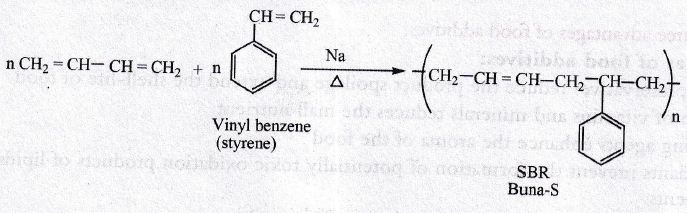
(iv) Mixture of styrene and 1,3 butadiene to form a copolymer (Buna -S)
Preparation of Buna-S:
It is a co-polymer. It is obtained by the polymerisation of buta -1,3 - diene and styrene in the ratio 3: 1 in the presence of sodium.
13.
14.
Cr2+ is stronger reducing agent than Fe2+. The standard electrode potential (E0) of Cr2+ is -0.91 V and that of Fe2+ is only -0.44 V.
If the standard electrode potential of a metal is large and negative is a powerful reducing agent, because it loses electrons easily.
Hence Cr2+ is stronger reducing agent.
15.
Given: NaCl is doped with 10-2 mole % of SrCl2
(i.e.) 100 moles of NaCl doped with 10-2 moles of SrCl2
\(\therefore \) 1 mole of NaCl is doped with 10-4 moles of SrCl2
1 Sr2+ ion creates 1 cation vacancy
The number of cation vacancies created by 10-4 mole SrCl2 = 10-4 \(\times\) 6.023 \(\times\) 1023
= 6.023 \(\times\) 1019 vacancies

12th Standard Syllabus & Materials
12th Standard
TN 12th Computer Applications களப்பெயர் முறைமை (DNS) Sample Question Papers Study Material - QB365 Set A
NEW12th Standard
TN 12th Computer Applications வலையமைப்பு எடுத்துக்காட்டுகள் மற்றும் நெறிமுறைகள் Sample Question Papers Study Material - QB365 Set A
NEW12th Standard
TN 12th Computer Applications கணினி வலையமைப்பு ஓர் அறிமுகம் Sample Question Papers Study Material - QB365 Set A
NEW12th Standard
TN 12th Computer Applications PHP-உடன் MySQL-ஐ இணைத்தல் Sample Question Papers Study Material - QB365 Set A



Tamilnadu Stateboard 12th Standard Subjects

Maths
Chemistry

Physics

Biology

Computer Science

Business Maths and Statistics

Economics

Commerce

Accountancy

History

Computer Applications
Biology
Computer Technology
Computer Applications
Computer Science
Business Maths and Statistics
Commerce
Economics
Maths
Chemistry
Physics
Computer Technology
History
Accountancy

Tamil

English

French
Tamilnadu Stateboard Standards



