
 100% FREE ACCESS
12th Standard Syllabus & Materials
12th Standard
TN 12th Computer Applications மின்னணு தரவு பரிமாற்றம் Sample Question Papers Study Material - QB365 Set A
NEW12th Standard
TN 12th Computer Applications மின் - வணிக பாதுகாப்பு அமைப்புகள் Sample Question Papers Study Material - QB365 Set A
NEW12th Standard
TN 12th Computer Applications மின்னணு செலுத்தல் முறைகள் Sample Question Papers Study Material - QB365 Set A
NEW12th Standard
TN 12th Computer Applications மின் - வணிகம் Sample Question Papers Study Material - QB365 Set A
NEW12th Standard
TN 12th Computer Applications திறந்த மூல கருத்துருக்கள் Sample Question Papers Study Material - QB365 Set A
NEW12th Standard
TN 12th Computer Applications வலையமைப்பு வடமிடல் Sample Question Papers Study Material - QB365 Set A

Published on: 02/06/2021
QB365 provides detailed and simple solution for every Book back Questions in class 12 Chemistry Subject. It will helps to get more idea about question pattern in every book back questions with solution.
Download Tamil Nadu 12th Standard Chemistry question papers, model tests, one-mark questions, important questions, and public exam papers in PDF format. Free study materials and answer keys for TN State Board students.
Questions + Answers key
Take MCQ Chemistry Test1.
Why does bleeding stop by rubbing moist alum
2.
Identify A aniline + benzaldehyde → A
3.
Ksp of AgCl is \(1.8\times10^{-10}\). Calculate molar solubility in 1 M AgNO3
4.
Write the structure of all possible dipeptides which can be obtained form glycine and alanine
5.
A zero order reaction is 20% complete in 20 minutes. Calculate the value of the rate constant. In what time will the reaction be 80% complete?
6.
Give a reaction between nitric acid and a basic oxide.
7.
KF crystallizes in fcc structure like sodium chloride. Calculate the distance between K+ and F− in KF. (given : density of KF is 248 g cm-3)
8.
The selection of reducing agent depends on the thermodynamic factor: Explain with an example.
9.
How are the following conversions effected
(a) propanal into butanone
(b) Hex-3-yne into hexan-3-one.
(c) phenylmethanal into benzoic acid
(d) phenylmethanal into benzoin
10.
In fuel cell H2 and O2 react to produce electricity. In the process, H2 gas is oxidised at the anode and O2 at cathode. If 44.8 litre of H2 at 250C and 1 atm pressure reacts in 10 minutes, what is average current produced? If the entire current is used for electro deposition of Cu from Cu2+, how many grams of Cu deposited?
11.
How will you convert acetylene into n-butyl alcohol.
12.
The E0M2+/M value for copper is positive. Suggest a possible reason for this.
13.
How will you convert boric acid to boron nitride?
14.
What are bio degradable polymers? Give examples.
15.
A solution of [Ni(H2O)6]2+ is green, whereas a solution of [Ni(CN)4]2- is colorless -Explain
1.
(a) Blood is a colloidal sol. When we rub the injured part with moist alum, coagulation of blood takes place.
(b) Coagulation stops bleeding. Moist alum is an electrolyte.
2.
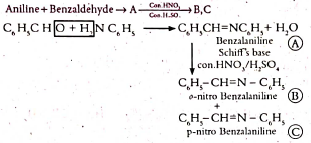
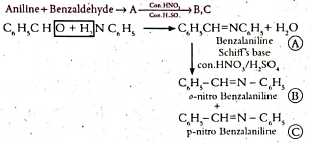

3.
Ksp = 1.8 \(\times\)10-10, [AgNO3]= 1 M
\(\mathrm{AgCl}_{(\mathrm{s})} \rightleftharpoons \mathrm{Ag}_{(\mathrm{aq})}^{+}+\mathrm{Cl}_{(\mathrm{aq})}^{-} \)
s s
\(\mathrm{AgNO}_{3(\mathrm{aq})} \rightleftharpoons \mathrm{Ag}_{(\text {aq })}^{+}+\mathrm{NO}_{3_{(\text {aq })}}^{-}\\ 1 \mathrm{M} \quad \quad \quad \quad \quad 1 \mathrm{M} \quad \quad 1 \mathrm{M} \)
\(\left[\mathrm{Ag}^{+}\right]=(\mathrm{s}+1) \approx 1 \quad(\therefore \mathrm{s}<<1) \)
\(\left[\mathrm{Cl}^{-}\right]=\mathrm{s} \)
\(\mathrm{K}_{\mathrm{sp}}=\left[\mathrm{Ag}^{+}\right]\left[\mathrm{Cl}^{-}\right] \)
\(1.8 \times 10^{-10}=(1)(s) \)
\(\therefore \mathrm{s}=1.8 \times 10^{-10} \mathrm{M}\)
4.
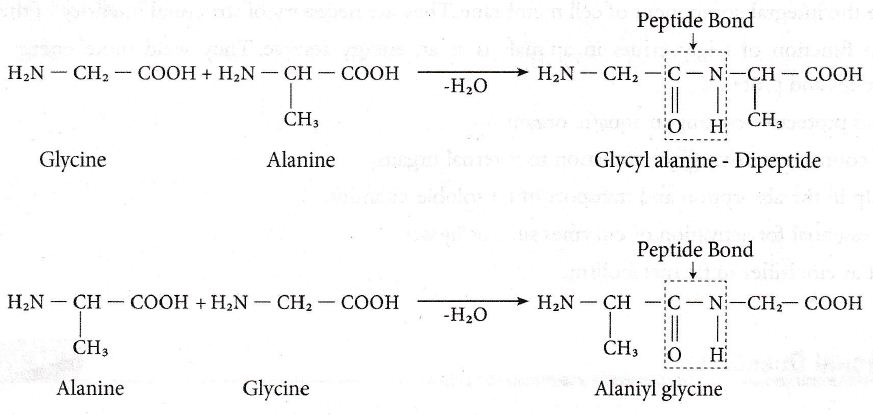
∴ Two dipeptides structures are possible from glycine and alanine. They are glycyl alanine and Alanyl glycine.
5.
(i) Let A = 100M, [A0] - [A] = 20M,
For the zero order reaction
\(k=\left( \frac { \left[ { A }_{ 0 } \right] -\left[ A \right] }{ t } \right) \)
(i) 20% completion \(k=\left( \frac { 20M }{ 20min } \right) \) = 1 mol L-1 min-1
(ii) 80% completion
\(\mathrm{K}=1 \mathrm{~mol} \mathrm{~L}{ }^{-1} \mathrm{~s}^{-1} ;\left[\mathrm{A}_{0}\right]=100 \mathrm{M} ;\left[\mathrm{A}_{0}\right]-[\mathrm{A}]=80 \mathrm{M} ; \mathrm{t}=?\)
\(\therefore t=\left(\frac{\left[A_{O}\right]-[A]}{K}\right)=\frac{80}{1}=80 \mathrm{mins}\)
6.
HNO3 reacts with basic oxides to form salts and water
ZnO + 2HNO3\(\longrightarrow \) Zn(NO3)2 + H2O
3FeO + 10HNO3 \(\longrightarrow \) 3Fe(NO3)3 + NO + 5H2O
7.
\(\text { Density }(\rho)=\frac{\mathrm{nM}}{\mathrm{a}^{3} \mathrm{~N}_{\mathrm{A}}} \)
\(\mathrm{n}=4, \mathrm{M}=\text { Molar mass of } \mathrm{KF}=58.1 \mathrm{~g} / \mathrm{mol} \)
\(\rho=2.48 \mathrm{~g} \mathrm{~cm}^{-3} \)
\(\mathrm{~N}_{\mathrm{A}}=6.023 \times 10^{23} \)
\(a^{3} =\frac{n M}{\rho N_{A}}=\frac{4 \times 58.1}{2.48 \times 6.023 \times 10^{23}} \)
\(a^{3} =15.55 \times 10^{-23} \)
\(a^{3} =0.1555 \times 10^{-21} \)
\(a =\sqrt[3]{0.1555 \times 10^{-21}} \)
\(a =0.5375 \times 10^{-7} \mathrm{~cm}=5.375 \times 10^{-8} \mathrm{~cm}=537.5 \mathrm{pm} \)
\(d =\frac{a}{\sqrt{2}}(\text { for fcc }) [\therefore r = \frac{a\sqrt{2}}{4}]\)
\(=\frac{537.5}{1.414}=380.13 \mathrm{pm}\)
\(\therefore\) The distance between K+ and F- in KF = 380.13 pm
8.
(i) The extraction of metals from their oxides can be carried out by using different reducing agents.
(ii) Consider the following reaction
\(\frac{2}{\mathrm{y}} \mathrm{M}_{\mathrm{x}} \mathrm{O}_{\mathrm{y}(\mathrm{s})} \rightarrow \frac{2 \mathrm{x}}{\mathrm{y}} \mathrm{M}_{(s)}+\mathrm{O}_{ 2(\mathrm{~g})}\) (1)
(iii) The above reduction may be carried out with carbon. In this case the reducing agent carbon may be oxidized to either CO or CO2
\(\mathrm{C}+\mathrm{O}_{2} \rightarrow \mathrm{CO}_{2(\mathrm{~g})} \) (2)
\(2 \mathrm{C}+\mathrm{O}_{2} \rightarrow 2 \mathrm{CO}_{(\mathrm{g})} \) (3)
(iv) If CO is used as a reducing agent
\(2 \mathrm{CO}+\mathrm{O}_{2} \rightarrow 2 \mathrm{CO}_{2(\mathrm{~g})}\) (4)
(v) A suitable reducing agent is selected based on the thermodynamics considerations.
(vi) We know that for a spontaneous reaction, the change in free energy (\(\triangle\)G) should be negative.
(vii) Therefore, thermodynamically, the reduction of metal oxide with a given reducing agent can occur if the free energy change for the coupled reaction is negative.
(viii) Hence, the reducing agent is selected in such a way that it provides a large negative \(\triangle\)G value for the coupled reaction.
9.
Propanal into butanone:
.JPG)
(b) Hex-3-yne into hexan-3-one.
Hydration of alkynes in 42% sulphuric acid containg H2SO4 as catalyst
\(\underset {Hex-3-yne}{\mathrm{CH}_{3}-\mathrm{CH}_{2}}-\mathrm{C} \equiv \mathrm{C}-\mathrm{CH}_{2}-\mathrm{CH}_{3} \frac{\mathrm{HgSO}_{4}}{\mathrm{H}_{2} \mathrm{SO}_{4} / \mathrm{H}_{2} \mathrm{O}} \)
.JPG)
(c) phenylmethanal into benzoic acid
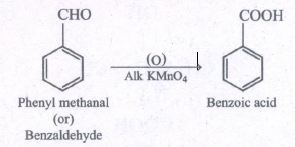
(d) phenylmethanal into benzoin
.JPG)
10.
(i) Oxidation at anode:
\(2H_{2(g)}+4OH^{-}_{(aq)}\rightarrow 4H_{2}O_{(I)}+4e^{-}\)
(ii) 1 mole of hydrogen gas produces 2 moles of electrons at 250C and 1 atm pressure, 1 mole of hydrogen gas occupies = 22.4 litres
\(\therefore \) no. of moles of hydrogen gas produced
= \(\frac{1 mole}{22.4 litres} \times 44.8 litres\)
= 2 moles of hydrogen
(iii) \(\therefore \) 2 of moles of hydrogen produces 4 moles of electro i.e., 4F charge.
t = 10 min
t = 10 x 60 sec
t = 600s
We know that Q= It
\(I=\frac{Q}{t}\)
\(=\frac{4F}{10 mins}\)
\(=\frac{4\times96500\quad C}{10\times60\quad s}\)
I = 643.33 A
Electro deposition of copper
\(Cu^{2+}_{(aq)}+2e^{-}\rightarrow Cu_{(s)}\)
(iv) 2F charge is required to deposit
(v) 1 mole of copper i.e., 63.5 g
(vi) If the entire current produced in the fuel cell ie., 4 F is utilised for electrolysis, then \(2\times63.5\) i.e., 127.0 g copper will be deposited at cathode.
11.
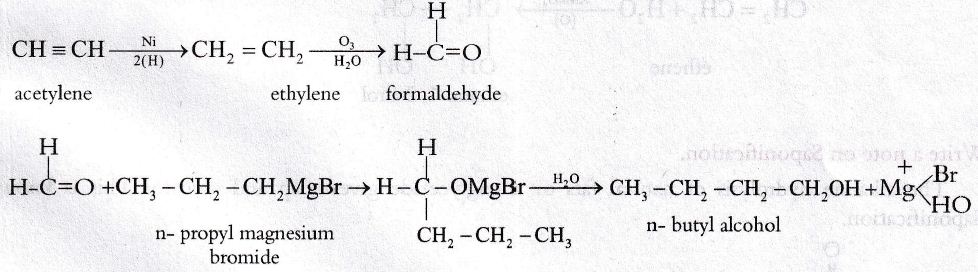
12.
Elemental copper is more stable than Cu2+. The electronic configuration of copper is 3d10 4s1 completely filled 3d orbital with stable configuration.
But Cu2+ has configuration as 3d9. Hence \(\mathrm{E}_{\mathrm{M}^{2+} / \mathrm{M}}^{0}\) value is positive for Cu2+.
13.
Fusion of urea with B(OH)3' in an atmosphere of ammonia at 800 - 1200 K gives boron nitride.
B(OH)3 + NH3 \(\overset { \Delta }{ \longrightarrow } \) BN+ 3H2O
14.
1. The materials that are readily decomposed by microorganisms in the environment are called biodegradable.
2. Natural polymers degrade on their own after certain period of time but the synthetic polymers do not.
3. It leads to serious environmental pollution. One of the solution to this problem is to produce biodegradable polymers which can be broken down by soil micro organism.
Examples:
(i) Polyhydroxy butyrate (PHB)
(ii) Polyhydroxy butyrate-co-A- hydroxyl valerate (PHBV)
(iii) Polyglycolic acid (PGA), Polylactic acid (PLA)
(iv) Poly ( E caprolactone) (PCL)
(v) Biodegradable polymers are used in medical field such as surgical sutures, plasma substitute etc...
4. these polymers are decomposed by enzyme action and are either metabolized or excreted from the body.
15.
[Ni (H2O)6]2+
.JPG)
It has two unpaired electrons. So there is d-d transition. Hence it is green coloured.
[Ni(CN)4]2-
.JPG)
There is no unpaired electrons. So it is colourless, as there is no d-d transition.

12th Standard Syllabus & Materials
12th Standard
TN 12th Computer Applications களப்பெயர் முறைமை (DNS) Sample Question Papers Study Material - QB365 Set A
NEW12th Standard
TN 12th Computer Applications வலையமைப்பு எடுத்துக்காட்டுகள் மற்றும் நெறிமுறைகள் Sample Question Papers Study Material - QB365 Set A
NEW12th Standard
TN 12th Computer Applications கணினி வலையமைப்பு ஓர் அறிமுகம் Sample Question Papers Study Material - QB365 Set A
NEW12th Standard
TN 12th Computer Applications PHP-உடன் MySQL-ஐ இணைத்தல் Sample Question Papers Study Material - QB365 Set A



Tamilnadu Stateboard 12th Standard Subjects

Maths
Chemistry

Physics

Biology

Computer Science

Business Maths and Statistics

Economics

Commerce

Accountancy

History

Computer Applications
Biology
Computer Technology
Computer Applications
Computer Science
Business Maths and Statistics
Commerce
Economics
Maths
Chemistry
Physics
Computer Technology
History
Accountancy

Tamil

English

French
Tamilnadu Stateboard Standards



