
 100% FREE ACCESS
12th Standard Syllabus & Materials
12th Standard
TN 12th Computer Applications மின்னணு தரவு பரிமாற்றம் Sample Question Papers Study Material - QB365 Set A
NEW12th Standard
TN 12th Computer Applications மின் - வணிக பாதுகாப்பு அமைப்புகள் Sample Question Papers Study Material - QB365 Set A
NEW12th Standard
TN 12th Computer Applications மின்னணு செலுத்தல் முறைகள் Sample Question Papers Study Material - QB365 Set A
NEW12th Standard
TN 12th Computer Applications மின் - வணிகம் Sample Question Papers Study Material - QB365 Set A
NEW12th Standard
TN 12th Computer Applications திறந்த மூல கருத்துருக்கள் Sample Question Papers Study Material - QB365 Set A
NEW12th Standard
TN 12th Computer Applications வலையமைப்பு வடமிடல் Sample Question Papers Study Material - QB365 Set A

Published on: 21/06/2021
QB365 provides detailed and simple solution for every Creative Questions in class 12 Chemistry Subject. It will helps to get more idea about question pattern in every Creative questions with solution.
Download Tamil Nadu 12th Standard Chemistry question papers, model tests, one-mark questions, important questions, and public exam papers in PDF format. Free study materials and answer keys for TN State Board students.
Questions + Answers key
Take MCQ Chemistry Test1.
Compound (A) with Molecular formula C7H6O does not reduce Fehling's solution. Compound (A) reacts with acetone in the presence of NaOH to give a compound (B) which is an α, β-unsaturated compound. Further (A) reacts with dimethyl aniline in the presence of cone, H2SO4 to give compound (C) which is a dye. Identify (A) (B) and (C). Explain the reactions.
2.
An organic compound Aofmolecular formula C3H6O answers iodoform test. Another organic compound B of molecular formula C7H6O is known as oil of bitter almonds. A reacts with B to form an unsaturated compound C of molecular formula C10H10O. Compound B reacts with malonic acid in the presence of pyridine to form an unsaturated acid D of molecular formula C9H5O2 Identify A, B, C and D. Explain the reactions.
3.
Ail organic compound. (A) C7H6O reduces Tollens reagent. Compound (A) reacts with acetic anhydride in the presence of anhydrous sodium acetate and gives an unsaturated acid (B). Compound (A) reacts with acetone in the presence of alkali and gives (C). What are (A)(B) and (C) Explain the reactions.
4.
An organic compound (A) of molecular formula C7H6O is called as oil of bitter almonds. (A) on oxidation gives (B) of molecular formula C7H6O2 which gives brisk effervescence with NaHCO3 solution. When (A) is refluxed with aqueous alcoholic (KCN) compound (C) is formed. Identify A, B and C and write the equations.
5.
Compound (A) with molecular formula C2H4O reduces Tollen's reagent. (A) On treatment with HCN gives compound (B). Compound (B) on hydrolysis with an acid gives compound (C) with molecular formula C3H6O3 which is an optically active compound. Compound (A) on reduction with N2H/C2HsONa gives a hydrocarbon (D) of molecular formula C2H6. Identify (A), (B), (C) and (D) and explain the reactions.
1.
(i) Compound (A) does not reduce Fehling's solution, so it is benzaldehyde.
(ii) Benzaldehyde (A) reacts with acetone in the presence of NaOH to give on a, p unsaturated compound (B).
\(\\ \\ \\ \underset { (A) }{ { C }_{ 6 }{ H }_{ 5 }CHO } +{ CH }_{ 3 }-{ COCH }_{ 3 }\overset { NaoH }{ \longrightarrow } \underset { (B) }{ { C }_{ 6 }{ H }_{ 5 } } -\underset { Acetone }{ CH=CH-{ COCH }_{ 3 } } \)
(iii) (A) reacts with dimethyl aniline in the presence of conc. H2SO4 to give compound (C).
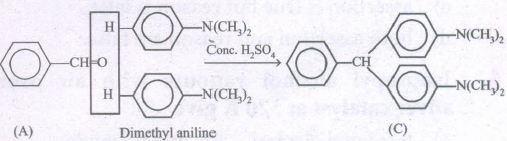
| Compound | Compound Name | Formula |
| A | Benzaldehyde | C6H5CHO |
| B | Benzal acetone | C6H5CH = CH-COCH3 |
| C | Triphenyl methane dye | 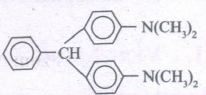 |
2.
(i) Organic Compound (A) is Acetone. Acetone (A) on iodoform test.
\({ CH }_{ 3 }CO{ CH }_{ 3 }\overset { { I }_{ 2 } }{ \underset { NaOH }{ \longrightarrow } } \underset { Iodoform }{ { CHI }_{ 3 } } +{ CH }_{ 3 }COONa\)
(ii) Compound (B) is Benzaldehyde. It is called oil of bitter almonds.
(iii) Acetone (A) reacts with (B) Benzaldehyde to from Benzal acetone (C). This reaction is known Claisen Schmidt reaction.
\(\underset{(B)}{{ C }_{ 6 }{ H }_{ 5 }CHO}+{ CH }_{ 3 }COC{ H }_{ 3 }\overset { NaOH }{ \longrightarrow } { C }_{ 6 }{ H }_{ 5 }\underset{(C)}CH=CHCOC{ H }_{ 3 }\)
(iv) Benzaldehyde reacts with malonic acid in the presence of pyridine gives compound (D) Cinnamic acid
\(\underset{(B)}{{ C }_{ 6 }{ H }_{ 5 }CHO}+ \underset{Malonicaid}{{ H }_{ 2 }C}\left( COOH \right) _{ 2 }\longrightarrow { C }_{ 6 }{ H }_{ 5 }CH=C
\left( COOH \right) _{ 2 }\longrightarrow \underset{(D)}{{ C }_{ 6 }{ H }_{ 5 }CH=CHCOOH}\) This reaction is called Knoevenagal reaction.
| Compound | Compound Name | Formula |
|---|---|---|
| A | Acetone | CH3COCH3 |
| B | Benzaldehyde | C6H5CHO |
| C | Benzal acetone | C6H5CH=CHCOCH3 |
| D | Cinnamic acid | C6H5CH=CHCOOH |
3.
(i) An organic compound (A) is identified as C6H5CHO benzaldehyde. Benzaldehyde reduces Tollen'sreagent and also undergoes. Cannizaro reaction.
\(\underset { (A) }{ C_{ 6 }{ H }_{ 5 }CHO } +{ Ag }_{ 2 }O\longrightarrow 2Ag+\underset { (B) }{ { C }_{ 6 }{ H }_{ 5 }COOH } \)
(ii) Benzaldehyde reacts with acetic anhydride in the presence of sodium acetate gives cinnamic acid and it is (B) an unsaturated acid
\(\underset { (A) }{ { C }_{ 6 }{ H }_{ 5 }CHO } +\left( { CH }_{ 3 }CO \right) _{ 2 }O\overset { { CH }_{ 3 }COONa }{ \longrightarrow } \underset { (B) }{ { C }_{ 6 }{ H }_{ 5 }CH } { =CHCOOH }+{ CH }_{ 3 }COOH\)
(iii) Compound A reacts with acetone to form compound (C) benzal acetone.
\(\underset {(A)}{{ C }_{ 6 }{ H }_{ 5 }CHO}+{ CH }_{ 3 }COC{ H }_{ 3 }\overset { NaOH }{ \longrightarrow } { C }_{ 6 }{ H }_{ 5 }CH=\underset { (C) }{ CH } -CO{ CH }_{ 3 }\)
| Compound | Compound Name | Formula |
| A | Benzaldehyde | C6H5CHO |
| B | Cinnamic acid | C6H5CH = CHCOOH |
| C | Benzal acetone | C6H5CH - CH-COCH3 |
4.
(i) From the molecular formula, (A) is identified as benzaldehyde and it is called as oil of bitter almonds.
(ii) Benzaldehyde is oxidised to benzoic acid by alkaline permanganate which gives brisk effervescence with NaHCO3.
\(\underset { (A) }{ { C }_{ 6 }{ H }_{ 5 }CHO } \overset { (O) }{ \longrightarrow } \underset { (B) }{ { C }_{ 6 }{ H }_{ 5 } } -COOH\)
(iii) When benzaldehyde is refluxed with aqueous alcoholic KCN, benzoin (C) is formed.
\({ C }_{ 6 }{ H }_{ 5 }CH=O+H-\overset { \underset { || }{ O } }{ C } -{ C }_{ 6 }{ H }_{ 5 }\overset { alc }{\underset{KCN} \longrightarrow } { C }_{ 6 }{ H }_{ 5 }-\underset { \overset { | }{ OH\\ (C) } }{ CH } -\overset { \underset { || }{ O } }{ C } -{ C }_{ 6 }{ H }_{ 5 }\)
| Compound | Compound Name | Formula |
| A | Benzaldehyde | C6H5CHO |
| B | Benzoic acid | C6HsCOOH |
| C | Benzoin | \({ C }_{ 6 }{ H }_{ 5 }CHOH-\overset { \underset { || }{ O } }{ C } -{ C }_{ 6 }{ H }_{ 5 }\) |
5.
(i) Compound (A) with molecular formula C2H4O reduces Tollen'sreagent.
(ii) (A) on treatment with HCN gives compound (B).
\(\underset { (A) }{ { CH }_{ 3 }-CHO } +HCN\longrightarrow { CH }_{ 3 }-\underset { \overset { | }{ OH\\ (B) } }{ CH } -CN\)
(iii) Compound (B) on hydrolysis with an acid gives compound (C) with molecular formula C3H6O3 which is an optically active compound.
\({ CH }_{ 3 }-\underset { \overset { | }{ OH\\ (B) } }{ CH } -CN\overset { { H }^{ + }{ H }_{ 2 }O }{ \underset { \Delta }{ \longrightarrow } } CH_{ 3 }-\underset { \overset { | }{ OH\\ (C) } }{ CH } -COOH\)
(iv) Compound (A) on reduction with N2H/C2H5ONa gives a hydrocarbon (D) of molecular formula C2H6.
\(\underset { (A) }{ { CH }_{ 3 }CHO } \overset { [H] }{ \underset { { N }_{ 2 }{ H }_{ 4 }/{ C }_{ 2 }{ H }_{ 5 }ONa }{ \longrightarrow } } \underset { (D) }{ CH_{ 3 }{ CH }_{ 3 } } \)
| Compound | Compound Name | Formula |
| A | Acetaldehyde | CH3CHO |
| B | Acetaldehyde Cyanohydrin |
\({ CH }_{ 3 }-\underset { \overset { | }{ OH } }{ CH } -CN\) |
| C | Lactic acid | CH3CH OH COOH |
| C | Ethane | CH3-CH3 |

12th Standard Syllabus & Materials
12th Standard
TN 12th Computer Applications களப்பெயர் முறைமை (DNS) Sample Question Papers Study Material - QB365 Set A
NEW12th Standard
TN 12th Computer Applications வலையமைப்பு எடுத்துக்காட்டுகள் மற்றும் நெறிமுறைகள் Sample Question Papers Study Material - QB365 Set A
NEW12th Standard
TN 12th Computer Applications கணினி வலையமைப்பு ஓர் அறிமுகம் Sample Question Papers Study Material - QB365 Set A
NEW12th Standard
TN 12th Computer Applications PHP-உடன் MySQL-ஐ இணைத்தல் Sample Question Papers Study Material - QB365 Set A



Tamilnadu Stateboard 12th Standard Subjects

Maths
Chemistry

Physics

Biology

Computer Science

Business Maths and Statistics

Economics

Commerce

Accountancy

History

Computer Applications
Biology
Computer Technology
Computer Applications
Computer Science
Business Maths and Statistics
Commerce
Economics
Maths
Chemistry
Physics
Computer Technology
History
Accountancy

Tamil

English

French
Tamilnadu Stateboard Standards



