
 100% FREE ACCESS
12th Standard Syllabus & Materials
12th Standard
TN 12th Computer Applications மின்னணு தரவு பரிமாற்றம் Sample Question Papers Study Material - QB365 Set A
NEW12th Standard
TN 12th Computer Applications மின் - வணிக பாதுகாப்பு அமைப்புகள் Sample Question Papers Study Material - QB365 Set A
NEW12th Standard
TN 12th Computer Applications மின்னணு செலுத்தல் முறைகள் Sample Question Papers Study Material - QB365 Set A
NEW12th Standard
TN 12th Computer Applications மின் - வணிகம் Sample Question Papers Study Material - QB365 Set A
NEW12th Standard
TN 12th Computer Applications திறந்த மூல கருத்துருக்கள் Sample Question Papers Study Material - QB365 Set A
NEW12th Standard
TN 12th Computer Applications வலையமைப்பு வடமிடல் Sample Question Papers Study Material - QB365 Set A

Published on: 02/06/2021
QB365 provides detailed and simple solution for every Book back Questions in class 12 Chemistry Subject. It will helps to get more idea about question pattern in every book back questions with solution.
Download Tamil Nadu 12th Standard Chemistry question papers, model tests, one-mark questions, important questions, and public exam papers in PDF format. Free study materials and answer keys for TN State Board students.
Questions + Answers key
Take MCQ Chemistry Test1.
Who do soaps not work in hard water?
2.
Explain the mechanism of cleansing action of soaps and detergents.
3.
What are drugs? How are they classified.
4.
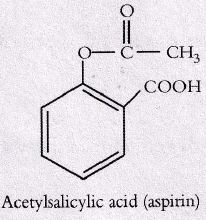
Write the structural formula of aspirin.
5.
How the tranquilizers work in body.
1.
Hard water contains salts of calcium and magnesium. When soaps are dissolved in hard water, these ions displace sodium and potassium from their salts and form insoluble calcium and magnesium salts of fatty acids. These insoluble salts separate as scum, Thus soaps do not work in hard water.
2.
(i) To understand how a soap works as a cleansing agent, let us consider sodium palmitate an example of a soap. The cleansing action of soap is directly related to the structure of carboxylate ions (palmitate ion) present in soap. The structure of palmitate exhibit dual polarity. The hydrocarbon portion is non polar and the carboxyl portion is polar.

(ii) The nonpolar portion is hydrophobic while the polar end is hydrophilic. The hydrophobic hydro carbon portion is soluble in oils and greases, but not in water. The hydrophilic carboxylate group is soluble in water.
(iii) The dirt in the cloth is due to the presence of dust particles intact or grease which stick. When the soap is added to an oily or greasy part of the cloth, the hydrocarbon part of the soap dissolve in the grease, leaving the negatively charged carboxylate end exposed on the grease surface.
(iv) At the same time the negatively charged carboxylate groups are strongly attracted by water, thus leading to the formation of small droplets called micelles and grease is floated away from the solid object. When the water is rinsed away, the grease goes with it. As a result, the cloth gets free from dirt and the droplets are washed away with water. The micelles do not combine into large drops because their surfaces are all negatively charged and repel each other. The cleansing ability of a soap depends upon its tendency to act as a emulsifying agent between water and water insoluble greases.
.JPG)
The cleansing action of detergents are similar to cleansing action of soap. Eg: the structure of a cationic detergents is:
.JPG)
3.
A drug is a substance that is used to modify or explore physiological systems or pathological states for the benefit of the recipient. It is used for the purpose of diagnosis, prevention, cure/relief of a disease.
a) Classification of drugs:
Drugs are classified based on their properties such as chemical structure, pharmacological effect, target system, site of action etc.
b) Classification based on the chemical structure:
In this classification, drugs with a common chemical skeleton are classified into a single group. For example, ampicillin, amoxicillin, methicillin etc.. all have similar structure and are classified into a single group called penicillin. Similarly, we have other group of drugs such as opiates, steroids, catecholamines etc. Compounds having similar chemical structure are expected to have similar chemical properties. However, their biological actions are not always similar. For example, all drugs belonging to penicillin group have same biological action, while groups such as barbiturates, steroids etc.. have different biological action.
Penicillins
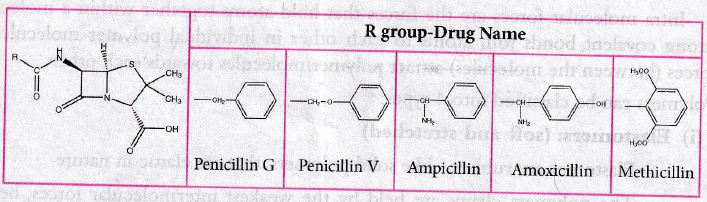
Classification based on Pharmacological effect:
In this classification, the drugs are grouped based on their biological effect that they produce on the recipient. For example, the medicines that have the ability to kill the pathogenic bacteria are grouped as antibiotics. This kind of grouping will provide the full range of drugs that can be used for a particular condition (disease). The physician has to carefully choose a suitable medicine from the available drugs based on the clinical condition of the recipient.
Examples:
Antibiotic drugs: amoxicillin, ampicillin, cefixime, cefpodoxime, erythromycin, tetracycline etc.. Antihypertensive drugs: propranolol, atenolol, metoprolol succinate, amlodipine etc...
Classification based on the target system (drug action):
In this classification, the drugs are grouped based on the biological system/process, that they target in the recipient. This classification is more specific than the pharmacological classification. For example, the antibiotics streptomycin and erythromycin inhibit the protein synthesis (target process) in bacteria and are classified in a same group. However, their mode of action is different. Streptomycin inhibits the initiation of protein synthesis, while erythromycin prevents the incorporation of new amino acids to the protein.
Classification based on the site of action (molecular target):
The drug molecule interacts with biomolecules such as enzymes, receptors etc, which are referred as drug targets. We can classify the drug based on the drug target with which it binds. This classification is highly specific compared to the others. These compounds often have a common mechanism of action, as the target is the same.
4.
Aspirin is o-acetyl salicylic acid
5.
(i) They are neurologically active drugs.
(ii) It acts on the central nervous system by blocking the neurotransmitter dopamine in the brain.
Uses : Reducing stress & anxiety, To cure sleep disorders & severe mental disease.
Ex : (i) Major tranquilizers : Haloperidol, Clozapine
(ii) Minor tranquilizers :Diozepam(Valium), alprazolam.

12th Standard Syllabus & Materials
12th Standard
TN 12th Computer Applications களப்பெயர் முறைமை (DNS) Sample Question Papers Study Material - QB365 Set A
NEW12th Standard
TN 12th Computer Applications வலையமைப்பு எடுத்துக்காட்டுகள் மற்றும் நெறிமுறைகள் Sample Question Papers Study Material - QB365 Set A
NEW12th Standard
TN 12th Computer Applications கணினி வலையமைப்பு ஓர் அறிமுகம் Sample Question Papers Study Material - QB365 Set A
NEW12th Standard
TN 12th Computer Applications PHP-உடன் MySQL-ஐ இணைத்தல் Sample Question Papers Study Material - QB365 Set A



Tamilnadu Stateboard 12th Standard Subjects

Maths
Chemistry

Physics

Biology

Computer Science

Business Maths and Statistics

Economics

Commerce

Accountancy

History

Computer Applications
Biology
Computer Technology
Computer Applications
Computer Science
Business Maths and Statistics
Commerce
Economics
Maths
Chemistry
Physics
Computer Technology
History
Accountancy

Tamil

English

French
Tamilnadu Stateboard Standards



