
 100% FREE ACCESS
12th Standard Syllabus & Materials
12th Standard
TN 12th Maths Applications of Matrices and Determinants Sample Question Papers Study Material - QB365 Set A
NEW12th Standard
TN 12th Computer Applications மின்னணு தரவு பரிமாற்றம் Sample Question Papers Study Material - QB365 Set A
NEW12th Standard
TN 12th Computer Applications மின் - வணிக பாதுகாப்பு அமைப்புகள் Sample Question Papers Study Material - QB365 Set A
NEW12th Standard
TN 12th Computer Applications மின்னணு செலுத்தல் முறைகள் Sample Question Papers Study Material - QB365 Set A
NEW12th Standard
TN 12th Computer Applications மின் - வணிகம் Sample Question Papers Study Material - QB365 Set A
NEW12th Standard
TN 12th Computer Applications திறந்த மூல கருத்துருக்கள் Sample Question Papers Study Material - QB365 Set A

Published on: 13/05/2022
QB365 provides detailed and simple solution for every Creative Questions in class 12 Chemistry Subject. It will helps to get more idea about question pattern in every Creative questions with solution.
latest Creative QuestionsDownload Tamil Nadu 12th Standard Chemistry question papers, model tests, one-mark questions, important questions, and public exam papers in PDF format. Free study materials and answer keys for TN State Board students.
Questions + Answers key
Take MCQ Chemistry Test1.
Explain the prepareation of Bakelite and Give its use.
2.
Styrene polymerises to polystyrene when heated in the presence of peroxide initiator.
(i) What is the mechanism involved?
(ii) Give the initiation step for the above process.
(iii) How does the chain propogate in the above mechanism?
(iv) How is the above chain reaction terminated?
3.
Explain the classification of polymers based on their structure and mode of synthesis.
4.
Explain Receptor as drug targets.
5.
Write a note on drug target interaction.
1.
The monomers are phenol and formaldehyde. The polymer is obtained by the condensation polymerization of these monomers in presence of either an acid or a base catalyst.
Phenol reacts with methanal to form ortho or para hydroxyl methylphenols which on further reaction with phenol gives linear polymer called novolac. Novalac on further heating with formaldehyde undergo cross linkages to form Bakelite.
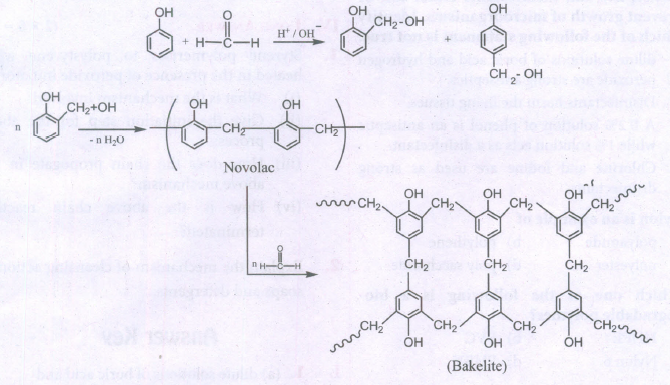
Uses:
Navolac is used in paints. Soft bakelites are used for making glue for binding laminated wooden planks and in varinishes, Hard bakelites are used to prepare combs, pens etc...
2.
(i) Free radical polymerisation.
(ii) Styrene polymerises to polystyrene when it is heated to ionic with a peroxide initiator. The mechanism involves the following steps.

(iii) Propagation step
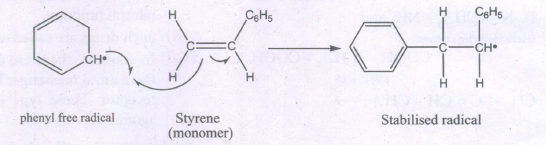
The stabilized radical attacks another monomer molecule to give an elongated radical.

Chain growth will continue with the successive addition of several thousands of monomer units.
(iv) The above chain reaction can be stopped by stopping the supply of monomer or by coupling of two chains or reaction with an impurity such as oxygen.

3.
(i) Structure:
(a) Linear polymers (long continuous chain) E.g. HDPE, PVC
(b) Branched polymers (one main chain with small chains as branches) E.g. polypropylene, LDPE.
(c) Cross linked polymers (linking of chain polymers) E.g. bakelite, melamine, formaldehyde
(ii) Mode of synthesis:
(a) Addition polymers. Formed by polymerisation of monomers without the elimination of byproduct. E.g. polyethylene, PVC, teflon.
(b) Condensation Polymer formed by the condensation of two or more monomers with the elimination of simple molecules like H2O, NH3, etc., E.g. Nylon:6-6, polyester.
4.
(i) Many drugs exert their physiological effects by binding to a specific molecule called a receptor whose role is to trigger a response in a cell.
(ii) The chemical messengers, bind to the active site of these receptors. This brings about the transfer of message into the cell.
(iii) The chemical messengers bind to the active site of these receptors.
(iv) This brings about the transfer of message into the cell
(v) These receptors show high selectivity.
(vi) If we want to block a message, a drug that binds to the receptor site should inhibit its natural function.
(vii) Such drugs are called antagonists.
(viii) In contrast, there are drugs which mimic the natural messenger by switching on the receptor. These type of drugs are called agonists.
5.
(i) The biochemical processes such as metabolism, cell-signaling etc... are essential for the normal functioning of our body.
(ii) These routine processes may be disturbed by any external factors such as microorganism, chemicals etc ..
(iii) Under such conditions medicines restore the normal functioning of the body.
(iv) These drug molecules interact with biomolecules such as proteins, lipids, etc .. that are responsible for different functions of the body.
(v) The drug interacts with these molecules and modify the normal biochemical reactions either by modifying the enzyme activity or by stimulating/suppressing certain receptors.

12th Standard Syllabus & Materials
12th Standard
TN 12th Computer Applications வலையமைப்பு வடமிடல் Sample Question Papers Study Material - QB365 Set A
NEW12th Standard
TN 12th Computer Applications களப்பெயர் முறைமை (DNS) Sample Question Papers Study Material - QB365 Set A
NEW12th Standard
TN 12th Computer Applications வலையமைப்பு எடுத்துக்காட்டுகள் மற்றும் நெறிமுறைகள் Sample Question Papers Study Material - QB365 Set A
NEW12th Standard
TN 12th Computer Applications கணினி வலையமைப்பு ஓர் அறிமுகம் Sample Question Papers Study Material - QB365 Set A



Tamilnadu Stateboard 12th Standard Subjects

Maths
Chemistry

Physics

Biology

Computer Science

Business Maths and Statistics

Economics

Commerce

Accountancy

History

Computer Applications
Biology
Computer Technology
Computer Applications
Computer Science
Business Maths and Statistics
Commerce
Economics
Maths
Chemistry
Physics
Computer Technology
History
Accountancy

Tamil

English

French
Tamilnadu Stateboard Standards



