
 100% FREE ACCESS
12th Standard Syllabus & Materials
12th Standard
TN 12th Maths Applications of Matrices and Determinants Sample Question Papers Study Material - QB365 Set A
NEW12th Standard
TN 12th Computer Applications மின்னணு தரவு பரிமாற்றம் Sample Question Papers Study Material - QB365 Set A
NEW12th Standard
TN 12th Computer Applications மின் - வணிக பாதுகாப்பு அமைப்புகள் Sample Question Papers Study Material - QB365 Set A
NEW12th Standard
TN 12th Computer Applications மின்னணு செலுத்தல் முறைகள் Sample Question Papers Study Material - QB365 Set A
NEW12th Standard
TN 12th Computer Applications மின் - வணிகம் Sample Question Papers Study Material - QB365 Set A
NEW12th Standard
TN 12th Computer Applications திறந்த மூல கருத்துருக்கள் Sample Question Papers Study Material - QB365 Set A

Published on: 13/05/2022
QB365 provides detailed and simple solution for every Book back Questions in class 12 Chemistry Subject. It will helps to get more idea about question pattern in every book back questions with solution.
latest Book back QuestionsDownload Tamil Nadu 12th Standard Chemistry question papers, model tests, one-mark questions, important questions, and public exam papers in PDF format. Free study materials and answer keys for TN State Board students.
Questions + Answers key
Take MCQ Chemistry Test1.
2.
Write the oxidation state, coordination number , nature of ligand, magnetic property and electronic configuration in octahedral crystal field for the complex K4[Mn(CN)6]
3.
What is crystal field stabilization energy (CFSE)?
4.
On the basis of VB theory explain the nature of bonding in [Co(C2O4)3]3-
5.
Discuss briefly the nature of bonding in metal carbonyls.
1.
2.
(i) Oxidation state of the central metal ion : +2 (i.e) Mn2+
(ii) Co-ordination number : 6
(iii) Nature of ligand: CN- (Negative ligand)
(iv) Magnetic property: Paramagnetic nature
(v) Electronic configuration:
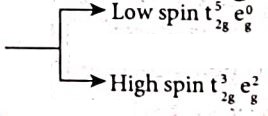
(vi) Oxidation state: +2 (or) Mn2+ of central metal ion
3.
The CFSE is defined as the energy of the electronic configuration in the ligand field minus the energy of the electronic configuration in the isotropic field.
CFSE (\(\Delta\)Eo) = {ELf}-{Eiso}
={[nt2g(-0.4) + neg(0.6)]\(\Delta\)o + npP} - {n'pP}
Here, nt2g is the number of electrons in t2g orbitals;
neg is number of electrons in eg orbitals;
np is number of electron pairs in the ligand field; &
n'p is the number of electron pairs in the isotropic field (barycenter).
P - pairing energy
4.
In \(\left[\mathrm{Co}\left(\mathrm{C}_{2} \mathrm{O}_{4}\right)_{3}\right]^{3-}\) Cobalt is in +3 oxidation state
\(\mathrm{Co}=[\mathrm{Ar}] 3 \mathrm{~d}^{7} 4 \mathrm{~s}^{2} \)
\(\mathrm{Co}^{3+}=3 \mathrm{~d}^{6} 4 \mathrm{~s}^{\circ}\)
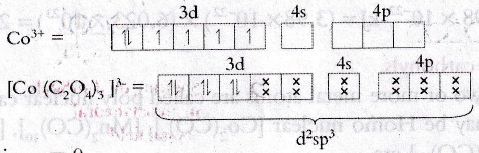
It is diamagnetic; n = 0
d2sp3 hybridisation; μs = 0
5.
Bonding in metal carbonyls:
(i) In metal carbonyls, the bond between metal atom and the carbonyl ligand consists of two components.
(ii) The first component is an electron pair donation from the carbon atom of carbonyl ligand into a vacant d-orbital of central metal atom.
(iii) This electron pair donation forms \(M\overset { \sigma \ bond }{ \longleftarrow } \text {CO sigma bond}\)
(iv) This sigma bond formation increases the electron density in metal d orbitals and makes the metal electron rich.
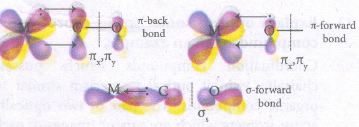
(v) In order to compensate for this increased electron density, a filled metal d-orbital interacts with the empty \({ \pi }^{ \bigstar }\) orbital on the carbonyl ligand and transfers the added electron density back to the ligand.
(vi) This second component is called \(\pi\)-back bonding.
(vii) Thus in metal carbonyls, electron density moves from ligand to metal through sigma bonding and from metal to ligand through pi bonding, this synergic effect accounts for strong M⇽CO bond in metal carbonyls.
(viii) This phenomenon is shown diagrammatically as follows.

12th Standard Syllabus & Materials
12th Standard
TN 12th Computer Applications வலையமைப்பு வடமிடல் Sample Question Papers Study Material - QB365 Set A
NEW12th Standard
TN 12th Computer Applications களப்பெயர் முறைமை (DNS) Sample Question Papers Study Material - QB365 Set A
NEW12th Standard
TN 12th Computer Applications வலையமைப்பு எடுத்துக்காட்டுகள் மற்றும் நெறிமுறைகள் Sample Question Papers Study Material - QB365 Set A
NEW12th Standard
TN 12th Computer Applications கணினி வலையமைப்பு ஓர் அறிமுகம் Sample Question Papers Study Material - QB365 Set A



Tamilnadu Stateboard 12th Standard Subjects

Maths
Chemistry

Physics

Biology

Computer Science

Business Maths and Statistics

Economics

Commerce

Accountancy

History

Computer Applications
Biology
Computer Technology
Computer Applications
Computer Science
Business Maths and Statistics
Commerce
Economics
Maths
Chemistry
Physics
Computer Technology
History
Accountancy

Tamil

English

French
Tamilnadu Stateboard Standards



