
 100% FREE ACCESS
12th Standard Syllabus & Materials
12th Standard
TN 12th Maths Applications of Matrices and Determinants Sample Question Papers Study Material - QB365 Set A
NEW12th Standard
TN 12th Computer Applications மின்னணு தரவு பரிமாற்றம் Sample Question Papers Study Material - QB365 Set A
NEW12th Standard
TN 12th Computer Applications மின் - வணிக பாதுகாப்பு அமைப்புகள் Sample Question Papers Study Material - QB365 Set A
NEW12th Standard
TN 12th Computer Applications மின்னணு செலுத்தல் முறைகள் Sample Question Papers Study Material - QB365 Set A
NEW12th Standard
TN 12th Computer Applications மின் - வணிகம் Sample Question Papers Study Material - QB365 Set A
NEW12th Standard
TN 12th Computer Applications திறந்த மூல கருத்துருக்கள் Sample Question Papers Study Material - QB365 Set A

Published on: 13/05/2022
QB365 provides detailed and simple solution for every Creative Questions in class 12 Chemistry Subject. It will helps to get more idea about question pattern in every Creative questions with solution.
latest Creative QuestionsDownload Tamil Nadu 12th Standard Chemistry question papers, model tests, one-mark questions, important questions, and public exam papers in PDF format. Free study materials and answer keys for TN State Board students.
Questions + Answers key
Take MCQ Chemistry Test1.
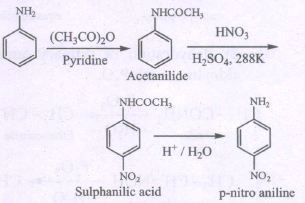
Convert aniline to p-nitro aniline
2.
Formic acid reduces Tollen's reagent but acetic acid does not - Give reasons.
3.
Write the preparation of neoprene and give its use.
4.
Why sucrose is called invert sugar?
5.
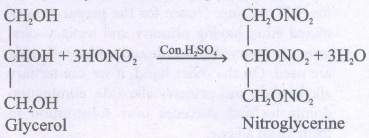
How is nitroglycerine prepared from glycerol?
6.
Wha tare catalyticpoisons? Give an example.
7.
What is salt bridge? How is it represented in a cell diagram?
8.
What is Henderson equation?
9.
What is the effect of temperature on the rate constant of a reaction? How can this temperature effect on rate constant be represented quantitatively?
10.
State Bragg's law.
1.
To get para product, the - NH2 group is protected by acetylation with acetic anhydride. Then, the nitrated product is hydrolysed to form the product.
2.
(i) Formic acid (HCOOH) is unique because it contains both an aldehyde group and carboxyl group also.
(ii) Hence it can act as a reducing agent. It reduces Fehling's solution Tollen's reagent and decolourises pink coloured KMnO4 solution.
(iii) Whereas in acetic acid, there is no aldehyde group and it cannot act as reducing agent.
(iv) Formic acid reduces ammoniacal silver nitrate solution (Tollen's reagent) to metallic silver
HCOOH + Ag2O⟶ H2O + CO2 + 2Ag↓ (metallic silver)
(v) Formic acid reduces Fehling's solution. It reduces blue coloured cupric ions to red coloured cuprous ions.
\(HCOO^{ - }+\underset { (blue) }{ 2{ Cu }^{ 2+ } } +5{ OH }^{ - }\longrightarrow { CO }_{ 3 }^{ 2- }+\underset { (red) }{ { Cu }_{ 2 }O } +3{ H }_{ 2 }O\)
3.
The free radical polymeristion of the monomer, 2-c Woro buta -1,3-diene( chloroprene) gives neoprene.

It is superior to rubber and resistant to chemical action.
Uses: It is used in the manufacture of chemical containers, conveyer belts
4.
On hydrolysis, sucrose yields equal amount of glucose and fructose units.
\(Sucrose\overset { Invertase }{ \longrightarrow } Glucose+Frutose\)
Sucrose (+66.6°) and glucose (+52.5o) are dextrorotatory compounds while fructose is levo rotatory (-92.4°). During hydrolysis of sucrose, the optical rotation of the reaction mixture changes from dextro to levo. Hence, sucrose is called as invert sugar.
5.
When glycerol is treated with a well cooled mixture of concentrated sulphuric acid and fuming nitric acid, nitroglycerine is formed.
6.
(i) A substance which destroys the activity of the catalyst is called a poison and the process IS called catalytic poisoning. Some of the examples are
(ii) Eg. The platinum catalyst used in the oxidation : of SO2 in contact process is poisoned by : arsenious oxide.
\({ 2SO }_{ 2 }+{ O }_{ 2 }\overset { Pt }{ \underset { Poissoned }{ \leftrightharpoons } } { 2SO }_{ 3 }\)
7.
(i) In the complete cell diagram, the two half cells are separated by a double vertical line (salt bridge) in between.
(ii) The zinc-copper cell can now be written as
| salt bridge | ||||
| Zn | | Zn2+ | || | Cu2+ | Cu |
| ANODE HALF-CELL CATHODE | HALF-CELL | |||
8.
Henderson equation is an equation which is used to determine the pH of an acid buffer with the help of the dissociation constant Ka of the weak acid and concentration of the acid and the salt used.
\(\boxed { pH={ pK }_{ a }+\log\frac { [salt] }{ [acid] } }\)
For a basic buffer \(pH={ pK }_{ b }+\log\frac { [salt] }{ [base] } \)
9.
(i) The rate constant is nearly doubled with a rise in temperature by 10oC for a chemical reaction.
(ii) The temperature effect on the rate constant can be represented quantitatively by Arrhenius equation.
\(k=A{ e }^{ \frac { -{ E }_{ a } }{ RT } }\)
10.
The fundamental equation that gives a simple relation between the wavelength of the X-rays, the interplanar distance in the crystal and the angle of reflection is known as Bragg's equation.
nλ = 2dsinθ
Where n is the order of reflection
λ is the wavelength of X-rays
d is the interplanar distance in the crystal
θ is the angle of reflection

12th Standard Syllabus & Materials
12th Standard
TN 12th Computer Applications வலையமைப்பு வடமிடல் Sample Question Papers Study Material - QB365 Set A
NEW12th Standard
TN 12th Computer Applications களப்பெயர் முறைமை (DNS) Sample Question Papers Study Material - QB365 Set A
NEW12th Standard
TN 12th Computer Applications வலையமைப்பு எடுத்துக்காட்டுகள் மற்றும் நெறிமுறைகள் Sample Question Papers Study Material - QB365 Set A
NEW12th Standard
TN 12th Computer Applications கணினி வலையமைப்பு ஓர் அறிமுகம் Sample Question Papers Study Material - QB365 Set A



Tamilnadu Stateboard 12th Standard Subjects

Maths
Chemistry

Physics

Biology

Computer Science

Business Maths and Statistics

Economics

Commerce

Accountancy

History

Computer Applications
Biology
Computer Technology
Computer Applications
Computer Science
Business Maths and Statistics
Commerce
Economics
Maths
Chemistry
Physics
Computer Technology
History
Accountancy

Tamil

English

French
Tamilnadu Stateboard Standards



