
 100% FREE ACCESS
12th Standard Syllabus & Materials
12th Standard
TN 12th Computer Applications மின்னணு தரவு பரிமாற்றம் Sample Question Papers Study Material - QB365 Set A
NEW12th Standard
TN 12th Computer Applications மின் - வணிக பாதுகாப்பு அமைப்புகள் Sample Question Papers Study Material - QB365 Set A
NEW12th Standard
TN 12th Computer Applications மின்னணு செலுத்தல் முறைகள் Sample Question Papers Study Material - QB365 Set A
NEW12th Standard
TN 12th Computer Applications மின் - வணிகம் Sample Question Papers Study Material - QB365 Set A
NEW12th Standard
TN 12th Computer Applications திறந்த மூல கருத்துருக்கள் Sample Question Papers Study Material - QB365 Set A
NEW12th Standard
TN 12th Computer Applications வலையமைப்பு வடமிடல் Sample Question Papers Study Material - QB365 Set A

Published on: 22/06/2021
QB365 provides detailed and simple solution for every Creative Questions in class 12 Chemistry Subject. It will helps to get more idea about question pattern in every Creative questions with solution.
Download Tamil Nadu 12th Standard Chemistry question papers, model tests, one-mark questions, important questions, and public exam papers in PDF format. Free study materials and answer keys for TN State Board students.
Questions + Answers key
Take MCQ Chemistry Test1.
Compound A of molecular formula C7H8 is treated with chlorine and then with NaOH to get compound B of molecular formula C7H8O. B on oxidation by acidified K2Cr2O7 gives compound C of molecular formula C7H6O. Compound C on treatment with 50% caustic soda gives the compound B and also D. Find A, B, C and D. Explain the reactions.
2.
Write the characteristics of catalysts.
3.
To 1M solution of AgNO3, 0.75 F quantity of current is passed. What is the concentration of the electrolyte, AgNO3 remaining in the solution?
4.
5.
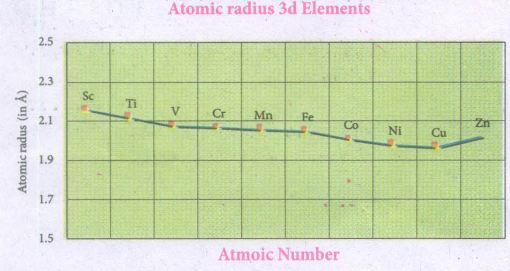
Why is there a variation of atomic and ionic size as we move from Sc to Zn?
6.
Mention the uses of helium.
7.
What are molecular solids? Explain the types of molecular solids.
8.
How are silicates classified? Give an example for each type of silicate.
9.
Indicate the types of isomerism exhibited by the following complexes and draw the structures for these isomers.
(i) K[Cr(H2O)2 (C2O4)2]
(ii) [Co(en)3]CI3
(iii) [Co(NH3)5(NO2)](NO3)2
(iv) [Pt (NH3)(H2O)CI2]
1.
(i) An organic compound (A) is identified as toluene from its molecular formula.
(ii) (A) on reaction with chlorine gives benzyl chloride which on further reaction with NaOH produces (B).
\({ C }_{ 6 }{ H }_{ 5 }-{ { { CH }_{ 3 } } }\overset { { Cl }_{ 2 } }{ \underset { -HCl }{ \longrightarrow } } { C }_{ 6 }{ H }_{ 5 }{ CH }_{ 2 }Cl\overset { NaOH }{ \underset { -Nacl }{ \longrightarrow } } \underset { (B) }{ { C }_{ 6 }H_{ 5 }{ CH }_{ 2 }OH } \)
(iii) B) on oxidation with acidified K2Cr2O7 gives (C).
\({ C }_{ 6 }{ H }_{ 5 }{ CH }_{ 2 }\overset { { K }_{ 2 }{ Cr }_{ 2 }{ O }_{ 7 }/{ H }^{ + } }{ \underset { (O) }{ \longrightarrow } } \underset { (C) }{ { C }_{ 6 }{ H }_{ 5 }CHO+{ { H }_{ 2 }O } } \)
(iv) Benzaldehyde on treatment with 50% caustic soda gives (D) and (B).
\(\underset { (C) }{ { C }_{ 6 }{ H }_{ 5 }CHO } +{ C }_{ 6 }{ H }_{ 5 }CHO\overset { 50 \% }{ \underset { NaOH }{ \longrightarrow } } \underset { (B) }{ { C }_{ 6 }{ H }_{ 5 }{ CH }_{ 2 }OH } +\underset { (D) }{ { C }_{ 6 }{ H }_{ 5 }COOH } \)
| Compound | Compound Name | Formula |
| A | Toluene | C6H5-CH3 |
| B | Benzyl alcohol | C6H5CH2OH |
| C | Benzaldehyde | C6H5CHO |
| D | Benzoic acid | C6H5COOH |
2.
(i) For a chemical reaction, catalyst is needed in very small quantity.
(ii) There may be some physical changes, but the catalyst remains unchanged in mass and chemical composition in a chemical reaction.
(iii) A catalyst itself cannot initiate a reaction.
(iv) A solid catalyst will be more effective if it is taken in a finely divided form.
(v) A catalyst are specific in nature.
(vi) In an equilibrium reaction, presence of catalyst reduces the time for attainment of equilibrium and hence it does not affect the position of equilibrium and the value of equilibrium constant.
(vii) A catalyst is highly effective at a particular temperature called as optimum temperature.
(viii) Presence of a catalyst generally does not change the nature of products
3.
Initial concentration of
AgNO3 = 1M= IN
Quantity of current 0.75 F
Formula:
1Faraday = 1equivalent mass
Solution:
For IF current In AgNO3 will be liberated.
For 0.75 F current 0.75 N AgNO3 will be liberated
The concentration of AgNO3 remaining
= 1.0 - 0.75 = 0.25 N
ஃ The concentration of AgNO3 remaining
4.
5.
(i) It is generally expected a steady decrease in atomic radius along a period as the nuclear charge increases and the extra electrons are added to the same sub shell.
(ii) But for the 3d transition elements, the expected decrease in atomic radius is observed from Sc to V, thereafter up to Cu the atomic radius nearly remains the same.
(iii) As we move from Sc to Zn in 3d series the extra electrons are added to the 3d orbitals, the added 3d electrons only partially shield the increased nuclear charge and hence the effective nuclear charge increases slightly.
(iv) However, the extra electrons added to the 3d sub shell strongly repel the 4s electrons and these two forces are operated in opposite direction and as they tend to balance each other, it leads to constancy in atomic radii.
(v) At the end of the series, d - orbitals of Zinc contain 10 electrons in which the repulsive interaction between the electrons is more than the effective nuclear charge and hence, the orbitals slightly expand and atomic radius slightly increases.
6.
(i) Because of its lightness and noninflammability helium is used to filling balloons for meteorological observations.
(ii) Because of its lightness it is used in inflating aeroplane tyres.
(iii) Helium oxygen mixture is used by deep sea divers in preference to nitrogen oxygen mixtures. This prevents bends when a diver comes to the surface.
(iv) A mixture of oxygen and helium is used in the treatment of asthma.
(v) Liquid helium (b.pt 4.2K) is used as cryogenic agent for carrying out various experiments at low temperatures.
(vi)It is used to produce and sustain powerful super conducting magnets of modern NMR Spectrometers and Magnetic Resonance Imaging system (MRI) for clinical diagnosis.
7.
Molecular solids:
In molecular solids, the constituents are neutral molecules. They are held together by weak Vander Waals forces. Generally molecular solids are soft and they do not conduct electricity. These molecular solids are further classified into three types.
(i) Non-polar molecular solids:
(a) In non-polar molecular solids constituent molecules are held together by weak dispersion forces or London forces.
(b) They have low melting points and are usually in liquids or gaseous state at room temperature.
Ex: Naphthalene, anthracene etc.,
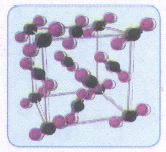
(ii) Polar molecular solids:
(a) The constituents are molecules formed by polar covalent bonds.
(b) They are held together by relatively strong dipole-dipole interactions.
(c) They have higher melting points than the nonpolar molecular solids.
Ex: Solid CO2, solid NH3 etc.
(iii) Hydrogen bonded molecular solids:
(a) The constituents are held together by hydrogen bonds.
(b) They are generally soft solids under room temperature.
(c) Examples: solid ice (H2O), glucose, urea etc.
8.
Silicates are classified into various types based on the way in which the tetrahedral units, [SiO4]4- are linked together.
(i) Ortho silicates (Neso silicates):
The simplest silicates which contain discrete [SiO4]4- tetrahedral units are called ortho silicates or nesosilicates.
Examples: Phenacite - Be2SiO4 (Be2+ ions are tetrahedrally surrounded by O2- ions)
(ii) pyro silicate (or) Soro silicates: Silicates:
Which contain [Si2O7]6- ions are called pyro silicates (or) Soro silicates.
Example: Thortveitite - Sc2Si2O7
(iii) Cyclic silicates (or Ring silicates):
Silicates which contain (SiO3)32n- ions which are formed by linking three or more tetrahedral SiO44- units cyclically are called cyclic silicates.
Example: Beryl [Be3Al2 (SiO3)6] (an aluminosilicate with each aluminium is surrounded by 6 oxygen atoms octahedrally)
(iv) Inosilicates: Silicates which contain 'n':
number of silicate units liked by sharing two or more oxygen atoms are called inosilicates.
Example: They are further classified as chain silicates and double chain silicates.
(v) Chain silicates (or pyroxenes):
These silicates contain [(SiO3)n]2n- ions formed: by linking 'n' number of tetrahedral [SiO4]4- units linearly. Each silicate unit shares two of its oxygen atoms with other units.
Example: Spodumene - LiAl(SiO3)2·
(vi) Double chain silicates (or amphiboles):
These silicates contains \(\left[ { Si }_{ 4 }{ O }_{ 11 } \right] _{ n }^{ 6n- }\) ions. In these silicates there are two different types of tetrahedra:
(a) Those sharing 3 vertices
(b) those sharing only 2 vertices.
Example:
Asbestos: These are fibrous and non-combustible silicates.
(vii) Sheet or phyllo silicates:
Silicates which contain \(({ Si }_{ 2 }{ O }_{ 5 })_{ n }^{ 2n- }\) are called sheet or phyllo silicates. In these, Each [SiO4]4- tetrahedron unit shares three oxygen atoms with others and thus by forming two dimensional sheets.
Example: Talc, Mica etc.
(viii) Three dimensional silicates (or tectosilicates):
Silicates in which all the oxygen atoms of [SiO4]4- tetrahedra are shared with other tetrahedra to form three dimensional network are called three dimensional or tectosilicates.
Example: Quartz.
9.
(i) It exhibits both geometrical and optical isomerism
(a) Geometrical isomers:
.JPG)
(b) Optical isomers:
.JPG)
(ii) It shows two optical isomers
.JPG)
(iii) Ionisation isomers
Linkage isomers
[Co(NH3)5(NO2)(NO3)2], [CO(NH3)5 (ONO)](NO3)2
(iv) Geometrical isomers
.JPG)

12th Standard Syllabus & Materials
12th Standard
TN 12th Computer Applications களப்பெயர் முறைமை (DNS) Sample Question Papers Study Material - QB365 Set A
NEW12th Standard
TN 12th Computer Applications வலையமைப்பு எடுத்துக்காட்டுகள் மற்றும் நெறிமுறைகள் Sample Question Papers Study Material - QB365 Set A
NEW12th Standard
TN 12th Computer Applications கணினி வலையமைப்பு ஓர் அறிமுகம் Sample Question Papers Study Material - QB365 Set A
NEW12th Standard
TN 12th Computer Applications PHP-உடன் MySQL-ஐ இணைத்தல் Sample Question Papers Study Material - QB365 Set A



Tamilnadu Stateboard 12th Standard Subjects

Maths
Chemistry

Physics

Biology

Computer Science

Business Maths and Statistics

Economics

Commerce

Accountancy

History

Computer Applications
Biology
Computer Technology
Computer Applications
Computer Science
Business Maths and Statistics
Commerce
Economics
Maths
Chemistry
Physics
Computer Technology
History
Accountancy

Tamil

English

French
Tamilnadu Stateboard Standards



