
 100% FREE ACCESS
12th Standard Syllabus & Materials
12th Standard
TN 12th Maths Applications of Matrices and Determinants Sample Question Papers Study Material - QB365 Set A
NEW12th Standard
TN 12th Computer Applications மின்னணு தரவு பரிமாற்றம் Sample Question Papers Study Material - QB365 Set A
NEW12th Standard
TN 12th Computer Applications மின் - வணிக பாதுகாப்பு அமைப்புகள் Sample Question Papers Study Material - QB365 Set A
NEW12th Standard
TN 12th Computer Applications மின்னணு செலுத்தல் முறைகள் Sample Question Papers Study Material - QB365 Set A
NEW12th Standard
TN 12th Computer Applications மின் - வணிகம் Sample Question Papers Study Material - QB365 Set A
NEW12th Standard
TN 12th Computer Applications திறந்த மூல கருத்துருக்கள் Sample Question Papers Study Material - QB365 Set A

Published on: 13/05/2022
QB365 provides detailed and simple solution for every Creative Questions in class 12 Chemistry Subject. It will helps to get more idea about question pattern in every Creative questions with solution.
latest Creative QuestionsDownload Tamil Nadu 12th Standard Chemistry question papers, model tests, one-mark questions, important questions, and public exam papers in PDF format. Free study materials and answer keys for TN State Board students.
Questions + Answers key
Take MCQ Chemistry Test1.
An organic compound (A) of molecular formula C7H8 on oxidation with air and in presence of V2O5 to form (B) of molecular formula C7H6O. (B) on reduction with lithium aluminium hydride to form (C) of molecular formula C7H8O. Identify (A), (B) and (C) and explain the reactions.
2.
Explain the classification of hormones.
3.
Explain the classification of polymers based on their structure and mode of synthesis.
4.
An organic compound (A) C6H6O gives violet colour with neutral FeCl3 solution. With NH3 in the presence of anhydrous ZnCI2, (A) gives (B) (C6H7N). (A) with dimethyl sulphate gives (C) (C7H8O). What are (A), (B) and (C)? Explain the reactions.
5.
How do primary, secondary and tertiary amines react with nitrous acid?
6.
Explain the various chemical methods by which colloids can be prepared.
7.
Derive a relationship between dissociation constant Ka and molar conductivity \({ \Lambda }_{ m }\)
8.
Derive Henderson - Hasselbalch equation
9.
A first order reaction completes 25% of the reaction in 100 mins. What are the rate constant and half life values of the reaction?
10.
An element with molar mass 2.7 x 10⁻² kg mol forms a cubic unit cell with edge length 405 pm. If its density is 2.7 x 10³ kg m-3, What is the nature of the cubic unit cell?
1.
(i) (A) on oxidation with air and V2O5 gives (B).
\(\underset{(A)}{{ C }_{ 6 }{ H }_{ 5 }{ CH }_{ 3 }}\overset { \left( O \right) }{ \underset { { V }_{ 2 }{ O }_{ 5 } }{ \longrightarrow } } \underset{(B)}{{ C }_{ 6 }{ H }_{ 5 }CHO}\)
(ii) (B) on reduction with LiAIH4 gives C.
\({ C }_{ 6 }{ H }_{ 5 }CH\overset { \left[ H \right] }{ \underset { LiA/{ H }_{ 4 } }{ \longrightarrow } } \underset{(C)}{{ C }_{ 6 }{ H }_{ 5 }CHO}\)
| Compound | Compound Name | Formula |
| A | Toluene | C6H5CH3 |
| B | Benzaldehyde | C6H5CHO |
| C | Benzylalcohol | C6H5CH2OH |
2.
(i) Hormones are classified according to the distance over which they act as, endocrine, paracrine and autocrine hormones.
(ii) Endocrine hormones act on cells distant from the site of their release. Example: insulin and epinephrine are synthesized and released in the bloodstream by specialized ductless endocrine glands.
(iii) Paracrine hormones (alternatively, local mediators) act only on cells close to the cell that released them. For example, interleukin -1 (IL-1) Autocrine hormones act on the same cell that released them. For example, protein growth factor interleukin-2 (IL-2).
3.
(i) Structure:
(a) Linear polymers (long continuous chain) E.g. HDPE, PVC
(b) Branched polymers (one main chain with small chains as branches) E.g. polypropylene, LDPE.
(c) Cross linked polymers (linking of chain polymers) E.g. bakelite, melamine, formaldehyde
(ii) Mode of synthesis:
(a) Addition polymers. Formed by polymerisation of monomers without the elimination of byproduct. E.g. polyethylene, PVC, teflon.
(b) Condensation Polymer formed by the condensation of two or more monomers with the elimination of simple molecules like H2O, NH3, etc., E.g. Nylon:6-6, polyester.
4.
(i) An organic compound (A) C6H6O gives violet colour with neutral FeCl3 solution.
(ii) With NH3 in the presence of anhydrous ZnCI2,(A) gives (B) (C6H7N).
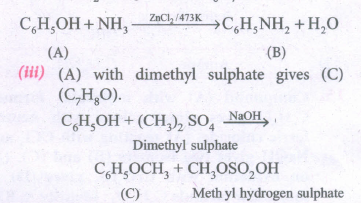
| Compound | Compound Name | Formula |
| A | Phenol | C6H5OH |
| B | Aniline | C6H5NH2 |
| C | Anisole | C6H5OCH3 |
5.
(i) Primary amine react with nitrous acid to form alcohols and nitrogen gas
\(\underset { primary \ amine }{ { CH }_{ 3 }NH_{ 2 } } \rightarrow \underset { unstable }{ { [{ CH } }_{ 3 }-N=N-OH] } \rightarrow { CH }_{ 3 }OH+{ N }_{ 2 }\)
Aliphatic diazonium compound is unstable because of absence of resonance stabilisation.
(ii) Secondary amines react with nitrous acid to form N-nitroso amines which are water insoluble yellow oils.
\(\underset { Secondary \ amine }{ { { (CH }_{ 3 } })_{ 2 }NH } +HO-N=O\rightarrow \underset { N-nitroso \ dimethy \ amine-yellow \ oil\\ (insolube \ in \ water) }{ { (CH }_{ 3 })_{ 2 }N-N=O } \)
(iii) Tertiary amine react with nitrous acid to form trialkyl ammonium nitrite salts which are soluble in water
\(\underset { Tertiary \ amine }{ { (CH }_{ 3 })_{ 2 }N } +HONO\rightarrow \underset { trimethyl \ ammonium \ nitrite\\ (salt \ soluble \ in \ water) }{ { { (CH }_{ 3 }) }_{ 3 }{ NH }^{ + }{ NO }_{ 2 }^{ - } } \)
6.
Condensation Methods:
Various chemical methods for the formation of colloidal particles.
(i) Oxidation:
Sols of some non-metals are prepared by this method. (a) When hydroiodic acid is treated with iodic acid, 12 sol is obtained.
\({ HIO }_{ 3 }+5HI\longrightarrow { 3H }_{ 2 }O+{ I }_{ 2 }\) (Sol)
(ii) Reduction:
Many organic reagents like phenyl hydrazine, formaldehyde, etc are used for the formation of sols. For example: Gold sol is prepared by reduction of auric chloride using formaldehyde.
\(2{ AuCl }_{ 3 }+3HCHO+{ 3H }_{ 2 }O\longrightarrow 2Au\left( sol \right) +6HCl+3HCOOH\)
(iii) Hydrolysis:
Sols of hydroxides of metals like chromium and aluminium can be produced by this method.
For example,
\({ FeCl }_{ 3 }+3H_{ 2 }O\longrightarrow Fe(OH)_{ 3 }+3HCl\)
(iv) Double decomposition:
For the preparation of water insoluble sols this method can be used. When hydrogen sulphide gas is passed through a solution of arsenic oxide, a yellow coloured arsenic sulphide is obtained as a colloidal solution.
\({ As }_{ 2 }{ O }_{ 3 }+3{ H }_{ 2 }S\longrightarrow { AS }_{ 2 }{ S }_{ 3 }+{ 3H }_{ 2 }O\)
(v) Decomposition:
When few drops of an acid is added to a dilute solution of sodium thio sulphate, the insoluble free sulphur produced by decomposition of sodium thiosulphate accumulates into small, clusters which impart various colours blue, yellow and even red to the system. depending on their growth within the size of colloidal dimensions.
\({ S }_{ 2 }{ O }_{ 3 }^{ 2- }+{ 2H }^{ + }\longrightarrow \underset{sol}S+{ H }_{ 2 }O+{ SO }_{ 2 }\)
By exchange of solvent:
(i) Colloidal solution of few substances like phosphorous or sulphur is obtained by preparing the solutions in alcohol and pouring them into water.
(ii) As they are insoluble in water, they form colloidal solution.
P in alcohol + water ⟶ Psol.
7.
According to Ostwald dilution Law,
\({ K }_{ a }=\frac { { \alpha }^{ 2 }C }{ (1-\alpha ) } \) ...(1)
Substitute a value in the above expression (1)
\({ K }_{ a }=\frac { { \Lambda }_{ m }^{ 2 }C }{ { \Lambda }_{ m }^{ 2 }\left( 1-\frac { { \Lambda }_{ m } }{ { \Lambda }_{ m }^{ o } } \right) } \)
\({ K }_{ a }=\frac { { \Lambda }_{ m }^{ 2 }C }{ { \Lambda }_{ m }^{ 2 }\frac { { \Lambda }_{ m }^{ o }-{ \Lambda }_{ m } }{ { \Lambda }_{ m }^{ o } } } \)
⇒ \({ K }_{ a }=\frac { { \Lambda }_{ m }^{ 2 }C }{ { \Lambda }_{ m }^{ 2 }{ (\Lambda }_{ m }^{ o }-{ \Lambda }_{ m }) } \)
8.
(i) The concentration of hydronium ion in an acidic buffer solution depends on the ratio of the concentration of the weak acid to the concentration of its conjugate base present in the solution i.e.,
\(\left[ { H }_{ 3 }{ O }^{ + } \right] ={ K }_{ a }\frac { [{ acid] }_{ aq } }{ [{ base] }_{ aq } } \)
(ii) The weak acid is dissociated only to a small extent. Moreover, due to common ion effect, the dissociation is further suppressed and hence the equilibrium concentration of the acid is nearly equal to the initial concentration of the unionised acid. Similarly, the concentration of the conjugate base is nearly equal to the initial concentration of the added salt.
\(\left[ { H }_{ 3 }{ O }^{ + } \right] ={ K }_{ a }\frac { [{ acid] } }{ [{ salt] } } \)
(iii) Here [acid] and [salt] represent the initial concentration of the acid and salt, respectively used to prepare the buffer solution
Taking logarithm on both sides of the equation
\(\log\left[ { H }_{ 3 }{ O }^{ + } \right] ={ \log K }_{ a }+\log\frac { [{ acid] } }{ [{ salt] } } \)
reverse the sign on both sides
- \(\log\left[ { H }_{ 3 }{ O }^{ + } \right] ={- \log K }_{ a }-\log\frac { [{ acid] } }{ [{ salt] } } \)
We know that
pH = -log [H3O+] and pKa = -log Ka
\(\Rightarrow pH={ pK }_{ a }-\log\frac { [{ acid] } }{ [{ salt] } } \)
\(\Rightarrow pH={ pK }_{ a }+\log\frac { [{ acid] } }{ [{ salt] } } \)
Similarly for a basic buffer,
pOH = \({ pK }_{ a }+\log\frac { [{ acid] } }{ [{ salt] } } \)
9.
Given data: Time taken for 25% completion of the reaction = 100 mins
a = 100; x = 25 and a - x = 75; t = 100min
Formula: \(k=\frac { 2.303 }{ t } \log { \frac { a }{ a-x } } ;{ t }_{ \frac { 1 }{ 2 } }=\frac { 0.693 }{ k } \)
Solution:
\(k=\frac { 2.303 }{ 100 } \log\frac { 100 }{ 100-25 } \)
\(=\frac { 2.303 }{ 100 } \log\frac { 100 }{ 75 } =\frac { 2.303 }{ 100 } \log\frac { 4 }{ 3 } \)
\(=\frac { 2.303 }{ 100 } \times 0.1249\)
Rate constant(k) = 2.8773 x 10⁻³ min-1
\({ t }_{ \frac { 1 }{ 2 } }=\frac { 0.693 }{ k } =\frac { 0.693 }{ 2.8773\times { 10 }^{ -3 }{ ,min }^{ -1 } } \)
\(=\frac { 693 }{ 2.8773 } =240.85\)
Half-life period (t1/2) = 240.85 minutes
10.
Density of the element, d = 2.7 x 10³ kg m-3
Molar mass, M = 2.7 x 10⁻² kg mol-1
Edge length, a = 405 pm
= 405 x 10-12 m
= 4.05 x 10⁻¹⁰ m
Avogadro's number, NA= 6.022 x 10²³ mol-1
\(\therefore d=\frac { Z\times M }{ { a }^{ 3 }\times { N }_{ A } } \)
\(\Rightarrow Z=\frac { d\times { a }^{ 3 }{ N }_{ A } }{ M } \)
\(=\frac { 2.7\times { 10 }^{ 3 }kg\quad { m }^{ -3 }{ (4.05\times { 10 }^{ -10 }m) }^{ 3 }\times 6.022\times { 10 }^{ 23 }{ mol }^{ -1 } }{ 2.7\times { 10 }^{ -2 }kg\quad { mol }^{ -1 } } \)
= 4.004 = 4.
This implies that four atoms of the element are present per unit cell. Hence the unit cell is face centred cubic.

12th Standard Syllabus & Materials
12th Standard
TN 12th Computer Applications வலையமைப்பு வடமிடல் Sample Question Papers Study Material - QB365 Set A
NEW12th Standard
TN 12th Computer Applications களப்பெயர் முறைமை (DNS) Sample Question Papers Study Material - QB365 Set A
NEW12th Standard
TN 12th Computer Applications வலையமைப்பு எடுத்துக்காட்டுகள் மற்றும் நெறிமுறைகள் Sample Question Papers Study Material - QB365 Set A
NEW12th Standard
TN 12th Computer Applications கணினி வலையமைப்பு ஓர் அறிமுகம் Sample Question Papers Study Material - QB365 Set A



Tamilnadu Stateboard 12th Standard Subjects

Maths
Chemistry

Physics

Biology

Computer Science

Business Maths and Statistics

Economics

Commerce

Accountancy

History

Computer Applications
Biology
Computer Technology
Computer Applications
Computer Science
Business Maths and Statistics
Commerce
Economics
Maths
Chemistry
Physics
Computer Technology
History
Accountancy

Tamil

English

French
Tamilnadu Stateboard Standards



