
 100% FREE ACCESS
12th Standard Syllabus & Materials
12th Standard
TN 12th Maths Applications of Matrices and Determinants Sample Question Papers Study Material - QB365 Set A
NEW12th Standard
TN 12th Computer Applications மின்னணு தரவு பரிமாற்றம் Sample Question Papers Study Material - QB365 Set A
NEW12th Standard
TN 12th Computer Applications மின் - வணிக பாதுகாப்பு அமைப்புகள் Sample Question Papers Study Material - QB365 Set A
NEW12th Standard
TN 12th Computer Applications மின்னணு செலுத்தல் முறைகள் Sample Question Papers Study Material - QB365 Set A
NEW12th Standard
TN 12th Computer Applications மின் - வணிகம் Sample Question Papers Study Material - QB365 Set A
NEW12th Standard
TN 12th Computer Applications திறந்த மூல கருத்துருக்கள் Sample Question Papers Study Material - QB365 Set A

Published on: 13/05/2022
QB365 provides detailed and simple solution for every Book back Questions in class 12 Chemistry Subject. It will helps to get more idea about question pattern in every book back questions with solution.
latest Book back QuestionsDownload Tamil Nadu 12th Standard Chemistry question papers, model tests, one-mark questions, important questions, and public exam papers in PDF format. Free study materials and answer keys for TN State Board students.
Questions + Answers key
Take MCQ Chemistry Test1.
Describe the construction of Daniel cell. Write the cell reaction.
2.
Which of 0.1M HCl and 0.1 M KCl do you expect to have greater \(\stackrel{0}{\Lambda}_{\mathrm{m}}\)and why?
3.
Why is anode in galvanic cell considered to be negative and cathode positive electrode?
4.
Calculate the molar conductance of 0.025M aqueous solution of calcium chloride at 25°C. The specific conductance of calcium chloride is 12.04 x 10⁻² Sm-1.
5.
A conductivity cell has two platinum electrodes separated by a distance 1.5 cm and the cross sectional area of each electrode is 4.5 sq cm. Using this cell, the resistance of 0.5 N electrolytic solution was measured as 15 Ω. Find the specific conductance of the solution.
1.
1. Daniel cell is a galvanic cell. This is a voltaic cell also.
(a) The separation of half reaction is the basis for the construction of Daniel cell. It consists of two half cells.
(i) Oxidation half cell: A metallic zinc strip that dips into an aqueous solution of zinc sulphate taken in a beaker, as shown in Figure
(ii) Reduction half cell: A copper strip that dips into an aqueous solution of copper sulphate taken in a beaker, as shown in Figure
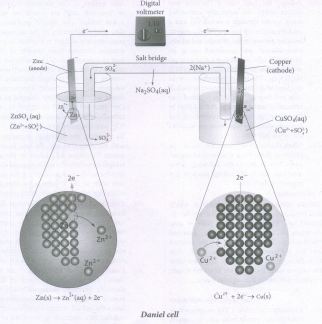
(iii) Joining the half cells:
(a) The zinc and copper strips are externally connected using a wire through a switch (k) and a load (example: volt meter). The electrolytic solution present in the cathodic and anodic compartment are connected using an inverted U tube containing a agar-agar gel mixed with an inert electrolyte such as KCI, Na2SO4 etc.,
(b) The ions of inert electrolyte do not react with other ions present in the half I cells and they are not either oxidised (or) reduced at the electrodes. The solution in the salt bridge cannot get poured out, but through which the ions can move into (or) out of the half cells.
(c) When the switch (k) closes the circuit, the electrons flows from zinc strip to copper strip. This is due to the following redox reactions which are taking place at the respective electrodes.
(iv) Anodic oxidation:
(i) zinc strip acts as the anode.
(ii) Here,oxidation occurs.
The electrode at which the oxidation occur is called the anode. In Daniel cell, the oxidation take place at zinc electrode, i.e., zinc is oxidised to Zn2+ ions and the electrons.
The Zn2+ ions enters the solution and the electrons enter the zinc metal, then flow through the external wire and then enter the copper strip.
Electrons are liberated at zinc electrode and hence it is negative (-ve).
\(Zn_{ (s) }\longrightarrow { { Zn }^{ 2+ }_{ (aq) }+{ 2e }^{ - } } \) (loss of electron-oxidation)
(v) Cathodic reduction:
As discussed earlier. the electrons flow through the circuit from zinc to copper, where the Cu2+ ions in the solution accept the electrons, get reduced to copper and the same get deposited on the electrode Here, the electrons are consumed and hence it is positive (+ve).
\({ Cu }_{ (aq) }^{ 2+ }+{ 2e }^{ - }\longrightarrow { { Cu }_{ (s) } } \)(gain of electron - reduction)
b) When a Zinc metal strip is placed in a copper sulphate solution, the blue colour of the solution fades and the copper is deposited on the zinc strip as red - brown crust due to the following spontaneous chemical reaction.
\(\mathrm{Zn}_{(\mathrm{s})}+\mathrm{CuSO}_{4(\mathrm{aq})} \rightarrow \mathrm{ZnSO}_{4(\mathrm{aq})}+\mathrm{Cu}_{(\mathrm{s})}\)
The energy produced in the above reaction is lost to the surroundings as heat.
In the above redox reaction, Zinc is oxidised to Zn2+ ions and the Cu2+ ions are reduced to metallic copper. The half reactions are represented as below.
\(\mathrm{Zn}_{(\mathrm{s})} \rightarrow \mathrm{Zn}^{2+}{ }_{(\mathrm{aq})}+2 \mathrm{e}^{-} \text {(oxidation) } \)
\(\mathrm{Cu}^{2+}{ }_{(\mathrm{aq})}+2 \mathrm{e}^{-} \rightarrow \mathrm{Cu}_{(\mathrm{s})} \text { (reduction) }\)
If we perform the above two half reactions separately in an apparatus as shown in figure, some of the energy produced in the reaction will be converted into electrical energy.
2.
(i) The Conductance of HCl will be more, because H+ ion has the maximum mobility of all the ions due to its smallest size and mass.
(ii) At \(25^{0} \mathrm{C}: \mathrm{H}^{+}=36.23 \mathrm{~m}^{2} \mathrm{~S}^{-1} \mathrm{~V}^{-1}\)
(iii) The conductance depends upon
1) Nature of electrolyte
2) Concentration
3) Mobility of ion
4) Temperature
3.
Anodic oxidation:
The electrode at which the oxidation occurs is called the anode. In Daniel cell, the oxidation take place at zinc electrode, i.e., zinc is oxidised to Zn2+ ions and the electrons. The Zn2+ ions enters the solution and the electrons enter the zinc metal, then flow through the external wire and then enter the copper strip. Electrons are liberated at zinc electrode and hence it is negative (-ve).
\({ Zn }_{ (s) }\longrightarrow { Zn }^{ 2+ }{ _{ (aq) } }+ 2{ e }^{ - } \) (loss of electron-oxidation)
Cathodic reduction:
The electrons flow through the circuit from zinc to copper, where the Cu2+ ions in the solution accept the electrons, get reduced to copper and the same get deposited on the electrode. Here, the electrons are consumed and hence it is positive (+ve).
\({ Cu }^{ 2+ }_{ (aq) }+{ 2e }^{ - }\longrightarrow { Cu }_{ (s) } \)(gain of electron-reduction)
4.
Molar conductance = Λm = \( \frac{k\ (Sm^{-1})\times10^{-3}}{M} mol^{-1}m^{3} \)
\(= \frac{(12.04 \times 10^{-2} Sm^{-1}) \times 10^{-3} (mol^{-1}m^{3})} {0.025}\)
= 481.6 x 10⁻⁵ Sm2mol-1
5.
l = 1.5 cm = 1.5 × 10⁻²m
A = 4.5 cm2 = 4.5 × (10-4)m2
R = 15Ω
\(\kappa = \frac{1}{R}(\frac{l}{A})\)
\(\kappa = \frac{1}{15\Omega}\times\frac{1.5\times10^{-2}m}{4.5\times10^{-4}m^2}\)
= 2.22 ohm-1 m-1
= 2.22 Sm-1

12th Standard Syllabus & Materials
12th Standard
TN 12th Computer Applications வலையமைப்பு வடமிடல் Sample Question Papers Study Material - QB365 Set A
NEW12th Standard
TN 12th Computer Applications களப்பெயர் முறைமை (DNS) Sample Question Papers Study Material - QB365 Set A
NEW12th Standard
TN 12th Computer Applications வலையமைப்பு எடுத்துக்காட்டுகள் மற்றும் நெறிமுறைகள் Sample Question Papers Study Material - QB365 Set A
NEW12th Standard
TN 12th Computer Applications கணினி வலையமைப்பு ஓர் அறிமுகம் Sample Question Papers Study Material - QB365 Set A



Tamilnadu Stateboard 12th Standard Subjects

Maths
Chemistry

Physics

Biology

Computer Science

Business Maths and Statistics

Economics

Commerce

Accountancy

History

Computer Applications
Biology
Computer Technology
Computer Applications
Computer Science
Business Maths and Statistics
Commerce
Economics
Maths
Chemistry
Physics
Computer Technology
History
Accountancy

Tamil

English

French
Tamilnadu Stateboard Standards



