
 100% FREE ACCESS
12th Standard Syllabus & Materials
12th Standard
TN 12th Maths Applications of Matrices and Determinants Sample Question Papers Study Material - QB365 Set A
NEW12th Standard
TN 12th Computer Applications மின்னணு தரவு பரிமாற்றம் Sample Question Papers Study Material - QB365 Set A
NEW12th Standard
TN 12th Computer Applications மின் - வணிக பாதுகாப்பு அமைப்புகள் Sample Question Papers Study Material - QB365 Set A
NEW12th Standard
TN 12th Computer Applications மின்னணு செலுத்தல் முறைகள் Sample Question Papers Study Material - QB365 Set A
NEW12th Standard
TN 12th Computer Applications மின் - வணிகம் Sample Question Papers Study Material - QB365 Set A
NEW12th Standard
TN 12th Computer Applications திறந்த மூல கருத்துருக்கள் Sample Question Papers Study Material - QB365 Set A

Published on: 13/05/2022
QB365 provides detailed and simple solution for every Creative Questions in class 12 Chemistry Subject. It will helps to get more idea about question pattern in every Creative questions with solution.
latest Creative QuestionsDownload Tamil Nadu 12th Standard Chemistry question papers, model tests, one-mark questions, important questions, and public exam papers in PDF format. Free study materials and answer keys for TN State Board students.
Questions + Answers key
Take MCQ Chemistry Test1.
Write the electrochemical mechanism of corrosion.
2.
Explain SHE as a reference electrode.
3.
How will you determine the conductivity of an electrolytic solution using a wheatstone, bridge?
4.
Calculate the emf of the cell having the cell reaction 2Ag+ + Zn ⇌ 2Ag + Zn2+ and Eocell = 1.56 V at 25°C when concentration of Zn2+ = 0.1 M and Ag+ = 10 M in the solution.
\([{ E }_{ cell }={ E }_{ cell }^{ o }-\frac { RT }{ nF } In\frac { [{ Zn }^{ 2+ }] }{ [{ Ag] }^{ 2 } } ]\)
5.
Calculate the emf of the cell Zn/ZnO2, OH-, HgO/Hg given that Eo values of OH-, ZnO and OH-, HgO/Hg half cells are -1.216 V and 0.098 V respectively.
1.
(i) The formation of rust requires both oxygen and water. Since it is an electrochemical redox process, it requires an anode and cathode in different places on the iron.
(ii) The iron surface and a droplet of water on the surface form a tiny galvanic cell.
(iii) The region enclosed by water is exposed to low amount of oxygen and it acts as the anode.
(iv) The remaining area has high amount of oxygen and it act a cathode. So an electro chemical cell is formed. Corrosion occurs at the anode i.e., in the region enclosed by the water.
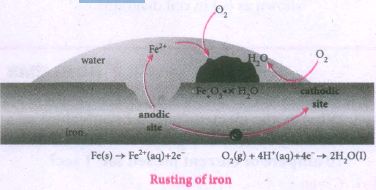
Anode (oxidation)Iron dissolve in the andoe region:
\({ 2Fe }_{ (s) }\rightarrow { 2Fe }_{ (aq) }^{ 2+ }+{ 4e }^{ - }\) Eo = 0.44V
The electrons move through the iron metal from the anode to the cathode area where the oxygen dissolved in water, is reduced to water.
Cathode (reduction):
The reaction of atmospheric carbon dioxide with water gives carbonic acid which furnishes the H+ ions for reduction.
\({ O }_{ 2(g) }+{ 4H }_{ (aq) }^{ + }+{ 4e }^{ - }\rightarrow { 2H }_{ 2 }O(l)\) Eo = 1.23 V
The electrical circuit is completed by the migration of ions through water droplet.
The overall redox reactions is,
\({ 2Fe }_{ (s) }+{ O }_{ 2(g) }+{ 4H }_{ (aq) }^{ + }\rightarrow { 2Fe }_{ (aq) }^{ 2+ }+{ 2H }_{ 2 }O(l)\) Eo = 0.444 + 1.23 = 1.67V
The positive emf value indicates that the reaction is spontaneous
Fe2+ ions are further oxidised to Fe3+ which on further reaction with oxygen to form rust.
\({ 4Fe }_{ (Aq) }^{ 2+ }+{ O }_{ 2(g) }+{ 4H }_{ (aq) }^{ + }\rightarrow { 4Fe }_{ (aq) }^{ 2+ }+{ 2H }_{ 2 }O(l)\)
\({ 3Fe }_{ (Aq) }^{ 3+ }+{ 4{ H }_{ 2 }O }(l)\rightarrow { Fe }_{ 2 }{ O }_{ 3 }.{ H }_{ 2 }{ O }_{ (s) }+{ 6H }_{ (aq) }^{ + }\)
2.
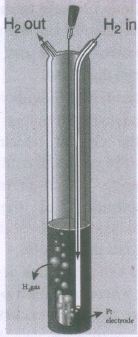
Standard Hydrogen Electrode (SHE) is used as the reference electrode. It has been assigned an arbitrarily emf of zero volt. It consists of a platinum electrode in contact with 1M HCI solution and 1atm hydrogen gas. The hydrogen gas is bubbled through the solution at 25°C. SHE can act as a cathode as well as an anode. The Half cell reactions are given below.
If SHE is used as a cathode, the reduction reactions is
2H+ (aq,1M) + 2e- ⟶ H2 (g, 1 atm) Eo= 0 volt
If SHE is used as an anode, the oxidation reaction is
H2 (g.1 atm) ⟶ 2H+ (aq, 1M) + 2e- Eo= volt
Illustration: Let us calculate the reduction potential of zinc electrode dipped in zinc sulphate solution using SHE.
Step 1: The following galvanic cell is constructed using SHE
Zn(s) | Zn2+ (aq,1M) || H+ (aq, 1M) | H2 (g, 1 atm)|pt(s)
Step 2: The emf of the above galvanic cell is measured using a volt meter. In this case, the measured emf of the above galvanic cell is 0.76V.
Calculation
We know that,
Eocell = (Eoox)Zn|Zn2+ + (Eored)SHE
Eocell = 0.79 and (Eored)SHE = 0V.
Substitute these values in the above equation
⇒ 0.76V = (Eoox) Zn|Zn2+ + 0V
⇒ (Eoox)Zn|Zn2+ = 0.76V
This oxidation potential corresponds to the below mentioned half cell reaction which takes place at the cathode.
Zn ⇾ Zn2+ + 2e- (Oxidation)
The emf for the reverse reaction will give the reduction potential
Zn2+ + 2e- ⇾ Zn; Eo= - 0.76V
∴ (Eoox)Zn2+|Zn = - 0.76V
3.
(i) The conductivity of an electrolytic solution is determined by using a wheatstone bridge arrangement in which one resistance is replaced by a conductivity cell filled with the electrolytic solution of unknown conductivity.
(ii) In the measurement of specific resistance of a metallic wire, a DC power supply is used. Here, if we apply DC current through the conductivity cell, it will lead to the electrolysis of the solution taken in the cell. So, AC current is used for this measurement to prevent electrolysis
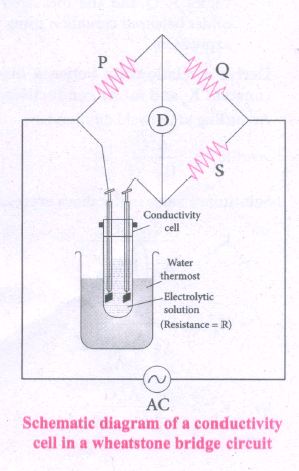
(iii) A wheatstone bridge is constituted using known resistances P, Q, a variable resistance S and conductivity cell (Let the resistance of the electrolytic solution taken in it be R) as shown in the figure. An AC source (550 Hz to 5 KHz) is connected between the junctions A and C. Connect a suitable detector (Such as the telephone ear piece detector) between the junctions 'B' and 'D'.
(iv) The variable resistance (S) is adjusted until the bridge is balanced and in this conditions there is no current flow through the detector.
Under balanced condition,
\(\frac { P }{ Q } =\frac { R }{ S } \)
\(\therefore R=\frac { P }{ Q } \times S\)
(v) The resistance of the electrolytic solution (R) is calculated from the known resistance values P, Q and the measured 'S' value under balanced condition using the above expression
4.
Eocell = 1.56V [Zn2+]
= 0.1 M [Ag+] = 10 M
Formula:
\([{ E }_{ cell }={ E }_{ cell }^{ o }-\frac { RT }{ nF } In\frac { [{ Zn }^{ 2+ }] }{ [{ Ag] }^{ 2 } } ]\)
Solution:
= 1.56 - 0.02955 log 0.001;
= 1.56 - (- 0.08865)
= 1.56 + 0.08865 = 1.6486 V
Ecell = 1.6486 V.
5.
Given:
Zn/ZnO2, OH-, HgO/Hg
EoR = 0.098 V; EL= -1.216 V
Formula: ∴ Eocell = EoR-EoL
Solution: Eocell = 0.098-(-1.216)
= 0.098 + 1.216 = +1.314
Eo = + 1.314 V.

12th Standard Syllabus & Materials
12th Standard
TN 12th Computer Applications வலையமைப்பு வடமிடல் Sample Question Papers Study Material - QB365 Set A
NEW12th Standard
TN 12th Computer Applications களப்பெயர் முறைமை (DNS) Sample Question Papers Study Material - QB365 Set A
NEW12th Standard
TN 12th Computer Applications வலையமைப்பு எடுத்துக்காட்டுகள் மற்றும் நெறிமுறைகள் Sample Question Papers Study Material - QB365 Set A
NEW12th Standard
TN 12th Computer Applications கணினி வலையமைப்பு ஓர் அறிமுகம் Sample Question Papers Study Material - QB365 Set A



Tamilnadu Stateboard 12th Standard Subjects

Maths
Chemistry

Physics

Biology

Computer Science

Business Maths and Statistics

Economics

Commerce

Accountancy

History

Computer Applications
Biology
Computer Technology
Computer Applications
Computer Science
Business Maths and Statistics
Commerce
Economics
Maths
Chemistry
Physics
Computer Technology
History
Accountancy

Tamil

English

French
Tamilnadu Stateboard Standards



