
 100% FREE ACCESS
12th Standard Syllabus & Materials
12th Standard
TN 12th Maths Applications of Matrices and Determinants Sample Question Papers Study Material - QB365 Set A
NEW12th Standard
TN 12th Computer Applications மின்னணு தரவு பரிமாற்றம் Sample Question Papers Study Material - QB365 Set A
NEW12th Standard
TN 12th Computer Applications மின் - வணிக பாதுகாப்பு அமைப்புகள் Sample Question Papers Study Material - QB365 Set A
NEW12th Standard
TN 12th Computer Applications மின்னணு செலுத்தல் முறைகள் Sample Question Papers Study Material - QB365 Set A
NEW12th Standard
TN 12th Computer Applications மின் - வணிகம் Sample Question Papers Study Material - QB365 Set A
NEW12th Standard
TN 12th Computer Applications திறந்த மூல கருத்துருக்கள் Sample Question Papers Study Material - QB365 Set A

Published on: 13/05/2022
QB365 provides detailed and simple solution for every Creative Questions in class 12 Chemistry Subject. It will helps to get more idea about question pattern in every Creative questions with solution.
latest Creative QuestionsDownload Tamil Nadu 12th Standard Chemistry question papers, model tests, one-mark questions, important questions, and public exam papers in PDF format. Free study materials and answer keys for TN State Board students.
Questions + Answers key
Take MCQ Chemistry Test1.
An organic compound 'A' is a sodium salt of phenolic acid with molecular formula C7H5O3Na. 'A' on heating with soda lime gives compound 'B' of molecular formula C6H6O. 'B' gives violet colour with neutral ferric chloride. 'B' on treatment with C6H5COCI in the presence of NaOH gives an ester 'C'. Identify 'A', 'B' and 'C'. Explain the reactions.
2.
An organic compound (A) C6H6O gives violet colour with neutral FeCl3 solution. With NH3 in the presence of anhydrous ZnCI2, (A) gives (B) (C6H7N). (A) with dimethyl sulphate gives (C) (C7H8O). What are (A), (B) and (C)? Explain the reactions.
3.
An organic compound (A) of molecular formula C3H8O2 is obtained as by-product in the manufacture of soap. Compound (A) on heating with P2O5 gives an unsaturated compound (B) of molecular formula C3H4O. Compound (A) with well cooled mixture of Conc.H2SO4 and fuming HNO3 form compound (C) which is an explosive. Identify A, B and C and explain the rection.
4.
An organic compound A of molecular formula C3H6O on reduction with LiAlH4 gives B. Compound B gives blue colour in Victor Meyer's test and also forms a chloride C with SOCl2. The chloride on treatment with alcoholic KOH gives D. Identify A, B, C and D and explain the reactions.
5.
An organic compound (A) C2H6O liberates hydrogen on treatment with metallic sodium. (A) on mild oxidation gives (B) C2H4O which answers iodoform test. (B) when treated with cone. H2SO4 undergoes polymerisation to give (C) a cyclic compound. Identify (A) (B) and (C) and explain the reactions.
1.
(i) The organic compound (A) which is sodium salt of phenolic acid is sodium salicylate.
(ii) (A) on heating with soda lime gives Compound (B) phenol. Phenol gives violet colouration with neutral perchloride.
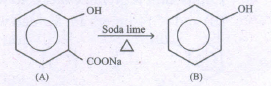
(iii) Phenol on treatment with C6H5COCl in the presence of NaOH gives on ester 'C':
C6H5OH + C6H5COCl \(\overset { NaOH }{ \longrightarrow } \underset { (C) }{ { C }_{ 6 }{ H }_{ 5 }OCO{ C }_{ 6 }{ H }_{ 5 }+HCl } \)
| Compound | Compound Name | Formula |
| A | Sodium benzoate' | 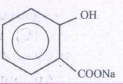 |
| B | Phenol | C6H5OH |
| C | Phenyl benzoate | C6H5OCO C6H5 |
2.
(i) An organic compound (A) C6H6O gives violet colour with neutral FeCl3 solution.
(ii) With NH3 in the presence of anhydrous ZnCI2,(A) gives (B) (C6H7N).
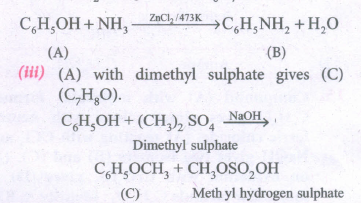
| Compound | Compound Name | Formula |
| A | Phenol | C6H5OH |
| B | Aniline | C6H5NH2 |
| C | Anisole | C6H5OCH3 |
3.
(i) Compound (A) with molecular formula C3H8O3 is glycerol.
(ii) Glycerol on heating with P2O5 gives an unsaturated compound (B).
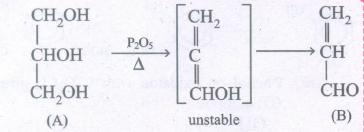
(iii) Glycerol with cooled mixture of cone. H2SO4 and fuming HNO3 form compound (C).
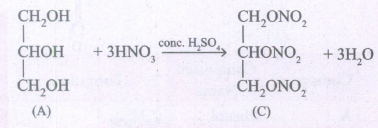
| Compound | Compound Name | Formula |
| A | Glycerol | \(\overset { CH_{ 2 }OH }{ \underset { \overset { CHOH }{ \underset { { CH }_{ 2 }OH }{ | } } }{ | } } \) |
| B | Acrolein | \(\overset { CH_{ 2 } }{ \underset { \overset { CH }{ \underset { { CH }O }{ | } } }{ || } } \) |
| C | Nitroglycerine | \(\overset { CH_{ 2 }O{ NO }_{ 2 }\quad }{ \underset { \overset { CHO{ NO }_{ 2 } }{ \underset { { CH }_{ 2 }O{ NO }_{ 2 } }{ | } } }{ | } } \) |
4.
(i) Compound (A) is carbonyl compound, it is acetone
(ii) (A) on reduction with LiAlH4 gives (B) it gives blue colour in Victor Meyer'stest.
\({ CH }_{ 3 }-\underset { \overset { || }{ \underset { (A) }{ O } } }{ C } -{ CH }_{ 3 }\overset { { LiAIH }_{ 4 } }{ \underset { \left[ H \right] }{ \longrightarrow } } { CH }_{ 3 }-{ CH }_{ 3 }-\underset { \overset { | }{ \underset { (B) }{ OH } } }{ CH } -{ CH }_{ 3 }\)
(iii) (B) reacts with SOCl2to give (C).
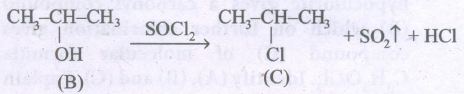
(iv) (C) on treatment with alcoholic KOH, forms (D) by elimination reaction.
\({ CH }_{ 3 }-\underset { \overset { | }{ \underset { (C) }{ Cl } } }{ C } H-{ CH }_{ 3 }\overset { alc.KOH }{ \longrightarrow } \underset { (D) }{ { CH }_{ 3 }CH={ CH }_{ 2 }+HCl } \)
| Compound | Compound Name | Formula |
| A | Acetone | \({ CH }_{ 3 }-\underset { \overset { || }{ O } }{ C } -{ CH }_{ 3 }\) |
| B | Isopropyl alcohol | \({ CH }_{ 3 }-\underset { \overset { | }{ OH } }{ CH } -{ CH }_{ 3 }\) |
| C | Isopropyl chloride | \({ CH }_{ 3 }-\underset { \overset { | }{ Cl } }{ CH } -{ CH }_{ 3 }\) |
| D | Propylene | CH3-CH=CH2 |
5.
(i) \( \underset { (A) }{2 \mathrm{C}_{2} \mathrm{H}_{5}} \mathrm{OH}+2 \mathrm{Na} \longrightarrow 2 \mathrm{C}_{2} \mathrm{H}_{5} \mathrm{ONa}+\mathrm{H}_{2} \uparrow \)
(ii) Ethyl alcohol on mild oxidation gives acetaldehyde (B) It answers idoform test.
\({ CH }_{ 3 }-\underset{(A)}{{ CH }_{ 2 }OH}\overset { Mild\left( O \right) }{ \longrightarrow } \underset { (B) }{ CH_{ 3 }CHO } +{ H }_{ 2 }O\)
\( \underset {(B)}{\mathrm{CH}_{3} \mathrm{CHO}+}3 \mathrm{I}_{2}+\mathrm{NaOH} \overset { B }{ \underset { Iodoform }{ \longrightarrow } } \mathrm{CHI}_{3}+\mathrm{HCOONa}+3 \mathrm{HI}\)
(iii) Acetaldehyde when treated with Cone H2SO4 undergoes polymerisation and the product obtained is paraldehyde (C).
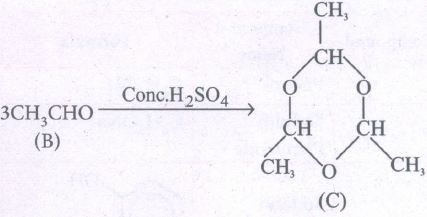
| Compound | Compound Name | Formula |
| A | Ethyl alcohol | CH3CH2OH |
| B | Acetaldehyde | CH3CHO |
| C | Paraldehyde | 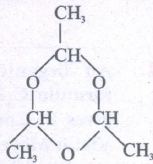 |

12th Standard Syllabus & Materials
12th Standard
TN 12th Computer Applications வலையமைப்பு வடமிடல் Sample Question Papers Study Material - QB365 Set A
NEW12th Standard
TN 12th Computer Applications களப்பெயர் முறைமை (DNS) Sample Question Papers Study Material - QB365 Set A
NEW12th Standard
TN 12th Computer Applications வலையமைப்பு எடுத்துக்காட்டுகள் மற்றும் நெறிமுறைகள் Sample Question Papers Study Material - QB365 Set A
NEW12th Standard
TN 12th Computer Applications கணினி வலையமைப்பு ஓர் அறிமுகம் Sample Question Papers Study Material - QB365 Set A



Tamilnadu Stateboard 12th Standard Subjects

Maths
Chemistry

Physics

Biology

Computer Science

Business Maths and Statistics

Economics

Commerce

Accountancy

History

Computer Applications
Biology
Computer Technology
Computer Applications
Computer Science
Business Maths and Statistics
Commerce
Economics
Maths
Chemistry
Physics
Computer Technology
History
Accountancy

Tamil

English

French
Tamilnadu Stateboard Standards



