
 100% FREE ACCESS
12th Standard Syllabus & Materials
12th Standard
TN 12th Maths Applications of Matrices and Determinants Sample Question Papers Study Material - QB365 Set A
NEW12th Standard
TN 12th Computer Applications மின்னணு தரவு பரிமாற்றம் Sample Question Papers Study Material - QB365 Set A
NEW12th Standard
TN 12th Computer Applications மின் - வணிக பாதுகாப்பு அமைப்புகள் Sample Question Papers Study Material - QB365 Set A
NEW12th Standard
TN 12th Computer Applications மின்னணு செலுத்தல் முறைகள் Sample Question Papers Study Material - QB365 Set A
NEW12th Standard
TN 12th Computer Applications மின் - வணிகம் Sample Question Papers Study Material - QB365 Set A
NEW12th Standard
TN 12th Computer Applications திறந்த மூல கருத்துருக்கள் Sample Question Papers Study Material - QB365 Set A

Published on: 21/06/2021
QB365 provides detailed and simple solution for every Creative Questions in class 12 Chemistry Subject. It will helps to get more idea about question pattern in every Creative questions with solution.
Download Tamil Nadu 12th Standard Chemistry question papers, model tests, one-mark questions, important questions, and public exam papers in PDF format. Free study materials and answer keys for TN State Board students.
Questions + Answers key
Take MCQ Chemistry Test1.
A buffer solution containing 0.1 mole of ammonium hydroxide and 0.15 mole of ammonium chloride per litre of the solution. Calculate the pH of the buffer solution. Kb for ammonium hydroxide is 1.8 x 10⁻⁵.
2.
Derive the hydrolysis constant for the hydrolysis of salt of strong base and weak acid. Deduce its pH.
3.
On hydrolysis of salts of strong acid and strong base, the solution obtained is neutral. Justify your answer with a suitable example
4.
Explain buffer action in an acidic buffer.
5.
Calculate the pH of 0.1 M NH4OH if Kb = 1.75 x 10⁻⁵
1.
This is a buffer mixture containing a weak base and its salt. Hence the equation to be used is
\(pH={ pK }_{ a }+{ \log }\frac { [salt] }{ [acid] } \)
pKb = logKb
= -log 1.8 - log 10-5 = 4.7447
∴ \(pOH=4.7447+\log\frac { 0.15 }{ 0.10 } \)
pOH = 4.7447 + log 1.5
= 4.7447 + 0.1761 = 4.9208
pH + POH = 14
pH + 4.9208 = 14
pH = 9.08
2.
Let us find a relation between the equilibrium constant for the hydrolysis reaction (hydrolysis constant) and the dissociation constant of the acid.
\({ K }_{ h }=\frac { [{ CH }_{ 3 }COOH][{ OH }^{ - }] }{ [{ CH }_{ 3 }{ COO }^{ - }][{ H }_{ 2 }O] } \)
\({ K }_{ h }=\frac { [{ CH }_{ 3 }COOH][{ OH }^{ - }] }{ [{ CH }_{ 3 }{ COO }^{ - }] } \) ...(1)
\({ CH }_{ 3 }{ COONH }_{ (aq) }\rightleftharpoons { C }{ H }_{ 3 }COO_{ (aq) }^{ - }+{ H }_{ (aq) }^{ + }\)
\({ K }_{ h }=\frac { [{ CH }_{ 3 }CO{ O }^{ - }][{ H }^{ + }] }{ [{ CH }_{ 3 }{ COO }H] } \) ...(2)
(1) x (2)
⇒ Kb . Ka = [H+][OH-]
we know that [H+] [OH-] = Kw
Kh· Ka = Kw
Kh value in terms of degree of hydrolysis (h) and the concentration of salt (C) for the equilibrium can be obtained as in the case of Ostwald's dilution law. Kh = h2C. and i.e [OH-] = \(\sqrt { { K }_{ h }.C } \)
pH of salt solution in terms of Ka and the concentration of the electrolyte
pH + pOH = 14
pH = 14 - pOH = 14 - {-log [OH-]}
= 14 + log [OH-]
∴ pH = 14 + log (KhC)\(\frac12\)
pH =14 + log \({ \left( \frac { { K }_{ w }C }{ { K }_{ a } } \right) }^{ \frac { 1 }{ 2 } }\)
pH = 14 + (\(\frac12\) log Kw + \(\frac12\) log C - \(\frac12\) log Ka)
[∴ Kw = 10-14]
\(pH=14-7+\frac { 1 }{ 2 } \log \ C+\frac { 1 }{ 2 } p{ K }_{ a }\frac { 1 }{ 2 } \log{ K }_{ w }=\frac { 1 }{ 2 } \times { \log10 }^{ -14 }=\frac { -14 }{ 2 } (1)=-7\)
\(pH=7+\frac { 1 }{ 2 } { pK }_{ a }+\frac { 1 }{ 2 } \log \ C\) [-log Ka = pKa]
3.
Let us consider the reaction between NaOH and nitric acid to give sodium nitrate and water.
\(\mathrm{NaOH}_{(\mathrm{aq})}+\mathrm{HNO}_{3(\mathrm{aq})} \longrightarrow \mathrm{NaNO}_{3(\mathrm{aq})}+\mathrm{H}_{2} \mathrm{O}(\mathrm{l})\)
The salt NaNO3 completely dissociates in water to produce Na+ and NO3- ions.
\( \mathrm{NaNO}_{3(\mathrm{aq})} \longrightarrow \mathrm{NO}_{(\mathrm{aq})}^{+}+\mathrm{NO}_{3(\mathrm{aq})}^{-} \)
Water dissociates to a small extent as
\(\mathrm{H}_{2} \mathrm{O}_{(\mathrm{l})} \rightleftharpoons \mathrm{H}_{(\mathrm{aq})}^{+}+\mathrm{OH}_{(\mathrm{aq})}^{-}\)
Since [H+] = [OH-], water is neutral
\({ NO }_{ 3 }^{ - }\) ion is the conjugate base of the strong acid HNO3 and hence it has no tendency to react with H+.
Similarly, Na+ is the conjugate acid of the strong base NaOH and it has no tendency to react with OH-.
It means that there is no hydrolysis. In such cases [H+] = [OH-] pH is maintained and, therefore, the solution is neutral.
4.
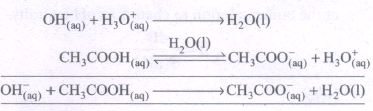
Let us explain the buffer action in a solution containing CH3COOH and CH3COONa.
The dissociation of the buffer components occurs as below.
\( \mathrm{CH}_{3} \mathrm{COOH}_{(\mathrm{sq})} \rightleftharpoons \mathrm{CH}_{3}-\mathrm{COO}_{(\mathrm{aq})}^{-}+\mathrm{H}_{3} \mathrm{O}_{(\mathrm{aq})}^{+} \)
\(\mathrm{CH}_{3} \mathrm{COONa}_{(\mathrm{s})} \stackrel{\mathrm{H}_{2} \mathrm{O}_{(\mathrm{l})}}{\longrightarrow} \mathrm{CH}_{3}-\mathrm{COO}_{(\mathrm{aq})}^{-}+\mathrm{Na}_{(\mathrm{aq})}^{+}\)
If an acid is added to this mixture, it will be consumed by the conjugate baseCH3COO- to form the undissociated weak acid i.e, the increase in the concentration of H+ does not reduce the pH significantly.
\({ { CH }_{ 3 }COO }_{ (aq) }^{ - }+{ H }_{ (aq) }^{ + }\rightarrow { CH }_{ 3 }{ COOH }_{ (aq) }\)
If a base is added, it will be neutralized by H3O+, and the acetic acid is dissociated to maintain the equilibrium. Hence the pH is not significantly altered.
5.
Degree if dissociation \(\alpha =\sqrt { \frac { K_{ a } }{ C } } ,C\alpha =\sqrt { { K }_{ a }.C } \)
∴ \(pOH=\log\frac { 1 }{ \sqrt { { K }_{ b }.C } } =\log\frac { { 10 }^{ 3 } }{ \sqrt { 1.75\times { 10 }^{ -5 }\times .1 } } \)
\(=\log\frac { 1 }{ \sqrt { 1.75\times { 10 }^{ -6 } } } =\log\frac { { 10 }^{ 3 } }{ \sqrt { 1.75 } } \)
\(=3-\frac { 1 }{ 2 } \log1.75\)
\(=3-\frac { 1 }{ 2 } \times 0.2430=2.8785\)
pH = 14 - pOH
∴ pH = 14 - 2.8785 = 11.1215
Alternating,
\(\left[ { H }^{ - } \right] =\sqrt { { K }_{ b }\times C } \)
\(=\sqrt { 1.75\times { 10 }^{ -5 }\times 0.1 } =\sqrt { 1.75\times { { 10 }^{ -6 } } } \)
= 1.322 x 10⁻³
∴ pOH = - log [H+] = - log (1.323 x 10⁻³)
3 - 0.1216 = 2.8784
∴ pH = 14 - pOH = 14 - 2.8784 = 11.1216

12th Standard Syllabus & Materials
12th Standard
TN 12th Computer Applications வலையமைப்பு வடமிடல் Sample Question Papers Study Material - QB365 Set A
NEW12th Standard
TN 12th Computer Applications களப்பெயர் முறைமை (DNS) Sample Question Papers Study Material - QB365 Set A
NEW12th Standard
TN 12th Computer Applications வலையமைப்பு எடுத்துக்காட்டுகள் மற்றும் நெறிமுறைகள் Sample Question Papers Study Material - QB365 Set A
NEW12th Standard
TN 12th Computer Applications கணினி வலையமைப்பு ஓர் அறிமுகம் Sample Question Papers Study Material - QB365 Set A



Tamilnadu Stateboard 12th Standard Subjects

Maths
Chemistry

Physics

Biology

Computer Science

Business Maths and Statistics

Economics

Commerce

Accountancy

History

Computer Applications
Biology
Computer Technology
Computer Applications
Computer Science
Business Maths and Statistics
Commerce
Economics
Maths
Chemistry
Physics
Computer Technology
History
Accountancy

Tamil

English

French
Tamilnadu Stateboard Standards



