
 100% FREE ACCESS
12th Standard Syllabus & Materials
12th Standard
TN 12th Maths Applications of Matrices and Determinants Sample Question Papers Study Material - QB365 Set A
NEW12th Standard
TN 12th Computer Applications மின்னணு தரவு பரிமாற்றம் Sample Question Papers Study Material - QB365 Set A
NEW12th Standard
TN 12th Computer Applications மின் - வணிக பாதுகாப்பு அமைப்புகள் Sample Question Papers Study Material - QB365 Set A
NEW12th Standard
TN 12th Computer Applications மின்னணு செலுத்தல் முறைகள் Sample Question Papers Study Material - QB365 Set A
NEW12th Standard
TN 12th Computer Applications மின் - வணிகம் Sample Question Papers Study Material - QB365 Set A
NEW12th Standard
TN 12th Computer Applications திறந்த மூல கருத்துருக்கள் Sample Question Papers Study Material - QB365 Set A

Published on: 22/06/2021
QB365 provides detailed and simple solution for every Creative Questions in class 12 Chemistry Subject. It will helps to get more idea about question pattern in every Creative questions with solution.
Download Tamil Nadu 12th Standard Chemistry question papers, model tests, one-mark questions, important questions, and public exam papers in PDF format. Free study materials and answer keys for TN State Board students.
Questions + Answers key
Take MCQ Chemistry Test1.
What is zone refining? Describe the principle involved in the purification of the metal by this method.
2.
List the applications of iron.
3.
Explain refining of titanium by Van-Arkel method.
4.
Explain froth flotation, with diagram.
1.
Zone refining:
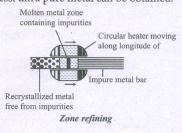
This method is employed for preparing highly pure metal (such as silicon, tellurium, germanium), which are used as semiconductors. It is based on the principle that melting point of a substance is lowered by the presence of impurities. Consequently, when an impure molten metal is cooled, crystals of the pure metal are solidified, and the impurities remain behind the remaining metal.
The process consists In casting the impure metal in the form of a bar. A circular heater fitted around this bar is slowly moved longitudinally from one end to the other. At the heated zone, the bar melts, and as the heater moves on, pure metal crystallizes, while the impurities pass into the adjacent molten part In this way, the impurities are swept from one end of the bar to the other. By repeating the process, ultra pure metal can be obtained.
2.
(i) Iron is one of the most useful metals and its alloys are used everywhere including bridges, electricity pylons, bicycle chains, cutting tools and rifle barrels.
(ii) Cast iron is used to make pipes, valves and pumps stoves etc.
(iii) Magnets can be made from iron and its alloys and compounds.
(iv) An important alloy of iron is stainless steel, and it is very resistant to corrosion. It is used in architecture, bearings, cutlery, surgical instruments and jewellery.
(v) Nickel steel is used for making cables, automobiles and aeroplane parts.
(vi) Chrome steels are used for manufacturing cutting tools and crushing machines.
3.
(i) Van-Arkel method is based on the thermal decomposition of metal compounds which lead to the formation of pure metals.
(ii) Titanium and zirconium can be purified, using this method.
(iii) For example, the impure titanium metal is heated in an evacuated vessel with iodine at a temperature of 550 K to form the volatile titanium tetra-iodide(Til4)
(iv) The impurities are left behind, as they do not react with iodine
\({ Ti }_{ (s) }+{ 2I }_{ 2(s) }\longrightarrow { Til }_{ 4 }(vapour)\)
(v) The volatile titanium tetraiodide vapour is passed over a tungsten filament at a temperature around 1800 K.
(vi) The titanium tetraiodide is decomposed and pure titanium is deposited on the filament
(vii) The iodine is reused.
\({ Til }_{ 4 }(vapour)\longrightarrow { { Ti }_{ (s) } }+{ 2I }_{ 2(s) }\)
4.
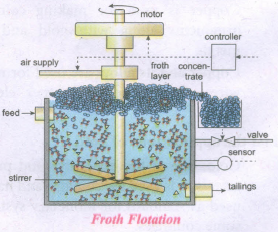
(i) Froth flotation method is commonly used to concentrate sulphide ores such as galena (PbS), zinc blende (ZnS) etc.
(ii) In this method, the metallic ore particles which are preferentially wetted by oil can be separated from gangue.
(iii) In this method, the crushed ore is suspended in water and mixed with frothing agent such as pine oil, eucalyptus oil etc.
(iv) A small quantity of sodium ethyl xanthate which acts as a collector is also added.
(v) A froth is generated by blowing air through this mixture.
(vi) The collector molecules attach to the ore particle and make them water repellent.
(vii) As a result, ore particles, wetted by the oil, rise to the surface along with the froth.
(viii) The froth is skimmed off and dried to recover the concentrated ore.
(ix) The gangue particles that are preferentially wetted by water settle at the bottom.

12th Standard Syllabus & Materials
12th Standard
TN 12th Computer Applications வலையமைப்பு வடமிடல் Sample Question Papers Study Material - QB365 Set A
NEW12th Standard
TN 12th Computer Applications களப்பெயர் முறைமை (DNS) Sample Question Papers Study Material - QB365 Set A
NEW12th Standard
TN 12th Computer Applications வலையமைப்பு எடுத்துக்காட்டுகள் மற்றும் நெறிமுறைகள் Sample Question Papers Study Material - QB365 Set A
NEW12th Standard
TN 12th Computer Applications கணினி வலையமைப்பு ஓர் அறிமுகம் Sample Question Papers Study Material - QB365 Set A



Tamilnadu Stateboard 12th Standard Subjects

Maths
Chemistry

Physics

Biology

Computer Science

Business Maths and Statistics

Economics

Commerce

Accountancy

History

Computer Applications
Biology
Computer Technology
Computer Applications
Computer Science
Business Maths and Statistics
Commerce
Economics
Maths
Chemistry
Physics
Computer Technology
History
Accountancy

Tamil

English

French
Tamilnadu Stateboard Standards



