
 100% FREE ACCESS
12th Standard Syllabus & Materials
12th Standard
TN 12th Computer Applications மின்னணு தரவு பரிமாற்றம் Sample Question Papers Study Material - QB365 Set A
NEW12th Standard
TN 12th Computer Applications மின் - வணிக பாதுகாப்பு அமைப்புகள் Sample Question Papers Study Material - QB365 Set A
NEW12th Standard
TN 12th Computer Applications மின்னணு செலுத்தல் முறைகள் Sample Question Papers Study Material - QB365 Set A
NEW12th Standard
TN 12th Computer Applications மின் - வணிகம் Sample Question Papers Study Material - QB365 Set A
NEW12th Standard
TN 12th Computer Applications திறந்த மூல கருத்துருக்கள் Sample Question Papers Study Material - QB365 Set A
NEW12th Standard
TN 12th Computer Applications வலையமைப்பு வடமிடல் Sample Question Papers Study Material - QB365 Set A

Published on: 01/06/2021
QB365 provides detailed and simple solution for every Book back Questions in class 12 Chemistry Subject. It will helps to get more idea about question pattern in every book back questions with solution.
Download Tamil Nadu 12th Standard Chemistry question papers, model tests, one-mark questions, important questions, and public exam papers in PDF format. Free study materials and answer keys for TN State Board students.
Questions + Answers key
Take MCQ Chemistry Test1.
Give the structure of CO and CO2.
2.
Write a note on Fisher tropsch synthesis.
3.
Write a short note on anomalous properties of the first element of p-block.
4.
Describe briefly allotropism in p- block elements with specific reference to carbon.
1.
| Oxides of Carbon | Structure | Parameters |
| CO |  |
Three electron pairs are shared between carbon and oxygen. The C-O bond distance is 1.128\(\overset{o}{A}\). |
| CO2 |  |
Equal bond distance for the both C-O bonds. Two C-O sigma bond, It has 3c-4e bond. |
2.
The reaction of CO with hydrogen at a pressure of less than 50 atm using metal catalysts at 500 - 700 K yields saturated and unsaturated hydrocarbons.
\(nCO+(2n+1){ H_2 }\longrightarrow C_{ n }{ H }_{ (2n+2) }+{ nH }_{ 2 }O\)
\(nCO+2n{ H }_{ 2 }\longrightarrow { C }_{ n }{ H }_{ 2n }+{ nH }_{ 2 }O\)
3.
In p-block elements, the first member of each group differs from the other elements of the corresponding group. The following factors are responsible for this anomalous behaviour
(i) Small size of the first member.
(ii) High ionisation enthalpy and high electronegativity.
(iii) Absence of d-orbitals in their valance shell.
4.
Allotropism:
1. Some elements exist in more than one crystalline or molecular forms in the same physical state
(a) In Greek "allos" means ⇒ Another
(b) "trope" means ⇒ Change
2. The different forms of an element are called allotropes.
Allotropy of carbon:
Carbon exists as diamond, graphite, fullerenes, carbon nanotubes and graphene.
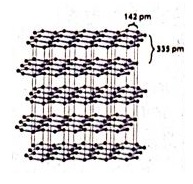
Graphite:
1. Graphite is the most stable allotropic form of carbon at normal temperature and pressure.
2. It is soft and conducts electricity.
3. It is composed of flat two dimensional sheets of carbon atoms.
4. Each sheet is a hexagonal.
5. It is "sp2" hybridised.
6. C-C bond length is 1.41 Å
7. Each C-atom forms three σ bonds with three neighbouring carbon atoms using three of its valence electrons and the fourth electron present in the unhybridised p-orbital form a π-bond.
8. The successive C-sheets are held together by weak Vander Waals forces.
9 The distance successive sheet is 3.40 Å.
10. It is used as a lubricant either on its own or as a graphited oil.
Diamond:
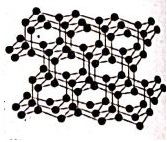
1. It is very hard.
2. It is "sp3" hybridised.
3. C-C bond length is 1.54 Å
4. It is used for sharpening hard tools, cutting glasses, making bores and rock drilling.
Fullerenes:
1. These allotropes are discrete molecules such as \(C_{32}, C_{50}, C_{60}, C_{70}, C_{76}\) etc.
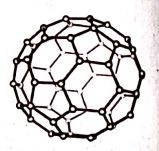
2. It has cage like structure
3. The C60 molecules have a "soccer" ball like structure and is called buckminster fullerene or buckyballs.
4. It has a fused ring structure consists of 20 six membered rings and 12 five membered ring.
5. Each carbon atom is "sp2" hybridised.
6. It has three σ bonds and a delocalised π bond giving aromatic character to these molecules.
7. The C-C bond distance is 1.44 Å
8. The C=C bond distance is 1.38 Å.
Carbon nanotubes:
1. Carbon nanotubes, another recently discovered allotropes, have graphite like tubes with fullerene ends.
2. Along the axis, these nanotubes are stronger than steel and conduct electricity.
3. These have many applications in nanoscale electronics, catalysis, polymers and medicine.
Graphene:
It has a single planar sheet of "sp2" hybridised carbon atoms that are densely packed in a "honeycomb crystal" lattice.

12th Standard Syllabus & Materials
12th Standard
TN 12th Computer Applications களப்பெயர் முறைமை (DNS) Sample Question Papers Study Material - QB365 Set A
NEW12th Standard
TN 12th Computer Applications வலையமைப்பு எடுத்துக்காட்டுகள் மற்றும் நெறிமுறைகள் Sample Question Papers Study Material - QB365 Set A
NEW12th Standard
TN 12th Computer Applications கணினி வலையமைப்பு ஓர் அறிமுகம் Sample Question Papers Study Material - QB365 Set A
NEW12th Standard
TN 12th Computer Applications PHP-உடன் MySQL-ஐ இணைத்தல் Sample Question Papers Study Material - QB365 Set A



Tamilnadu Stateboard 12th Standard Subjects

Maths
Chemistry

Physics

Biology

Computer Science

Business Maths and Statistics

Economics

Commerce

Accountancy

History

Computer Applications
Biology
Computer Technology
Computer Applications
Computer Science
Business Maths and Statistics
Commerce
Economics
Maths
Chemistry
Physics
Computer Technology
History
Accountancy

Tamil

English

French
Tamilnadu Stateboard Standards



