
 100% FREE ACCESS
12th Standard Syllabus & Materials
12th Standard
TN 12th Maths Applications of Matrices and Determinants Sample Question Papers Study Material - QB365 Set A
NEW12th Standard
TN 12th Computer Applications மின்னணு தரவு பரிமாற்றம் Sample Question Papers Study Material - QB365 Set A
NEW12th Standard
TN 12th Computer Applications மின் - வணிக பாதுகாப்பு அமைப்புகள் Sample Question Papers Study Material - QB365 Set A
NEW12th Standard
TN 12th Computer Applications மின்னணு செலுத்தல் முறைகள் Sample Question Papers Study Material - QB365 Set A
NEW12th Standard
TN 12th Computer Applications மின் - வணிகம் Sample Question Papers Study Material - QB365 Set A
NEW12th Standard
TN 12th Computer Applications திறந்த மூல கருத்துருக்கள் Sample Question Papers Study Material - QB365 Set A

Published on: 21/06/2021
QB365 provides detailed and simple solution for every Creative Questions in class 12 Chemistry Subject. It will helps to get more idea about question pattern in every Creative questions with solution.
Download Tamil Nadu 12th Standard Chemistry question papers, model tests, one-mark questions, important questions, and public exam papers in PDF format. Free study materials and answer keys for TN State Board students.
Questions + Answers key
Take MCQ Chemistry Test1.
Write note on impurity defect?
2.
How are crystals classified?
3.
How can you determine the atomic mass of an unknown metal if you know its density and the dimension of its unit cell? Explain.
4.
What are molecular solids? Explain the types of molecular solids.
5.
A cubic solid is made of two elements P and Q. Atoms of Q are at the corners of the cube and P at the body - centre. What is the formula of the compound? What is the coordination numbers of P and Q?
1.
(i) The defects in ionic solids is by adding impurity ions.
(ii) If the impurity ions are in different valance state from that of host, vacancies are created in the crystal lattice of the host.
(iii) For example, addition of CdCl2 to silver chloride yields solid solutions where the divalent cation Cd2+ occupies the position of Ag+.
(iv) This will disturb the electrical neutrality of the crystal.
(v) In order to maintain the same, proportional number of Ag+ ions leaves the lattice.
(vi) This produces a cation vacancy in the lattice, such kind of crystal defects are called impurity defects.
2.
Crystal defects are classified as follows
(i) Point defects
(ii) Line defects
(iii) Interstitial defects
(iv) Volume defects
Point defects are further classified as follows
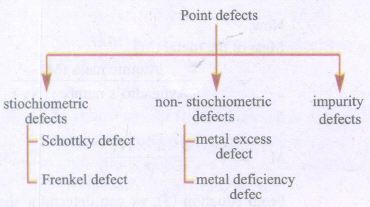
3.
(i) By knowing the density of an unknown metal and the dimension of its unit cell, the atomic mass of the metal can be: determined.
(ii) Let 'a' be the edge length of a unit cell of a crystal, 'd' be the density of the metal, 'm' be the atomic mass of the metal and 'z' be the number of atoms in the unit cell.
(iii) Now,
Density of the unit cell
\(=\frac{Mass\ of\ the\ unit\ cell}{Volume\ of\ the\ unit\ cell}\)
\(d=\frac{Z\times m}{a^3}\) ...(1)
[Since, mass of the unit cell = Number of atoms in the unit cell x Atomic mass]
[Volume of the unit cell = (edge length of the cubic unit cell)3]
(iv) From equation (1), We have
\(m=\frac{d\times a^3}{Z}\) ....(2)
(v) Now,
Mass of the metal (M) \(=\frac{Atomic\ mass(M)}{Avogadro's\ number(N_A)}\)
M=\(\frac{d\times a^3 \times N_A}{Z}\)
(vi) From equation (3), we can determine the atomic mass of the unknown metal.
4.
Molecular solids:
In molecular solids, the constituents are neutral molecules. They are held together by weak Vander Waals forces. Generally molecular solids are soft and they do not conduct electricity. These molecular solids are further classified into three types.
(i) Non-polar molecular solids:
(a) In non-polar molecular solids constituent molecules are held together by weak dispersion forces or London forces.
(b) They have low melting points and are usually in liquids or gaseous state at room temperature.
Ex: Naphthalene, anthracene etc.,
(ii) Polar molecular solids:
(a) The constituents are molecules formed by polar covalent bonds.
(b) They are held together by relatively strong dipole-dipole interactions.
(c) They have higher melting points than the nonpolar molecular solids.
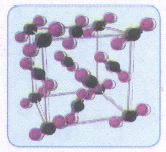
Ex: Solid CO2, solid NH3 etc.
(iii) Hydrogen bonded molecular solids:
(a) The constituents are held together by hydrogen bonds.
(b) They are generally soft solids under room temperature.
(c) Examples: solid ice (H2O), glucose, urea etc.
5.
(i) It is given that the atoms of A are present at the corners of the cube.
(ii) Therefore, number of atoms of Q in one unit cell = 8 x \(\frac{1}{8}\) = 1
(iii) It is also given that the atoms of P are present at the body - centre.
(iv) Therefore, number of atoms of P in one unit cell.
(v) This means that the ratio of the number of P atoms to the number of Q atoms, P: Q = 1:1.
(vi) Hence, the formula of the compound is PQ.
(vii) The coordination number of both P and Q is 8.

12th Standard Syllabus & Materials
12th Standard
TN 12th Computer Applications வலையமைப்பு வடமிடல் Sample Question Papers Study Material - QB365 Set A
NEW12th Standard
TN 12th Computer Applications களப்பெயர் முறைமை (DNS) Sample Question Papers Study Material - QB365 Set A
NEW12th Standard
TN 12th Computer Applications வலையமைப்பு எடுத்துக்காட்டுகள் மற்றும் நெறிமுறைகள் Sample Question Papers Study Material - QB365 Set A
NEW12th Standard
TN 12th Computer Applications கணினி வலையமைப்பு ஓர் அறிமுகம் Sample Question Papers Study Material - QB365 Set A



Tamilnadu Stateboard 12th Standard Subjects

Maths
Chemistry

Physics

Biology

Computer Science

Business Maths and Statistics

Economics

Commerce

Accountancy

History

Computer Applications
Biology
Computer Technology
Computer Applications
Computer Science
Business Maths and Statistics
Commerce
Economics
Maths
Chemistry
Physics
Computer Technology
History
Accountancy

Tamil

English

French
Tamilnadu Stateboard Standards



