
 100% FREE ACCESS
12th Standard Syllabus & Materials
12th Standard
TN 12th Maths Applications of Matrices and Determinants Sample Question Papers Study Material - QB365 Set A
NEW12th Standard
TN 12th Computer Applications மின்னணு தரவு பரிமாற்றம் Sample Question Papers Study Material - QB365 Set A
NEW12th Standard
TN 12th Computer Applications மின் - வணிக பாதுகாப்பு அமைப்புகள் Sample Question Papers Study Material - QB365 Set A
NEW12th Standard
TN 12th Computer Applications மின்னணு செலுத்தல் முறைகள் Sample Question Papers Study Material - QB365 Set A
NEW12th Standard
TN 12th Computer Applications மின் - வணிகம் Sample Question Papers Study Material - QB365 Set A
NEW12th Standard
TN 12th Computer Applications திறந்த மூல கருத்துருக்கள் Sample Question Papers Study Material - QB365 Set A

Published on: 21/06/2021
QB365 provides detailed and simple solution for every Creative Questions in class 12 Chemistry Subject. It will helps to get more idea about question pattern in every Creative questions with solution.
Download Tamil Nadu 12th Standard Chemistry question papers, model tests, one-mark questions, important questions, and public exam papers in PDF format. Free study materials and answer keys for TN State Board students.
Questions + Answers key
Take MCQ Chemistry Test1.
Write any five applications of colloids in day - to day life.
2.
Explain the electrical property of colloids with a neat diagram. (or) Write a note on Helmholta electrical double layer.
3.
Explain the various chemical methods by which colloids can be prepared.
4.
Write a note on phase transfer catalysis.
5.
Write the characteristics of catalysts.
1.
Food:
Food stuffs like milk cream, butter, etc are present in colloidal form.
Medicines:
Antibodies such as penicillin and streptomycin are produced in colloidal form for suitable injections. Colloidal gold and colloidal calcium are used as tonics. Milk of magnesia is used for stomach troubles. Silver sol protected by gelatine known as Argyrol is used as eye lotion.
In Industry:
Colloids find many applications in industries
(i) Water purification:
Purification of drinking water is activated by coagulation of suspended impurities in water using alums containing Al3+.
(ii) In washing:
The cleansing action of soap is due to the formation of emulsion of soap molecules with dirt and grease.
(iii) Tanning of leather:
Skin and hides are protein containing positively charged particles which are coagulated by adding tannin to give hardened leather for further application. Chromium salts are used for the purpose. Chrome tanning can produce soft and polishable leather.
(iv) Rubber industry:
Latex is the emulsion of natural rubber with negative particles. By heating rubber with sulphur, vulcanized rubbers are produced for tyres, tubes, etc.
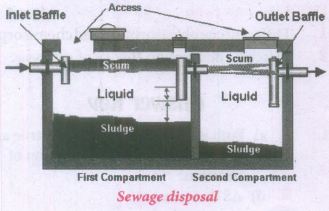
(v) Sewage disposal:
Sewage contains dirt, mud and wastes dispersed in water. The passage of electric current deposits the wastes materials which can be used as a manure.
(vi) Cortrell's precipitator:
Carbon dust in air is solidified by Cottrell's precipitator. In it, a high potential difference of about 50,000V is used. The charge on carbon is neutralized and solidified. Thus the air is free from carbon particles.
(vii) The blue colour of the sky in nature is due to Tyndall effect of air particles.
(viii) Formation of delta:
The electrolyte in sea and river water coagulates the solid particles in river water at their intersection. So, the earth becomes a fertile land.
(ix) Analytical application:
Qualitative and quantitative analysis are based on the various properties of colloids.
2.
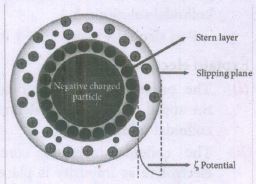
Helmholtz double layer:
(i) The surface of colloidal particle adsorbs one type of ion due to preferential adsorption.
(ii) This layer attracts the oppositely charged < ions in the medium and hence at the boundary separating the two electrical double layers are setup.
(iii) This is called as Helmholtz electrical double layer.
(iv) As the particies nearby are having similar: charges, they cannot come close and condense.
3.
Condensation Methods:
Various chemical methods for the formation of colloidal particles.
(i) Oxidation:
Sols of some non-metals are prepared by this method. (a) When hydroiodic acid is treated with iodic acid, 12 sol is obtained.
\({ HIO }_{ 3 }+5HI\longrightarrow { 3H }_{ 2 }O+{ I }_{ 2 }\) (Sol)
(ii) Reduction:
Many organic reagents like phenyl hydrazine, formaldehyde, etc are used for the formation of sols. For example: Gold sol is prepared by reduction of auric chloride using formaldehyde.
\(2{ AuCl }_{ 3 }+3HCHO+{ 3H }_{ 2 }O\longrightarrow 2Au\left( sol \right) +6HCl+3HCOOH\)
(iii) Hydrolysis:
Sols of hydroxides of metals like chromium and aluminium can be produced by this method.
For example,
\({ FeCl }_{ 3 }+3H_{ 2 }O\longrightarrow Fe(OH)_{ 3 }+3HCl\)
(iv) Double decomposition:
For the preparation of water insoluble sols this method can be used. When hydrogen sulphide gas is passed through a solution of arsenic oxide, a yellow coloured arsenic sulphide is obtained as a colloidal solution.
\({ As }_{ 2 }{ O }_{ 3 }+3{ H }_{ 2 }S\longrightarrow { AS }_{ 2 }{ S }_{ 3 }+{ 3H }_{ 2 }O\)
(v) Decomposition:
When few drops of an acid is added to a dilute solution of sodium thio sulphate, the insoluble free sulphur produced by decomposition of sodium thiosulphate accumulates into small, clusters which impart various colours blue, yellow and even red to the system. depending on their growth within the size of colloidal dimensions.
\({ S }_{ 2 }{ O }_{ 3 }^{ 2- }+{ 2H }^{ + }\longrightarrow \underset{sol}S+{ H }_{ 2 }O+{ SO }_{ 2 }\)
By exchange of solvent:
(i) Colloidal solution of few substances like phosphorous or sulphur is obtained by preparing the solutions in alcohol and pouring them into water.
(ii) As they are insoluble in water, they form colloidal solution.
P in alcohol + water ⟶ Psol.
4.
(i) Suppose the reactant of a reaction is present in one solvent and the other reactant is present in an another solvent.
(ii) The reaction between them is very slow, if the solvents are immisible.
(iii) As the solvents from separate phases the reactants have to migrate across the boundary to react.
(iv) But migration of reactants across the boundary is not easy. For such situations a third solvent is added which is miscible with both.
(v) So, the phase boundary is eliminated reactants freely mix and react fast.
(vi) But for large scale production of any product, use of a third solvent is not convenient as it may be expensive.
(vii) For such problems phase transfer catalysis provides a simple solution, which avoides the use of solvents.
(viii) It directs the use a phase transfer catalyst (a phase transfer reagent) to facilitate transport of a reactant in one solvent to the other solvent where the second reactant is present.
(ix) As the reactants are now brought together they rapidly react and form the product.
5.
(i) For a chemical reaction, catalyst is needed in very small quantity.
(ii) There may be some physical changes, but the catalyst remains unchanged in mass and chemical composition in a chemical reaction.
(iii) A catalyst itself cannot initiate a reaction.
(iv) A solid catalyst will be more effective if it is taken in a finely divided form.
(v) A catalyst are specific in nature.
(vi) In an equilibrium reaction, presence of catalyst reduces the time for attainment of equilibrium and hence it does not affect the position of equilibrium and the value of equilibrium constant.
(vii) A catalyst is highly effective at a particular temperature called as optimum temperature.
(viii) Presence of a catalyst generally does not change the nature of products

12th Standard Syllabus & Materials
12th Standard
TN 12th Computer Applications வலையமைப்பு வடமிடல் Sample Question Papers Study Material - QB365 Set A
NEW12th Standard
TN 12th Computer Applications களப்பெயர் முறைமை (DNS) Sample Question Papers Study Material - QB365 Set A
NEW12th Standard
TN 12th Computer Applications வலையமைப்பு எடுத்துக்காட்டுகள் மற்றும் நெறிமுறைகள் Sample Question Papers Study Material - QB365 Set A
NEW12th Standard
TN 12th Computer Applications கணினி வலையமைப்பு ஓர் அறிமுகம் Sample Question Papers Study Material - QB365 Set A



Tamilnadu Stateboard 12th Standard Subjects

Maths
Chemistry

Physics

Biology

Computer Science

Business Maths and Statistics

Economics

Commerce

Accountancy

History

Computer Applications
Biology
Computer Technology
Computer Applications
Computer Science
Business Maths and Statistics
Commerce
Economics
Maths
Chemistry
Physics
Computer Technology
History
Accountancy

Tamil

English

French
Tamilnadu Stateboard Standards



