
 100% FREE ACCESS
12th Standard Syllabus & Materials
12th Standard
TN 12th Computer Applications மின்னணு தரவு பரிமாற்றம் Sample Question Papers Study Material - QB365 Set A
NEW12th Standard
TN 12th Computer Applications மின் - வணிக பாதுகாப்பு அமைப்புகள் Sample Question Papers Study Material - QB365 Set A
NEW12th Standard
TN 12th Computer Applications மின்னணு செலுத்தல் முறைகள் Sample Question Papers Study Material - QB365 Set A
NEW12th Standard
TN 12th Computer Applications மின் - வணிகம் Sample Question Papers Study Material - QB365 Set A
NEW12th Standard
TN 12th Computer Applications திறந்த மூல கருத்துருக்கள் Sample Question Papers Study Material - QB365 Set A
NEW12th Standard
TN 12th Computer Applications வலையமைப்பு வடமிடல் Sample Question Papers Study Material - QB365 Set A

Published on: 05/06/2021
QB365 provides detailed and simple solution for every book back questions in class 12 Computer Applications subject.It will helps to get more idea about question pattern in every book back questions with solution.
Download Tamil Nadu 12th Standard Computer Applications question papers, model tests, one-mark questions, important questions, and public exam papers in PDF format. Free study materials and answer keys for TN State Board students.
Questions + Answers key
Take MCQ Computer Applications Test
1.
Briefly explain SSL.
2.
Define Secure Electronic Transaction (SET) and its features.
3.
Differentiate symmetric key and asymmetric key encryption.
4.
Explain encryption technology.
5.
Write about dimensions of E-Commerce Security.
1.
1. The most common cryptographic protocol is Secure Sockets Layers (SSL). SSL is a hybrid encryption protocol for securing transactions over the internet. The SSL standard was developed by Netscape in collaboration with Mastercard, Bank of America, MCI and silicon graphics.
2. Today, all browsers in the market support SSL, and most of the secure communication are proceeded through this protocol. SSL works completely hidden for the users, who does not have to intervene in the protocol.
3. The only thing the user has to do is make sure on URL starts with https://instead of http:// where "s" obviously means secured.
4. SSL was renamed as TLS (Transport Layer Security) in 2001.
2.
Secure Electronic Transaction (SET) is a security protocol for electronic payments with credit cards, in particular via the internet.
SET system incorporates the following key features.
1. Using public key encryption and private key encryption, ensure data confidentiality.
2. Use information digest technology to ensure the integrity of information.
3. Dual signature technology to ensure the identity of both parties in the transaction.
3.
| Symmetric Key Encryption | Asymmetric Key Encryption |
| Same key is used for both encryption and decryption | Different keys are used for encryption and decryption |
| Speed of encryption or decryption is very fast | Speed of encryption or decryption is comparatively slow |
| Plain text and cipher text are of same size | The size of cipher text is always greater than plain text. |
| Algorithms like DES, AES, RC4 uses symmetric key encryption | Algorithms like RSA, ECC, DSA use asymmetric key encryption |
| Provides confidentiality | Provides confidentiality, authenticity and non-repudiation |
| The number of key used grows exponentially with the number of users | The number of key used grows linearly with the number of users |
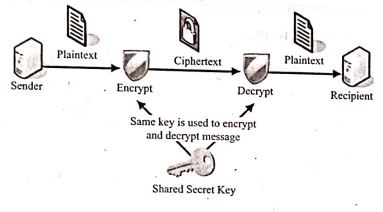 |
|
4.
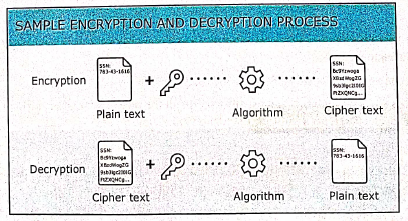
Encryption technology is an effective information security protection. It is defined as converting a plaintext into meaningless ciphertext using encryption algorithm thus ensuring the confidentiality of the data. The encryption or decryption process use a key to encrypt or decrypt the data. At present two encryption technologies are widely used. They are symmetric key encryption system and an asymmetric key encryption system. Thre figure below shows the Data Encryption and Decryption process:
5.
As the security issue is the most worrying issue for E-Business, ensuring the security of E-Commerce activities has become the core research field of E-Commerce. The following are some of the security elements involved in E-Commerce.
(i) Authenticity:( conforming genuineness of data shared.
(ii) Availability:prevention against data delay or removal.
(iii) Completeness: unification of all business information.
(iv) Confidentiality: protecting data against unauthorized disclosure.
(v) Effectiveness: effective handling of hardware, software and data.
(vi) Integrity: prevention of the data being unaltered.
(vii) Non-repudiation: prevention against violation agreement after the deal.
(viii) Privacy:prevention of customers personal data being used by others.
(ix) Reliability: providing a reliable identification of the individuals or businesses.
(x) Review ability: capability of monitoring activities to audit and track the operations.

12th Standard Syllabus & Materials
12th Standard
TN 12th Computer Applications களப்பெயர் முறைமை (DNS) Sample Question Papers Study Material - QB365 Set A
NEW12th Standard
TN 12th Computer Applications வலையமைப்பு எடுத்துக்காட்டுகள் மற்றும் நெறிமுறைகள் Sample Question Papers Study Material - QB365 Set A
NEW12th Standard
TN 12th Computer Applications கணினி வலையமைப்பு ஓர் அறிமுகம் Sample Question Papers Study Material - QB365 Set A
NEW12th Standard
TN 12th Computer Applications PHP-உடன் MySQL-ஐ இணைத்தல் Sample Question Papers Study Material - QB365 Set A



Tamilnadu Stateboard 12th Standard Subjects

Maths

Chemistry

Physics

Biology

Computer Science

Business Maths and Statistics

Economics

Commerce

Accountancy

History
Computer Applications
Biology
Computer Technology
Computer Applications
Computer Science
Business Maths and Statistics
Commerce
Economics
Maths
Chemistry
Physics
Computer Technology
History
Accountancy

Tamil

English

French
Tamilnadu Stateboard Standards


