
 100% FREE ACCESS
12th Standard Syllabus & Materials
12th Standard
TN 12th Maths Applications of Matrices and Determinants Sample Question Papers Study Material - QB365 Set A
NEW12th Standard
TN 12th Computer Applications மின்னணு தரவு பரிமாற்றம் Sample Question Papers Study Material - QB365 Set A
NEW12th Standard
TN 12th Computer Applications மின் - வணிக பாதுகாப்பு அமைப்புகள் Sample Question Papers Study Material - QB365 Set A
NEW12th Standard
TN 12th Computer Applications மின்னணு செலுத்தல் முறைகள் Sample Question Papers Study Material - QB365 Set A
NEW12th Standard
TN 12th Computer Applications மின் - வணிகம் Sample Question Papers Study Material - QB365 Set A
NEW12th Standard
TN 12th Computer Applications திறந்த மூல கருத்துருக்கள் Sample Question Papers Study Material - QB365 Set A

Published on: 13/05/2022
QB365 provides detailed and simple solution for every book back questions in class 12 Computer Applications subject.It will helps to get more idea about question pattern in every book back questions with solution.
latest Book back QuestionsDownload Tamil Nadu 12th Standard Computer Applications question papers, model tests, one-mark questions, important questions, and public exam papers in PDF format. Free study materials and answer keys for TN State Board students.
Questions + Answers key
Take MCQ Computer Applications Test
1.
Explain in detail of File handling functions in PHP.
2.
Explain concepts of HTTP Uploading process.
3.
Explain the process File handling.
4.
Discuss in detail about HTML form controls.
5.
Explain Form Handling methods.
1.
File handling is an important activity of all web application development process.
Files are processed for different tasks using the following events :
(i) PHP Open a File,
(ii) PHP Read a File,
(iii) PHP Close a File,
(iv) PHP Write a File,
(v) PHP Appending a File and
(vi) PHP uploading a File.
(1) PHP Open a File : fopen() is a system function available in PHP. This function helps to open a file in the server. It contains two parameters one for the file and the other one specifies in which mode the file should be opened (Read/Write).
Syntax:
$file_Object= fopen("FileName", "Read/
WriteMode") or die("Error Message!");
Example:

$myfile = fopen("Student.txt", "r")
or die("Unable to open file!");
?>
(ii) PHP Read a File: The fread() function reads from an open file. The file object comes from fopen function.
Syntax:
fread($file_Object,filesize("FileName"));
Example:
fread($myfile,filesize("Student.txt"));
?>
(iii) PHP Close a File: The fclose() function is used to close an opened file. The file object comes from fopen function.
Syntax:
fclose($file_Object);
Example:
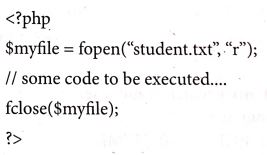
(iv) PHP write a File: The fwrite() function is used to write to a file.
Syntax:

2.
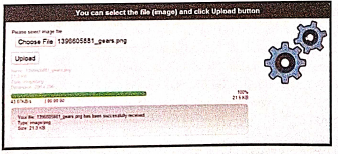
1. File upload is the best feature to select one file from the local machine to server machine.
2. Form tag is used to mention a method as POST or GET and encrypt/attribute mentioned as "multipart /form-data. In the tag mention type = "file" attribute shows the input field as a file select control with a "Browse" button next to the input control.
3. In server machine "php.ini" file search for the file uploads directive, and set it to On : "file uploads = On"
4. After submitting the upload button the request reaches to student_photo_upload.php file.
5. In the file$_FILES variable collects all uploaded file information such as name of the file, size of the file and extension of the file etc. All the details are checked throughly and the error are saved in an array variable The file finally moves under the image directly if the array error variable is empty.
Example:
Fileupload.html:
3.
In the file handling process following task can be included
(i) open file for read and write
(ii) close file
(iii) perform operations on file
(iv) write results
With PHP we can handle file easily. There are various in built functions available for file handling for PHP.
Using file handling we can open, create, upload and edit files in PHP before working with file. We must open the file first using fopen() function.fopen() function is used in a following manner to perform this task.
$fp = fopen(
In the above code, we have used two parameters while using fopen() function.
filename to open mode in which file is to be opened.
The function will return a file pointer if the file is successfully opened, otherwise it will return false.
Modes we use in the file handling
| Mode | Description |
| r | Read only mode |
| r+ | Read and write mode |
| W | Write mode only |
| W+ | Write and read model |
| a | Append file mode |
| a+ | Read and append mode |
| x | It used to create and open a file only for writing purpose. |
4.
The following control are available in HTML forms:
(i) Text inputs
(ii) Buttons
(iii) Checkbox
(iv) Radio box
(v) File Select
(vi) Form Tag
(i) Text inputs contain textbox and text area controls.
(ii) Buttons may contain Submit button, Reset button and Cancel Button.
(iii) Checkbox is a important feature which selects more than one value from the HTML form.
(iv) Radio box is similar to checkbox but one value can be chosen at a time.
(v) File select is the best feature to select one file from the local machine to server machine at a time.
(vi) Form tag is used to mention a method (POST or GET) and control the entire form controls in the HTML document.
5.
PHP Basic Form Handling:
(i) When the user keys in the input data in HTML controls and clicks the submit button the request will be generated and reaches a PHP file which is mentioned in the FORM tag under the Action attribute.
(ii) All the input values are synchronized and sent to the server via POST method or GET method. Method is an attribute of form tag in HTML.
(iii) Once the data reaches the server,two PHP variables such as \($\)_POST and \($\)_GET collects the data and prepares the response accordingly.
Post Method: The input data sent to the server with POST method is stored in the request body of the client's HTTP request.
Get Method: The input data sent to the server with POST method via URL address is known as query string. All input data are visible by user after they clicks the submit button.
Example:
Test.html:
< html >
< body >
<form action="'welcome.php" method=''post" >
Name: < input type="text" name="name'' > < br >
E-mail: < input type="text" name="email" > < br >
< input type=''submit" >
< /form >
< /body >
< /html >
Welcome.php:
< html >
< body >
Welcome < ?php echo \($\)_POST["name"]; ? > < br >
Your email address is: < ?php echo \($\)_POST["email"]; ? >
< /body >
< /html >
Output
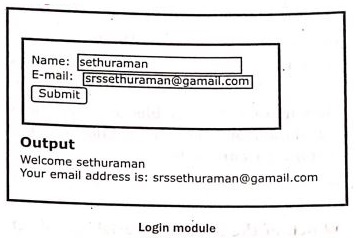
(i) HTML File contains two Text Box (Name and Email), One Button and one form tag. The remote server PHP file (welcome.php) is mentioned in form tag under the Action Attribute.
(ii) In "Welcome.Php" file, PHP variables such as \($\)_POST and \($\)_GET collects the data and prepares the response accordingly.
(iii) Eventually the user will receive the output response in the client machine's browser screen.

12th Standard Syllabus & Materials
12th Standard
TN 12th Computer Applications வலையமைப்பு வடமிடல் Sample Question Papers Study Material - QB365 Set A
NEW12th Standard
TN 12th Computer Applications களப்பெயர் முறைமை (DNS) Sample Question Papers Study Material - QB365 Set A
NEW12th Standard
TN 12th Computer Applications வலையமைப்பு எடுத்துக்காட்டுகள் மற்றும் நெறிமுறைகள் Sample Question Papers Study Material - QB365 Set A
NEW12th Standard
TN 12th Computer Applications கணினி வலையமைப்பு ஓர் அறிமுகம் Sample Question Papers Study Material - QB365 Set A



Tamilnadu Stateboard 12th Standard Subjects

Maths

Chemistry

Physics

Biology

Computer Science

Business Maths and Statistics

Economics

Commerce

Accountancy

History
Computer Applications
Biology
Computer Technology
Computer Applications
Computer Science
Business Maths and Statistics
Commerce
Economics
Maths
Chemistry
Physics
Computer Technology
History
Accountancy

Tamil

English

French
Tamilnadu Stateboard Standards


