
 100% FREE ACCESS
12th Standard Syllabus & Materials
12th Standard
TN 12th Maths Applications of Matrices and Determinants Sample Question Papers Study Material - QB365 Set A
NEW12th Standard
TN 12th Computer Applications மின்னணு தரவு பரிமாற்றம் Sample Question Papers Study Material - QB365 Set A
NEW12th Standard
TN 12th Computer Applications மின் - வணிக பாதுகாப்பு அமைப்புகள் Sample Question Papers Study Material - QB365 Set A
NEW12th Standard
TN 12th Computer Applications மின்னணு செலுத்தல் முறைகள் Sample Question Papers Study Material - QB365 Set A
NEW12th Standard
TN 12th Computer Applications மின் - வணிகம் Sample Question Papers Study Material - QB365 Set A
NEW12th Standard
TN 12th Computer Applications திறந்த மூல கருத்துருக்கள் Sample Question Papers Study Material - QB365 Set A

Published on: 13/05/2022
QB365 provides detailed and simple solution for every book back questions in class 12 Computer Applications subject.It will helps to get more idea about question pattern in every book back questions with solution.
latest Book back QuestionsDownload Tamil Nadu 12th Standard Computer Applications question papers, model tests, one-mark questions, important questions, and public exam papers in PDF format. Free study materials and answer keys for TN State Board students.
Questions + Answers key
Take MCQ Computer Applications Test
1.
Explain the DDL command of their functions in SQL.
2.
Write a note on open source software tools available in MySQL Administration.
3.
4.
List the basic concepts of ER Model with suitable example
5.
Discuss on various database models available in DBMS.
1.
SQL - Structured Query Language is a stand. language used for accessing and manipulating databases.
Data Definition Language (DDL)
The DDL commands are used to define database schema (Structure). Also to create and modify the structure of the database object in the database. CREATE, ALTER, DROP,RENAME and TRUNCATE commands belongs to this category.
SOL DDL COMMANDS LIST
| Command | Description |
| CREATE | Used to create database or tables |
| ALTER | Modifies the existing structure of database or table |
| DROP | Deletes a database or table. |
| RENAME | Used to rename an existing object in the database |
| TRUNCATE | Used to delete all table records |
Create Database used to create new SQL Database.
Syntax: CREATE database databasename;
Example: mysql>create database studentDB;
Drop Database - used to remove any of the existing SQL Database.
Syntax: DROP database databasename;
Example: mysql>DROP database studentDB;
TRUNCATE Command:
Syntax: TRUNCATE table tablename;
Example: TRUNCATE table studentDB;
ALTER Command:
Syntax:
ALTER TABLE table_name
ADD column_name column_definition;
Example:
ALTER TABLE student
ADD student_name char(50);
2.
MYSQL is a database management system and it is ease of use.
Types of Software tools:
(i). Many open source tools are available in the market to design the database in a better and efficient manner.
(ii). PhpMyAdmin is most popular for Web-Administration.
(iii). The Popular Desktop Application tools are MySQL Workbench and HeidiSQL.
1. PHPMYADMIN (Web Admin):
(i). This administrative tools of MySQL is a web application written in PHP.
(ii). They are used predominantly in web-hosting.
(iii). The main feature is providing web interface, importing data from CSV and exporting data to various formats.
(iv). It generates live charts for monitoring MySQL server activities like connections, processes and memory usage.
(v). It also helps in making the complex queries easier.
2. MySQL Workbench (Desktop Application)
(i). It is a database tool used by developers and DBA's mainly for visualization.
(ii). This tool helps in data modeling, development of SQL, server configuration and backup for MySQL.
(iii). Its Basic release version is 5.0 and current version 8.0 support all operating systems.
(iv). The SQL editor of this tool is very flexible and comfortable in dealing multiple results set.
3. HeidiSQL (Desktop Application)
(i). This open source tools helps in the administration of better database systems.
(ii). It supports GUI (Graphical User Interface) features for monitoring server host, server connection, Databases, Table, Views, Triggers and Events.
3.
4.
ER Modeling basic concepts: The basic concepts of ER model consists of
1. Entity or Entity type
2. Attributes
3. Relationship
(i) Entity (or) Entity type
(i) An Entity can be real-world object (or) animation which is easily identifiable by anyone even by a common man.
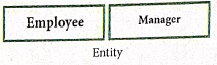
(ii) Example: In a company's database Employee, HR, Manager are considered as entities, where each of these entity will be having their own attributes.An entity is represented by a rectangular box.
Types of Entity:
(a) Strong Entity
(b) Weak Entity
(c) Entity Instance
(i) Strong Entity
1. Strong entity is not depend on other entity and it will have a primary key.
2. It is represented by one rectangle.

3. For Example Roll Number. Everyone Roll Number varies and it will not be same.
(ii) Weak Entity
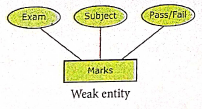
1. A weak entity is dependent on other entities and it doesn't have any primary key like strong entity.
2. It is represented by double rectangle.

3. For Example, "Marks" is the weak entity and there is no primary key or unique id. It is depend on the existence of the other entity.
(iii) Entity Instance
1. Instances are the values for the entity. So an Entity Instance denotes the category values for the given entity.
Entities Instances
| Entities | Instances |
| Human | Male, Female |
| Animals | Dog, cats, lion |
| Jobs | Engineer, Doctor, Lawyer |
| Actors | Ajith, Vijay, Vikram |
| Electronics | Laptop, Mobile |
2. Attributes
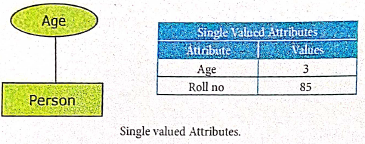
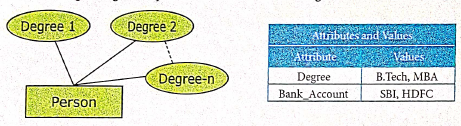
An attribute is the information about that entity and it will entity describe, quantity, qualify, classify and specify and entity. An attribute will always have a single value, that value can be a number or character or string.
Types of attributes :
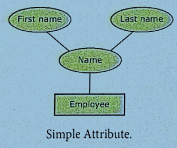
(i) Key Attribute
(ii) Simple Attributes
(ii) Composite Attributes
(iv) Single Valued Attribute
(v) Multi Valued Attribute
3. Relationship Type
In ER Model, relationship exists between two entities. Three types of relationships are available and the Entity-Relationship (ER) diagram is based on the three types listed below
(i) One-to-One relationship: Consider two entities A and B. One-to-one (1:1) relationship is said to exist in a relational database design, if 0 or 1 instance of entity A is associated with 0 or 1 instance of entity B, and 0 or 1 instance of entity B is associated with 0 or I instance of entity A.
(ii) One-to-Many relationship: Consider two entities A and B. One-to-many (1:N) relationship is said to exist in a relational database design, for 1 instance of entity A there exists 0 or 1 or many instances of entity B, but for 1 instance of entity B there exists 0 ur 1 instance of entity A.
(iii) Many-to-Many relationship: Consider two entities A and B. many-to-many (M:N) relationship is said to exist in a relational database design, for 1 instance of entity A there exists 0 or 1 or many instances of entity B, and for 1 instance of entity B there exists 0 or 1 or many instance of entity A.
In reality one-to-one are in less usage, where as one-to-many and many-to-many are commonly used. However in relational database, many-to-many are converted into one-to-many relationships.
5.
The database technology came into existence in terms of models with relational and object- relational behavior. The major database models are listed below:
1. Hierarchical Database Model:
(i). The famous Hierarchical database model was IMS (Information Management System), IBM's first DBMS.
(ii). In this model each record has information in parent/child relationship like a tree structure.
(iii). The collection of records was called as record types. This individual records are equal to rows.
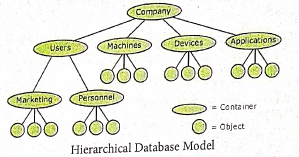
Advantages: Less redundant data, efficient search, data-integrity and security.
Limitations: Complex to implement and difficulty in handling many to many relationship.
2. Network model:
(i). The first developed network data model was IDS (Integrated Data Store) at Honeywell.
(ii). Network model is similar to Hierarchical model except that in this model each member can have more than one owner.
(iii). The Many to Many relationships are handled in a better way.
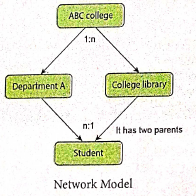
(iv). This model identified by the three database components Network schema, Sub schema and Language for data management.
Network schema: schema defines all about the structure of the data base.
Sub schema: controls on views of the database for the user.
Language: basic procedural for accessing the database.
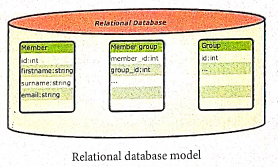
3. Relational model:
Oracle and DB2 are few commercial relational models in use Relational model is defined with two terminologies: Instance and Schema.
Instance: A table consisting of rows and columns.
Schema: Specifies the structure including name and type of each column.
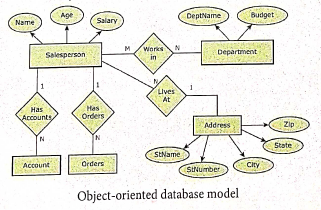
4. Object oriented database model:
(i). This model incorporates the combination of Object Oriented Programming (OOP's) concepts and database technologies.
(ii). Practically, this model serves as the base of Relational model. Object oriented model uses small, reusable software known as Objects.
(iii). These are stored in object oriented database.

12th Standard Syllabus & Materials
12th Standard
TN 12th Computer Applications வலையமைப்பு வடமிடல் Sample Question Papers Study Material - QB365 Set A
NEW12th Standard
TN 12th Computer Applications களப்பெயர் முறைமை (DNS) Sample Question Papers Study Material - QB365 Set A
NEW12th Standard
TN 12th Computer Applications வலையமைப்பு எடுத்துக்காட்டுகள் மற்றும் நெறிமுறைகள் Sample Question Papers Study Material - QB365 Set A
NEW12th Standard
TN 12th Computer Applications கணினி வலையமைப்பு ஓர் அறிமுகம் Sample Question Papers Study Material - QB365 Set A



Tamilnadu Stateboard 12th Standard Subjects

Maths

Chemistry

Physics

Biology

Computer Science

Business Maths and Statistics

Economics

Commerce

Accountancy

History
Computer Applications
Biology
Computer Technology
Computer Applications
Computer Science
Business Maths and Statistics
Commerce
Economics
Maths
Chemistry
Physics
Computer Technology
History
Accountancy

Tamil

English

French
Tamilnadu Stateboard Standards


