
 100% FREE ACCESS
12th Standard Syllabus & Materials
12th Standard
TN 12th Maths Applications of Matrices and Determinants Sample Question Papers Study Material - QB365 Set A
NEW12th Standard
TN 12th Computer Applications மின்னணு தரவு பரிமாற்றம் Sample Question Papers Study Material - QB365 Set A
NEW12th Standard
TN 12th Computer Applications மின் - வணிக பாதுகாப்பு அமைப்புகள் Sample Question Papers Study Material - QB365 Set A
NEW12th Standard
TN 12th Computer Applications மின்னணு செலுத்தல் முறைகள் Sample Question Papers Study Material - QB365 Set A
NEW12th Standard
TN 12th Computer Applications மின் - வணிகம் Sample Question Papers Study Material - QB365 Set A
NEW12th Standard
TN 12th Computer Applications திறந்த மூல கருத்துருக்கள் Sample Question Papers Study Material - QB365 Set A

Published on: 28/02/2021
12th Standard English Medium Computer Science Reduced syllabus Public Exam Model Question Paper - 2021
Download Tamil Nadu 12th Standard Computer Science question papers, model tests, one-mark questions, important questions, and public exam papers in PDF format. Free study materials and answer keys for TN State Board students.
Questions + Answers key
Take MCQ Computer Science Test
1.
_________is used to describe the lower bound of asymptotic function.
Big Alpha
Big Beta
Big 0
Big Omega
2.
Which of the following creates an object which maps data to a dictionary?
listreader()
reader()
tuplereader()
DictReader ()
3.
A tuple is also known as
table
row
attribute
field
4.
A table is known as
tuple
attribute
relation
entity
5.
A private class variable is prefixed with
__
&&
##
**
6.
What is the use of type() function in python?
To create a Tuple
To know the type of an element in tuple.
To know the data type of python object
To create a list.
7.
In which arguments the correct positional order is passed to a function?
Required
Keyword
Default
Variable-length
8.
Which punctuation should be used in the blank?
if < condition > ____
statements-block 1
else:
statements-block 2
;
::
!
" : "
9.
10.
11.
The complexity of linear search algorithm is
O(n)
O(log n)
O(n2)
O(n log n)
12.
From the following sorting algorithms which algorithm needs the minimum number of swaps?
Bubble sort
Insertion sort
Selection sort
All the above
13.
Bundling two values together into one can be considered as
Pair
Triplet
single
quadrat
14.
15.
Which of the following defines what an object can do?
Operating System
Compiler
Interface
Interpreter
16.
Explain Jump statement in python.
17.
Write a program to create a list of numbers in the range 1 to 10. Then delete all the even numbers from the list and print the final list.
18.
hat is the use of HAVING clause. Give an example python script
19.
20.
21.
Write a Python code to find the L.C.M. of two numbers.
22.
Write a program to display multiplication table for a given number.
23.
Explain the Bubble sort algorithm with example.
24.
Write any five benefits in using modular programming.
25.
What are called Parameters and write a note on
(i) Parameter without Type
(ii) Parameter with Type
26.
Write the output of the following program
Disp()
a:=10
Disp 1():
print a
Disp 1():
print a
Disp()
27.
Write the output of the following program
a:=10
Disp():
a:=7
print a
Disp 1():
print a
28.
Give an example of pure function.
29.
Give an example of function definition parameter without type.
30.
List the types of Visualizations in Matplotlib.
31.
Write the command to populate record in a table. Give an example.
32.
Mention the users who uses the Database.
33.
Write the expansion of (i) SWIG (ii) MinGW
34.
Explain how will you use global and local variable with same name.
35.
Write a pseudo code for linear search
36.
Write the different factors in which the time efficiency of an algorithm its measured
37.
Write a short note on comment statement.
38.
Write a short note on types of variable scope.
39.
Write a note on module.
40.
Write a short note an syntax for function types.
41.
Explain the syntax of function definitions.
1.
(d)
Big Omega
2.
(d)
DictReader ()
3.
(b)
row
4.
(c)
relation
5.
(a)
__
6.
(c)
To know the data type of python object
7.
(a)
Required
8.
(d)
" : "
9.
(c)
10.
(a)
11.
(a)
O(n)
12.
(c)
Selection sort
13.
(a)
Pair
14.
(a)
15.
(c)
Interface
16.
The jump statement in Python, is used to unconditionally transfer the control from one part of the program to another. There are three keywords to achieve jump statements in Python: break, continue, pass. The following flowchart illustrates the use of break and continue.
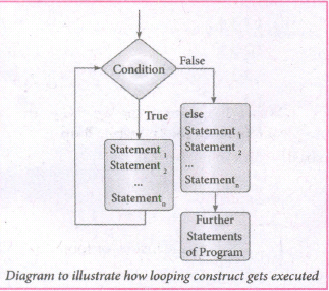
(i) break statement: The break statement terminates the loop containing it. Control of the program flows to the statement immediately after the body of the loop. A while or for loop will iterate till the condition is tested false, but one can even transfer the control out of the loop (terminate) with help of break statement. When the break statement is executed, the control flow of the program comes out of the loop and starts executing the segment of code after the loop structure. If break statement is inside a nested loop (loop inside another loop), break will terminate the innermost loop.
Syntax:
break
(ii) Continue statement: Continue statement unlike the break statement is used to skip the remaining part of a loop and start with next iteration.
Syntax:
continue
(iii) Pass statement: pass statement is generally used as a placeholder. When we have a loop or function that is to be implemented in the future and not now, we cannot develop such functions or loops with empty body segment because the interpreter would raise an error. So, to avoid this we can use pass statement to construct a body that does nothing.
Syntax:
pass
17.
Program:
Num = []
for x in range(1, 11):
Num.append(x)
print("The list of numbers from 1 to 10 = ",Num)
for index, i in enumerate(Num):
if(i%2==0):
del Num[index]
print("The list after deleting even numbers = ", Num)
Output:
The list of numbers from 1 to 10 = [1, 2, 3, 4, 5, 6, 7, 8, 9, 10]
The list after deleting even numbers =. [1, 3, 5, 7, 9]
18.
HAVING clause is used to filter data based on7the group functions. This is similar to WHERE condition but can be used , only with group functions. Group functions cannot be used in WHERE Clause but can be used in HAVING clause.
Example:
import sqlite3
connection = sqlite3.connect("Academy.db")
cursor = connection.cursorO
cursor.execute("SELECT GENDER,COUNT(GENDER) FROM Student GROUP BY GENDER HAVING COUNT( GENDER> 3")
result = cursor.fetchall( )
co = [i[o] for i in cursor. description]
print(co)
print(result)
Output:
['gender', 'COUNT(GENDER)']
[('M', 5)]
19.
20.
21.
Program:
def lcm(x, y):
if x>y:
greater = x
else:
greater = y
while (True):
if ((greater % x == 0) and (greater % y ==0))
lcm = greater
break
greater + = 1
return lcm
a = int (input ("Enter the first number:"))
b = int (input ("Enter the second number: "))
print ("The L.C.M of", a, "and", b, "is", lcm (a, b))
[OR]
Method II: (without using functions)
a = int (input ("Enter the first number:"))
b = int (input ("Enter the second number:"))
if a>b:
mini a
else:
min 1 = b
while (1):
if (min 1% a 0 and mini 1% b=0):
print ("LCM is:", mini)
break
mini = min 1+1
Output:
Enter the first number: 15
Enter the second number: 20
LCM is: 60
22.
Multiplication table :
num =int(input("Enter the number: "))
print("multiplication Table of", num)
for i in range(1,11):
print (num,"x",i, "= ",num*i )
Output :
Enter the number : 6
Multiplication Table of 6
6 x 1 = 6
6 x 2 = 12
6 x 3 = 18
6 x 4 = 24
6 x 5 = 30
6 x 6 = 36
6 x 7 = 42
6 x 8 = 48
6 x 9 = 54
6 x 10 = 60.
23.
Bubble sort algorithm:
(i) Bubble sort algorithm simple sorting algorithm. The algorithm starts at the beginning of the list of values stored in an array. It compares each pair of adjacent elements and swaps them if they are in the unsorted order.
(ii) This comparison and passed to be continued until no swaps are needed, which indicates that the list of values stored in an array is sorted. The algorithm is a comparison sort, is named for the way smaller elements "bubble" to the top of the list.
(iii) Although the algorithm is simple, it is too slow and less efficient when compared to insertion sort and other sorting methods.
(iv) Assume list is an array of n elements. The swap function swaps the values of the given array elements.
Procedure :
(i) Start with the first element i.e., index = 0, compare the current element with the next element of the array.
(ii) If the current element is greater than the next element of the array, swap them.
(iii) If the current element is less than the next or right side of the element, move to the next element. Go to Step 1 and repeat until the end of the index is reached.
(iv) Let's consider an array with values {15, 11, 16, 12, 14, 13} Below, we have a pictorial representation of how bubble sort will sort the given array.
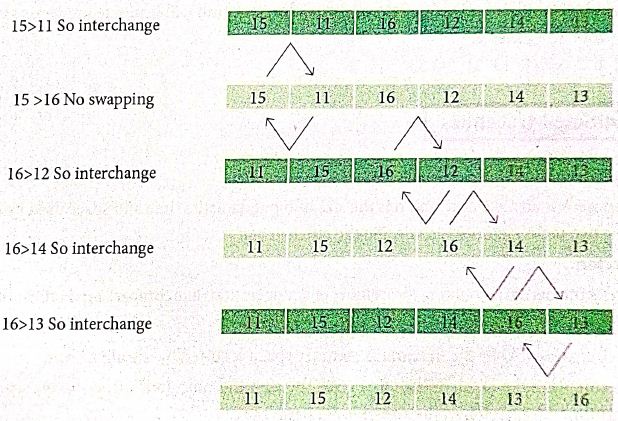
(v) The above pictorial example is for iteration-d. Similarly, remaining iteration can be done. The final iteration will give the sorted array. At the end of all the iterations we will get the sorted values in an array as given below:
| 11 | 12 | 13 | 14 | 15 | 16 |
24.
(i) Less code to be written.
(ii) A single procedure can be developed for reuse, eliminating the need to retype the code many times.
(iii) Programs can be designed more easily because a small teana deals with only a
small part of the entire code.
(iv) Modular programming allowS many programmers to collaborate on the same
application.
(v) The code is stored across multiple files.
(vi) Code is short, sirnple and easy to understand.
(vii) Errors can easily be identified, as they are localized to a subroutine or function.
(viii) The same code can be used in man applications.
(ix) The scoping of variables can easily be controlled.
25.
Parameters and arguments:
Parameters are the variable in a function definition and arguments are the values which are passed to a function definition
(i) Parameter without Type: Let us see an example of a function,definition :
(requires: b >=0 )
(returns: a to the power of b)
let rec pow a b:=
if b=0 then 1
else a*powa(b-1)
(i) In the above function definition variable 'b' is the parameter and the value which is passed to the variable 'b' is the argument. The precondition (requires) and postcondition (returns) of the function is given.
(ii) Note we have not mentioned any types (data types). Some language computer solves this type (data type) inference problem algorithmically, but some require the type to be mentioned.
(iii) In, the above function deinition if expression can return 1 in the then branch, shows that as per the typing rule the entire if expression has type int
(iv) Since the if expression is of type 'int', the function's return type also be int. 'b' is compared to 0 with the equality operator. so 'b' is also a type of int: Since 'a' is multiplied with another expression using the operator, 'a' must be an int.
(ii) Parameter with Type: Now let us write the same function definition with types for some reasons:
(requires: b > 0 )
(returns: a to the power of b )
let rec pow (a:int) (b:int): int :=
if b=0 then 1
n else a * pow b (a-1)
(i) When we write the type annotations for ‘a’ and ‘b’ the parentheses are mandatory. Generally, we can leave out these annotations, because it's simpler to let the compiler infer them.
(ii) There are times we may want to explicitly write down types. This is useful on times when you get a type error from the compiler that doesn't make sense. Explicitly annotating the types can help with debugging such an error message.
(iii) The syntax to define functions is close to the mathematical usage: the definition is introduced by the keyword let followed by the name of the function and its arguments; then the formula that computes the image of the argumentis written atter an := sign. If you want to define a recursive function: use "let rec" instead of "let"
Syntax:The syntax for function detinitions: let irec fn al a2 ... an := k
(iv) Here the 'fn' is used as a function name. The nanmes 'a1' to 'an'are variables used as parameters. The keyword 'rec' is required if 'fn' is to be a recursive function; otherwise it may be omitted.
26.
The output of the program
10
10
27.
The output of the program
7
10
28.
let square x
return: x * x
let i: = 0;
ifi < strlen> (s) then
-- Do something which doesn't affect s
++i
29.
(requires: b>=0 )
(returns: a to the power of b)
let rec pow a b:=
if b=0 then I
else a * pow a (b-1)
30.
(i) Line plot
(ii) Scatter plot
(iii) Histogram
(iv) Box plot
(v) Bar chart and
(vi) Pie chart
31.
To populate the table "INSERT" command is passed to SQLite."execute" method executes the SQL command to perform some action.
Example:
Sql_command =" " INSERT INTO student (Rollno, Sname, Grade, Gender, Average, birth_date) values (NULL, "Akshay", "B", "M", "87.8", "2001-12-12");" " cursor.execute(sql_command)
32.
Users of database can be human users or programmers, other programs or applications.
33.
(i) SWIG - Simplified Wrapper Interface Generator
(ii) MinGW - Minimalist GNU for Windows
34.
x=5
def loc():
x=10
print ("local x:", x)
loc()
print ("global x:", x)
Output:
local x: 10
global x:5
35.
(i) Traverse the array using 'for loop'
(ii) In every iteration, compare the target search key value with the current value of the list.
(iii) If the values match, display the current index and value of the array
(iv) If the values do not match, move on to the next array element
(v) If no match is found, display the search element not found.
36.
The execution time that you measure in this case would depend on a number of factors such as:
(i) Speed of the machine
(ii) Compiler and other system Software tools
(iii) Operating System
(iv) Programming language used
(v) Volume of data required
37.
(i) In Python, comments begin with hash symbol (#). The lines that begins with # are considered as comments and ignored by the Python interpreter.
(ii) Comments may be single line or no multilines. The multiline comments should be enclosed within a set of # as given below.
# It is Single line Comment
# It is multiline comment
which contains more than one line #
38.
(i) Public members (generally methods declared in a class) are accessible from outside the class.
(ii) A variable which is declared outside of all the functions in a program is known as global variable.
(iii) A variable which is declared inside a function which contains another function definition with in it, the inner function can also access the variable of the outer function. This scope is called enclosed scope.
(iv) Built-in scope the widest scope has all the names that are pre-loaded into program scope when we. start the compiler or interpreter.
39.
(i) A module is a part of a program. Programs are composed of one or more independently developed modules. A single module can contain one or several statements closely related each other.
(ii) Modules work perfectly on individual level and can be integrated with other modules. A software program can be divided into modules to ease the job of programming and debugging as well.
(iii) A program can be divided into small functional modules that work together to get the output. The process of subdividing a computer program into separate subprograms is called Modular programming.
(iv) Modular programming enables programmers to divide up the work and debug pieces of the program independently. The examples of modules are procedures, subroutines, and functions.
40.
The syntax for function types
x\(\rightarrow \)y
x1 \(\rightarrow \)x2\(\rightarrow \)y
x1 \(\rightarrow \) .... \(\rightarrow \)x n\(\rightarrow \)y
The 'x' and 'y' are variables indicating types. The type x \(\rightarrow \) y is the type of a function that gets an input of type 'x' and returns an output of type 'y'. Where as x1\(\rightarrow \) x2 -\(\rightarrow \) y is a type of a function that takes two inputs, the first input is of type 'x1' and the second input of type 'x1', and returns an output of type 'y'. Likewise x1 \(\rightarrow \)...\(\rightarrow \)x n\(\rightarrow \)y has type 'x' as input of n arguments and 'y' type as output.
41.
(i) The syntax to define functions is close to the mathematical usage: the definition is introduced by the keyword let, followed by the name of the function and its arguments; then the formula that computes the image of the argument is written after an = sign. If you want to define a recursive function: use "let rec" instead of "let".
(ii) Syntax: The syntax for function definitions:
let rec fn a1 a2 ... an :;= k
(iii) Here the 'fn' is a variable indicating an identifier being used as a function name. The names 'a1' to 'an' are variables indicating the identifiers used as parameters. The keyword 'rec' is required if 'fn' is to be a recursive function; otherwise it may be omitted.

12th Standard Syllabus & Materials
12th Standard
TN 12th Computer Applications வலையமைப்பு வடமிடல் Sample Question Papers Study Material - QB365 Set A
NEW12th Standard
TN 12th Computer Applications களப்பெயர் முறைமை (DNS) Sample Question Papers Study Material - QB365 Set A
NEW12th Standard
TN 12th Computer Applications வலையமைப்பு எடுத்துக்காட்டுகள் மற்றும் நெறிமுறைகள் Sample Question Papers Study Material - QB365 Set A
NEW12th Standard
TN 12th Computer Applications கணினி வலையமைப்பு ஓர் அறிமுகம் Sample Question Papers Study Material - QB365 Set A



Tamilnadu Stateboard 12th Standard Subjects

Maths

Chemistry

Physics

Biology
Computer Science

Business Maths and Statistics

Economics

Commerce

Accountancy

History

Computer Applications
Biology
Computer Technology
Computer Applications
Computer Science
Business Maths and Statistics
Commerce
Economics
Maths
Chemistry
Physics
Computer Technology
History
Accountancy

Tamil

English

French
Tamilnadu Stateboard Standards
