100% FREE ACCESS
12th Standard Syllabus & Materials
12th Standard
TN 12th Computer Applications மின்னணு தரவு பரிமாற்றம் Sample Question Papers Study Material - QB365 Set A
NEW12th Standard
TN 12th Computer Applications மின் - வணிக பாதுகாப்பு அமைப்புகள் Sample Question Papers Study Material - QB365 Set A
NEW12th Standard
TN 12th Computer Applications மின்னணு செலுத்தல் முறைகள் Sample Question Papers Study Material - QB365 Set A
NEW12th Standard
TN 12th Computer Applications மின் - வணிகம் Sample Question Papers Study Material - QB365 Set A
NEW12th Standard
TN 12th Computer Applications திறந்த மூல கருத்துருக்கள் Sample Question Papers Study Material - QB365 Set A
NEW12th Standard
TN 12th Computer Applications வலையமைப்பு வடமிடல் Sample Question Papers Study Material - QB365 Set A

Published on: 27/02/2021
12th Standard English Medium Computer Science Reduced syllabus Public Exam Model Question Paper With Answer Key - 2021
Download Tamil Nadu 12th Standard Computer Science question papers, model tests, one-mark questions, important questions, and public exam papers in PDF format. Free study materials and answer keys for TN State Board students.
Questions + Answers key
Take MCQ Computer Science Test
1.
2.
What is the output of the following program? import csv
d=csv.reader(open('c:\PYPRG\ch13\city.csv'))
next(d)
for row in d:
print(row)
if the file called “city.csv” contain the following details
chennai,mylapore
mumbai,andheri
chennai,mylapore
mumbai,andheri
chennai,mumba
chennai,mylapore,mumbai,andheri
3.
Functions defined inside a class:
Functions
Module
Methods
section
4.
5.
While defining a function which of the following symbol is used.
; (semicolon)
. (dot)
: (colon)
$ (dollar)
6.
Which statement is generally used as a placeholder?
continue
break
pass
goto
7.
Which of the following is not a token?
Interpreter
Identifiers
Keyword
Operators
8.
Which members are accessible from outside the class?
Public members
Protected members
Secured members
Private members
9.
Which of the following is used in programming languages to map the variable and object?
::
:=
=
==
10.
The process of binding a variable name with an object is called
Scope
Mapping
late binding
early binding
11.
The data type whose representation is unknown are called
Built in datatype
Derived datatype
Concrete datatype
Abstract datatype
12.
The data type whose representation is known are called
Built in datatype
Derived datatype
Concrete datatype
Abstract datatype
13.
The functions which will give exact result when same arguments are passed are called
Impure functions
Partial Functions
Dynamic Functions
Pure functions
14.
Which of the following is a unit of code that is often defined within a greater code structure?
Subroutines
Function
Files
Modules
15.
The small sections of code that are used to perform a particular task is called
Subroutines
Files
Pseudo code
Modules
16.
Read the following code. What does the following represents.
(i) Labels
(ii) Usage
(iii) X ticks
(iv) Range
(v) Show
17.
Write a python code to display the following plot.
18.
What will be the output of the following code?
list = [2**x for x in range(5)]
print (list)
19.
Write a Python program to display the given pattern
C O M P U T E R
C O M P U T E
C O M P U T
C O M P U
C O M P
C O M
C O
C
20.
What are string literals? Explain.
21.
Identify the scope of the variables in the following pseudo code and write its output
color:= 'Red'
mycolor( ):
b:='Blue'
myfavcolor( ):
g:='Green'
printcolor, b, g
myfavcolor( )
printcolor, b
mycolor( )
print color
22.
Identify Which of the following are List, Tuple and class ?
(a) arr [1, 2, 34]
(b) arr (1, 2, 34)
(c) student [rno, name, mark]
(d) day= (‘sun’, ‘mon’, ‘tue’, ‘wed’)
(e) x= [2, 5, 6.5, [5, 6], 8.2]
(f) employee [eno, ename, esal, eaddress]
23.
What are the different ways to access the elements of a list. Give example.
24.
What is the side effect of impure function. Give example.
25.
Why strlen is called pure function?
26.
Explain the concept access control.
27.
Explain each word of the following command.
Python
28.
Construct the following SQL statements in the student table-
(i) SELECT statement using GROUP BY clause.
(ii) SELECT statement using ORDER BY clause.
29.
What is nested tuple? Explain with an example.
30.
Explain the following built-in functions.
(a) id ()
(b) chr ()
(c) round ()
(d) type ()
(e) pow ()
31.
Explain input() and print() functions with examples.
32.
Write any Five Characteristics of Modules.
33.
Explain the types of scopes for variable or LEGB rule with example.
34.
How will you access the multi-item. Explain with example.
35.
Explain with example Pure and impure functions.
36.
Write the syntax of GROUP BY and HAVING clause.
37.
What is the rule to apply DROP TABLE command?
38.
How will search NULL values in a field? Give example.
39.
How will you retain duplicate rows while displaying the table?
40.
Write is purpose of using skipinitialspace parameter.
41.
What is called modification?
42.
What is the use of close ( ) method?
43.
Differentiate text mode and binary mode.
1.
(a)
2.
(b)
mumbai,andheri
3.
(c)
Methods
4.
(d)
5.
(c)
: (colon)
6.
(c)
pass
7.
(a)
Interpreter
8.
(a)
Public members
9.
(c)
=
10.
(b)
Mapping
11.
(d)
Abstract datatype
12.
(c)
Concrete datatype
13.
(d)
Pure functions
14.
(b)
Function
15.
(a)
Subroutines
16.
(i) Labels ⇾ Specifies labels for the bars.
(ii) Usgae ⇾ Assign values to the labels specified.
(iii) Xticks ⇾ Display the tick marks along the x-axis at the values represented. Then specify the label for each tick mark.
(iv) Range ⇾ Create sequence of numbers.
(v) Show ⇾ Displays the plot
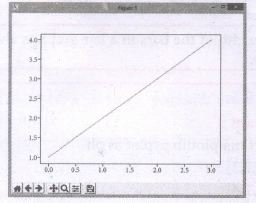
17.
Program:
import matplotlib.pyplot as plt
pIt.plot([1, 2, 3, 4]) ,
plt.show ( )
Output:
18.
Output: [1,2,4,8,16]
19.
Str 1 = "COMPUTER"
index = 0
for i in str 1:
print (str 1[:index -1])
index =1
20.
(i) In Python, a string literal is a sequence 0 characters surrounded by quotes. Python supports Single, double and triple quotes for a string.
(ii) A character literal is a single character surrounded by single or double quotes. The value with triple-quote u ''' ''' is used to give multi-line string literal.
Program:
To test String Literals:
# Demo Program to test String Literals
strings = "This is Python"
char = "C"
multiline_str = ''''This is a multiline string with more than one line code.'''
print (strings)
print (char)
print (multiline_str)
# End of the Program
Output:
This is Python
C
This is a multiline string with more than one line code.
21.
Output:
Red, Blue, Green
Red, Blue
Red.
Seope f Variables :

22.
(a) List
(b) Tuple
(c) Class
(d) Tuple
(e) List
(f) Class
23.
(i) The elements of a list can be accessed in two ways. The first way is via our familiar method of multiple assignment, which unpacks a list into its elements and binds each element to a different name.
lst := [10, 20]
x, y := lst
(ii) In the above example x will become l0 andy will become 20.
(iii) A second method for accessing the elements in a list is by the element selection operator. Unlike a list literal, a square brackets expression directly following another expression does not evaluate to a list value, but instead selects an element from the value of the preceding expression.
Ist [0]
10
lst [1]
20
24.
The variables used inside the function may cause side effects though the functions which are not passed with any arguments. In such cases the function is called impure function.
For example the mathematical function random() will give different outputs for the same function call.
let randomnumber :=
a := random()
if a > 10 then
return: a
else
return: 10
25.
(i) Strlen is a pure function because the function takes one variable as a parameter, and accesses it to find its length.
(ii) This function reads external memory but does not change it, and the value returned derives from the external memory accessed.
26.
(i) Access control is a security technique that regulates who or what can view or use resources in a computing environment.
(ii) It is a fundamental concept in security that minimizes risk to the object.
(iii) In other words access control is a selective restriction of access to data. IN Object oriented programming languages it is implemented through access modifiers.
(iv) Classical object-oriented languages, such as C++ and Java. control the access to class members by public, private and protected keywords.
(v) Private members of a class are denied access from the outside the class. They can be handled only from within the class.
(vi) Public members (generally methods declared in a class) are accessible from outside the class. The object of the same class is required to invoke a public method. This arrangement of private instance variables and public methods ensures the principle of data encapsulation.
(vii) Protected members of a class are accessible from within the class and are also available to its sub-classes. No other process is permitted access to it. This enables specific resources of the parent class to be inherited by the child class.
(viii) Python doesn't have any mechanism that effectively restricts access to any instance variable or method. Python prescribes a convention of prefixing the name of the variable or method with single or double underscore to emulate the behaviour of protected and private access specifiers.
(ix) All members in a Python class are public by default. whereas by default in C++ and java they are private. Any member can be accessed from outside the class environment in Python which is not possible in C++ and java.
27.
Python < filename.py > - < i > <C++ filename without cpp extension>
| Python | Keyword to execute the Python program from command-line |
| filename.py- i | Name of the Python program to executed input mode |
| C++ filename without cpp extension | Name of C++ file to be compiled and executed |
For example type Python pycpp.py - i pali in the command prompt and press enter key. If the compilation is successful we will get the desired output. Otherwise the error will be displayed.
28.
1. SELECT * FROM student WHERE gender = Male GROUP BY gender;
2. SELECT * FROM student WHERE Age > 18 ORDER BY DESC;
29.
In Python, a tuple can be defined inside another tuple; called Nested tuple. In a nested tuple, each tuple is considered as an element. The for loop will be useful to access all the elements in a nested tuple.
Example:
Toppers = (("Vinodini", "XII-F", 98.7), ("Soundarya", "XII-H", 97.5),
("Tharani", "XII-F", 95.3), ("Saisri", "XII-G", 93.8))
for i in Toppers:
print(i)
Output:
('Vinodini', 'XII-F', 98.7)
('Soundarya', 'XII-H', 97.5)
('Tharani', 'XII-F', 95.3)
('Saisri', 'XII-G', 93.8)
30.
| Function | Description | Syntax | Example |
| (a) id() | id () Return the "identity" of an objects i.e. The address of the object in memory. Note: The address of x and y may differ in your system. |
id(object) | x = 15 y = 'a' print('address of x is :',id(x)) print ('address of y is :',id (y)) Output: address of x is: 1357486752 address of y is: 13480736 |
| (b) Chr() | Returns the Unicode character for the given ASCII value. This function is inverse of ord() function. | Chr(i) | c=65 d=43 print(chr(c)) print(chr(d)) Output: A + |
| (c) round() | Returns the nearest integer to its input. 1. First argument(number) is used to specify the value to be rounded. |
round (number, [ndigits]) | x = 17.9 y = 22.2 z = -18.3 print('x value is rounded to', round(x)) print('y value ic rounded to', round(y)) print ('z value is rounded to', round(z)) |
| (d) type() | Returns the type of object for the given single object. Note: This function used with single object parameter. |
type(object) | x = 15.2 y = 'a' s = true print(type(x)) print(type(y)) print(type(s)) Output: < class 'float' > < class 'str' > < class 'bool' > |
| (e) pow() | Returns the computation of ab i.e. (a**b) a raised to the power of b. | pow(a, b) | a = 5 b = 2 c = 3.0 print(pow(a, b)) print(pow(a, c)) print(pow(a + b, 3)) Output: 25 125.0 343 |
31.
1. The print () Function:
ln Python, the print() function is used to display result on the screen. The syntax for print ( ) is as follows:
Example:
print ("String to be displayed as output")
print (variable)
print ("String to be displayed as output", variable)
print ("String1", variable, "string 2", variable, "String 3",....)
Example:
>>> print("Welcome to python Programming'")
welcome to Python Programoming
>>>x = 5
>>> y = 6
>>> z= X+Y
>>> print (z)
>>> print ("The sum =", z)
The sum = 11
>>>print ("The sum of", x, "and", y, "is", z)
The sum of 5 and 6 is 11.
The print () evaluates the expression before printing it on the monitor. The print () displays an entire statement which is specified within print(). Comma(,) is used as a separator in print () to print more than one item.
input () function:
In Python, input) function is used to accept data as input at run time. The syntax for input () function is
Syntax:
Variable = input ("prompt String')
Where, prompt string in the Syntax is a statement or message to the user, to knowwhat input can be given.
If a prompt string is used, it is displayed on the monitor; the user can provide expected data from the input device. The input() takes whatever is typed from the Keyboard and stores the entered data in the given Variable. If prompt string is not given in input() no message is displayed on the screen, then, the user will not know what is to be typed as input.
Example 1:
input () with prompt String
>>>City=input ("Enter your city:")
Enter your city: Madurai
>>>print ("I am from", city)
I am from Madurai
Example 2:
input() without prompt string
>>> city = input ()
Rajarajan
>>>print ("I am from", city)
I am from Rajarajan
in Example 2, the input () is not having any pronmpt string, thus the user will not know what is to be typed as input. If the user inputs irrelevant data as given in the above example then the output will be unexpected. So, to make your program more interactive, provide prompt string with input (). The input () accepts all data as string or characters but not as numbers. Ifa numerical value is entered, the input values should be explicitly converted into numeric data type. The int) function is used to convert string data as integer data explicitly.
Example 3:
X=int (input ("Enter Number 1:"))
Y= int (input ("Enter Number 2:" ))
print ("The Sum =", x + y)
Output:
Enter Number 1: 34
Enter Number 2:56
The Sum =90.
32.
The following are the desirable characteristics of a module.
(i) Modules contain instructions, processing logic, and data.
(ii) Modules can be separately compiled and stored in a library.
(iii) Modules can be included in a program.
(iv) Module segments can be used by invoking a name and some parameters.
(v) Module segments can be used by other modules.
33.
Types of Variable Scope:
There are 4 types of Variable Scope, let's discuss them one by one:
Local Scope:
(i) Local scope refers to variables defined in current function. Always, a function will first look up for a variable name in its local scope. Only if it does not find it there, the outer scopes are checked.
Look at this example
| 1. Disp(): 2. a:=7 3. print a 4. Disp() |
Entire program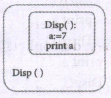 |
Output of the Program 7 |
(ii) On execution of the above code the variable a displays the value 7, because it is defined and available in the local scope.
Global Scope:
(i) A variable which is declared outside of all the functions in a program is known as global variable.
(ii) This means, global variable can be accessed inside or outside of all the functions in a program.
Example:
| 1. a:=10 2. Disp(): 3. a:=7 4. print a 5. Disp() 6. print a |
Entire program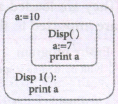 |
Output of the Program 7 10 |
(iii) On execution of the above code the variable 'a' which is defined inside the function displays the value 7 for the function call Disp() and then it displays 10; because a is defined in global scope.
Enclosed Scope:
(i) All programming languages permit functions to be nested. A function (method) with in another function is called nested function.
(ii) A variable which is declared inside a function which contains another function definition with in it, the inner function can also access the variable of the outer function. This scope is called enclosed scope.
(iii) When a compiler or interpreter search for a variable in a program, it first search Local, and then search Enclosing scopes. Consider
the following example:
| 1. Disp(): 2. a:=10 3. Disp1() 4. print a 5. Disp1() 6. print a 7. Disp() |
Entire Program |
Output of the Program 10 10 |
(iv) In the above example Disp1( ) is defined with in Disp( ). The variable 'a' defined in Disp( ) can be even used by Disp1( ) because it is also a member of Disp( ).
Built-in Scope:
(i) The built-in scope has all the names that are pre-loaded into the program scope when we start the compiler or interpreter.
(ii) Any variable or function which is defined in the modules of a programming language has Built-in or module scope. They are loaded as soon as the library files are imported to the program.Consider the following example.
  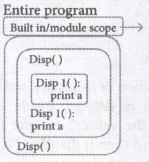 |
Library files associated with the software |
LEGB rule :
The LEGB rule is used to decide the order in which the scopes are to be searched
for scope resolution. The scopes are listed below in terms of hierarchy (highest to
lowest).
.png)
34.
(i) The structure construct (In OOP languages it's called class construct) is used to represent multi-part objects where each part is named (given a name). Consider the following pseudo code:
Class Person:
creation()
first Name:=""
last Name:=""
id :=""
email :=""
The new data type Person is pictorially represented as
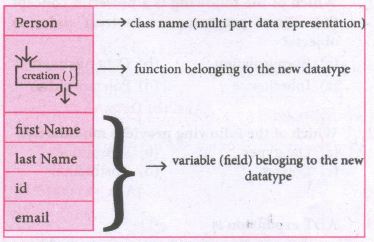
In the case of something more complex, like a person, we have a multí-item object where each item is a named thing: the first name, the last name, the id, and the email. One could use a list to represent a person:
Person = ['padmashri', 'Baskar', '994-222-1234', 'compsci@gmail.com']
| Let main() contains | |
| p1:=Person() | statement creates the object |
| first name:= "padmashri" | setting a field called firstName with value padamashri |
| last name:= "Baskar" | setting a field called last name with value Baskar |
| id:= "994-222-1234" | setting a field called id value 994-222-1234 |
| email="compsci@gmail.com" | setting a field called email with value compsci@gmail.com |
| -- output of firstName: Padmashri | |
(ii) The class (structure) construct defines the from for multi-part objects that represent a person.
(iii) Person is referred to as a class or a type, while pl is referred to as an object or an instance.
(iv) Here class Person as a Cookie cutter, and pl as a particular cookie, Using the cookie cutter you can make many cookies, Same way using class created many objects of that type.
(v) A class defines a data abstraction by grouping related data items. A class is not just data, it has functions defined within it, We say such functions are subordinate to the class because their job is to do thngs with the data of the class.
35.
Pure functions:
(i) Pure functions are functions which will give exact result when the same arguments are passed.
(ii) For example the mathematical function sin (0) always results 0. This means that every time you call the function with the same arguments, you wil always get the same result.
(iii) A function can be a pure function provided it should not have any external variable which will alter the behavior of that variable.
let us see an Example:
Let square x : =
return: x * x
(iv) The above function square is a pure function because it will not give different results for same input.
(v) There are various theoretical advantages of having pure functions. One advantage is that if a function is pure, then if it is called several times with the same arguments, the compiler only needs to actually call the function once.
Example:
let length s:=
i:= 0
let i:= 0;
if i<strlen (s) then
-- Do something which doesn't affect s
++1
(vi) If it is compiled, strlen (s) is called each time and strlen needs to iterate over the whole of 's'. If the compiler is smart enough to work out that strlen is a pure function and that 's' is not updated in the loop, then it can remove the redundant extra calls to strlen and make the loop to execute only one time.
(vii) From these what we can understand, strlen is a pure function because the function takes one variable as a parameter, and accesses it to find its length. This function reads external memory but does not change it, and the value returned derives from the external memory accessed
Impure functions:
(i) The variables used inside the function may cause side effects through the functions which are not passed with any arguments. In which cases the function is called impure function.
(ii) When a function depends on variable or functions outside of its definition block, you can never be sure that the function will behave the same every time it's called. For example, the mathematical functions random ( ) will give different outputs for the same function call.
Example:
let randomnumber:=
a := random()
if a > 10 then
return: a
else
return: 10
(iii) Here the function Random is impure as it is not sure what will be the result when we call the function
36.
SELECT < column-names > FROM < table-name > GROUP BY < column-name > HAVING condition];
37.
The is a condition for dropping a table; is it must be an empty table.
38.
The NULL value in a field can be searched in a table using the ISNULL in the WHERE clause. For example to list all the students whose Age contains no value, the command is used as: SELECT * FROM Student WHERE Age IS NULL;
39.
The ALL keyword retains duplicate rows. It will display every row of the table without considering duplicate entries
SELECT ALL Place FROM Student;
40.
The dialect parameter skipinitialspace when it is True, whitespace immediately following the delimiter is ignored. The default is False.
41.
Making some changes in the data of the existing file or adding more data is called modification.
42.
Closing a file will free up the resources that were tied with the file and is done using Python close ( ) method.
43.
| Text mode | Binary mode | |
| i) | The default is reading in text mode. | Binary mode returns bytes. |
| ii) | In this mode, while reading from the file the data would be in the format of strings. | This is the mode to be used when dealing with non-text files like image or exe files |

12th Standard Syllabus & Materials
12th Standard
TN 12th Computer Applications களப்பெயர் முறைமை (DNS) Sample Question Papers Study Material - QB365 Set A
NEW12th Standard
TN 12th Computer Applications வலையமைப்பு எடுத்துக்காட்டுகள் மற்றும் நெறிமுறைகள் Sample Question Papers Study Material - QB365 Set A
NEW12th Standard
TN 12th Computer Applications கணினி வலையமைப்பு ஓர் அறிமுகம் Sample Question Papers Study Material - QB365 Set A
NEW12th Standard
TN 12th Computer Applications PHP-உடன் MySQL-ஐ இணைத்தல் Sample Question Papers Study Material - QB365 Set A



Tamilnadu Stateboard 12th Standard Subjects

Maths

Chemistry

Physics

Biology
Computer Science

Business Maths and Statistics

Economics

Commerce

Accountancy

History

Computer Applications
Biology
Computer Technology
Computer Applications
Computer Science
Business Maths and Statistics
Commerce
Economics
Maths
Chemistry
Physics
Computer Technology
History
Accountancy

Tamil

English

French
Tamilnadu Stateboard Standards