
 100% FREE ACCESS
12th Standard Syllabus & Materials
12th Standard
TN 12th Computer Applications மின்னணு தரவு பரிமாற்றம் Sample Question Papers Study Material - QB365 Set A
NEW12th Standard
TN 12th Computer Applications மின் - வணிக பாதுகாப்பு அமைப்புகள் Sample Question Papers Study Material - QB365 Set A
NEW12th Standard
TN 12th Computer Applications மின்னணு செலுத்தல் முறைகள் Sample Question Papers Study Material - QB365 Set A
NEW12th Standard
TN 12th Computer Applications மின் - வணிகம் Sample Question Papers Study Material - QB365 Set A
NEW12th Standard
TN 12th Computer Applications திறந்த மூல கருத்துருக்கள் Sample Question Papers Study Material - QB365 Set A
NEW12th Standard
TN 12th Computer Applications வலையமைப்பு வடமிடல் Sample Question Papers Study Material - QB365 Set A

Published on: 27/02/2021
12th Standard English Medium Computer Science Reduced Syllabus Three Mark important Questions - 2021(Public Exam )
Download Tamil Nadu 12th Standard Computer Science question papers, model tests, one-mark questions, important questions, and public exam papers in PDF format. Free study materials and answer keys for TN State Board students.
Questions + Answers key
Take MCQ Computer Science Test
1.
Write the output for the following statement.
(i) print ("PYTHON" . lower ())
(ii) print ("PYTHON" . islower ())
(iii) print ("PYTHON" . isupper ())
(iv) print ("PYTHON" . upper ())
2.
Write the description for the following escape sequence.
(i) \r
(ii) \000
(iii) \v
3.
What is the use of global keyword? Explain with an example?
4.
Write a note on "Required arguments".
5.
Write a python program to print all numbers from 10 to 15 using while loop.
6.
Fill in the blanks.
(i) _____ statements are ignored by Python interpreter.
(ii) The value of an operator used is called _______
(iii) 100/30 = ______
7.
Write a note on statement which are ignored by the Python interpreter.
8.
Fill up the blanks to get the following output from Python code given.
Output:
Enter Number 1: 34
Enter Number 2: 70
The Sum = 104
Code:
X = \(\overset { (1) }{ \_ \_ \_ \_ \_ } \) (input ("Enter Number 1:"))
Y = \(\overset { (2) }{ \_ \_ \_ \_ \_ } \) (\(\overset { (3) }{ \_ \_ \_ \_ \_ } \) ("Enter Number 2 :"))
\(\overset { (4) }{ \_ \_ \_ \_ \_ } \) ("The sum =", \(\overset { (5) }{ \_ \_ \_ \_ \_ } \))
9.
Write a short note on types of variable scope.
10.
Write a note on module.
11.
Explain the syntax of function definitions.
12.
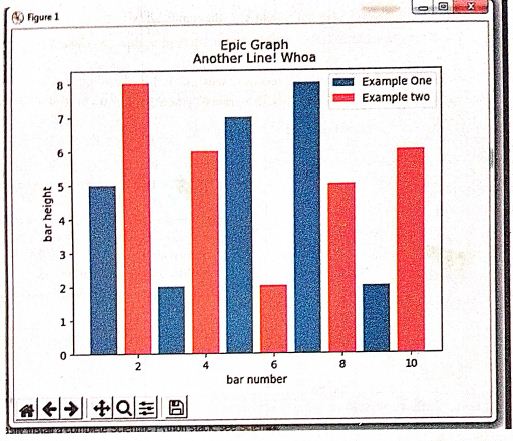
Draw the output for the following data visualization plot.
import matplotlib.pyplot as plt
plt.bar([1,3,5,7,9],[5,2,7,8,2], label="Example one")
plt.bar([2,4,6,8,10],[8,6,2,5,6], label="Example two", color='g')
plt.legend()
plt.xlabel('bar number')
plt.ylabel('bar height')
plt.title('Epic Graph in Another Line! Whoa')
plt.show()
13.
Write a note on different types of DBMS users.
14.
What is the role of DBA?
15.
Find the error in the following program to get the given output?
class Fruits:
def __init__(self, f1, f2):
self.f1 = f1
self.f2 = f2
def display(self):
print("Fruit 1 = %s, Fruit 2 = %s" %(self.f1, self.f2))
F = Fruits ('Apple', 'Mango')
del F.display
F.display()
Output: Fruit 1 = Apple, Fruit 2 = Mango
16.
What are class members? How do you define it?
17.
Write a short about the followings with suitable example:
(a) capitalize( )
(b) swapcase( )
18.
What is composition in functions?
19.
What happens when we modify global variable inside the function?
20.
Explain Ternary operator with examples.
21.
Write short notes on Arithmetic operator with examples.
22.
Define Enclosed scope with an example.
23.
Identify Which of the following are List, Tuple and class ?
(a) arr [1, 2, 34]
(b) arr (1, 2, 34)
(c) student [rno, name, mark]
(d) day= (‘sun’, ‘mon’, ‘tue’, ‘wed’)
(e) x= [2, 5, 6.5, [5, 6], 8.2]
(f) employee [eno, ename, esal, eaddress]
24.
What is the side effect of impure function. Give example.
25.
Mention the characteristics of Interface.
1.
(i) python
(ii) false
(iii) false
(iv) PYTHON
2.
(i) carriage return
(ii) character with octal value
(iii) vertical tab
3.
The global keyword are used modify the global variable inside the function.
Changing Global Variable From Inside a Function using global keyword.
x = 0 # global variable
def add():
global x
x=x+5 # increment by 2
print ("Inside add() function x value is :",x)
add()
print ("In main x value is :", x)
Output:
Inside add() function x value is : 5
In main x value is : 5
4.
(i) "Required Arguments" are the arguments passed to a function in correct positional order. Here, the number of arguments in the function call should match exactly with the function definition.
(ii) Atleast one parameter to prevent syntax errors to get the required output.
(iii) Example:
def printstring(str):
print ("Example - Required arguments")
print (str)
return
# Now you can call printstring() function
printstring ("Welcome")
Output:
Example - Required arguments
Welcome
5.
Example: Program to illustrate the use of while loop - to print all numbers from 10 to 15
i=10 # intializing part of the control variable
while (i<=15): # test condition
print (i, end='\t') # statements - block 1
i=i+1 # Updation of the control variable
Output:
10 11 12 13 14 15
6.
(i) Comment
(ii) Operands
(iii) 3
7.
(i) In Python, comments begin with hash symbol (#). The lines that begins with # are considered as comments and ignored by the Python interpreter.
(ii) Comments may be single line or no multilines. The multiline comments should be enclosed within a set of # as given below.
# It is Single line Comment
# It is multiline comment
which contains more than one line #
8.
(1) int
(2) int
(3) input
(4) print
(5) x + y
9.
(i) Public members (generally methods declared in a class) are accessible from outside the class.
(ii) A variable which is declared outside of all the functions in a program is known as global variable.
(iii) A variable which is declared inside a function which contains another function definition with in it, the inner function can also access the variable of the outer function. This scope is called enclosed scope.
(iv) Built-in scope the widest scope has all the names that are pre-loaded into program scope when we. start the compiler or interpreter.
10.
(i) A module is a part of a program. Programs are composed of one or more independently developed modules. A single module can contain one or several statements closely related each other.
(ii) Modules work perfectly on individual level and can be integrated with other modules. A software program can be divided into modules to ease the job of programming and debugging as well.
(iii) A program can be divided into small functional modules that work together to get the output. The process of subdividing a computer program into separate subprograms is called Modular programming.
(iv) Modular programming enables programmers to divide up the work and debug pieces of the program independently. The examples of modules are procedures, subroutines, and functions.
11.
(i) The syntax to define functions is close to the mathematical usage: the definition is introduced by the keyword let, followed by the name of the function and its arguments; then the formula that computes the image of the argument is written after an = sign. If you want to define a recursive function: use "let rec" instead of "let".
(ii) Syntax: The syntax for function definitions:
let rec fn a1 a2 ... an :;= k
(iii) Here the 'fn' is a variable indicating an identifier being used as a function name. The names 'a1' to 'an' are variables indicating the identifiers used as parameters. The keyword 'rec' is required if 'fn' is to be a recursive function; otherwise it may be omitted.
12.
13.
Database Administrators:
Database Administrator or DBA is the one who manages the complete database management system. DBA takes care of the security of the DBMS, managing the license keys, managing user accounts and access etc.
Application Programmers or software Developers:
This user group is involved in developing and designing the parts of DBMS.
End User:
All modern applications, web or mobile, store user data. Applications are programmed in such a way that they collect user data and store the data on DBMS systems running on their server. End users are the one who store, retrieve, update and delete data.
Database designers:
Database designers are responsible for identifying the data to be stored in the database for choosing appropriate structures to represent and store the data.
14.
Database Administrator or DBA is the one who manages the complete database management system. DBA takes care of the security of the DBMS, managing the license keys, managing user accounts and access etc.
15.
In line No.8, del F.display will not come.
16.
Variables defined inside a class are called as "Class Variable" and functions are called as "Methods. Class variable and methods are together known as members of the class. The class members should be accessed through objects or instance of class. A class can be defined anywhere in a Python program.
Defining classes: In Python, a class is defined by using the keyword class. Every class has a unique name followed by a colon (:).
Syntax for Defining a Class:
class class_name:
statement_1
statement_2
....................
....................
statement_n
17.
| Syntax | Description | Example |
| (a) capitalize() | Used to capitalize the first character of the string | >>> city="chennai" >>> print(city, capitalize( )) Chennai |
| (b) swapcase( ) | It will change case of every character to its opposite case vice-versa. | >>> strl="tAmilL NaDu" >>>print(strl.swapcase( )) TaMIl nAdU |
18.
(i) The value returned by a function may be used as an argument for another function in a nested manner.
(ii) This is called composition, For example, if we wish to take a numeric value or an expression as a input from the user, we take the input string from the user using the function input() and apply eval() function to evaluate its value.
19.
If we modify the global variable, we can see the change on the global variable outside the function also.
Example:
x=0 # global variable
def add():
global x
x=x+5 # increment by 5
print ("Inside add() function x value is:",x)
add()
print ("In main x value is:", x)
Output:
Inside add() function x value is: 5
In main x value is: 5 #value of x changed outside the function
20.
(i) Ternary operator is also known as conditional operator that evaluate something based on a condition being true or false.
(ii) It simply allows testing a condition in a single line replacing the multiline if-else making the code compact. The syntax for conditional operator is,
Variable Name = [on_true] if [Test expression]
else [on_false]
(iii) Example:
min = 50 if 49 < 50 else 70 # min = 50
min = 50 if 49 > 50 else 70 # min = 70
21.
(i) An arithmetic operator is a mathematical operator that takes two operands and performs a calculation on them. They are used for simple arithmetic.
(ii) Most computer languages contain a set of such operators that can be used within equations to perform different types of sequential calculations.
(iii) Python supports the following Arithmetic operators.
| Operator-Operation | Examples | Result |
| Assume a=100 and b=10 Evaluate the following expressions | ||
| + (Addition) | >>> a+b | 110 |
| - (Subtraction) | >>> a-b | 90 |
| * (Multiplication) | >>> a*b | 1000 |
| / (Division) | >>> a/b | 10.0 |
| % (Modulus) | >>> a%30 | 10 |
| ** (Exponent) | >>> a**2 | 10000 |
| // (Floor Division) | >>> a// 30 (Integer Division) | 3 |
22.
(i) All programming languages permit functions to be nested. A function (method) within another function is called nested function.
(ii) A variable which is declared, inside a function which contains another function definition with in it, the inner function can also access the variable of the outer function. This scope is called enclosed scope.
(iii) When a compiler or interpreter search for a variable in a program, it first searches Local, and then searches Enclosing scopes. Consider the following example
|
1. Disp(); |
Entire program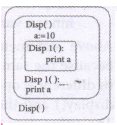 |
Output of the program 10 10 |
23.
(a) List
(b) Tuple
(c) Class
(d) Tuple
(e) List
(f) Class
24.
The variables used inside the function may cause side effects though the functions which are not passed with any arguments. In such cases the function is called impure function.
For example the mathematical function random() will give different outputs for the same function call.
let randomnumber :=
a := random()
if a > 10 then
return: a
else
return: 10
25.
(i) The class template specifies the interfaces to enable an object to be created and operated properly.
(ii) An object's attributes and behaviour is controlled by sending functions to the object.

12th Standard Syllabus & Materials
12th Standard
TN 12th Computer Applications களப்பெயர் முறைமை (DNS) Sample Question Papers Study Material - QB365 Set A
NEW12th Standard
TN 12th Computer Applications வலையமைப்பு எடுத்துக்காட்டுகள் மற்றும் நெறிமுறைகள் Sample Question Papers Study Material - QB365 Set A
NEW12th Standard
TN 12th Computer Applications கணினி வலையமைப்பு ஓர் அறிமுகம் Sample Question Papers Study Material - QB365 Set A
NEW12th Standard
TN 12th Computer Applications PHP-உடன் MySQL-ஐ இணைத்தல் Sample Question Papers Study Material - QB365 Set A



Tamilnadu Stateboard 12th Standard Subjects

Maths

Chemistry

Physics

Biology
Computer Science

Business Maths and Statistics

Economics

Commerce

Accountancy

History

Computer Applications
Biology
Computer Technology
Computer Applications
Computer Science
Business Maths and Statistics
Commerce
Economics
Maths
Chemistry
Physics
Computer Technology
History
Accountancy

Tamil

English

French
Tamilnadu Stateboard Standards
