
 100% FREE ACCESS
12th Standard Syllabus & Materials
12th Standard
TN 12th Computer Applications மின்னணு தரவு பரிமாற்றம் Sample Question Papers Study Material - QB365 Set A
NEW12th Standard
TN 12th Computer Applications மின் - வணிக பாதுகாப்பு அமைப்புகள் Sample Question Papers Study Material - QB365 Set A
NEW12th Standard
TN 12th Computer Applications மின்னணு செலுத்தல் முறைகள் Sample Question Papers Study Material - QB365 Set A
NEW12th Standard
TN 12th Computer Applications மின் - வணிகம் Sample Question Papers Study Material - QB365 Set A
NEW12th Standard
TN 12th Computer Applications திறந்த மூல கருத்துருக்கள் Sample Question Papers Study Material - QB365 Set A
NEW12th Standard
TN 12th Computer Applications வலையமைப்பு வடமிடல் Sample Question Papers Study Material - QB365 Set A

Published on: 22/06/2021
QB365 provides detailed and simple solution for every Creative Questions in class 12 Computer Science Subject. It will helps to get more idea about question pattern in every Creative questions with solution.
Download Tamil Nadu 12th Standard Computer Science question papers, model tests, one-mark questions, important questions, and public exam papers in PDF format. Free study materials and answer keys for TN State Board students.
Questions + Answers key
Take MCQ Computer Science Test
1.
Explain the sorting algorithm that uses n-1 number passes to get the final sorted list.
2.
Explain the selection sort Algorithm with an example.
3.
Differentiate Algorithm and program
4.
Define efficiency of an algorithm? How the efficiency of an algorithm was determined?
5.
Explain complexity of an algorithm.
1.
(i) Insertion sort is a simple sorting algorithm. It works by taking elements from the list one by one and inserting then in their correct position in to a new sorted list.
(ii) This algorithm builds the final sorted array at the end. This algorithm uses n-1 number of passes to get the final sorted list as per the pervious algorithm as we have discussed.
Pseudo for Insertion sort:
Step 1 - If it is the first element, it is already sorted.
Step 2 - Pick next element
Step 3 - Compare with all elements in the sorted sub-list
Step 4 - Shift all the elements in the sorted sublist that is greater than the value to be sorted Step 5 - Insert the value Step 6 - Repeat until list is sorted.
2.
(i) The selection sort is a simple sorting algorithm that improves on the performance of bubble sort by making only one exchange for every pass through the list.
(ii) This algorithm will first find the smallest elements in array and swap it with the element in the first position of an array, then it will find the second smallest element and swap that element with the element in the second position, and it will continue until the entire array is sorted in respective order.
(iii) This algorithm repeatedly selects the next smallest element and swaps in into the right place for every pass. Hence it is called selection sort.
Pseudo code:
(i) Start from the first element i.e., index-(), we search the smallest element in the array, and replace it with the element in the first position.
(ii) Now we move on to the second element position, and look for smallest element present in the sub-array, from starting index to till the last index of sub - array.
(iii) Now replace the second smallest identified in step-2 at the second position in the or original array, or also called first position in the sub array.
(iv) This is repeated, until the array is completely sorted.
(v) Let's consider an array with values {13, 16, 11, 18, 14, 15}
(vi) Below, we have a pictorial representation of how selection sort will sort the given array respective order.
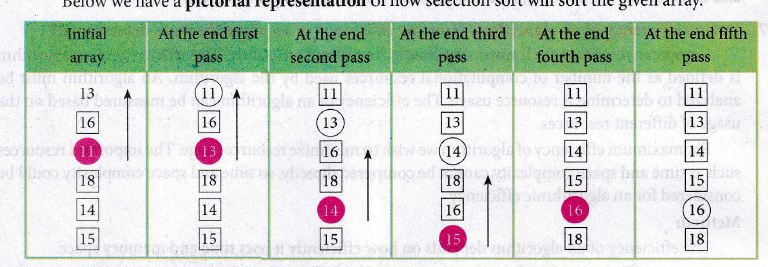
(i) In the first pass, the smallest element will be 11, so it will be placed at the first position.
(ii) After that, next smallest element will be searched from an array.
(iii) Then leaving the first element, next smallest element will be searched. It get 13 as smallest, so it will be placed at the second position.
(iv) Then leaving 11 and 13. It will search for the next smallest element and put it at third position and keep doing this until array is sorted.
(v) Finally, it will get the sorted array end of the pass.
3.
| Algorithm | Program |
|---|---|
| Algorithm helps to solve a given problem logically and it can be contrasted with the program | Program is an expression of algorithm in a programming language. |
| Algorithm can be categorized based on their implementation methods, design techniques etc | Algorithm can be implemented by structured or object oriented programming approach |
| There is no specific rules for algorithm writing but some guidelines should be followed. | Program should be written for the selected language with specific syntax |
| Algorithm resembles a pseudo code which can be implemented in any language | Program is more specific to a programming language |
4.
(i) Computer resources are limited that should be utilized efficiently. The efficiency of an algorithm is defined as the number of computational resources used by the algorithm.
(ii) An algorithm must be analyzed to determine its resource usage. The efficiency of an algorithm can be measured based on the usage of different resources.
(iii) For maximum efficiency of algorithm we wish to minimize resource usage. The important resources such as time and space complexity cannot be compared directly, so time and space complexity could be considered for an algorithmic efficiency.
Method for determining Efficiency:
(i) The efficiency of an algorithm depends on how efficiently it uses time and memory space.
(ii) The time efficiency of an algorithm is measured by different factors. For example, write a program for a defined algorithm, execute it by using any programming language, and measure the total time it takes to run.
(iii) The execution time that you measure in this case would depend on a number of factors such as: -
1. Speed of the machine
2. Compiler and other system Software tools
3. Operating System
4. Programming language used
5. Volume of data required
(iv) However, to determine: how efficiently an algorithm solves a given problem, you would like to determine how the execution time is affected by the nature of the algorithm.
(v) Therefore, we need to develop fundamental laws that determine the efficiency of a program in terms of the nature of the underlying algorithm.
5.
Suppose A is an algorithm and n is the size of input data, the time and space used by the algorithm A are the two main factors, which decide the efficiency of A.
(i) Time Factor: Time is measured by counting the number of key operations like comparisons in the sorting algorithm.
(ii) Space Factor: Space is measured by the maximum memory space required by the algorithm. The complexity of an algorithm f (n) gives the running time and/or the storage space required by the algorithm in terms of n as the size of input data.
(iii) Time Complexity: The Time complexity of an algorithm is given by the number of steps taken by the algorithm to complete the process.
(iv) Space Complexity: Space complexity of an algorithm is the amount of memory required to run to its completion. The space required by an algorithm is equal to the sum of the following two components:
A fixed part is defined as the total space required to store certain data and variables for an algorithm. For example, simple variables and constants used in an algorithm.
A variable part is defined as the total space required by variables, which sizes depends on the problem and its iteration. For example: recursion used to calculate factorial of a given value n.

12th Standard Syllabus & Materials
12th Standard
TN 12th Computer Applications களப்பெயர் முறைமை (DNS) Sample Question Papers Study Material - QB365 Set A
NEW12th Standard
TN 12th Computer Applications வலையமைப்பு எடுத்துக்காட்டுகள் மற்றும் நெறிமுறைகள் Sample Question Papers Study Material - QB365 Set A
NEW12th Standard
TN 12th Computer Applications கணினி வலையமைப்பு ஓர் அறிமுகம் Sample Question Papers Study Material - QB365 Set A
NEW12th Standard
TN 12th Computer Applications PHP-உடன் MySQL-ஐ இணைத்தல் Sample Question Papers Study Material - QB365 Set A



Tamilnadu Stateboard 12th Standard Subjects

Maths

Chemistry

Physics

Biology
Computer Science

Business Maths and Statistics

Economics

Commerce

Accountancy

History

Computer Applications
Biology
Computer Technology
Computer Applications
Computer Science
Business Maths and Statistics
Commerce
Economics
Maths
Chemistry
Physics
Computer Technology
History
Accountancy

Tamil

English

French
Tamilnadu Stateboard Standards


