
 100% FREE ACCESS
12th Standard Syllabus & Materials
12th Standard
TN 12th Maths Applications of Matrices and Determinants Sample Question Papers Study Material - QB365 Set A
NEW12th Standard
TN 12th Computer Applications மின்னணு தரவு பரிமாற்றம் Sample Question Papers Study Material - QB365 Set A
NEW12th Standard
TN 12th Computer Applications மின் - வணிக பாதுகாப்பு அமைப்புகள் Sample Question Papers Study Material - QB365 Set A
NEW12th Standard
TN 12th Computer Applications மின்னணு செலுத்தல் முறைகள் Sample Question Papers Study Material - QB365 Set A
NEW12th Standard
TN 12th Computer Applications மின் - வணிகம் Sample Question Papers Study Material - QB365 Set A
NEW12th Standard
TN 12th Computer Applications திறந்த மூல கருத்துருக்கள் Sample Question Papers Study Material - QB365 Set A

Published on: 13/05/2022
QB365 provides detailed and simple solution for every Creative Questions in class 12 Computer Science Subject. It will helps to get more idea about question pattern in every Creative questions with solution.
latest Creative QuestionsDownload Tamil Nadu 12th Standard Computer Science question papers, model tests, one-mark questions, important questions, and public exam papers in PDF format. Free study materials and answer keys for TN State Board students.
Questions + Answers key
Take MCQ Computer Science Test
1.
What are called tuples?
2.
Write the syntax of variable - length arguments.
3.
Write the syntax how break statement used in for loop.
4.
What is the use of Jump statements in python?
5.
Draw the flowchart that illustrates the working of for loop.
6.
Write a note on the parameters used in print () statement.
7.
Write a program in python to check if the accepted number even or odd.
a = int(input("Enter any number:"))
if a%2==0:
print (a, "is an even number")
else:
print (a, "is an odd number")
8.
What is meant by alternative or branching?
9.
Name the built - in number objects in python.
10.
Assume a = 50 and b = 40. write the output the following statement.
(i) print ("The a > b or a = := b = ", a > b or a==b)
(ii) print ("The a > b and a == b = ", a > b and a==b)
(iii) print ("The not a > b == ", not a > b)
11.
Assume the value of a = 100 and b = 75. Evaluate the following expression.
(i) a==b
(ii) a!=b
(iii) a//b
(iv) a>=b
12.
Why the following identifiers are invalid?
(i) 12 Name
(ii) name$
(iii) physics-mark
(iv) break
13.
Write the syntax of input () used in python.
14.
Write the Syntax of using print () in python.
15.
What is the purpose of using Input-output functions?
16.
How will you invoke python IDLE?
17.
How many ways the Python shell can be used?
18.
What is modular programming?
19.
Write the output of the following program
a:=10
Disp():
a:=7
print a
Disp 1():
print a
20.
What are the types of variable scope
21.
Define variable.
22.
From the statement P1 : = Preson(), What does P1 and person referred.
23.
Write a pseudocode to depressant rational numbers using list.
24.
How the concrete level of data abstraction implemented?
25.
Identify which is the constructor and selector from the following statement.
(i) The Functions that retrieve information from the datatype.
(ii)The function which creates an object.
1.
Non-keyword variable arguments are called tuples.
2.
def function_name(*args):
function_body
return_statement
3.
for var in sequence:
if condtion:
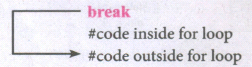
4.
The jump statement in Python, is used to unconditionally transfer the control from one part of the program to another. There are three keywords to achieve jump statements in Python: break, continue, pass. The following flowchart illustrates the use of break and continue.
5.
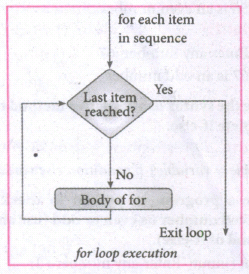
6.
(i) print can have end, sep as parameters. end parameter can be used when we need to give any escape sequences like '\t' for tab, '\n' for new line and so on.
(ii) sep as parameter can be used to specify any special characters like, (comma) (semicolon) as separator between values
7.
Output:
Enter any number: 56
56 is an even number
Output 2:
Enter any number: 67
67 is an odd number
8.
There may be situations in our real life programming where we need to skip a segment or set of statements and execute another segment based on the test of a condition. This is called alternative or branching.
9.
The built-in number objects in Python supports integers, floating point numbers and complex numbers.
10.
(i) The a > b or a == b = True
(ii) The a > b and a == b = False
(iii)The not a > b = False.
11.
(i) False
(ii) true
(iii) 1
(iv) true.
12.
(i) An identifies must start with an alphabet.
(ii) No punctuation characters are allowed.
(iii) Only underscore (-) allowed.
(iv) Identifiers must not be a Python keyword.
13.
Variable = input ("prompt string")
Where, prompt string in the syntax is a statement or message to the user, to know what input can be given.
14.
Syntax:
print ("string to be displayed as output" )
print (variable)
print ("String to be displayed as output", variable)
print ("String1", variable, "String 2", variable, "String 3" .....)
15.
The input () function helps to enter data at run time by the user and the output function print () is used to display the result of the program on the screen after execution.
16.
(i) The following command can be used t invoke Python IDLE from Window OS.
(ii) Start ⟶ All Programs ⟶ Python 3.x ⟶ IDL (Python 3.x)
(or)
(iii) Click python  Icon on the Desktop if available.
17.
Python shell can be used in two ways, viz. Interactive mode and Script mode.
18.
The process of subdividing a computer program into separate sub-programs is called modular programming.
19.
The output of the program
7
10
20.
(i) Local scope
(ii) Enclosed scope
(iii) Global scope
(iv) Built-in scope
21.
Variable are addresses (references, or pointers, to an object in memory
22.
Person is referred to as a class or a type, while p1 is referred to as an object or an instance.
23.
rational(n, d):
return [n, d]
numer(x):
return x[0]
denom(x):
return x[1]
24.
(i) To implement the concrete level of data abstraction, languages like Python provides a compound structure called Pair which is made up of list or Tuple.
(ii) The first way to implement pairs is with the List construct
25.
(i) Selector
(ii) Constructor

12th Standard Syllabus & Materials
12th Standard
TN 12th Computer Applications வலையமைப்பு வடமிடல் Sample Question Papers Study Material - QB365 Set A
NEW12th Standard
TN 12th Computer Applications களப்பெயர் முறைமை (DNS) Sample Question Papers Study Material - QB365 Set A
NEW12th Standard
TN 12th Computer Applications வலையமைப்பு எடுத்துக்காட்டுகள் மற்றும் நெறிமுறைகள் Sample Question Papers Study Material - QB365 Set A
NEW12th Standard
TN 12th Computer Applications கணினி வலையமைப்பு ஓர் அறிமுகம் Sample Question Papers Study Material - QB365 Set A



Tamilnadu Stateboard 12th Standard Subjects

Maths

Chemistry

Physics

Biology
Computer Science

Business Maths and Statistics

Economics

Commerce

Accountancy

History

Computer Applications
Biology
Computer Technology
Computer Applications
Computer Science
Business Maths and Statistics
Commerce
Economics
Maths
Chemistry
Physics
Computer Technology
History
Accountancy

Tamil

English

French
Tamilnadu Stateboard Standards


