
 100% FREE ACCESS
12th Standard Syllabus & Materials
12th Standard
TN 12th Computer Applications மின்னணு தரவு பரிமாற்றம் Sample Question Papers Study Material - QB365 Set A
NEW12th Standard
TN 12th Computer Applications மின் - வணிக பாதுகாப்பு அமைப்புகள் Sample Question Papers Study Material - QB365 Set A
NEW12th Standard
TN 12th Computer Applications மின்னணு செலுத்தல் முறைகள் Sample Question Papers Study Material - QB365 Set A
NEW12th Standard
TN 12th Computer Applications மின் - வணிகம் Sample Question Papers Study Material - QB365 Set A
NEW12th Standard
TN 12th Computer Applications திறந்த மூல கருத்துருக்கள் Sample Question Papers Study Material - QB365 Set A
NEW12th Standard
TN 12th Computer Applications வலையமைப்பு வடமிடல் Sample Question Papers Study Material - QB365 Set A

Published on: 01/03/2021
12th Standard English Medium Economics Reduced syllabus Annual Exam Model Question Paper - 2021
Download Tamil Nadu 12th Standard Economics question papers, model tests, one-mark questions, important questions, and public exam papers in PDF format. Free study materials and answer keys for TN State Board students.
Questions + Answers key
Take MCQ Economics Test
1.
Assertion: There has been enormous increase in defence expenditure in India during planning period.
Reason: The defence expenditure of the government was Rs. 10,874 crores in 1990-91 which increased significantly to Rs. 2,95,511 crores in 2018-19.
Both A and R are true and R is the correct explanation of A
Both A and R are true but R is not the correct explanation of A
A is true but R is false
A is false but R is true
2.
Match the items in the List – I with items in List – II. Select the correct answer from the code given below
Free Trade Area
Customs Union
Common Market
Trade Barriers
3.
Who wrote ‘Poverty and Un- British Rule in India’ that the drain of wealth from India under the British rule was the major cause of the increase in poverty in India?
Vallabhai Patel
Mahatma Gandhi
Dadabhai Naoroji
Pandit Nehru
4.
Given the diagram, find the correct answer.
Degrees of correlation :
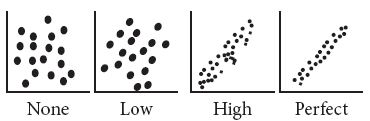
all the above are correct
all the above are incorrect
I and II are correct, III and IV are incorrect
I and II are incorrect, III and IV are correct
5.
Assertion: Environmental quality is a set of properties and characteristics of the environment either generalized or local, as they impinge on human beings and other organisms.
Reason: It is a measure of the condition of an environment relative to and to any human need.
Both A and R are true and R is the correct explanation of A
Both A and R are true but R is not the correct explanation of A
A is true but R is false
A is false but R is true
6.
Suppose the exchange rate between Indian Currency and US Dollar is Rs.1= $ 65. If it changes to Rs.1 = $ 55, the value of which currency increased and decreased?
both currency value will increase
both currency value will decrease
Indian currency value will increase and US Dollar Value will decrease
Indian currency value will decrease and US Dollar Value will increase
7.
According to Keynes the most important determinant of investment
MEC
Effective demand
Aggregate demand
Rate of interest
8.
Identify which is not an example of capitalistic economy.
The USA economy
Germany economy
Indian economy
Australia economy
9.
_________ Income is the buying power of nominal income.
Gross Income
Real Income
Percapita Income
National Income
10.
Every economy in the world aims at attaining the level of _________
Full employment
Unemployment
Seasonal unemployment
Educated unemployment
11.
If the points on the scatter diagram indicate that as one variable increases the other variable tends to decrease the value of r will be:
Perfect positive
Perfect negative
Negative
Zero
12.
Economic growth measures the_______
Growth of productivity
Increase in nominal income
Increase in output
None of the above
13.
Primary cause of Soil pollution is ________
Pest control measures
Land reclamation
Agricultural runoff
Chemical fertilizer
14.
Deficit Budget means
An excess of government's revenue over expenditure
An excess of government's current expenditure over its current revenue
An excess of government's total expenditure over its total revenue
None of above
15.
16.
A Commercial Bank is an institution that provides services
Accepting deposits
Providing loans
Both a and b
None of the above
17.
Irving Fisher’s Quantity Theory of Money was popularized in
1908
1910
1911
1914
18.
J.B. Say is a _______.
Neo Classical Economist
Classical Economist
Modern Economist
New Economist
19.
The average income of the country is________
Personal Income
Per capita income
Inflation Rate
Disposal Income
20.
The country following Capitalism is ________________
Russia
America
India
China
21.
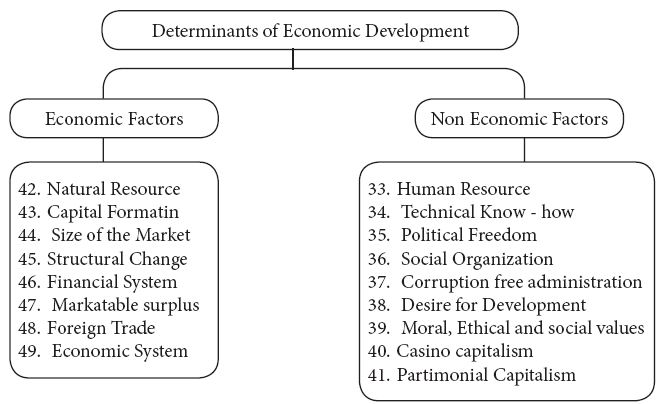
List the economic and non-economic determinants of economic development.
22.
What is money? Explain the three functions that money performs. Which one is the primary function of money?
23.
What are the limitations of accelerator.
24.
Explain the achievements of WTO.
25.
What is Depreciation?
26.
27.
State the meaning of e-waste.
28.
What are import quotas?
29.
Explain about aggregate supply with the help of diagram.
30.
State the importance of Macro Economics.
31.
Distinguish between correlation and regression.
32.
Elucidate various measures of economic development.
33.
State the importance of the comparative advantage of international trade.
34.
What are the causes for the increase in public debt?
35.
Explain the Secondary Functions.
36.
Briefly explain the relationship between GDP growth and the quality of environment.
37.
State and explain instruments of fiscal policy.
38.
Discuss the role of WTO in India’s socio-economic development.
39.
Explain briefly the Comparative Cost Theory.
40.
Explain the role of Commercial Banks in economic development.
41.
Explain the operation of the Accelerator.
42.
Critically explain Say’s law of market.
43.
Explain the importance of national income
44.
Compare the features among Capitalism, Secularism and Mixedism
45.
Define contractionary monetary policy.
46.
Write a note on the demand-side of the vicious circle of poverty.
47.
Write a note on “wage-price rigidity” Keynes.
48.
Write a short note of induced investment?
49.
Write down the countries that have capitalistic, economy.
50.
Specify the meaning of seed ball.
51.
Mention any two objectives of ASEAN.
52.
What is Stagflation?
53.
List out the assumptions of Say’s law.
54.
What is the difference between NNP and NDP?
1.
(d)
A is false but R is true
2.
(d)
Trade Barriers
3.
(c)
Dadabhai Naoroji
4.
(a)
all the above are correct
5.
(a)
Both A and R are true and R is the correct explanation of A
6.
(c)
Indian currency value will increase and US Dollar Value will decrease
7.
(a)
MEC
8.
(c)
Indian economy
9.
(b)
Real Income
10.
(a)
Full employment
11.
(c)
Negative
12.
(c)
Increase in output
13.
(d)
Chemical fertilizer
14.
(c)
An excess of government's total expenditure over its total revenue
15.
(c)
16.
(c)
Both a and b
17.
(c)
1911
18.
(b)
Classical Economist
19.
(b)
Per capita income
20.
(b)
America
21.
22.
(i) Money is anything that is generally accepted as a medium of exchange.
(ii) Money must be able to act as a medium of exchange, a store of value, and a unit of account. For money to act as a medium of exchange, sellers must generally accept and buyers must generally use it to pay for goods and services.
(iii) For money to serve as a store of value, it can be used to transport purchasing power from one period of time to another.
(iv) For money to serve as a unit of account, it must function as a consistent way of quoting prices.
(v) The primary function of money is to serve as a medium of exchange.
23.
1. The assumption of constant capitaloutput ratio is unrealistic.
2. Resources are available only before full employment.
3. Excess capacity in capital goods industries is assumed.
4. Accelerator will work only if the increased demand is permanent.
5. Accelerator will work only when credit is available easily.
6. If there is unused or excess capacity in the consumer goods industry, the accelerator principle would not work.
24.
i) Use of restrictive measures for BoP problems has declined markedly.
ii) Services trade has been brought in to the multilateral system and many countries.
25.
(i) The Depreciation cost (or) capital consumption refers to all those expenditure undertaken by the producers to replace the worn out parts of the capital goods like Machinery, tools, equipments and buildings used up in the production of goods and services.
(ii) These expenditure should be excluded from the Gross output
26.
27.
(i) Electronic waste is the new by product of the Info Tech society.
(ii) It includes a growing range of electronic devices from household appliances, such as refrigerators, air conditioners, cell phones, computers.
(iii) e-waste can be defined as the result when consumer, business and household devices are sent for re-cycling (e.g., television, computers, audio-equipments, VCR, DVD, telephone, Fax, Xerox machines, wireless devices, video games).
28.
(i) It is a trade restriction that sets a limit on the quantity of a good that can be imported into a country in a given period of time.
(ii) Quotas are used to benefit the producers of good in that economy.
29.
(i) Aggregate supply refers to the value of total output of goods and services produced in an economy in a year ie national product or income.
(ii) The components of aggregate supply are:
(iii) Aggregate (desired) consumption expenditure (C)
(iv) Aggregate (desired) private savings (S)
(v) Net tax payments (T)
(vi) Personal (desired) transfer payments to the foreigners (Rf)
AS = C + S + T + Rf
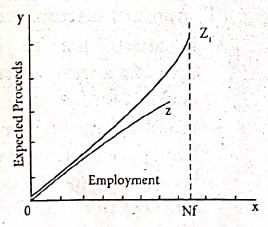
In this figure 2 aggregate supply curves are drawn for the assumption of fixed money wages and variable wages.
Explanation
(i) Z Curve is linear (fixed money wages)
(ii) Z1 curve is non-linear (wage rate increases with employment)
(iii) When full employment level of Nf is reached output cannot be increased by employing more men.
(iv) So aggregate supply curve becomes inelastic (Vertical straight line).
(v) In reality aggregate supply curve will be like Z1 .
(vi) If prices are high and wages low, the producers will employ more labourers.
(vii) 4YAggregate supply is an important factor in determining the level of economic activity.
30.
(i) Macro economics helps to understand the functioning of the economy at the aggregate level, to evolve strategies to solve the basic problems.
(ii) To understand the future problems, needs and challenges.
(iii) To provide opportunities to use scientific investigation to understand reality.
(iv) To make meaningful comparison and analysis of economic indicators. To predict the future and formulate suitable policies to avoid economic crises.
31.
| S.No | Correlation | Regression |
| 1 | Correlation is the relationship between two or more variables, which vary with the other in the same or the opposite direction |
Regression means going back and it is a mathematical measure showing the average relationship between two variables |
| 2 | Both the variables X and Y are random variables |
Both the variables may be random variables |
| 3 | It finds out the degree of relationship between two variables and not the cause and effect relationship. |
It indicates the cause and effect relationship between the variables and establishes functional relationship. |
| 4 | It is used for testing and verifying the relation between two variables and gives limited information |
Besides verification it is used for the prediction of one value, in relation to the other given value. |
| 5 | The coefficient of correlation is a relative measure. The range of relationship lies between –1 and +1 |
Regression coefficient is an absolute figure. If we know the value of the independent variable, we can find the value of the dependent variable |
| 6 | There may be spurious correlation between two variables. |
In regression there is no such spurious regression |
| 7 | It has limited application, because it is confined only to linear relationship between the variables |
It has wider application, as it studies linear and nonlinear relationship between the variables |
| 8 | It is not very useful for further mathematical treatment. |
It is widely used for further mathematical treatment |
32.
Economic development is measured on the basis of four criteria
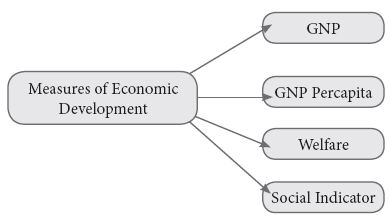
Gross National Product (GNP):
(i) GNP is the total market value of all final goods and services produced within a nation in a particular year, plus income earned by its citizens (including income of those located abroad), minus income of non-residents located in that country.
(ii) GNP is one measure of the economic condition of a country, under the assumption that a higher GNP leads to a higher quality of living, all other things being equal.
GNP per capita:
(i) This relates to increasing in the per capita real income of the economy over the long period
(ii) This indicator of economic growth emphasizes that for economic development the rate of increase in real per capita income should be higher than the growth rate of population.
Welfare:
(i) Economic development is regarded as a process whereby there is an increase in the consumption of goods and services by individuals.
(ii) From the welfare perspective, economic development is defined as a sustained improvement in health, literacy, and standard of living
Social Indicators:
(i) Social indicators are normally referred to as basic and collective needs of the people
(ii) The direct provision of basic needs such as health, education, food, water, sanitation, and housing facilities check social backwardness.
| S/N | Basic need | Indicators |
|---|---|---|
| 1 | Health | Life expectancy at birth |
| 2 | Education | Literacy signifying primary school enrolment as a percent of the population. |
| 3 | Food | Calorie Supply per head |
| 4 | Water supply | Infant mortality and percentage of the population with access to potable water |
| 5 | Sanitation | Infant mortality and percentage of the population with access to sanitation. |
33.
(i) The balance of aggregate demand and aggregate supply was first described.
(ii) The cost of goods is determined by the ratio of aggregate demand and supply for them, both domestically and from abroad;
(iii) He theory is true regarding any quantity of goods and any number of countries, as well as for the analysis of trade between different entities.
(iv) In this case, country specialization in some goods depends on the ratio of wage levels in each country;
(v) The theory based the existence of benefits from trade for all countries, taking part in it;
(vi) There become possible to develop foreign economic policy on the scientific foundation.
34.
(i) War and preparation for war:
Waging war has become one of the important causes for incurring debts by the governments.
(ii) Social obligation:
Modern states are considered to be 'welfare states' and they have to undertake many social obligations like public health, sanitation, education, insurance, transport and communications etc.
(iii) Economic development deficit:
(1) The government has to undertake many projects for economic development of the country.
(2) Construction of railways, power projects, irrigation projects, heavy industries etc. Employment: Most of the governments of modern days face the problem of unemployment and has become the duty to solve this by making huge public expenditure.
(v) Controlling inflation:
The government can withdraw excess money from circulation, by raising public debt and thus prevent prices from rising.
(vi) Fighting depression:
During the depression phase, private investment is lacking.
35.
(i) Savings done in terms of commodities were not permanent.
(ii) With the invention of money, this difficulty has now disappeared and savings are now done in terms of money.
(iii) Money also serves as an excellent store of wealth.
(iv) Money can be easily converted into other assets such as land, machinery, plant etc.
(v) The modern money - economy has greatly facilitated the borrowing and lending processes.
(vi) In other words, money now acts as the standard of deferred payments.
(vii) The field of exchange also went on extended to distant lands.
(viii) It is therefore, felt necessary to transfer purchasing power from one place to another.
36.
(i) Strong economic growth or high GDP growth leads to excessive use of resources.
(ii) Natural resources are essential inputs for production in many sectors;
(iii) Production and consumption lead to pollution and other pressures on the environments.
(iv) Poor environmental quality affects economic growth and well being by lowering the quantity and quality of resources or due to health impact.
(v) There is the need to balance growth and the sustainability of eco system.
(vi) So we have to ensure our sustainable existence, consume less and curb economic growth.
37.
(i) Fiscal Policy is implemented through fiscal instruments also called 'fiscal tools' or fiscal levers - Government expenditure, taxation and borrowing are the instruments of fiscal policy.
Taxation:
(i) Taxes transfer income from the people to the Government.
(ii) Taxes are direct or indirect.
(iii) An increase in tax reduces disposable income.
(iv) So tax should be raised to control inflation.
(v) During depression, taxes are to be reduced.
Public Expenditure:
(i) Public expenditure raises wages and salaries of the employees and so aggregate demand for goods rises.
(ii) So, public expenditure is raised during recession and reduced during inflation.
Public debt:
(i) When Government borrows by floating a loan, there is transfer of funds from the public to the Government.
(ii) At the time of interest payment and repayment of public debt, funds are transferred from Government to public.
38.
Introduction:
1. India is the founding member of the WTO.
2. India favours multilateral trade approach and enjoys MFN status.
3. India benefited from WTO on following grounds:
4. By reducing tariff rates on raw materials, components and capital goods, it was able to import more for meeting her developmental needs.
5. India's imports go on increasing.
6. India gets market access in several countries without any bilateral trade agreements.
7. Advanced technology has been obtained at cheaper cost.
8. India is in a better position to get quick redressal from the trade disputes.
9. Indian exporters benefited from wider market information.
39.
Introduction
1. David Ricardo formulated comparative cost theory.
2. J. S. Mill, Marshall, Taussig refined it.
Theory
1. Trade can take place even if absolute cost difference is absent but there is comparative cost difference.
Illustration
2. Ricardo's theory is explained with an example of production costs of cloth and wheat in America and India.
(Units of labour needed to produce one unit)
| Country | Cloth | Wheat | Domestic Exchange Ratios |
| America | 100 | 120 | 1 Wheat = 1.2 Cloth |
| India | 90 | 80 | 1 Wheat = 0.88 Cloth |
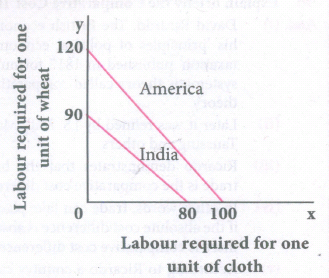
(i) India has absolute advantage in production of both cloth and wheat.
(ii) But, India will produce wheat where she enjoys comparative cost advantage (80 / 120<90 / 100).
(iii) For America the comparative cost disadvantage is lesser in cloth production.
(iv) So America will specialize in cloth production and export it to India in exchange for wheat.
(v) Both nations gains.
(vi) With trade India can get 1 unit of cloth and 1 unit of wheat by using 160 labour units (80+80). With no trade India has to use 170 units of labour (80+90).
(vii) The same explanation applies to America too.
Criticisms
(i) Labour cost is a small portion of the total cost. So the theory based on labour cost is unrealistic,
(ii) Labourers in different countries are not equal in efficiency.
40.
Introduction
(i) Commercial banks are institutions that conduct business with profit motive by accepting public deposits and lending loans.
Capital Formation
(i) Bank mobilize the small savings of the people scattered over a wide area through their network of branches and make it available for productive purposes.
(ii) Attractive schemes of the banks induce the people to save their money
Creation of Credit
(i) Credit creation leads to increased production, employment, sales and prices and thereby there is faster economic development.
Channelizing Funds towards Productive Investment
(i) Pooled savings is allocated to various sectors and productivity increases.
Encouraging Right Industries
(i) Banks give loan to right type of persons.
(ii) Banks grant loans and advances to manufacturers whose products are in great demand.
(iii) Manufacturers introduce new methods of production and assist in raising the national income of the country.
Banks Monetize Debt
(i) Banks transform the loan to be repaid after a certain period into cash, which can be immediately used for business activity.
(ii) Manufacturers and wholesale traders cannot increase their sales without selling goods on credit basis.
(iii) But credit sales may lead to locking up of capital.
(iv) So production is reduced.
(v) As banks are lending money by discounting bills of exchange, business concerns are able to carry out economic activities without gap.
Finance to Government
(i) Government needs finance for promoting industries.
(ii) Banks provide long-term credit to Government by investing their funds in Government securities and short-term finance by purchasing Treasury Bills.
(iii) RBI has given Rs.68,000 crores to the government of India in the year 2018-19.
Employment Generation
(i) Bank's branches are opened frequently and so new employment opportunities are created.
Banks Promote Entrepreneurship
(i) Banks induce new entrepreneurs to take up the well-formulated projects and provision of counseling services like technical and managerial guidance.
(ii) Conclusions Banks provide 100 % credit for worthwhile projects, which is also technically feasible and economically viable.
(iii) Thus commercial banks help for the development of entrepreneurship in the country.
41.
Introduction
A systematic development of the simple accelerator model was made by J.M.Clark, It was further developed by Hicks, Samuelson and Harrod.
Definition
Accelerator coefficient is the ratio between induced investment and an initial change in consumption \(\beta=\frac{\Delta \mathrm{I}}{\Delta \mathrm{C}}\)
Operation
Suppose that in order to produce 1000 consumer goods, 100 machines are needed. Working life of a machine is 10 yrs i.e, every year 10 machines have to be replaced. This is called replacement demand
(i) Suppose that demand for consumer goods rises by 10 % (i.e, from 1000 to 1100)
(ii) This results in increase in demand for 10 more machines
(iii) The total demand for machines is 20 i.e, 10 % increase in demand for consumer goods causes 100 % increase in demand for machine (from 10 to 20 )
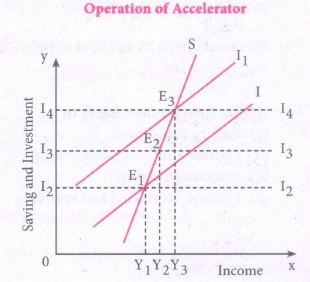
Explanation
(i) SS is the saving curve.
(ii) II is the investment curve.
(iii) At point E1 the economy is in equilibrium with OY1 income.
(iv) S and I are equal at O2.
(v) Now I increased from OI2 to OI4.
(vi) This increases income from OY1 to OY3 at E2 equilibrium.
(vii) If the increase in investment by I2I4 is purely exogenous, then the increase in income by Y1Y3 would be due to multiplier.
(viii) But in this diagram it is assumed that exogenous investment is only by I2I3 and induced investment is by I3I4.
(ix) Therefore, the increase in income by Y1Y2 is due to the multiplier effect and the increase in income by Y2Y3 is due to the accelerator effect.
42.
Introduction
According to J. B. Say "Supply creates its own demand"
Explanation
A person receives his income from production which is spent on the purchase of goods and services produced by others. For the economy as a whole, therefore, total production equals total income.
Criticisms
(i) According to Keynes, supply does not. create its demand. It is not applicable where demand does not increase as much as production increases.
(ii) Automatic adjustment process will not remove unemployment. Unemployment can be removed by increase in the rate of investment.
(iii) Money is not neutral. Individuals hold money for unforeseen contingencies, businessmen keep cash reserve for future activities.
(iv) Say's law is supply creates its own demand and there is no over production. Keynes said that over production is possible
(v) Keynes regards full employment as a special case because there is underemployment in capitalist economies.
(vi) State intervention is needed when there is over production and mass unemployment.
43.
(i) National income is of great importance for the economy of a country.
(ii) National income helps us to know the relative importance and contribution of each sector. We could find how income is produced, how it is distributed, how much is spent, saved or taxed.
(iii) National income data is used to formulate monetary policy, fiscal policy and other policies.
(iv) Data regarding gross income, output, saving and consumption is uscd in economic planning.
(v) National income data is used to build economic models in short run and long run.
(vi) It is used to make international comparison, inter regional comparison and inter temporal comparison of growth of the economy during different periods.
(vii) If income is equally distributed, the per capita income will reflect the economic welfare of the country.
44.
| S.No | Features | Capitalism | Socialism | Mixedism |
|---|---|---|---|---|
| 1. | Ownership of Means of Production | Private Ownership | Public Ownership | Private Ownership and Public Ownership |
| 2. | Economic Motive | Profit | Social Welfare | Social Welfare and Profit Motive |
| 3. | Solution of Central Problems | Free Market System | Central Planning System | Central Planning System and Free Market System |
| 4. | Government Role | Internal Regulation only | Complete Involvement | Limited Role |
| 5. | Income Distribution | Unequal | Equal | Less unequal |
| 6. | Nature of Enterprise | Private Enterprise | Government Enterprise | Both Private and State Enterprises |
| 7. | Economic Freedom | Complete Freedom | Lack of Freedom | Limited Freedom |
| 8 | Major Problem | Inequally | Inefficiency | Inequality and Inefficiency |
45.
(i) The Contractionary monetary policy is dear money policy, which maintains short-term interest rates higher than usual or which slows the rate of growth in the money supply or even shrinks it.
(ii) This slows short-term economic growth and lessens inflation.
46.
(i) The demand-side of the vicious circle of poverty is that the low level of real income leads to a low level of demand which, in turn, leads to a low rate of investment and hence back to deficiency of capital, low productivity and low income.
(ii) Low Income ⟶ Low Demand Low Investment ⟶ Low Productivity ⟶ Low Income
47.
i. According to Keynes there is wageprice rigidity.
ii. In the real world it is not possible to reduce the wages on account of government policy and due to the existence of trade unions.
iii. So the wages are more or less rigid rather than flexible
48.
Induced investment is the expenditure on fixed assets and stocks which are required when level of income and demand in an economy goes up.
49.
i) The USA
ii) West Germany
iii) Australia and
iv) Japan
50.
(i) A seed ball is a seed that has been wrapped in soil materials, usually a mixture of clay and compost and then dried.
(ii) The seed is pre-planted and can be sown by depositing the seed ball anywhere suitable for the species, keeping the seed safely until the proper germination window arises.
51.
(i) To accelerate the economic growth, social progress and cultural development in the region.
(ii) To promote regional peace and stability and adherence to the principles of the UN Charter.
52.
Stagflation is a combination of stagnant economic growth, high unemployment and high inflation.
53.
1. No single buyer or seller can affect the price.
2. Full employment
3. People are motivated by self interest Market forces determine everything right.
4. Perfect competition exists in labour and product market.
5. There is wage price flexibility.
6. Money acts as medium of exchange.
7. Long run analysis.
8. No overproduction or unemployment.
54.
(i) NDP = GDP - Depreciation.
(ii) NNP = GNP - Depreciation.
(iii) The difference between NDP and NNP is the net factor income from abroad.
(iv) In NDP it is excluded but in NNP it is included.

12th Standard Syllabus & Materials
12th Standard
TN 12th Computer Applications களப்பெயர் முறைமை (DNS) Sample Question Papers Study Material - QB365 Set A
NEW12th Standard
TN 12th Computer Applications வலையமைப்பு எடுத்துக்காட்டுகள் மற்றும் நெறிமுறைகள் Sample Question Papers Study Material - QB365 Set A
NEW12th Standard
TN 12th Computer Applications கணினி வலையமைப்பு ஓர் அறிமுகம் Sample Question Papers Study Material - QB365 Set A
NEW12th Standard
TN 12th Computer Applications PHP-உடன் MySQL-ஐ இணைத்தல் Sample Question Papers Study Material - QB365 Set A



Tamilnadu Stateboard 12th Standard Subjects

Maths

Chemistry

Physics

Biology

Computer Science

Business Maths and Statistics
Economics

Commerce

Accountancy

History

Computer Applications
Biology
Computer Technology
Computer Applications
Computer Science
Business Maths and Statistics
Commerce
Economics
Maths
Chemistry
Physics
Computer Technology
History
Accountancy

Tamil

English

French
Tamilnadu Stateboard Standards
