
 100% FREE ACCESS
12th Standard Syllabus & Materials
12th Standard
TN 12th Maths Applications of Matrices and Determinants Sample Question Papers Study Material - QB365 Set A
NEW12th Standard
TN 12th Computer Applications மின்னணு தரவு பரிமாற்றம் Sample Question Papers Study Material - QB365 Set A
NEW12th Standard
TN 12th Computer Applications மின் - வணிக பாதுகாப்பு அமைப்புகள் Sample Question Papers Study Material - QB365 Set A
NEW12th Standard
TN 12th Computer Applications மின்னணு செலுத்தல் முறைகள் Sample Question Papers Study Material - QB365 Set A
NEW12th Standard
TN 12th Computer Applications மின் - வணிகம் Sample Question Papers Study Material - QB365 Set A
NEW12th Standard
TN 12th Computer Applications திறந்த மூல கருத்துருக்கள் Sample Question Papers Study Material - QB365 Set A

Published on: 01/03/2021
12th Standard English Medium Economics Reduced Syllabus Annual Exam Model Question Paper with Answer key - 2021
Download Tamil Nadu 12th Standard Economics question papers, model tests, one-mark questions, important questions, and public exam papers in PDF format. Free study materials and answer keys for TN State Board students.
Questions + Answers key
Take MCQ Economics Test
1.
Pick the year of establishment of World Trade Organisation. Pick the year of establishment of World Trade Organisation
1945
2001
1995
1996
2.
A situation in which every able bodied person who is willing to work at the prevailing wage rate, is employed_________?
Less than full employment
Full employment
underemployment
structural employment
3.
Which of the statements do not hold true?
Both regression coefficients cannot be greater than 1
Regression coefficients are unaffected by origin shift and scale shift
Both correlation and regression coefficients are of same sign
Two regression lines coincide if r=±1
4.
According to the classical theory of international trade:
Only countries with low wages will export
Only countries with high wages will import
Countries with high wages will have higher prices
All the above are false
5.
______________ occur outside of the market i.e. they affect people not directly involved in the production and consumption of a good or service
Fee good
spill-over effects
Public good
private good
6.
How many models of circular flow of economy are there?
One
Three
Five
Two
7.
___________ occupies an important place in the study of public finance.
Public debt
Public expenditure
Public revenue
Public policy
8.
"The consumption expenditure depends not only on his current income but also past income and standard of living" Who said this?
J.M.Keynes
R.F.Khan
J.R Hicks
Duesenberry
9.
According to the year 2001, Indian per capita income is _________ dollar.
520
460
240
900
10.
The vicious circle of poverty was introduced by______
Adam smith
Nurkse
Dalton
Robbins
11.
Econometrics is the integration of
Economics and Statistics
Economics and Mathematics
Economics, Mathematics and Statistics
None of the above
12.
Which of the following country adopts indicative planning?
France
Germany
Italy
Russia
13.
The process of nutrient enrichment is termed as
Eutrophication
Limiting nutrients
Enrichment
Schistosomiasis
14.
The word budget has been derived from the French word "bougette" which means
A small bag
An empty box
A box with papers
None of the above
15.
Who among the following enunciated the concept of single factoral terms of trade?
Jacob Viner
G.S.Donens
Taussig
J.S.Mill
16.
A Bank is a
Financial institution
Corporate
An Industry
Service institutions
17.
___________inflation occurs when general prices of commodities increases due to increase in production costs such as wages and raw materials.
Cost-push
demand pull
running
galloping
18.
In disguised unemployment, the marginal productivity of labour is _________
Zero
One
Two
Positive
19.
Which is a flow concept ?
Number of shirts
Total wealth
Monthly income
Money supply
20.
21.
How the gross value of the farm output is obtained In India?
22.
Fill in the table below assuming the consumption function has the following form: C = 500 + 9Y.
| Income | Consumption |
| Rs. 0 | |
| 100 | |
| 200 | |
| 300 |
23.
Specify the two achievements of BRICS.
24.
Write short notes on National planning commission.
25.
Write a note on paper currency standard
26.
State and explain the different kinds of Correlation
27.
What are the causes of water pollution?
28.
Write a brief note on flexible exchange rate.
29.
Explain about aggregate supply with the help of diagram.
30.
Indicate the demerits of socialism.
31.
List the Revenue of State Sources.
32.
Distinguish between Qualitative and Quantitative data.
33.
Elucidate various measures of economic development.
34.
List the problems in defining Money Supply.
35.
List the offers of International specialization.
36.
37.
38.
Bring out the functions of World Bank.
39.
How the Rate of Exchange is determined? Illustrate.
40.
Explain the role of Commercial Banks in economic development.
41.
Illustrate the working of Multiplier.
42.
Narrate the equilibrium between ADF and ASF with diagram
43.
44.
45.
Write a short on - Traveler’s Cheque.
46.
Write a brief note on “Traditional Approach” about economic development
47.
Explain how the following two equations can both be true: Multiplier k = 1/MPS Multiplier k = 1/1-MPC.
48.
Mention some of stages of business cycle
49.
What are the three motives of liquidity preference?
50.
State the meaning of environment.
51.
52.
What is Stagflation?
53.
Give short note on frictional unemployment.
54.
Trace the relationship between GNP and NNP.
1.
(c)
1995
2.
(b)
Full employment
3.
(b)
Regression coefficients are unaffected by origin shift and scale shift
4.
(d)
All the above are false
5.
(b)
spill-over effects
6.
(b)
Three
7.
(c)
Public revenue
8.
(d)
Duesenberry
9.
(b)
460
10.
(b)
Nurkse
11.
(c)
Economics, Mathematics and Statistics
12.
(b)
Germany
13.
(a)
Eutrophication
14.
(a)
A small bag
15.
(a)
Jacob Viner
16.
(a)
Financial institution
17.
(a)
Cost-push
18.
(a)
Zero
19.
(c)
Monthly income
20.
(b)
21.
(i) Total production of 64 agriculture commodities is estimated. The output of each crop is measured by multiplying the area sown by the average yield per hectare.
(ii) The total output of each commodity is valued at market prices.
(iii) The aggregate value of total output of these 64 commodities is taken to measure the gross value of agricultural output.
(iv) The net value of the agricultural output is measured by making deductions for the cost of seed, manures and fertilisers, market charges, repairs and depreciation from the gross value
22.
| Income | Consumption |
| Rs. 0 | 500 |
| 100 | 590 |
| 200 | 680 |
| 300 | 770 |
23.
i) The establishment of the Contingent Reserve Arrangement (CRA).
ii) In the sixth BRICS summit in Brazil the member countries, signed an agreement to create a development bank (New Development.
24.
(i) The National planning commission was set up in India in 1950.
(ii) A major function of the planning commission was to formulate a plan for the most effective and balanced utilization of the country's resources".
(iii) The planning commission formulated the First Five Year Plan for the period 1951 - 56.
25.
(i) The paper currency standard reffers to the monetary system in which the paper currency notes issued by the treasury of the Central Bank.
(ii) Paper currency is not convertible into any metal.
(iii) Its value is determined independent of the value of gold or any other commodity.
(iv) It also known as managed currency standard.
26.
Three of the most important ways of classifying correlation are:
(i) Based on the direction of change of variables
Positive Correlation:
(i) The correlation is said to be positive if the values of two variables move in the same direction.
(ii) Ex. Y = a + bx
Negative Correlation:
(i) When the values of variables move in the opposite directions.
(ii) Ex. Y = a - bx
(ii) Based on the number of variables studied.
Simple Correlation:
(i) If only two variables are taken for study.
Multiple Correlations:
(i) If three or more than three variables are studied simultaneously.
\(\operatorname{Ex}: Q_{d}=f\left(P, P_{v}, P, t, y\right)\)
Partial Correlation:
(i) If there are more than two variables but only two variables are considered keeping the other variables constant, then the correlation is said to be Partial Correlation.
(iii) Based on the constancy of the ratio of change between the variables
Linear Correlation:
(i) When on the amount of change in one variable tends to bear a constant ratio to the amount of change in the other.
(ii) Ex. Y = a + bx2
Non Linear:
(i) The amount of change in one variable does not bear a constant ratio to the amount of change in the other variables.
(ii) Ex. Y = a + bx2
27.
Discharge of sewage and waste water:
(i) Sewage, garbage and liquid waste of households, agricultural runoff and effluents from factories are discharged into lakes and rivers.
(ii) These wastes contain harmful chemicals and toxins which make the water poisonous for aquatic animals and plants.
Dumping of solid wastes:
(i) The dumping of solid wastes and litters in water bodies cause huge problems.
Discharge of industrial wastes:
(i) Industrial waste contains asbestos, lead, mercury, grease oil and petrochemicals.
Oil Spill:
(i) Sea water gets polluted due to oil spilled from ships and tankers.
Acid Rain:
(i) When the acidic particles caused by air pollution mix with water vapour, it results in acid rain.
Global warming:
(i) The increase in water temperature affects aquatic plants and animals.
Eutrophication:
(i) The increased level of nutrients in water depletes oxygen in water and this negatively affects fish and other aquatic animal population.
28.
Also known as floating exchange rate, the exchange rates are freely determined in an open market by market forces of demand and supply.
29.
(i) Aggregate supply refers to the value of total output of goods and services produced in an economy in a year ie national product or income.
(ii) The components of aggregate supply are:
(iii) Aggregate (desired) consumption expenditure (C)
(iv) Aggregate (desired) private savings (S)
(v) Net tax payments (T)
(vi) Personal (desired) transfer payments to the foreigners (Rf)
AS = C + S + T + Rf
In this figure 2 aggregate supply curves are drawn for the assumption of fixed money wages and variable wages.
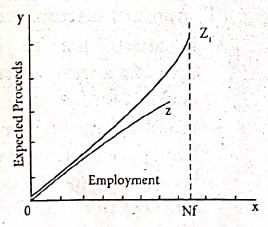
Explanation
(i) Z Curve is linear (fixed money wages)
(ii) Z1 curve is non-linear (wage rate increases with employment)
(iii) When full employment level of Nf is reached output cannot be increased by employing more men.
(iv) So aggregate supply curve becomes inelastic (Vertical straight line).
(v) In reality aggregate supply curve will be like Z1 .
(vi) If prices are high and wages low, the producers will employ more labourers.
(vii) 4YAggregate supply is an important factor in determining the level of economic activity.
30.
(i) Red tapism and bureaucracy since, approval of many officials is needed.
(ii) Absence of incentive and so productivity is less.
(iii) Limited freedom of choice in the consumption of goods and services.
(iv) The state takes all major decisions. There is concentration and misuse of power.
31.
1. Capitation tax
2. Duties in respect of succession to agricultural land.
3. Duties of excise on certain goods produced or manufactured in the State, such as alcoholic liquids, opium, etc.
4. Estate duty in respect of agricultural land.
5. Fees in respect of any of the matters in the State List, but not including fees taken in any Court.
6. Land Revenue.
7. Rates of stamp duty in respect of documents other than those specified in the Union List.
8. Taxes on agricultural income.
9. Taxes on land and buildings.
10. Taxes on mineral rights, subject to limitations impose by Parliament relating to mineral development.
11. Taxes on the consumption or sale of electricity.
12. Taxes on the entry of goods into a local area for consumption, use or sale therein.
13. Taxes on the sale and purchase of goods other than newspapers.
14. Taxes on the advertisements other than those published in newspapers.
15. Taxes on goods and passengers carried by road or on inland waterways.
16. Taxes on vehicles.
17. Taxes on animals and boats.
18. Taxes on professions, trades, callings and employments.
19. Taxes on luxuries, including taxes on entertainments, amusements, betting and gambling.
20. Tolls.
32.
1. Find out the actual mean of given data (x̅)
2. Find out the deviation of each value from the mean (x = X - x̅ )
3. Square the deviations and take the total of squared deviations Σx2
4. Divided the total Σx2 by the number of observation \(\left( { \frac { \sum { x } }{ n } }^{ 2 } \right) \)
5. The square root of \(\left( { \frac { \sum { x } }{ n } }^{ 2 } \right) \) is standard deviation.
| BASIS FOR COMPARISON |
QUALITATIVE DATA | QUANTITATIVE DATA |
| Meaning | Qualitative data is the data in which the classification of objects is based on attributes and properties. |
Quantitative data are those that can be quantified in definite units of measurement |
| Examples | Eg. Gender, Community, honesty | Age, income, number of firms etc |
| Approach | Subjective | Objective |
| Collection of data | Unstructured | Structured |
| Sample | Small number of nonrepresentative samples |
Large number of representative samples |
| Outcome | Develops initial understanding. | Recommends final course of action |
33.
Economic development is measured on the basis of four criteria
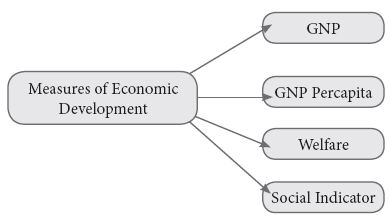
Gross National Product (GNP):
(i) GNP is the total market value of all final goods and services produced within a nation in a particular year, plus income earned by its citizens (including income of those located abroad), minus income of non-residents located in that country.
(ii) GNP is one measure of the economic condition of a country, under the assumption that a higher GNP leads to a higher quality of living, all other things being equal.
GNP per capita:
(i) This relates to increasing in the per capita real income of the economy over the long period
(ii) This indicator of economic growth emphasizes that for economic development the rate of increase in real per capita income should be higher than the growth rate of population.
Welfare:
(i) Economic development is regarded as a process whereby there is an increase in the consumption of goods and services by individuals.
(ii) From the welfare perspective, economic development is defined as a sustained improvement in health, literacy, and standard of living
Social Indicators:
(i) Social indicators are normally referred to as basic and collective needs of the people
(ii) The direct provision of basic needs such as health, education, food, water, sanitation, and housing facilities check social backwardness.
| S/N | Basic need | Indicators |
|---|---|---|
| 1 | Health | Life expectancy at birth |
| 2 | Education | Literacy signifying primary school enrolment as a percent of the population. |
| 3 | Food | Calorie Supply per head |
| 4 | Water supply | Infant mortality and percentage of the population with access to potable water |
| 5 | Sanitation | Infant mortality and percentage of the population with access to sanitation. |
34.
(i) First, in an advanced and more important an evolving-financial system, it was not possible to define the tock of Money in an unambiguous way.
(ii) At least there were a number of different but equally valid definitions of the money supply and there was no strong reason for choosing one in preference to any other.
(iii) As we have seen, money can be defined either narrowly or broadly.
(iv) However, there are or have been within the some institutional context a number of different definitions of the money supply.
(v) The definitions change frequently as does the popularity of one measure over another which partly illustrates the difficulty in trying to pin down the concept.
35.
1. Better utilization of resources.
2. Concentration in the production of goods in which it has a comparative advantage.
3. Saving in time.
4. Perfection of skills in production.
5. Improvement in the techniques of production.
6. Increased production.
7. Higher standard of living in the trading countries
36.
37.
38.
Investment for productive purposes
(i) World Bank helps in reconstruction and development of territories of member nations through investment for productive purposes.
(ii) It encourages the development of productive facilities and resources in less developed countries.
Balanced growth of international trade
(i) Promoting the long range balanced growth of trade at international level and the maintaining equilibrium in BoPs of member nations by encouraging international investment.
Provision of loans and guarantees
(i) Arranging the loans or providing guarantee on loans by various other channels and execute important projects.
Promotion of foreign private investment
(i) This is done by means of guarantees on loans and other investment made by private investors.
(ii) The Bank supplements private investment by providing finance for productive purpose out of its own resources or from borrowed funds.
Technical services
(i) The World Bank facilitates different kinds of technical services to the member countries through Staff College and experts.
39.
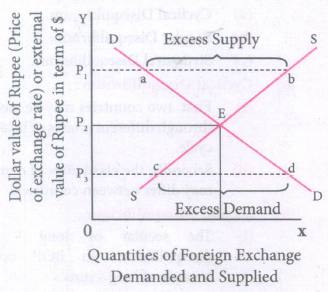
(i) The equilibrium rate of exchange is determined in the foreign exchange market according to the general theory of value, by the interaction of demand and supply,
(ii) Y axis represents exchange rate, be cos value of rupee in terms of dollars
(iii) X axis represents demand and supply of forex.
(iv) E is the equilibrium point where DD intersects SS. The exchange rate is P2.
40.
Introduction
(i) Commercial banks are institutions that conduct business with profit motive by accepting public deposits and lending loans.
Capital Formation
(i) Bank mobilize the small savings of the people scattered over a wide area through their network of branches and make it available for productive purposes.
(ii) Attractive schemes of the banks induce the people to save their money
Creation of Credit
(i) Credit creation leads to increased production, employment, sales and prices and thereby there is faster economic development.
Channelizing Funds towards Productive Investment
(i) Pooled savings is allocated to various sectors and productivity increases.
Encouraging Right Industries
(i) Banks give loan to right type of persons.
(ii) Banks grant loans and advances to manufacturers whose products are in great demand.
(iii) Manufacturers introduce new methods of production and assist in raising the national income of the country.
Banks Monetize Debt
(i) Banks transform the loan to be repaid after a certain period into cash, which can be immediately used for business activity.
(ii) Manufacturers and wholesale traders cannot increase their sales without selling goods on credit basis.
(iii) But credit sales may lead to locking up of capital.
(iv) So production is reduced.
(v) As banks are lending money by discounting bills of exchange, business concerns are able to carry out economic activities without gap.
Finance to Government
(i) Government needs finance for promoting industries.
(ii) Banks provide long-term credit to Government by investing their funds in Government securities and short-term finance by purchasing Treasury Bills.
(iii) RBI has given Rs.68,000 crores to the government of India in the year 2018-19.
Employment Generation
(i) Bank's branches are opened frequently and so new employment opportunities are created.
Banks Promote Entrepreneurship
(i) Banks induce new entrepreneurs to take up the well-formulated projects and provision of counseling services like technical and managerial guidance.
(ii) Conclusions Banks provide 100 % credit for worthwhile projects, which is also technically feasible and economically viable.
(iii) Thus commercial banks help for the development of entrepreneurship in the country.
41.
Introduction
The concept of multiplier Was first developed by R.F. Khan in terms of employment. J.M Keynes redefined it as investment multiplier.
Definition
Multiplier is defined as the ratio of the change in national income to change in investment.
\(K=\Delta Y / \Delta I\)
The value of multiplier depends on MPC.
\(\mathrm{K}=\frac{1}{1-\mathrm{MPC}} \text { since } \mathrm{MPC}+\mathrm{MPS}=1\)
\(k=\frac{1}{N 118}\)
Multiplier is inversely related to MPS and directly with MPC.
If MPC is, 0.75, MPS is 0.25 then K=4.00
\(\frac{1}{1-0.75} \text { or } \frac{1}{0.25}=4\)
| MPC | MPS | k |
| 0.00 | 1.00 | 1 |
| 0.10 | 0.90 | 1.11 |
| 0.50 | 0.50 | 2.00 |
| 0.75 | 0.25 | 4.00 |
Working
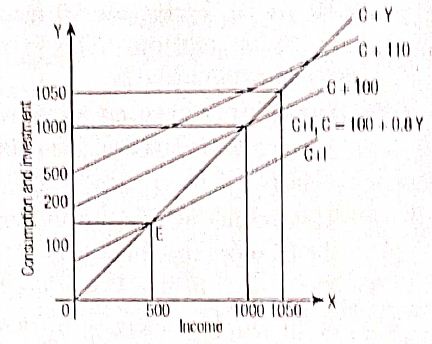
(i) Suppose government undertakes investment expenditure equal to र100 cr on public works.
(ii) Income of labourers and suppliers of materials increases by र100 cr
(iii) If MPC is 0.8 that is 80 %. र80 cr is spent on consumption र20 cr salved
(iv) Suppliers of goods get an income of र80 cr. They spend र64 cr (ie 80% of र80 cr).
(v) In this manner consumption expenditure and increase in income act in a chain like manner.
42.
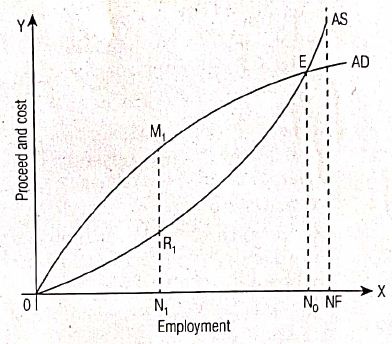
Introduction
Under the Keynes theory of employment, a simple two sector economy consisting of the household sector and the business sector is taken to understand the equilibrium between ADF and ASF.
Explanation
1. AD and AS reach equilibrium at E. The employment level is No
2. At ON1employment, the aggregate supply is N1R1. But the aggregate demand is M1N1.
3. The expected level of profit is M1R1.
4. To attain this level of profit, entrepreneurs will employ more labourers, till they reach point E i.e. ONo.
5. Beyond ONo, the aggregate demand curve is below the aggregate supply curve showing loss.
6. So they will never employ more than ONo labour.
7. The equilibrium level of employment need not be the full employment level (No).
8. The difference between No - N1 is the level of unemployment.
Conclusion
Thus the concept of effective demand becomes significant in explaining the under employment equilibrium.
43.
44.
45.
Banks issue traveler’s cheques to individuals for traveling outside the country. Traveler’s cheques are the safe and easy way to protect money while traveling.
46.
(i) The traditional approach defines development strictly in economic terms.
(ii) The increase in GNP is accompanied by decline in share of agriculture in output and employment while those of manufacturing and service sectors increase.
(iii) It emphasizes the importance of industrialization.
47.
The reason that both equations are true is because of the identity MPS + MPC = 1. This is true because there are only two things that one can do with one's income - consume and save.
48.
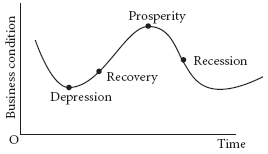
i. Boom
ii. Recession
iii. Depression
iv. Recovery
49.
Liquidity preference is based on three motives. They are,
(i) Transaction motive
(ii) Precautionary motive
(ii) Speculative motive
50.
(i) Environment means "all the conditions, circumstances, and influences surrounding and affecting the development of an organism or group of organisms".
(ii) It also means that the complex of physical, chemical and biotic factors that act upon an organism or an ecological community ultimately determine its form and survival.
51.
52.
Stagflation is a combination of stagnant economic growth, high unemployment and high inflation.
53.
(i) It arises due to imbalance between supply of labour and demand for labour.
(ii) It is because of immobility of labour, lack of necessary skills, breakdown of machinery, shortage of raw materials.
(iii) The persons who lose jobs and in search of jobs are also included.
54.
(i) NNP is obtained deducting the value of depreciation from GNP.
(ii) NNP = GNP - depreciation allowance.

12th Standard Syllabus & Materials
12th Standard
TN 12th Computer Applications வலையமைப்பு வடமிடல் Sample Question Papers Study Material - QB365 Set A
NEW12th Standard
TN 12th Computer Applications களப்பெயர் முறைமை (DNS) Sample Question Papers Study Material - QB365 Set A
NEW12th Standard
TN 12th Computer Applications வலையமைப்பு எடுத்துக்காட்டுகள் மற்றும் நெறிமுறைகள் Sample Question Papers Study Material - QB365 Set A
NEW12th Standard
TN 12th Computer Applications கணினி வலையமைப்பு ஓர் அறிமுகம் Sample Question Papers Study Material - QB365 Set A



Tamilnadu Stateboard 12th Standard Subjects

Maths

Chemistry

Physics

Biology

Computer Science

Business Maths and Statistics
Economics

Commerce

Accountancy

History

Computer Applications
Biology
Computer Technology
Computer Applications
Computer Science
Business Maths and Statistics
Commerce
Economics
Maths
Chemistry
Physics
Computer Technology
History
Accountancy

Tamil

English

French
Tamilnadu Stateboard Standards
