
 100% FREE ACCESS
12th Standard Syllabus & Materials
12th Standard
TN 12th Maths Applications of Matrices and Determinants Sample Question Papers Study Material - QB365 Set A
NEW12th Standard
TN 12th Computer Applications மின்னணு தரவு பரிமாற்றம் Sample Question Papers Study Material - QB365 Set A
NEW12th Standard
TN 12th Computer Applications மின் - வணிக பாதுகாப்பு அமைப்புகள் Sample Question Papers Study Material - QB365 Set A
NEW12th Standard
TN 12th Computer Applications மின்னணு செலுத்தல் முறைகள் Sample Question Papers Study Material - QB365 Set A
NEW12th Standard
TN 12th Computer Applications மின் - வணிகம் Sample Question Papers Study Material - QB365 Set A
NEW12th Standard
TN 12th Computer Applications திறந்த மூல கருத்துருக்கள் Sample Question Papers Study Material - QB365 Set A

Published on: 01/03/2021
12th Standard English Medium Economics Reduced Syllabus Creative Five Mark Question with Answerkey - 2021(Public Exam )
Download Tamil Nadu 12th Standard Economics question papers, model tests, one-mark questions, important questions, and public exam papers in PDF format. Free study materials and answer keys for TN State Board students.
Questions + Answers key
Take MCQ Economics Test
1.
Write the History, Administration and Brief Functions of RBI.
2.
Compare and contrast RBI and other Commercial Banks.
3.
Elaborate the WTO Agreements in detail.
4.
Distinguish between Fisher’s and Cambridge Equation.
5.
List the problems in defining Money Supply.
6.
Explain the supply of Money and determinants of money supply in India.
7.
In each of the following scenarios, classify the individual as frictionally, structurally, or cyclically unemployed. Explain your classification.
(a) There has been a general economic slow down. Because of weak demand, Kumar has lost his portering job at the railway station.
(b) Sathish, a newly qualified dental graduate, is looking for a place to set up practice.
(c) Latha is thrown out of work by the introduction of a more mechanized production process.
(d) Devi, a computer programmer with a large bank, quit her job two months ago in search of a better-paid programming position. She is still looking.
8.
List the offers of International specialization.
9.
Explain Adam Smith’s Theory of Absolute Cost Advantage.
10.
Given the table, calculate GNP, NNP, National Income, Personal Income and Disposable income.
11.
Explain the determinants of Equilibrium Exchange Rate.
12.
Discuss the concept of “Factor Cost”.
13.
Explain the basic concepts of national income.
14.
Derive the value of the multiplier assuming the basic form of the consumption function as C = a + bY where "a" is autonomous consumption and "b" is the marginal propensity to consume. You may assume a two-sector economy.
15.
Explain the concept of super multiplier.
16.
Discuss the features of Capitalist economy.
17.
Explain the disadvantages of FDI.
18.
Explain Marginal propensity to consume and multiplier, with the help of a diagram.
19.
What are the factors on which MEC depends? Also give details on the factors which influence MEC.
20.
Explain consumption function with the help of diagram.
21.
Discuss the method measuring the National Income by Income Method.
22.
Comparison of Classicism and Keynesianism.
23.
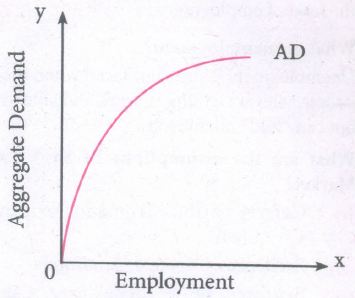
Draw the diagram ADF.
24.
Explain the merits of Mixed Economy.
25.
Explain the Secondary Functions.
1.
History:
(i) Formed on April 1, 1935 in accordance with the RBI Act, 1934
(ii) Nationalized on January 1, 1949 (Fully owned by GOI)
(iii) Headquarter moved from Calcutta to Mumbai in 1937
(iv) Osborne Smith was the first Governor of RBI
Administration:
(i) It is the Central Bank/ Regulator for all bank in India
(ii) Also called “Lender of Last Resort”
(iii) Governors and 4 Deputy Governors along with a central board of directors appointed by the GOI.
Functions:
(i) Issues currency
(ii) Banker to the government. {It collects receipts of funds and makes payments on behalf of the government}
(iv) Regulator of Indian Banking system
(v) Custodian of Forex
(vi) Controller of credit
2.
| BASIS | RBI | COMMERCIAL BANK |
| Meaning | The bank which looks after the monetary system of the country is known as Central Bank. | The establishment, which provides banking services to the public is known as Commercial Bank. |
| Role | It is a banker to the banks and the government of the country | It is the banker to the citizens of the nation |
| Established by | Reserve Bank of India Act, 1934 | Banking Regulation Act, 1949. |
| Ownership | Public | Public or Private |
| Monetary Authority | It is the supreme monetary authority with wide powers | No such authority. |
| Objective | Public welfare and economic development. | Earning Profits |
| Money supply | Ultimate source of money supply in the economy. | No such function is performed by it. |
| Right to print and issue currency notes | Yes | No |
| Deals with | Banks and Governments | General Public |
| How many banks are there | Only one | Many |
3.
1. Agreement on Trade Related Intellectual Property Rights (TRIPs)
(i) Intellectual Property Rights include copy right, trade marks, patents, geographical indications, trade secrets, industrial designs, etc.
(ii) TRIPS Agreement provides for granting product patents instead of process patents.
(iii) The period of protection will be 20 years for patents, 50 years for copy rights, 7 years for trade marks and 10 years for layout designs.
(iv) As a result of TRIPS, the dependence of LDCs on advanced countries for seeds, drugs, fertilizers and pesticides has increased.
(v) Farmers are depending on the industrial firm for their seeds
2. Agreement on Trade Related Investment Measures (TRIMs)
(i) TRIMs are related to conditions or restrictions in respect of foreign investment in the country.
(ii) It calls for introducing equal treatment for foreign companies on par with national companies. TRIMs were widely employed by developing countries.
3. General Agreement on Trade in Services (GATS)
(i) GATS is the first multilateral set of rules covering trade in services like banking, insurance, transportation, communication, etc.,
(ii) All members countries are supposed to extend MFN (Most Favoured Nation) status to all other countries without any discrimination
(iii) Transparency should be maintained by publishing all relevant laws and regulations over services
4. Phasing out of Multi Fibre Agreement (MFA)
(i) The multi fibre agreement governed the world trade in textiles and garments since 1974.
(ii) It imposed quotas on export of textiles by developing nations to the developed countries
(iii) This quota system was to be phased out over a period of ten years. This was beneficial to India.
5. Agreement on Agriculture (AoA)
(i) Agriculture was included for the first time under GATT.
(ii) The important aspects of the agreement are Tariffication, Tariff cuts and Subsidy reduction.
4.
| Base of difference | Fisher's Equation | Cambridge's Equation |
| 1. Flow and stock of Money | Fishers's equation gives importance to flow of money | Cambridge's equation stress on stock of money. |
| 2. Natural of Price Level | P represents the average price level of all goods and services. | P represents the price of consumer goods. |
| 3. Stress on Demand Supply | Fisher's viewpoint stress on supply of money | Cambridge's viewpoint stresses on demand of money |
| 4. Time | It is associated with a period of time | It is associated with the point of time |
| 5. Demand of Money |
According to Fisher, the Demand of money is for actual transactions | According to Cambridge ideology, the demand of money is for the storage of money. |
5.
(i) First, in an advanced and more important an evolving-financial system, it was not possible to define the tock of Money in an unambiguous way.
(ii) At least there were a number of different but equally valid definitions of the money supply and there was no strong reason for choosing one in preference to any other.
(iii) As we have seen, money can be defined either narrowly or broadly.
(iv) However, there are or have been within the some institutional context a number of different definitions of the money supply.
(v) The definitions change frequently as does the popularity of one measure over another which partly illustrates the difficulty in trying to pin down the concept.
6.
Money Supply in India
Money supply is a stock variable. RBI publishes information for four alternative
measures of Money supply, namely M1, M2, M3 and M4.
M1 = Currency, coins and demand deposits
M2 = M1 + Savings deposits with post office savings banks
M3 = M2 + Time deposits of all commercial and cooperative banks
M4 = M3 + Total deposits with Post offices.
M1 and M2 are known as narrow money
M3 and M4 are known as broad money
Determinants of Money Supply
1. Currency Deposit Ratio (CDR); It is the ratio of money held by the public in currency to that they hold in bank deposits.
2. Reserve deposit Ratio (RDR); Reserve Money consists of two things (a) vault cash in banks and (b) deposits of commercial banks with RBI.
3. Cash Reserve Ratio (CRR); It is the fraction of the deposits the banks must keep with RBI.
4. Statutory Liquidity Ratio (SLR); It is the fraction of the total demand and time deposits of the commercial banks is the form of specified liquid assets.
7.
(a) Kumar is cyclically unemployed. He has lost his job as a result of the general economic recession.
(b) Sathish is frictionally unemployed. Job openings exist for him. It is merely a case of tracking down a position.
(c) Latha is structurally unemployed. Unemployment due to technological change in an industry is classified as structural.
(d) Devi, is frictionally unemployed. Job openings exist for her.
8.
1. Better utilization of resources.
2. Concentration in the production of goods in which it has a comparative advantage.
3. Saving in time.
4. Perfection of skills in production.
5. Improvement in the techniques of production.
6. Increased production.
7. Higher standard of living in the trading countries
9.
Adam Smith argued that all nations can be benefitted when there is free trade and specialisation in terms of their absolute cost advantage
The Theory
(i) According to Adam Smith, the basis of international trade was absolute cost advantage.
(ii) Trade between two countries would be mutually beneficial when one country produces a commodity at an absolute cost advantage over the other country which in turn produces another commodity at an absolute cost advantage over the first country.
Assumptions
1. There are two countries and two commodities (2 x 2 model).
2. Labour is the only factor of production
3. Labour units are homogeneous
4. The cost or price of a commodity is measured by the amount of labour required to produce it.
5. There is no transport cost.
Illustration
Absolute cost advantage theory can be illustrated with the help of the following example.
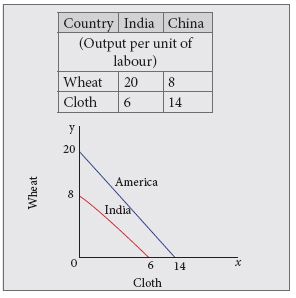
(iii) From the illustration, it is clear that India has an absolute advantage in the production of wheat over China and China has an absolute advantage in the production of cloth over India
(iv) Therefore, India should specialize in the production of wheat and import cloth from China. China should specialize in the production of cloth and import wheat from India
(v) This kind of trade would be mutually beneficial to both India and China.
10.
| Billions of Dollars | |
| GDP | 8,000 |
| Receipts of factor income from the rest of the world | 250 |
| Payment of factor income to the rest of the world | 300 |
| Depreciation | 900 |
| Indirect taxes minus subsidies | 500 |
| Corporate profits minus dividends | 500 |
| Social insurance payments | 700 |
| Personal interest income received from the government and consumers | 300 |
| Transfer payments to persons | 1100 |
| Personal taxes | 1000 |
GNP = 8000 + 250 – 300 = 7950
NNP = 7950 – 900 = 7050
NI = 7050 – 500 = 6550
PI = 6550 – 500 – 700 + 300 + 1100
= 6750
DI = 6750 – 1000
= 5750
11.
Determinants of Exchange Rates
Exchange rates are determined by numerous factors and they are related to the trading relationship between two countries
1. Differentials in Inflation
Inflation and exchange rates are inversely related. A country with a consistently lower inflation rate exhibits a rising currency value, as its purchasing power increases relative to other currencies.
2. Differentials in Interest Rates
There is a high degree of correlation between interest rates, inflation and exchange rates. Central banks can influence over both inflation and exchange rates by manipulating interest rates. Higher interest rates attract foreign capital and cause the exchange rate to rise and vice versa.
3. Current Account Deficits
A deficit in the current account implies excess of payments over receipts. The country resorts to borrowing capital from foreign sources to make up the deficit. Excess demand for foreign currency lowers a country’s exchange rate.
4. Public Debt
Large public debts are driving out foreign investors, because it leads to inflation. As a result, exchange rate will be lower
5. Terms of Trade
A country’s terms of trade also determines the exchange rate. If the price of a country’s exports rises by a greater rate than that of its imports, its terms of trade will improve. Favorable terms of trade imply greater demand for the country’s exports and thus BoP becomes favorable.
6. Political and Economic Stability
If a nation’s political climate is stable and economic performance is good, its currency value will be appreciated by attracting more foreign capital
7. Recession
Interest rates are low during the recession phase. This will decrease inflow of foreign capital. As a result, a currency will be depreciated against other currencies, thereby lowering the exchange rate.
8. Speculation
If a country’s currency value is expected to rise, investors will demand more of that currency in order to make a profit in the near future. This results in appreciation of the exchange rate. Beside the above determinants, relative dominance in the global politics and the power to announce economic sanctions over other countries also determine exchange rates
12.
1. There are a number of inputs that are included into a production process when producing goods and services. These inputs are commonly known as factors of production and include things such as land, labour, capital and entrepreneurship.
2. Producers of goods and services incur a cost for using these factors of production. These costs are ultimately added onto the price of the product.
3. The factor cost refer to the cost of production that is incurred by a firm when producing goods and services.
4. Examples of such production costs include the cost of renting machines, purchasing machinery and land, paying salaries and wages, cost of obtaining capital, and the profit margins that are added by the entrepreneur.
5. The factor cost does not include the taxes that are paid to the government since taxes are not directly involved in the production process and, therefore, are not part of the direct production cost.
6. However, subsidies received are included in the factor cost as subsidies are direct inputs into the production.
13.
The following are some of the concepts used in measuring national income.
1. GDP
2. NNP
3. NNP at factor cost
4. Personal Income
5. Disposable Income
6. Per capita Income
7. Real Income
8. GDP deflator
Gross Domestic Product (GDP)
GDP is the total market value of final and services produced within the country during a year. This is calculated at market prices and is known as GDP at market prices.
Net Domestic Product (NDP)
1. NDP is the value of net output of the economy during the year. Some of the country’s capital equipment wears out or becomes outdated each year during the production process. Gross National Product (GNP)
2. GNP is the total measure of the flow of final goods and services at market value resulting from current production in a country during a year, including net income from abroad.
Net National Product (NNP)(at Market price)
Net National Product refers to the value of the net output of the economy during the year. NNP is obtained by deducting the value of depreciation, or replacement allowance of the capital assets from the GNP.
NNP at Factor cost
NNP refers to the market value of output. Whereas NNP at factor cost is the total of income payment made to factors of production.
Personal Income
Personal income is the total income received by the individuals of a country from all sources before payment of direct taxes in a year. Personal income is never equal to the national income, because the former includes the transfer payments whereas they are not included in national income
Disposable Income
1. Disposable Income is also known as Disposable personal income. It is the individuals income after the payment of income tax. This is the amount available for households for consumption. Per Capita Income.
2. The average income of a person of a country in a particular year is called Per Capita Income. Per capita income is obtained by dividing national income by population.
Real Income
Nominal income is national income expressed in terms of a general price level of a particular year in other words, real income is the buying power of nominal income.
GDP deflator
GDP deflator is an index of price changes of goods and services included in GDP. It is a price index which is calculated by dividing the nominal GDP in a given year by the real GDP for the same year and multiplying it by 100.
14.
Since Y = C + I we can write Y = a + bY + I.
This equation can be rearranged to yield
Y - bY = a + I
Y(1 - b) = a + I
We can then solve for Y in terms of I by dividing through by (1 - b):
Y = (a + I) (1/1 - b)
Now we can see that an increase in I will increase Y by
ΔY = ΔI x (1/1 - b)
Since b D MPC, the expression becomes
ΔY = ΔI x 1/(1 - MPC)
Therefore, the multiplier is 1/1 - MPC or 1/MPS.
15.
Meaning of Super Multiplier
(i) In order to measure the total effect of initial investment on income, Hicks has combined the k and β mathematically and given it the name of the Super Multiplier.
(ii) The super multiplier is worked out by combining both induced consumption and induced investment. The combined name of the super multiplier and the accelerator is also called the leverage effect
Components of Super Multiplier
(i) The super multiplier is greater than simple multiplier which includes only autonomous investment and no induced investment, while super multiplier includes induced investment.
(ii) The super multiplier is greater than simple multiplier which includes only autonomous investment and no induced investment, while super multiplier includes induced investment.
The Leverage Effect
The combined effect of the multiplier and the accelerator is also called the leverage effect which may lead the economy to very high or low level of income propagation.
Symbolically,
Y= C + IA + IP
Y = Aggregate income.
C = Consumption expenditure
IA = autonomous investment
IP = induced private investment
The super – multiplier, tells us that if there is an initial increase in autonomous investment, income will increase by K times the autonomous investment.
16.
1. Private Ownership of Property and Law of Inheritance: The basic feature of capitalism is that all resources namely, land, capital, machines, mines etc. are owned by private individuals. The owner has the right to own, keep, sell or use these resources according to his will. The property can be transferred to heirs after death.
2. Freedom of Choice and Enterprise: Each individual is free to carry out any occupation or trade at any place and produce any commodity. Similarly, consumers are free to buy any commodity as per their choice
3. Profit Motive: Profit is the driving force behind all economic activities in a capitalistic economy. Each individual and organization produce only those goods which ensure high profit. Advance technology, division of labour, and specialisation are followed. The golden rule for a producer under capitalism is ‘to maximize profit.’
4. Free Competition: There is free competition in both product and factor market. The government or any authority cannot prevent firms from buying or selling in the market. There is competition between buyers and sellers.
5. Price Mechanism: Price mechanism is the heart of any capitalistic economy. All economic activities are regulated through price mechanism i.e, market forces of demand and supply.
6. Role of Government: As the price mechanism regulates economic activity, the government has a limited role in a capitalistic economy. The government provides basic services such as, defense, public health, education, etc.
7. Inequalities of Income: A capitalist society is divided into two classes – ‘haves’ that is those who own property and ‘have-nots’ who do not own property and work for their living. The outcome of this situation is that the rich become richer and poor become poorer. Here, economic inequality goes on increasing.
17.
(i) Private foreign capital tends to flow to the high profit areas rather than to the priority sectors.
(ii) The technologies brought in by the foreign investor may not be appropriate to the consumption needs, size of the domestic market etc.
(iii) Foreign investment, sometimes, have unfavorable effect on the Balance of Payments of a country because when the drain of foreign exchange by way of royalty, dividend, etc. is more than the investment made by the foreign concerns.
(iv) Foreign capital sometimes interferes in the national politics.
(v) Foreign investors sometimes engage in unfair and unethical trade practices.
(vi) Often, there are several costs associated with encouraging foreign investment.
(iv) Foreign investment in some cases leads to the destruction.
18.
(i) The propensity to consume refers to the portion of income spent on consumption.
MPC = \(\frac{ΔC}{ΔY}\)
(K) = \(\frac{1}{1-MPC}\)
(ii) The multiplier is the reciprocal of one minus marginal propensity to consume.
(iii) Multiplier is 1/MPS
(iv) The multiplier is therefore define as reciprocal of MPS.
(v) Multiplier is inversely related to MPS and directly with MPC.
Numerically, if MPC is 0.75, MPS is 0.25 and K is 4.
Using formula K = \(\frac{1}{1-MPC}\)
⇒\(\frac{1}{1-0.75}\) = 1/0.25 = 4
∴ Multiplier (K) = 4
| MPC | MPS | K |
|---|---|---|
| 1.00 | 1.00 | 1 |
| 0.10 | 1.90 | 1.11 |
| 0.50 | 0.50 | 2.00 |
| 0.75 | 0.25 | 4.00 |
| 0.90 | 0.10 | 10.00 |
| 1.00 | 0.00 | ∝ |
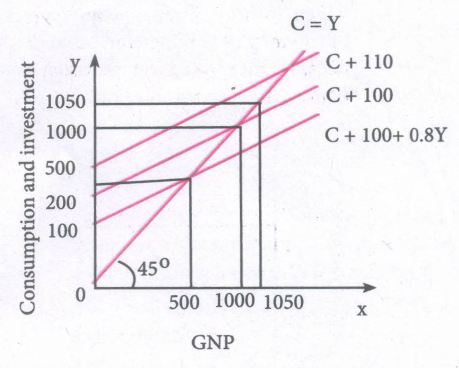
C = 100 + 0.8Y;
I = 10
Y = C + I
= 100 + 0.8 Y +9p00
.JPG)
0.2Y = 1000
∴ Y = 1000
Here, C = 100 + 0.8y
= 100 + 1000 = 900
S = 100 = I
After I is raised by 10, now I = 110
Y = 100 + 0.8y + 110
0.2y = 210
y = \(\frac{210}{0.2}\) = 1050
Here, C = 100 = 0.8 (1050) = 940,
S = 110 = I
(i) It implies the variables in axis-and axis are equal.
(ii) The MPC is assumed to be at 0.8. (C = 100 + 0.8y)
(iii) The aggregate demand (C + I) curve intersects 45° line at point E.
(iv) The new aggregate demand curve is
C + I = 100 + 0.8Y + 100 + 10
Y = \(\frac{210}{0.2}\)
C = 940; S = 110 = Z
19.
MEC depends on the following 2 factors :
(1) The prospective yield from a capital asset.
(2) The supply price of a capital asset. The marginal efficiency of capital is influenced by short-run as well as long run factors.
(a) Short - Run factors:
(i) Demand for the product:
If the market for a particular good is expected to grow and its costs are likely to fall, the rate of return from investment will be high.
(ii) Liquid assets:
If the entrepreneurs are holding large volume of working capital, they can take advantage of the investment opportunities that come in their way. The MEC will be high.
(iii) Sudden changes in incomes:
If the business community gets windfall profits, or tax concession the MEC will be high. On the other hand, MEC falls with the decrease in income.
(iv) Current rate of investment:
If in a particular industry, much investment has already taken place and the rate of investment currently going on in that industry is also very large, then the marginal efficiency of capital will be low.
(v) Wales of optimism and pessimism:
If businessmen are optimistic about future, the MEC will be likely to be high. During periods of pessimism the MEC is under estimated and so will be low.
(b) Long - Run Factors:
(i) Rate of growth of population:
If population is growing at a rapid speed, it is usually believed that the demand of various types of goods will increase.
(ii) Technological progress:
If investment and technological development take place in the industry, the prospects of increase in the net yield brightens up.
(iii) Monetary and fiscal policies:
Cheap money policy and liberal tax policy pave the way for greater profit margin and so MEC is likely to be high.
(iv) Political environment :
Political stability, smooth administration, maintenance of law and order help to improve MEC.
(v) Resource avaiqability:
Cheap and abundant supply of natural resources, efficient labour and stock of capital enhance the MEC.
20.
Meaning of consumption function.
(i) Propensity to consume refers to income consumption relationship.
(ii) Consumption function is a "functional relationship between two aggregates viz. total consumption and gross national income."
(iii) C = f(Y)
(iv) C = Consumption
Y = Income
f = Function
(v) Thus the consumption function indicates a functional relationship between C and Y.
(vi) C is the dependent variable and Y is the independent variable. i.e. C is determined by Y.
(vii) Based on the ceteris paribus (other things being same) assumption, as only income consumption relationship is considered.
(viii) All possible influences on consumption are held constant.
(ix) A hypothetical consumption schedule is given in table.
Income - Consumption Schedule (Rs.Cores)
| Income Y | Consumption C | Savings S |
|---|---|---|
| 0 | 20 | -20 |
| 60 | 70 | -10 |
| 120 | 120 | 0 |
| 180 | 170 | 10 |
| 240 | 220 | 20 |
| 300 | 270 | 30 |
| 360 | 320 | 40 |
If we take C = 100 + 0.8Y, then MPC = 0.8
Here if Y = 0, C = 100; if Y = 100, C = 180
If Y = 200, C = 260
If Y =300, C = 340 (MPC = \(\frac{ΔC}{ΔY}\) = 0.8)
In mathematical terms
C = a + b Y or C = 20 + 0.8Y
Where a > 0 and b < 1
C = Consumptiona = Constant or intercept = 20
Y = Income
b = MPC (Marginal prosperity to consume)
8.0 = \(\frac{ΔC}{ΔY}\)
(x) The above table shows that consumption is an increasing function of income because consumption expenditure increases with increase in income.
(xi) When income is zero, people spend out of their past savings on consumption because they must eat in order to live (Autonomous consumption).
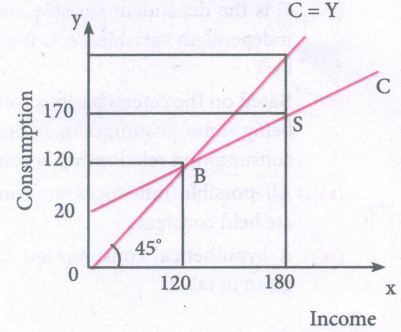
Here, when Y = 120, C = 120 (point B in the diagram)
When Y = 180, C = 170, S = 10 (point S in the diagram)
If oY increases to 360, C = 320, S = 40
(xii) In the diagram, income is measured horizontally.
(xiii) Consumption is measured vertically.
(xiii) In 45 line at all levels income and consumption are equal.
(xv) The consumption function measures not only the amount spent on consumption but also the amount saved.
(xvi) The propensity to save is merely the propensity not to consume.
21.
(i) Income by Income Method. Income method approaches National Income from the distribution side.
(ii) National income is calculated by adding up all the incomes generated in the course of producing national product.
(iii) Factor incomes are grouped under labour income, capital income and mixed income.
(iv) national income is calculated as domestic factor income plus net factor incomes from abroad. In short,
Y = w + r + i + π + (R-P)
w = wages
r = rent
i = interest
π = profits
R = Exports
P = Imports
(v) This method is adopted for estimating the contributions of the remaining sector, viz.
(vi) Data on income from abroad (the rest of) the world sector or foreign sector are obtained from the account of the balance of payment of the country.
Items no to be included:
(1) Transfer payments are not to be included in estimation of national income.
(2) The receipts from the sale of second hand goods should not be treated as part of national income.
Item to be included:
(1) Imputed value of rent for self occupied house or offices is to be included.
(2) Imputed value of services provided by owners of production unit (family labour) is to be included.
22.
| S.No | Keynesianism | Classicism |
|---|---|---|
| 1. | Short-run equilibrium | Long-run equilibrium |
| 2. | Saving is a vice | Saving is a social virtue |
| 3. | The function of money is a medium of exchange on the one side and a store of value on the other side. | The function of money is to act as a medium of exchange |
| 4. | Macro approach to national problems | Micro foundation to macro problems |
| 5. | State intervention is advocated | Champions of Laissez-fair policy |
| 6. | Applicable to all situations - full employment and less than full employment. | Applicable only to the full employment situation |
| 7. | Capitalism has inherent contradictions | Capitalism is well and good |
| 8. | Budgeting should be adjusted to the requirements of economy. | Balanced budget |
| 9. | The equality between saving and investment is advanced through changes in income. | The equality between saving and investment is achieved through chances of rate of interest. |
| 10. | Rate of interest is determined by the demand for and supply of money. | Rate of interest is determined by saving and investment. |
| 11. | Rate of interest is a flow. | Rate of interest is a stock. |
| 12. | Demand creates its own supply. | Supply creates its own demand. |
| 13. | Rate of interest is a reward for parting with liquidity. | Rate of interest is a reward for saving. |
23.
24.
(a) Rapid Economic Growth:
(i) It promotes rapid economic growth.
(ii) Thus both public requirements and private needs are taken care of.
(b) Balanced Economic Growth:
(i) Mixedism promotes balanced growth of the economy.
(ii) It promotes balanced growth between agriculture and industry.
(c) Proper utilization of Resources:
(i) The government can ensure proper utilization of resources.
(ii) The government controls must of the important activities directly.
(d) Economic Equality:
(i) The government uses progressive rates of taxation.
(ii) Income tax to bring about economic equality.
25.
(i) Savings done in terms of commodities were not permanent.
(ii) With the invention of money, this difficulty has now disappeared and savings are now done in terms of money.
(iii) Money also serves as an excellent store of wealth.
(iv) Money can be easily converted into other assets such as land, machinery, plant etc.
(v) The modern money - economy has greatly facilitated the borrowing and lending processes.
(vi) In other words, money now acts as the standard of deferred payments.
(vii) The field of exchange also went on extended to distant lands.
(viii) It is therefore, felt necessary to transfer purchasing power from one place to another.

12th Standard Syllabus & Materials
12th Standard
TN 12th Computer Applications வலையமைப்பு வடமிடல் Sample Question Papers Study Material - QB365 Set A
NEW12th Standard
TN 12th Computer Applications களப்பெயர் முறைமை (DNS) Sample Question Papers Study Material - QB365 Set A
NEW12th Standard
TN 12th Computer Applications வலையமைப்பு எடுத்துக்காட்டுகள் மற்றும் நெறிமுறைகள் Sample Question Papers Study Material - QB365 Set A
NEW12th Standard
TN 12th Computer Applications கணினி வலையமைப்பு ஓர் அறிமுகம் Sample Question Papers Study Material - QB365 Set A



Tamilnadu Stateboard 12th Standard Subjects

Maths

Chemistry

Physics

Biology

Computer Science

Business Maths and Statistics
Economics

Commerce

Accountancy

History

Computer Applications
Biology
Computer Technology
Computer Applications
Computer Science
Business Maths and Statistics
Commerce
Economics
Maths
Chemistry
Physics
Computer Technology
History
Accountancy

Tamil

English

French
Tamilnadu Stateboard Standards
