
 100% FREE ACCESS
12th Standard Syllabus & Materials
12th Standard
TN 12th Maths Applications of Matrices and Determinants Sample Question Papers Study Material - QB365 Set A
NEW12th Standard
TN 12th Computer Applications மின்னணு தரவு பரிமாற்றம் Sample Question Papers Study Material - QB365 Set A
NEW12th Standard
TN 12th Computer Applications மின் - வணிக பாதுகாப்பு அமைப்புகள் Sample Question Papers Study Material - QB365 Set A
NEW12th Standard
TN 12th Computer Applications மின்னணு செலுத்தல் முறைகள் Sample Question Papers Study Material - QB365 Set A
NEW12th Standard
TN 12th Computer Applications மின் - வணிகம் Sample Question Papers Study Material - QB365 Set A
NEW12th Standard
TN 12th Computer Applications திறந்த மூல கருத்துருக்கள் Sample Question Papers Study Material - QB365 Set A

Published on: 01/03/2021
12th Standard English Medium Economics Reduced Syllabus Creative Three Mark Question with Answerkey - 2021(Public Exam )
Download Tamil Nadu 12th Standard Economics question papers, model tests, one-mark questions, important questions, and public exam papers in PDF format. Free study materials and answer keys for TN State Board students.
Questions + Answers key
Take MCQ Economics Test
1.
What are the key difference between Credit and Debit Card?
2.
Write a brief note on “The First Rupee”.
3.
Write briefly about “Structural Adjustment Facility”
4.
Explain any three main causes of inflation in India.
5.
Explain the three secondary function of money.
6.
Write a note of John Maynard Keynes.
7.
Distinguish between Fictional and Structural unemployment.
8.
Discuss the elements of Automatic Correction in trade disequilibrium.
9.
Mention the difference between FDI and FPI.
10.
Compare and contrast different measures of GDP calculations.
11.
What are the five types of final goods and services that GNP includes?
12.
Explain any three long run factors of MEC.
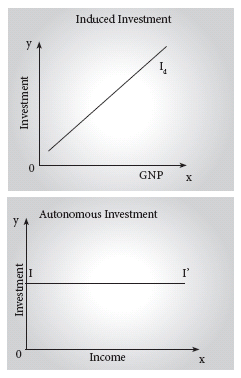
13.
Draw the diagram of induced investment and autonomous investment.
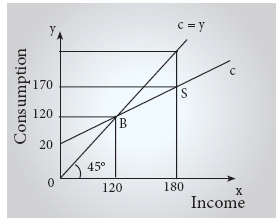
14.
Draw the diagram of consumption function.
15.
Explain are the Demerits of Capitalism.
16.
Mention any two functions of the ASEAN.
17.
List out the several types of indirect taxes.
18.
Explain any three limltations of leakages of multiplier.
19.
What are the difficulties in measuring National Income?
20.
Write the criticism of Say's Law.
21.
Explain the classical theory about unemployment?
22.
Explain the history of Barter System.
23.
Indicate the demerits of Mixed Economy.
24.
Explain any three features of Capitalistic Economy.
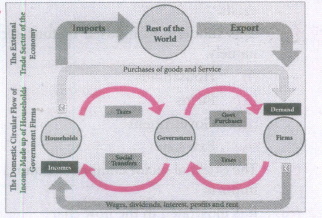
25.
Draw the Circular flow of income in a three sector economy.
1.
| BASIS | CREDIT CARD | DEBIT CARD |
| Meaning | A credit card is a payment card issued to users (cardholders) to enable the cardholder to pay a merchant for goods and services based on the cardholder’s promise to the card issuer to pay them for the amounts so paid plus the other agreed charges. | A Debit card is a card allowing the holder to transfer money electronically from their bank account when making a purchase. |
| Implies | Pay later | Pay now |
| Bank Account | A bank account is not a prerequisite for issuing a credit card. | A bank account is a must for issuing a debit card. |
| Bill | The holder of the card has to pay the credit card bill within 30 days of every month. | There is no such bill, the amount is directly deducted from the customer's account. |
| Interest | Interest is charged when payment is not made to the bank within a specified time period. | No interest is charged. |
2.
(i) The first rupee was introduced by Sher Shah Suri based on a ratio of 40 copper pieces (paisa) per rupee. The name was derived from the Sanskrit word Raupya, meaning silver.
(ii) Each banknote has its amount written in 17 languages (English and Hindi on the front and 15 other on the back) illustrating the diversity of the country.
3.
(i) The IMF established Structural Adjustment Facility (SAF) in March 1986 to provide additional balance of payments assistance on concessional terms to the poorer member countries.
(ii) In December 1987, the Enhanced Structural Adjustment Facility (ESAF) was set up to augment the availability of concessional resources to low income countries.
(iii) The purpose of SAF and ESAF is to force the poor countries to undertake strong macroeconomic and structural programmes to improve their balance of payments positions and promote economic growth
4.
(i) Increase in Money Supply: Inflation is caused by an increase in the supply of money which leads to increase in aggregate demand.
(ii) Increase in Disposable Income: When the disposable income of the people increases, it raises their demand for goods and services.
(iii) Increase in Public Expenditure: Government activities have been expanding due to developmental activities and social welfare programmes.
5.
(i) Money as a Store of value: Savings done in terms of commodities were not permanent. But, with the invention of money, this difficulty has now disappeared and savings are now done in terms of money.
(ii) Money as a Standard of Deferred Payments: Borrowing and lending were difficult problems under the barter system. In the absence of money, the borrowed amount could be returned only in terms of goods and services.
(iii) Money as a Means of Transferring Purchasing Power: The field of exchange also went on extending with growing economic development. The exchange of goods is now extended to distant lands.
6.
(i) John Maynard Keynes was one of the most influential economists of the 20th century.
(ii) He was born in Cambridge in1883. In addition to his work as an economist he held position as civil servant a director of the Bank of England, and leader of British delegation of negotiators at the Bretton Woods conference at points in his career.
(iii) Economic theory based on his idea is known as Keynesian economics, and remain highly influential today, particularly in the field of macroeconomics.
7.
| S.No | Fictional unemployment | Structural unemployment |
| 1 | Frictional unemployment arises due to imbalance between supply of labour and demand for labour | Structural unemployment is due to drastic change in the structure of the society |
| 2. | This is because of immobility of labour, lack of necessary skills, break down of machinery, shortage of raw materials etc. | Lack of demand for the product or shift in demand to other products cause this type of unemployment |
| 3. | The persons who lose jobs and in search of jobs are also included under frictional unemployment | This kind of unemployment results from massive and deep rooted changes in economic structure |
8.
1. Price Adjustments
As a result of foreign exchange outflow from a deficit country to a surplus country, there will be a fall in the money supply in the deficit country and increase in the money supply in the surplus country.
2. Interest Rate Adjustments
The contraction or expansion of money supply resulting from the BoP deficit or surplus leads to a rise or fall in the interest rates. A rise in interest rate in the deficit country will encourage investors to withdraw their funds from abroad and invest in their home country.
3. Income Adjustments
A nation with payments surplus will experience rising income which will increase imports and thereafter equilibrium is restored in Balance of Payments.
4. Capital Flows
Changes in the interest rate consequent to the BoP disequilibrium will encourage capital flows from the surplus nations to deficit nations helping restoration of the BoP equilibrium.
9.
| BASIS FOR COMPARISON | REPO RATE | REVERSE REPO RATE |
| Meaning | FDI refers to the investment made by the foreign investors to obtain a substantial interest in the enterprise located in a different country. | When an international investor, invests in the passive holdings of an enterprise of another country, i.e. investment in the financial asset, it is known as FPI. |
| Degree of control | High | Very less |
| Term | Long term | Short term |
| Investment in | Physical assets | Financial assets |
| Entry and exit | Difficult | Relatively easy. |
| Results in | Transfer of funds, technology and other resources | Capital inflows |
10.
| GDP (Expenditure) | GDP (Factor Incomes) | GDP (Value of Output) |
|---|---|---|
| 1. Consumption 2. Government 3. Spending 4. Investment spending 5. Change in value of stocks 6. Exports 7. Imports 8. GDP (Known as aggregate demand) |
(i) Income from People in jobs and in self employment (eg. wages and Salaries) (ii) Profit of private sector business (iii) Rent income from the ownership of land |
(i) Value added from each of the main economic sectors (ii) These sectors are (iii) Primary (iv) Secondary (v) Manufacturing (vi) Quaternary |
| Government spending | Profits of private sector business |
11.
(1) Value of final consumer goods and services produced in a year to satisfy the immediate wants of the people which is referred to as consumption (C);
(2) Gross private domestic investment in capital goods consisting of fixed capital formation, residential construction and inventories of finished and unfinished goods which is called as gross investment (I);
(3) Goods and services produced or purchased by the government which is denoted by (G) ; and
(4) Net exports of goods and services, i.e., the difference between value of exports and imports of goods and services, known as (X - M)
(5) GNP at market prices means the gross value of final goods and services produced annually in a country plus net factor income from abroad (C + I + G + (X - M) + (R - P)).
12.
(i) Monetary and Fiscal policies: Cheap money policy and liberal tax policy pave the way for greater profit margin and so MEC is likely to be high.
(ii) Political environment: Political stability, smooth administration, maintenance of law and order help to improve MEC.
(iii) Resource availability: Cheap and abundant supply of natural resources, efficient labour and stock of capital enhance the MEC.
13.
14.
15.
1. Concentration of Wealth and Income: Capitalism causes concentration of wealth and income in a few hands and thereby increases inequalities of income.
2. Wastage of Resources: Large amount of resources are wasted on competitive advertising and duplication of products.
3. Class Struggle: Capitalism leads to class struggle as it divides the society into capitalists and workers.
4. Business Cycle: Free market system leads to frequent violent economic fluctuations and crises.
5. Production of non essential goods: Even the harmful goods are produced if there is possibility to make profit.
16.
i) It paves way for market and investment opportunities for the member nations.
ii) It fosters co-operations in many areas including industry and trade.
17.
Types of Indirect Taxes:
Excise Duty: Payable by the manufacturer who shifts the tax burden to retailers and wholesalers.
Sales Tax: Paid by a shopkeeper or retailer, who then shifts the tax burden to customers by charging sales tax on goods and services.
Custom Duty: Import duties levied on goods from outside the country, ultimately paid for by consumers and retailers.
Entertainment Tax: Liability is on the cinema theatre owners, who transfer the burden to cinema goers.
18.
(i) Payfent towards past debts:
If a portion of the additional income is used for repayment of old loan, the MPC is reduced.
(ii) Non availability of consumer goods:
The multiplier theory assumes instantaneous supply of consumer goods following demand. But there is often a time lag.
(iii) Full employment situation:
Under conditions of full employment, resources are almost fully employed.
(iv) So additional investment will lead to inflation only rather than generation of additional real income.
19.
(i) Transfer payments
(ii) Difficulties in assessing depreciation allowance.
(iii) Unpaid Services
(iv) Income from illegal activities.
(v) Production for self consumption and changing price.
(vi) Capital Gains
(vii) Statistical problems
20.
The following are the criticisms against Say's law:
(i) According to Keynes, supply does not create its demand. It is not applicable where demand does not increase as much as production increases.
(ii) Automatic adjustment process will not remove unemployment. Unemployment can be removed by increase in the rate of investment.
(iii) Money is not neutral. Individuals hold money for unforeseen contingencies while businessmen keep cash reserve for future activities.
21.
(i) The classical theory of employment is composed of different views of classical economists on the issue of income and employment in the economy.
(ii) Classical economists assumed that the economy operates as the live of full employment without inflation in the long period.
(iii) They also assumed that wages and prices of goods were flexible and the competitive market existed in the economy.
22.
Barter System:
(i) Goods exchange for goods is known as Barter System.
(ii) In olden days goods were exchanged for goods and not for cash.
(iii) Barter system was introduced by Mesopotamia tribes.
(iv) Babylonian's also developed an improved barter system, where goods were exchanged for goods.
23.
Lack of Co-ordination:
The greatest drawback of Mixedism is lack of co-ordination between public sector and private sector.
Inefficiency:
Most of the public sector enterprises remain inefficient due to lethargic bureaucracy, red tapism and lack of motivation.
Fear of Nationalization:
In mixed economy, the fear of nationalization discourages the private entrepreneurs in their business operations.
24.
(i) Private Ownership of Property and Law of Inheritance:
The basic feature of capitalism is that all resources namely, land, capital, machines, mines etc. are owned by private individuals. The owner has the right to own, keep, sell or use these resources according to his will. The property can be transferred to heirs after death.
(ii) Freedom of Choice and Enterprise:
Each individual is free to carry out any occupation or trade at any place and produce any commodity. Similarly, consumers are free to buy any commodity as per their choice.
(iii) Free Competition:
There is free competition in both product and factor market. The government or any authority cannot prevent firms from buying or selling in the market. There is competition between buyers and sellers.
25.

12th Standard Syllabus & Materials
12th Standard
TN 12th Computer Applications வலையமைப்பு வடமிடல் Sample Question Papers Study Material - QB365 Set A
NEW12th Standard
TN 12th Computer Applications களப்பெயர் முறைமை (DNS) Sample Question Papers Study Material - QB365 Set A
NEW12th Standard
TN 12th Computer Applications வலையமைப்பு எடுத்துக்காட்டுகள் மற்றும் நெறிமுறைகள் Sample Question Papers Study Material - QB365 Set A
NEW12th Standard
TN 12th Computer Applications கணினி வலையமைப்பு ஓர் அறிமுகம் Sample Question Papers Study Material - QB365 Set A



Tamilnadu Stateboard 12th Standard Subjects

Maths

Chemistry

Physics

Biology

Computer Science

Business Maths and Statistics
Economics

Commerce

Accountancy

History

Computer Applications
Biology
Computer Technology
Computer Applications
Computer Science
Business Maths and Statistics
Commerce
Economics
Maths
Chemistry
Physics
Computer Technology
History
Accountancy

Tamil

English

French
Tamilnadu Stateboard Standards
