
 100% FREE ACCESS
12th Standard Syllabus & Materials
12th Standard
TN 12th Maths Applications of Matrices and Determinants Sample Question Papers Study Material - QB365 Set A
NEW12th Standard
TN 12th Computer Applications மின்னணு தரவு பரிமாற்றம் Sample Question Papers Study Material - QB365 Set A
NEW12th Standard
TN 12th Computer Applications மின் - வணிக பாதுகாப்பு அமைப்புகள் Sample Question Papers Study Material - QB365 Set A
NEW12th Standard
TN 12th Computer Applications மின்னணு செலுத்தல் முறைகள் Sample Question Papers Study Material - QB365 Set A
NEW12th Standard
TN 12th Computer Applications மின் - வணிகம் Sample Question Papers Study Material - QB365 Set A
NEW12th Standard
TN 12th Computer Applications திறந்த மூல கருத்துருக்கள் Sample Question Papers Study Material - QB365 Set A

Published on: 01/03/2021
12th Standard English Medium Economics Reduced Syllabus Creative Two Mark Question with Answerkey - 2021(Public Exam )
Download Tamil Nadu 12th Standard Economics question papers, model tests, one-mark questions, important questions, and public exam papers in PDF format. Free study materials and answer keys for TN State Board students.
Questions + Answers key
Take MCQ Economics Test
1.
Differential in short – NEFT and RTGS.
2.
Write a brief note on Demonetisation of 2016.
3.
List the frequent methods of credit control under selective method.
4.
What is “Banking Ombudsman Scheme”
5.
Explain the term “Demand for Money”
6.
Answer the questions below using the following information:
All figures are in billions of dollars.
| Currency held outside banks | Rs.800 |
| Demand Deposits | 1000 |
| Traveler's Checks | 100 |
| Other checkable deposits | 200 |
| Savings accounts | 300 |
| Money market accounts | 100 |
| Other near monies | 200 |
a. What is the value of M1?
b. What is the value of M2?
7.
Compare and contrast fiat money and commodity money.
8.
9.
What is “Wage-Price Spiral”?
10.
Draw the diagram of inflation on the basis of speed.
11.
Present the version of Keynes extended equation.
12.
Express the terms of Marshall’s Equation.
13.
What are the other names for M1, M2, M3 nd M4 Money?
14.
Write about Money as a Means of Transferring Purchasing Power in short.
15.
Comment : “Self-Adjustment not Possible”
16.
What is Aggregate demand?
17.
Compare and contrast the terms nominal GDP and real GDP.
18.
Define - Favourable BOT
19.
How Modern theory of International Trade attributes international differences in comparative costs to?
20.
List the assumption of Adam smith trade theory.
21.
What are the other names of international trade?
22.
What are the types Trade?
23.
Explain how the following two equations can both be true: Multiplier k = 1/MPS Multiplier k = 1/1-MPC.
24.
Compare and contrast the MPC and the MPS. Also explain what these two figures must always add up to.
25.
“Super Multiplier” – Define.
26.
What is the Meaning of Marginal Efficiency of Capital (MEC)?
27.
Objective Factors – Define.
28.
Increase in income always leads to an increase in both consumption and saving. – Explain.
29.
Write the formulas of APC, MPC, APS and MPS
30.
Draw the chart depicting various systems of economy
31.
Expand the given equation :Y = C + I + G + (X-M).
32.
Mention any two limitations of macroeconomics
33.
What is leakages of multiplier?
34.
What do you mean by investment?
35.
What are the types of investment?
36.
What is Gross Domestic Product?
37.
Write a short note on Capital Gains.
38.
What is GDP? Write the formula.
39.
Write the formula for calculating NDP.
40.
Write a short note about Keynes theory?
41.
In which year the state financial corporation was started?
42.
What is variable portfolio ceiling?
43.
What is Recovery?
44.
Write a short note on currency symbol in India.
45.
What is Narrow money?
46.
What is creeping inflation?
47.
What is Globalisation?
48.
Write the equation for Four-sector economy.
49.
Write down the countries that have capitalistic, economy.
50.
What is Mixed Economy?
1.
| BASIS | NEFT | RTGS |
| Meaning | NEFT is a system of online money transfers where the payment is made in a near real-time basis. | RTGS is an electronic payment system where the funds are transferred at the same time when the transaction took place. |
| Introduced in | 2005 | 2004 |
| Ceiling limit | No such limit, but the maximum amount per transaction is restricted to Rs. 50,000. | Minimum - 2 lakh, Maximum - No limit |
| Appropriate for | Small value transaction | High-value transaction. |
| Processing | Comparatively Slow | Fast |
2.
Demonetisation is the act of stripping a currency unit of its status as legal tender.
(i) It occurs whenever there is a change of national currency.
(ii) The current form or forms of money is pulled from circulation, often to be replaced with new coins or notes.
(iii) On 8 November 2016, the Indian Prime Minister Mr. NarendraModi announced the demonetization of all Rs.500 and Rs.1000 bank notes of the Mahatma Gandhi Series.
3.
The following are the frequent methods of credit control under selective method:
1. Rationing of Credit
2. Direct Action
3. Moral Persuasion
4. Method of Publicity
5. Regulation of Consumer’s Credit
6. Regulating the Marginal Requirements on Security Loans
4.
(i) RBI introduced the Banking Ombudsman Scheme in 1995.
(ii) Under this scheme, the complainants can file their complaints in any form, including online and can also appeal to the Ombudsman against the awards and the other decisions of the Banks.
5.
(i) Demand for money means the demand to hold money, that is, to keep one’s resources in liquid form instead of in some form of investment.
(ii) It means the desire to hold money in liquid cash as against spending the money.
6.
a. Value of M1 = 800 + = Rs. 2100 billion. 1000 + 100 + 200
b. Value of M2 = 2100 = Rs. 2700 billion. (M1) + 300 + 100 + 200
7.
(i) Fiat money includes items that are designated as money that are intrinsically worthless.
(ii) Commodity money are things like gold or silver which have alternative uses other than money.
(iii) They can be used in dental fillings or as jewelry.
8.
9.
Wage-price spiral is used to explain the cause and effect relationship between rising wages and rising prices or inflation.
10.
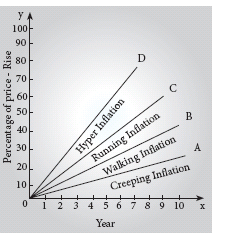
11.
Keynes extended his equation in the following form:
n = p (k + rk') or p = n/(k + rk')
Where,
n = total money supply
p = price level of consumer goods
k = peoples' desire to hold money in hand (in terms of consumer goods) in the total income of them
r = cash reserve ratio
k' = community’s total money deposit in banks, in terms of consumers goods
12.
The Marshall equation is expressed as:
M = KPY
Where
M is the quantity of money
Y is the aggregate real income of the community
P is Purchasing Power of money
K represents the fraction of the real income which the public desires to hold in the form of money.
13.
(i) M1 and M2 are known as narrow money
(ii) M3 and M4 are known as broad money
14.
(i) The field of exchange also went on extending with growing economic development.
(ii) The exchange of goods is now extended to distant lands.
15.
i. According to Say‘s Law, full employment is maintained by an automatic and self adjustment mechanism in the long run.
ii. But Keynes had no patience to wait for the long period for he believed that – In the long run we are all dead.
iii. It is not the automatic adjustment process which removes unemployment.
iv. But unemployment can be removed by increase in the rate of investment.
16.
The amount that households, firms, the governments and the foreign purchasers would like to spend on domestic output.
17.
Nominal GDP measures gross domestic product in current rupees. Real GDP measures gross domestic product by adjusting Nominal GDP for price changes
18.
When the total value of commodity exports of a country exceeds the total value of commodity imports of that country, it is said that the country has a ‘favourable’ balance of trade.
19.
i) difference in the endowments of factors of production between countries, and
ii) differences in the factor proportions required in production.
20.
1. There are two countries and two commodities (2 x 2 model).
2. Labour is the only factor of production.
3. Labour units are homogeneous.
4. The cost or price of a commodity is measured by the amount of labour required to produce it.
5. There is no transport cost.
21.
1. External trade
2. Foreign trade
3. Inter-regional trade
22.
a) Internal Trade and
b) International Trade.
23.
The reason that both equations are true is because of the identity MPS + MPC = 1. This is true because there are only two things that one can do with one's income - consume and save.
24.
i. The MPC is the marginal propensity to consume.
ii. It is the fraction of an increase in income that is consumed.
iii. The MPS is the marginal propensity to save.
iv. It is the fraction of an increase in income that is saved.
v. The MPC and the MPS must always sum to 1 since there are only two things that one can do with one's income - consume and save.
25.
(i) Hicks has combined the k and β mathematically and given it the name of the Super Multiplier.
(ii) The super multiplier is worked out by combining both induced consumption and induced investment.
26.
The rate of discount which makes the discounted present value of expected income stream equal to the cost of capital.
27.
Objective factors are the external factors which are real and measurable. These factors can be easily changed in the long run.
28.
This means that increased income is unlikely to lead to fall in either consumption or saving. Thus with increased income both consumption and saving increase.
29.
(i) The Average Propensity to Consume \(\frac { c }{ y } \)
(ii) The Marginal Prosperity to Consume =\(\frac { \triangle c }{ \triangle y } \)
(iii) The average Propensity to Save =\(\frac { s }{ y } \)
(iv) The Marginal Propensity to Save =\(\frac { s }{ y } \)
30.
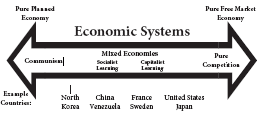
31.
Y = National Income
C = Consumption Expenditure
I = Investment Expenditure
G = Government Expenditure
(X – M) = Net Exports
32.
Macro economics suffers from certain limitations. They are:
1. There is a danger of excessive generalisation of the economy as a whole
2. It assumes homogeneity among the individual units.
3. There is a fallacy of composition. What is good of an individual need not be good for nation and viceversa. And, what is good for a country is not good for another country and at another time.
4. Many non - economic factors determine economic activities; but they do not find place in the usual macroeconomic books
33.
(i) The multiplier assumes that those who earn income are likely to spend a proportion of their additional income on consumption.
(ii) In practice, people tend to spend their additional income on other items
(iii) Such expenses are known as leakages.
34.
The term investment means purchase of stocks and shares, debentures, government bonds and equities.
35.
(i) Autonomous Investment
(ii) Induced Investment
36.
(i) Gross Domestic Product (GDP) is the total value of output (goods and services) produced by the factors of production located within the country's boundary in a year.
(ii) The factors of production may be owned by anyone-citizens or foreigners.
GDP = GNP - Net income earned from abroad
37.
Capital gains arise when a capital asset such as a house, other property, stocks or shares, etc. is sold at higher price than was paid for it at the time of purchase. Capital gains are excluded from national income.
38.
GDP is the total market value of final goods and services produced within the country during a year.
GDP by expenditure methods at market prices = C + I + G + (X - M)
39.
Net Domestic Product = GDP - Depreciation.
40.
Keynes theory of employment was based on the view of the short run. According to him, the factors of production such as capital goods, supply of labour, technology and efficiency of labour remain unchanged while determining the level of employment.
41.
The Government of India passed in 1951 the State Financial Corporation Act and SFCs were setup in many states.
42.
The system by which the central bank fixes ceiling or maximum amount of loans and advances for every commercial bank.
43.
An increase in business activities after the lowest point. (ie) depression
44.
(i) The symbol of Indian rupee came into use on 15th July, 2010.
(ii) India is the 5th Country to accept a unique currency symbol.
45.
M1 and M2 are narrow money as they includes currency plus demand deposits in banks and other deposits.
46.
(i) Creeping inflation is slow moving and very mild the rise in prices will not be perceptible but spread over a long period
(ii) This is also known as mild inflation of moderate inflation.
47.
Globalisation is nothing but connect the nations together through international trade and aiming at global development.
48.
y = C + I + G + (X - M)
C - Consumption Expenditure (Households)
I - Investment Expenditure (Firms)
G - Government Expenditure (Government)
(X-M) - Net Exports (External Sector)
49.
i) The USA
ii) West Germany
iii) Australia and
iv) Japan
50.
(i) In economic system both private and public sectors co-exist.
(ii) It work together towards economic development.

12th Standard Syllabus & Materials
12th Standard
TN 12th Computer Applications வலையமைப்பு வடமிடல் Sample Question Papers Study Material - QB365 Set A
NEW12th Standard
TN 12th Computer Applications களப்பெயர் முறைமை (DNS) Sample Question Papers Study Material - QB365 Set A
NEW12th Standard
TN 12th Computer Applications வலையமைப்பு எடுத்துக்காட்டுகள் மற்றும் நெறிமுறைகள் Sample Question Papers Study Material - QB365 Set A
NEW12th Standard
TN 12th Computer Applications கணினி வலையமைப்பு ஓர் அறிமுகம் Sample Question Papers Study Material - QB365 Set A



Tamilnadu Stateboard 12th Standard Subjects

Maths

Chemistry

Physics

Biology

Computer Science

Business Maths and Statistics
Economics

Commerce

Accountancy

History

Computer Applications
Biology
Computer Technology
Computer Applications
Computer Science
Business Maths and Statistics
Commerce
Economics
Maths
Chemistry
Physics
Computer Technology
History
Accountancy

Tamil

English

French
Tamilnadu Stateboard Standards
