
 100% FREE ACCESS
12th Standard Syllabus & Materials
12th Standard
TN 12th Maths Applications of Matrices and Determinants Sample Question Papers Study Material - QB365 Set A
NEW12th Standard
TN 12th Computer Applications மின்னணு தரவு பரிமாற்றம் Sample Question Papers Study Material - QB365 Set A
NEW12th Standard
TN 12th Computer Applications மின் - வணிக பாதுகாப்பு அமைப்புகள் Sample Question Papers Study Material - QB365 Set A
NEW12th Standard
TN 12th Computer Applications மின்னணு செலுத்தல் முறைகள் Sample Question Papers Study Material - QB365 Set A
NEW12th Standard
TN 12th Computer Applications மின் - வணிகம் Sample Question Papers Study Material - QB365 Set A
NEW12th Standard
TN 12th Computer Applications திறந்த மூல கருத்துருக்கள் Sample Question Papers Study Material - QB365 Set A

Published on: 01/03/2021
12th Standard English Medium Economics Reduced Syllabus Public Exam Model Question Paper - 2021
Download Tamil Nadu 12th Standard Economics question papers, model tests, one-mark questions, important questions, and public exam papers in PDF format. Free study materials and answer keys for TN State Board students.
Questions + Answers key
Take MCQ Economics Test
1.
Pick out the method which is not a part of redemption
Sinking Fund
Surplus Budget
Terminal Annuities
Refunding
2.
India’s relationship with ASEAN started in 1992 when India became a ………..?
sectoral dialogue partner
founding member
observer
permanent member.
3.
Which of the following economies largely structural unemployment which is due to slow rate of capital formation?
Developing economies
Underdeveloped economies
Developed economies
None of the above
4.
If all values of a sample are same, then its variance is
1
0
2
Cannot be determined
5.
India has a comparative cost advantage in
textiles
steel
both of them
none of them
6.
Which of the following can cause shifts in consumption function:
Psychological attitude
Social practices
Business motives
Changes in price level
7.
Which of the following statements regarding the circular-flow diagram is true?
If Vijay works for XYZ Solutions Ltd. and receives a salary payment, the transaction takes place in the market for goods and services.
If Vijay works for XYZ Solutions Ltd. and receives a salary payment, the transaction takes place in the market for goods and services.
None of these answers
The factors of production are owned by households.
8.
_________ are considered to be the lungs of the earth.
Oxygen
Water
Trees
Climate amelioration
9.
__________ employ factors of production to produce the goods and services.
Consumer
Business sectors
House holds
Farmers
10.
In _______ planning the period extends over 3 to 5 year upto 7 to 10 years.
over all
rolling
indicative
mid-term
11.
The value of the coefficient of correlation r lies between
0 and 1
-1 and 0
-1 and +1
-0.5 and +0.5
12.
13.
The common source of outdoor air pollution is caused by combustion processes from the following ______________
Heating and cooking
Traditional stoves
Motor vehicles
All the above
14.
Finance Commission determines
The finances of Government of India
The resources transfer to the states
The resources transfer to the various departments
None of the above
15.
Cyclical disequilibrium in BOP occurs because of
Different paths of business cycle.
The income elasticity of demand or price elasticity of demand is different.
long-run changes in an economy
Both (a) and (b)
16.
A Commercial Bank is an institution that provides services
Accepting deposits
Providing loans
Both a and b
None of the above
17.
_____inflation is in no way dangerous to the economy.
walking
running
creeping
galloping
18.
Structural unemployment is a feature in a ________.
Static society
Socialist society
Dynamic society
Mixed economy
19.
The largest proportion of national income comes from___________
Private sector
Local sector
Public sector
None of the above
20.
Economic system representing equality in distribution is _________.
Capitalism
Globalism
Mixedism
Socialism
21.
Write briefly about “Structural Adjustment Facility”
22.
Explain Effects on Production of Inflation.
23.
Write a note on social account method of national income.
24.
Write a note on Multiplier.
25.
What is vicious circle of poverty?
26.
27.
Specify the meaning of material balance principle.
28.
Explain the Net Barter Terms of Trade and Gross Barter Terms of Trade.
29.
30.
Outline the major merits of capitalism.
31.
Find the Karl Pearson coefficient of Correlation between X and Y from the following data:
| X: | 10 | 12 | 13 | 16 | 17 | 20 | 25 |
| Y: | 19 | 22 | 26 | 27 | 29 | 33 | 37 |
32.
Elucidate various measures of economic development.
33.
State the importance of the comparative advantage of international trade.
34.
What are the advantages of GST?
35.
Explain the Secondary Functions.
36.
Briefly explain the relationship between GDP growth and the quality of environment.
37.
38.
Explain the objectives of IMF.
39.
How the Rate of Exchange is determined? Illustrate.
40.
Describe the functions of Reserve Bank of India.
41.
Explain Keynes psychological law of consumption function with diagram.
42.
43.
Explain the importance of national income
44.
Compare the features of capitalism and socialism.
45.
Mention few major functions of RBI.
46.
What is the main criticism of Keynes on Classicals?
47.
Write a note on motives of precaution and foresight.
48.
What do you mean by economic development?
49.
What are the different models of circular flow of income?
50.
Specify the meaning of seed ball.
51.
52.
What is commodity money?
53.
54.
Write the formula for calculating GNP.
1.
(c)
Terminal Annuities
2.
(a)
sectoral dialogue partner
3.
(a)
Developing economies
4.
(b)
0
5.
(a)
textiles
6.
(d)
Changes in price level
7.
(d)
The factors of production are owned by households.
8.
(c)
Trees
9.
(b)
Business sectors
10.
(d)
mid-term
11.
(c)
-1 and +1
12.
(c)
13.
(b)
Traditional stoves
14.
(b)
The resources transfer to the states
15.
(d)
Both (a) and (b)
16.
(c)
Both a and b
17.
(c)
creeping
18.
(c)
Dynamic society
19.
(a)
Private sector
20.
(d)
Socialism
21.
(i) The IMF established Structural Adjustment Facility (SAF) in March 1986 to provide additional balance of payments assistance on concessional terms to the poorer member countries.
(ii) In December 1987, the Enhanced Structural Adjustment Facility (ESAF) was set up to augment the availability of concessional resources to low income countries.
(iii) The purpose of SAF and ESAF is to force the poor countries to undertake strong macroeconomic and structural programmes to improve their balance of payments positions and promote economic growth
22.
When the inflation is very moderate, it acts as an incentive to traders and producers. The profit due to rising prices encourages and induces business class to increase their investments in production, leading to generation of employment and income.
(i) However, hyper-inflation results in a serious depreciation of the value of money and it discourages savings.
(ii) When the value of money undergoes considerable depreciation, this may even drain out the foreign capital.
(iii) With reduced capital accumulation, the investment will suffer a serious set-back which may have an adverse effect on the volume of production.
23.
i. National income is also being measured by the social accounting method.
ii. Under this method, the transactions among various sectors such as firms, households, government, etc., are recorded and their interrelationships traced.
iii. The social accounting framework is useful for economists as well as policy makers,
iv. Because it represents the major economic flows and statistical relationships among various sectors of the economic system.
v. It becomes possible to forecast the trends of economy more accurately.
vi. Social Accounting and Sector Under this method, the economy is divided into several sectors. A sector is a group of individuals or institutions having common interrelated economic
vii. The economy is divided into the following sectors (i) Firms, (ii) Households, (iii) Government, (iv) Rest of the world and (v) Capital sector.
24.
(i) Multiplier expresses the relationship between an initial investment and the final increment in the GNP.
(ii) The magnified or amplified effect of initial investment on income is called as the multiplier effect.
(iii) Multiplier (K) = \(\frac{Change \ in \ equilibrium \ income}{Change \ in \ expenditure}\)
(or) K = \(\frac{ΔY}{ΔI}\) (or) K = \(\frac{1}{1-MPC}\) (or) \(\frac{1}{MPS}\)
25.
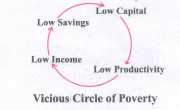
According to Ragnar Nurkse, low capital formation is one of the basic causes of poverty in UDCs. Low capital formation leads to low productivity. Low productivity results in low income and low income result in low savings and low saving leads to low capital formation. Thus, it forms a vicious circle of poverty.
26.
27.
(i) The law of conservation of matter and energy, emphasizes that in any production system "what goes in must come out".
(ii) All resources extracted from the environment eventually become unwanted wastes and pollutants.
(iii) Production of output by firms from inputs results in discharge of solid, liquid and gaseous wastes.
(iv) Waste results from consumption activities by households.
(v) Thus material and energy drawn from environment are used for production and consumption and returned back to the environment as wastes.
(vi) \(\mathrm{R}=\mathrm{W}_{1}+\mathrm{W}_{2}\)
(vii) Input = Output
28.
Net Barter Terms of Trade
1. This was developed by Taussig in 1927.
2. The ratio between the prices of exports and of imports is called net barter terms of trade.
3. Viner calls it commodity terms of trade.
4. \(\mathrm{T}_{\mathrm{n}}=\left(\mathrm{P}_{\mathrm{x}} / \mathrm{P}_{\mathrm{m}}\right) \times 100\)
5. Tn is Net Barter Terms of Trade
6. Px is Index number of export prices
7. Pm is Index number of import prices
8. This measures the gain from International Trade.
9. If Tn is greater than 100, it is terms of trade which means that for a rupee of export, more of imports can be received by a country.
Gross Barter Terms of Trade
1. Developed by Taussig in 1927 as an improvement over the net terms of trade.
2. It is an index of relationship between total physical quantity of imports and the total physical quantity of exports.
\(\mathrm{Tg}=\left(\mathrm{Q}_{\mathrm{m}} / \mathrm{Q}_{\mathrm{x}}\right) \times 100\)
3. Qm is Index of import quantities
4. Qx is Index of export quantities
5. If for a given quantity of export, more quantity of import can be consumed by a country, the terms of trade are favourable.
29.
30.
(i) Automatic working without any government intervention.
(ii) Efficient use of resources.
(iii) Incentives for hard work.
(iv) Production and productivity are high, so there is economic progress.
(v) Consumers sovereignty exist.
(vi) Increased saving and investment leads to higher capital formation.
(vii) Development of new technology.
31.
Formula for Assumed Mean Deviation method.
\(r=\frac { N\sum { dxdy-(\sum { dx } )(\sum { dy } ) } }{ \sqrt { { N\sum { dx } }^{ 2 }-{ (\sum { dx } ) }^{ 2 } } \sqrt { { N\sum { dy } }^{ 2 }-{ (\sum { y } ) }^{ 2 } } } \)
| S.No | X | Y | (X - A) = dx | (Y - A) = dy | dx2 | dy2 | dxdy |
| 1 | 10 | 19 | -6 | -8 | 36 | 64 | 48 |
| 2 | 12 | 22 | -4 | -5 | 16 | 25 | 20 |
| 3 | 13 | 26 | -3 | -1 | 9 | 1 | 3 |
| 4 | 16 | 27 | 0 | 0 | 0 | 0 | 0 |
| 5 | 17 | 29 | 1 | 2 | 1 | 4 | 2 |
| 6 | 20 | 33 | 4 | 6 | 16 | 36 | 24 |
| 7 | 25 | 37 | 9 | 10 | 81 | 100 | 30 |
| N = 7 | Ex = 113 | ΣY= 193 | Σ | Σ(Y - A) = 1 | Σ(Y - A) = 4 | Σdx2 = 159 | Σdxdy = 187 |
\(\bar { X } =\frac { \sum { } }{ N } =\frac { 113 }{ 7 } =16\frac { 1 }{ 7 } \)
\(\bar { Y } =\frac { \sum { Y } }{ N } =\frac { 193 }{ 7 } =27\frac { 4 }{ 7 } \)
Take the assumed values A = 16 & B =27 therefore dx = X - A → X - 16 and Wdy = → Y - 27
\(r=\frac { N\sum { dxdy-(\sum { dx } )(\sum { dy } ) } }{ \sqrt { { N\sum { dx } }^{ 2 }-{ (\sum { dx } ) }^{ 2 } } \sqrt { { N\sum { dy } }^{ 2 }-{ (\sum { y } ) }^{ 2 } } } \)
\(=\frac { 7X187-1X4 }{ \sqrt { 7X159-{ (1) }^{ 2 } } \sqrt { 7X230-{ (4) }^{ 2 } } } \)
\(=\frac { 1309-4 }{ \sqrt { 1112 } \sqrt { 1610-16 } } \)
\(=\frac { 1305 }{ \sqrt { 1112 } \sqrt { 1594 } } =\frac { 1305 }{ \sqrt { 33.34 } \sqrt { 39.92 } } \)
\(=\frac { 1305 }{ 1330.9 } =0.9865\quad =0.986\)
32.
Economic development is measured on the basis of four criteria
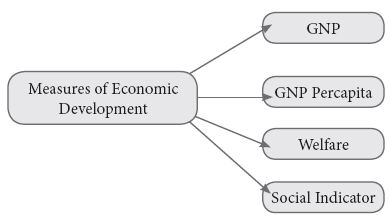
Gross National Product (GNP):
(i) GNP is the total market value of all final goods and services produced within a nation in a particular year, plus income earned by its citizens (including income of those located abroad), minus income of non-residents located in that country.
(ii) GNP is one measure of the economic condition of a country, under the assumption that a higher GNP leads to a higher quality of living, all other things being equal.
GNP per capita:
(i) This relates to increasing in the per capita real income of the economy over the long period
(ii) This indicator of economic growth emphasizes that for economic development the rate of increase in real per capita income should be higher than the growth rate of population.
Welfare:
(i) Economic development is regarded as a process whereby there is an increase in the consumption of goods and services by individuals.
(ii) From the welfare perspective, economic development is defined as a sustained improvement in health, literacy, and standard of living
Social Indicators:
(i) Social indicators are normally referred to as basic and collective needs of the people
(ii) The direct provision of basic needs such as health, education, food, water, sanitation, and housing facilities check social backwardness.
| S/N | Basic need | Indicators |
|---|---|---|
| 1 | Health | Life expectancy at birth |
| 2 | Education | Literacy signifying primary school enrolment as a percent of the population. |
| 3 | Food | Calorie Supply per head |
| 4 | Water supply | Infant mortality and percentage of the population with access to potable water |
| 5 | Sanitation | Infant mortality and percentage of the population with access to sanitation. |
33.
(i) The balance of aggregate demand and aggregate supply was first described.
(ii) The cost of goods is determined by the ratio of aggregate demand and supply for them, both domestically and from abroad;
(iii) He theory is true regarding any quantity of goods and any number of countries, as well as for the analysis of trade between different entities.
(iv) In this case, country specialization in some goods depends on the ratio of wage levels in each country;
(v) The theory based the existence of benefits from trade for all countries, taking part in it;
(vi) There become possible to develop foreign economic policy on the scientific foundation.
34.
(i) GST will mainly remove the cascading effect on the sale of goods and services.
(ii) Removal of cascading effect will directly impact of the cost of goods.
(iii) Tax is eliminated in this regime, the cost of goods decreases.
(iv) GST is also mainly technologically driven.
(v) All activities like registration, return filing, application for refund and response to notice need to be done online on the GST portal. This will speed up the processes.
35.
(i) Savings done in terms of commodities were not permanent.
(ii) With the invention of money, this difficulty has now disappeared and savings are now done in terms of money.
(iii) Money also serves as an excellent store of wealth.
(iv) Money can be easily converted into other assets such as land, machinery, plant etc.
(v) The modern money - economy has greatly facilitated the borrowing and lending processes.
(vi) In other words, money now acts as the standard of deferred payments.
(vii) The field of exchange also went on extended to distant lands.
(viii) It is therefore, felt necessary to transfer purchasing power from one place to another.
36.
(i) Strong economic growth or high GDP growth leads to excessive use of resources.
(ii) Natural resources are essential inputs for production in many sectors;
(iii) Production and consumption lead to pollution and other pressures on the environments.
(iv) Poor environmental quality affects economic growth and well being by lowering the quantity and quality of resources or due to health impact.
(v) There is the need to balance growth and the sustainability of eco system.
(vi) So we have to ensure our sustainable existence, consume less and curb economic growth.
37.
38.
(i) To promote international monetary cooperation among the member nations.
(ii) To facilitate faster and balanced growth of international trade.
(iii) To ensure exchange rate stability by curbing competitive exchange depreciations.
(iv) To reduce exchange controls imposed by member nations.
(v) To establish multilateral trade and payment system in respect of current transactions.
(vi) To promote the flow of capital from developed to developing nations.
(vii) To solve the problem of international liquidity.
39.
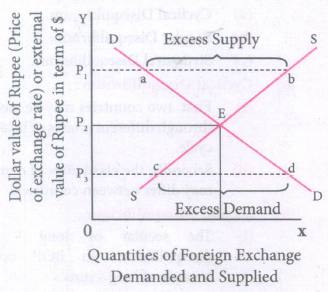
(i) The equilibrium rate of exchange is determined in the foreign exchange market according to the general theory of value, by the interaction of demand and supply,
(ii) Y axis represents exchange rate, be cos value of rupee in terms of dollars
(iii) X axis represents demand and supply of forex.
(iv) E is the equilibrium point where DD intersects SS. The exchange rate is P2.
40.
Introduction
(i) The Reserve Bank of India is India's central banking institution
(ii) It commenced its operations on 1 April 1935 and it was nationalised on 1 Jan, $1949 .$
1) Monetary Authority
(i) It controls the supply of money in the economy to stabilize exchange rate, maintain healthy balance of payment, attain financial stability, control inflation, strengthen banking system.
2) Issuer of currency
(i) It is the sole authority to issue currency
(ii) It also takes action to control the circulation of fake currency.
3) Issuer of Banking License
(i) Every bank has to obtain a banking license from RBI to conduct banking business in India.
4) Banker to the Government
(i) It is the banker to the central and the state governments.
(ii) It provides short term credit, manages all need issues of government loans, services the government debt outstanding
(iii) It advises the government on banking and financial matters.
5) Banker's Bank
(i) It is the bank of all banks in India as it provides loan to banks, accepts the deposit of banks and rediscounts the bills of banks.
6) Lender of last resort
(i) The banks can borrow from RBI by keeping eligible securities as collateral at the time of need when there is no other source.
7) Act as clearing house
(i) For settlement of banking transactions, RBI manages 14 clearing houses.
(ii) It facilitates the exchange of instruments and processing of payment instructions.
8) Custodian of foreign exchange reserves
(i) It administers and enforces the provision of Foreign Exchange Management Acr, 1999.
(ii) RBI buys and sells foreign currency to maintain the exchange rate of Indian rupee vs foreign currencies.
9) Regulator of Economy
(i) It controls the money supply in the system, monitors GDP, Inflation
10) Managing Government securities
(i) RBI administers investments in institutions when they invest specified minimum proportions of their total assets/liabilities in government securities.
11) Regulator and Supervisor of Payment and Settlement Systems
(i) RBI oversees the payment and settlement systems in the country.
(ii) It focuses on the development and functioning of safe, secure and efficient payment and settlement mechanisms.
12) Developmental Role
(i) It develops the quality of banking system in India and ensures that credit is available to the productive sectors of the economy.
(ii) It provides a wide range of promotional functions to support national objectives.
(iii) It establishes institutions which build the financial infrastructure.
(iv) It also helps in expanding access to affordable financial services and promotes financial education and literacy.
13) Publisher of monetary data
(i) It maintains and provides all essential bánking and other economic "data, formulating and critically evaluating the economic policies in India.
(ii) RBI collects, collates and publishes data regularly.
14) Exchange manager and controller
(i) RBI represents India as a member of the International Monetary Fund.
(ii) Most of thé commercial banks are authorized dealers of RBI.
15) Banking Ombudsman Scheme
(i) RBI introduced this Scheme in 1995
(ii) Those who have complaints including online, can appeal to the Ombudsman against the awards and the other decisions of the Banks.
16) Banking Codes and Standards Board of India
(i) To measure the performance of banks against Codes and Standards based on established global practices, the RBI has set up the Banking Codes and Standards Board of India.
41.
Law
According to Keynes, "men are disposed as a rule and on the average to increase their consumption as their income increases but not by as much as the increáse in their income".
Propositions
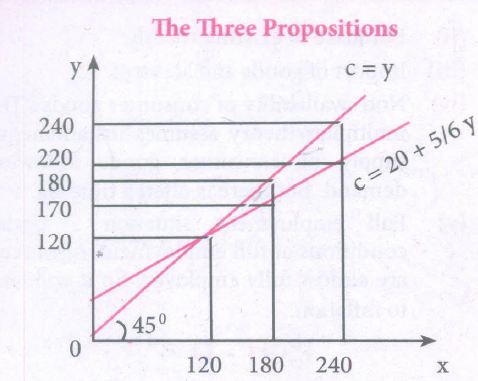
1. When income increases, consumption expenditure also increases, but by a smaller amount
(a) When income increases from 120 to 180; consumption also increases from 120 to 170 but the increase in consumption is less than the increase in income, 10 is saved.
2. The increased income will be divided in some proportion between consumption expenditure and saving
(a) When income increases to 180 and 240, it is divided between consumption (170 and 220) and saving (10 and 20)
3. Incrcascs in income always lead to in incrcase in both consumption and saving
(a) Increases in income to 180) and 240; lead to increased consumption 170 and 220; increased saving 10 and 20.
(b) It is clear from the widening area below the C curve and the saving gap between 45o line and C curve.
| Y | C | S |
|---|---|---|
| 120 | 120 | 0 |
| 180 | 170 | 10 |
| 240 | 220 | 20 |
42.
43.
(i) National income is of great importance for the economy of a country.
(ii) National income helps us to know the relative importance and contribution of each sector. We could find how income is produced, how it is distributed, how much is spent, saved or taxed.
(iii) National income data is used to formulate monetary policy, fiscal policy and other policies.
(iv) Data regarding gross income, output, saving and consumption is uscd in economic planning.
(v) National income data is used to build economic models in short run and long run.
(vi) It is used to make international comparison, inter regional comparison and inter temporal comparison of growth of the economy during different periods.
(vii) If income is equally distributed, the per capita income will reflect the economic welfare of the country.
44.
1. Capitalism and socialism are two extreme and opposite approaches.
2. In capitalism, there is total freedom but in socialism, there is no freedom at all.
3. In capitalism, there is private ownership of means of production but there is public ownership of means of production in socialism.
4. Profit is the driving force behind all economic activities in capitalism but it is social welfare under socialism.
5. Capitalism enjoys free market but in socialism there is central planning.
6. There is unequal income distribution in capitalism but there is equal income distribution in socialism.
7. The major problem in capitalism is inequality but it is inefficiency in socialism.
45.
(i) Issues currency
(ii) Banker to the government
(iii) collects receipts of funds and makes payments on behalf of the government
(iii) Regulator of Indian Banking system
(iv) Custodian of Forex
(v) Controller of credit
46.
i. Keynes did not accept the classical view that reduction in money wages led to full employment.
ii. He emphasized that unemployment could be removed by raising the effective demand.
iii. According to Keynes, a cut in money wages applied to the economy as a whole reduces employment rather than increasing it.
47.
1. The motive of precaution: To build up a reserve against unforeseen contingencies. Eg. Accidents, sickness.
2. The motive of foresight: The desire to provide for anticipated future needs. Eg. Old age.
48.
Economic development was refined in terms of reduction of poverty, inequality and unemployment within the context of a growing economy
49.
There are three models of circular flow of income. They are,
(i) Two sector model
(ii) Three sector model
(iii) Four sector model
50.
(i) A seed ball is a seed that has been wrapped in soil materials, usually a mixture of clay and compost and then dried.
(ii) The seed is pre-planted and can be sown by depositing the seed ball anywhere suitable for the species, keeping the seed safely until the proper germination window arises.
51.
52.
(i) Surplus goods were exchanged for money which in turn was exchanged for other needed goods.
(ii) Goods like furs, skins, salt, rice, wheat, utensils, weapons were used as money
53.
54.
\(\mathrm{GNP}=\mathrm{C}+\mathrm{I}+\mathrm{G}+(\mathrm{X}-\mathrm{M})+(\mathrm{R}-\mathrm{P})\) or \(\mathrm{GNP}_{\mathrm{MP}}=\mathrm{GDP}_{\mathrm{MP}}\) + Net Factor income from Abroad.

12th Standard Syllabus & Materials
12th Standard
TN 12th Computer Applications வலையமைப்பு வடமிடல் Sample Question Papers Study Material - QB365 Set A
NEW12th Standard
TN 12th Computer Applications களப்பெயர் முறைமை (DNS) Sample Question Papers Study Material - QB365 Set A
NEW12th Standard
TN 12th Computer Applications வலையமைப்பு எடுத்துக்காட்டுகள் மற்றும் நெறிமுறைகள் Sample Question Papers Study Material - QB365 Set A
NEW12th Standard
TN 12th Computer Applications கணினி வலையமைப்பு ஓர் அறிமுகம் Sample Question Papers Study Material - QB365 Set A



Tamilnadu Stateboard 12th Standard Subjects

Maths

Chemistry

Physics

Biology

Computer Science

Business Maths and Statistics
Economics

Commerce

Accountancy

History

Computer Applications
Biology
Computer Technology
Computer Applications
Computer Science
Business Maths and Statistics
Commerce
Economics
Maths
Chemistry
Physics
Computer Technology
History
Accountancy

Tamil

English

French
Tamilnadu Stateboard Standards
