
 100% FREE ACCESS
12th Standard Syllabus & Materials
12th Standard
TN 12th Computer Applications மின்னணு தரவு பரிமாற்றம் Sample Question Papers Study Material - QB365 Set A
NEW12th Standard
TN 12th Computer Applications மின் - வணிக பாதுகாப்பு அமைப்புகள் Sample Question Papers Study Material - QB365 Set A
NEW12th Standard
TN 12th Computer Applications மின்னணு செலுத்தல் முறைகள் Sample Question Papers Study Material - QB365 Set A
NEW12th Standard
TN 12th Computer Applications மின் - வணிகம் Sample Question Papers Study Material - QB365 Set A
NEW12th Standard
TN 12th Computer Applications திறந்த மூல கருத்துருக்கள் Sample Question Papers Study Material - QB365 Set A
NEW12th Standard
TN 12th Computer Applications வலையமைப்பு வடமிடல் Sample Question Papers Study Material - QB365 Set A

Published on: 01/03/2021
12th Standard English Medium Economics Reduced Syllabus Public Exam Model Question Paper with Answer key - 2021
Download Tamil Nadu 12th Standard Economics question papers, model tests, one-mark questions, important questions, and public exam papers in PDF format. Free study materials and answer keys for TN State Board students.
Questions + Answers key
Take MCQ Economics Test
1.
Which is not a component of GST
CGST
SGST
GCST
GCST
2.
What is known as ‘Paper Gold’?
Gold Bonds
Special Drawing Rights
Sovereign Investments
Gold Reserve of nations
3.
Consider the following statements:
1. P.C. Mahalanobis was first chairman of Planning Commission.
2. Primary emphasis during second plan was laid on the development of basic and key industries.
3. National Development Council of India is presided over by deputy chairman of Planning commission of India.
Select the correct answer from the given codes below:
1 only
2 only
1 and 2
None of these
4.
Find the formula for standard deveiation
Y= a – bx
Y= a + bx
\(\sqrt { \frac { \sum { |x-\bar { X } } }{ } } \)
\(\sqrt { \frac { { \sum { |x-\bar { X } | } }^{ 2 } }{ n } } \)
5.
An Eco-System comprises of
Living organisms
Non-living organisms
Both living and non-living organisms
Only plants
6.
According to Keynes the most important determinant of investment
MEC
Effective demand
Aggregate demand
Rate of interest
7.
What supports the production and consumption activities?
production activity
consumption activity
distribution activity
exchange activity
8.
_______ includes both visible and invisible items.
Balance of payment
Balance of Trade
Foreign Trade
None of these
9.
J.M. Keynes was born in _____________
1885
1884
1883
1882
10.
______ income is never equal to the national income.
Disposal Income
Percapita Income
Personal Income
GDP Deflate
11.
The value of the coefficient of correlation r lies between
0 and 1
-1 and 0
-1 and +1
-0.5 and +0.5
12.
Perspective plan is also known as______
Short-term plan
Medium-term plan
Long-term plan
None of the above
13.
The process of nutrient enrichment is termed as
Eutrophication
Limiting nutrients
Enrichment
Schistosomiasis
14.
Finance Commission determines
The finances of Government of India
The resources transfer to the states
The resources transfer to the various departments
None of the above
15.
In general, a primary reason why nations conduct international trade is because
Some nations prefer to produce one thing while others produce another
Resources are not equally distributed among all trading nations
Trade enhances opportunities to accumulate profits
Interest rates are not identical in all trading nations
16.
The Functions of commercial banks are broadly classified into
Primary Functions
Secondary functions
Other functions
a, b, and c
17.
_____inflation is in no way dangerous to the economy.
walking
running
creeping
galloping
18.
Classical theory advocates_______
Balanced budget
Unbalanced budget
Surplus budget
Deficit budget
19.
Expenditure method is used to estimate national income in_______
Construction sector
Agricultural Sector
Service sector
Banking sector
20.
The country following Capitalism is ________________
Russia
America
India
China
21.
Explain the primary function of money.
22.
What are the items should not be included while estimating national income through income method?
23.
Mention any two functions of the ASEAN.
24.
Explain the uses of multiplier
25.
Write a note on loss of freedom.
26.
Differentiate the economic model with econometric model.
27.
What are the causes of water pollution?
28.
State the objectives of Foreign Direct Investment.
29.
30.
Enumerate the features of mixed economy.
31.
Calculate Karl pearson's Cofficient of correlation form the followng data and interpret its value:
| Price:X | 10 | 12 | 14 | 15 | 19 |
| Supply:Y | 40 | 41 | 48 | 60 | 50 |
32.
Elucidate various measures of economic development.
33.
Solve and discuss the following using Marshall “Cash Balance Approach”.
(i) Suppose money supply in cash and bank deposits (M) = Rs. 1,000.
(ii) The total annual national income (R) = 10,000 units.
(iii) The goods (income) which the community wants to hold in money (K), say one-fifth of Y = 2,000 units.
34.
Explain Adam Smith’s Theory of Absolute Cost Advantage.
35.
What are the advantages of GST?
36.
Briefly explain the relationship between GDP growth and the quality of environment.
37.
Explain the scope of public finance.
38.
Explain the objectives of IMF.
39.
Bring out the components of balance of payments account.
40.
What are the objectives of Monetary Policy? Explain.
41.
Briefly explain the subjective and objective factors of consumption function?
42.
Describe the types of unemployment.
43.
Discuss the various methods of estimating the national income of a country.
44.
Discuss the scope of Macro Economics.
45.
What are Development Banks?
46.
Write a brief note on New Welfare oriented Approach about economic development
47.
What is the main criticism of Keynes on Classicals?
48.
What are Subjective Factors?
49.
What is Economic Policies?
50.
Specify the meaning of seed ball.
51.
Mention any two objectives of ASEAN.
52.
What is commodity money?
53.
What are the components of aggregate supply ?
54.
Write the formula for calculating GNP.
1.
(c)
GCST
2.
(b)
Special Drawing Rights
3.
(b)
2 only
4.
(d)
\(\sqrt { \frac { { \sum { |x-\bar { X } | } }^{ 2 } }{ n } } \)
5.
(c)
Both living and non-living organisms
6.
(a)
MEC
7.
(d)
exchange activity
8.
(a)
Balance of payment
9.
(c)
1883
10.
(c)
Personal Income
11.
(c)
-1 and +1
12.
(c)
Long-term plan
13.
(a)
Eutrophication
14.
(b)
The resources transfer to the states
15.
(b)
Resources are not equally distributed among all trading nations
16.
(d)
a, b, and c
17.
(c)
creeping
18.
(a)
Balanced budget
19.
(a)
Construction sector
20.
(b)
America
21.
(i) Money as a medium of exchange: This is considered as the basic function of money. Money has the quality of general acceptability, and all exchanges take place in terms of money.
(ii) Money as a measure of value: The second important function of money is that it measures the value of goods and services.
22.
1. Transfer payments are not to be included in estimation of national income as these payments are not received for any services provided in the current year such as pension, social insurance etc.
2. The receipts from the sale of second hand goods should not be treated as part of national income as they do not create new flow of goods or services in the current year.
3. Windfall gains such as lotteries are also not to be included as they do not represent receipts from any current productive activity.
4. Corporate profit tax should not be separately included as it has been already included as a part of company profit.
23.
i) It paves way for market and investment opportunities for the member nations.
ii) It fosters co-operations in many areas including industry and trade.
24.
(i) Multiplier highlights the importance of investment in income and employment theory.
(ii) The process throws light on the different stages of trade cycle.
(iii) It also helps in bringing the equality between S and I.
(iv) It helps to reduce unemployment and achieve full employment.
25.
(i) The absence of freedom in decision making, may act as an obstacle for economic growth.
(ii) Regulations and restrictions are the backbone of a planned economy.
(iii) The consumers, producers and the workers enjoy no freedom of choice.
(iv) Therefore Hayek explains in his book Road to Serfdom that centralized planning leads to loss of personal freedom and ends in economic stagnation.
26.
(i) Models in Mathematical Economics are developed based on Economic Theories, while Econometric Models are developed based on Economic Theories to test the validity of Economic Theories in reality through the actual data.
(ii) Regression Analysis in Statistics does not concentrate more on error term while Econometric Models concentrate more on error terms
27.
Discharge of sewage and waste water:
(i) Sewage, garbage and liquid waste of households, agricultural runoff and effluents from factories are discharged into lakes and rivers.
(ii) These wastes contain harmful chemicals and toxins which make the water poisonous for aquatic animals and plants.
Dumping of solid wastes:
(i) The dumping of solid wastes and litters in water bodies cause huge problems.
Discharge of industrial wastes:
(i) Industrial waste contains asbestos, lead, mercury, grease oil and petrochemicals.
Oil Spill:
(i) Sea water gets polluted due to oil spilled from ships and tankers.
Acid Rain:
(i) When the acidic particles caused by air pollution mix with water vapour, it results in acid rain.
Global warming:
(i) The increase in water temperature affects aquatic plants and animals.
Eutrophication:
(i) The increased level of nutrients in water depletes oxygen in water and this negatively affects fish and other aquatic animal population.
28.
FDI has the following objectives.
(i) Sales Expansion
(ii) Acquisition of resources
(iii) Diversification
(iv) Minimization of competitive risk
29.
30.
(i) The means of production and properties are owned by private and public.
(ii) Public and Private Sectors co-exist private sectors are profit motivated and public sectors aims at maximum social welfare.
(iii) The national plans prepared by the central planning authority is accepted by all sectors.
(iv) Basic economic problems are solved through the price mechanism and state intervention.
(v) Though the private can own resources, produce and distribute goods and services, the overall control on the economic activities is with the government.
31.
Let us take price as X and supply as Y
| Compulation of Pearson's Correlation Coefficient | ||||
| Price: X | Price: Y | XY | X2 | Y2 |
| 10 | 40 | 400 | 100 | 1600 |
| 12 | 41 | 492 | 144 | 1681 |
| 14 | 48 | 672 | 196 | 2304 |
| 15 | 60 | 900 | 2250 | 3600 |
| 19 | 50 | 950 | 3610 | 2560 |
| Σx=70 | Σy=239 | Σxy=3414 | Σx2=1026 | Σy2=11685 |
\(r=\frac { N\sum { XY-(\sum { X } )(\sum { Y } ) } }{ \sqrt { N\sum { { X }^{ 2 }-{ (\sum { X } ) }^{ 2 } } \sqrt { N\sum { { Y }^{ 2 }-{ (\sum { y } ) }^{ 2 } } } } } \)
\(r=\frac { (5x3414)-70x239) }{ \sqrt { (5x1026)-{ (70 })^{ 2 } } \sqrt { 5x11685-{ (239) }^{ 2 } } } \)
\(r=\frac { 17,070-16,730 }{ \sqrt { 230x } \sqrt { 1304 } } \)
\(r=\frac { 340 }{ 547.65 } =+0.621\)
Pirce of the product and supply for the product is positively correlated. When price of the product increases then the supply for the product also incresases.
32.
Economic development is measured on the basis of four criteria
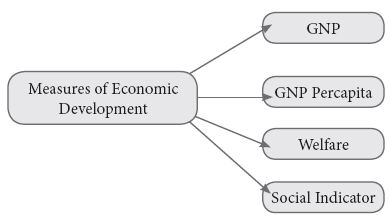
Gross National Product (GNP):
(i) GNP is the total market value of all final goods and services produced within a nation in a particular year, plus income earned by its citizens (including income of those located abroad), minus income of non-residents located in that country.
(ii) GNP is one measure of the economic condition of a country, under the assumption that a higher GNP leads to a higher quality of living, all other things being equal.
GNP per capita:
(i) This relates to increasing in the per capita real income of the economy over the long period
(ii) This indicator of economic growth emphasizes that for economic development the rate of increase in real per capita income should be higher than the growth rate of population.
Welfare:
(i) Economic development is regarded as a process whereby there is an increase in the consumption of goods and services by individuals.
(ii) From the welfare perspective, economic development is defined as a sustained improvement in health, literacy, and standard of living
Social Indicators:
(i) Social indicators are normally referred to as basic and collective needs of the people
(ii) The direct provision of basic needs such as health, education, food, water, sanitation, and housing facilities check social backwardness.
| S/N | Basic need | Indicators |
|---|---|---|
| 1 | Health | Life expectancy at birth |
| 2 | Education | Literacy signifying primary school enrolment as a percent of the population. |
| 3 | Food | Calorie Supply per head |
| 4 | Water supply | Infant mortality and percentage of the population with access to potable water |
| 5 | Sanitation | Infant mortality and percentage of the population with access to sanitation. |
33.
Marshall’s Equation
1. The Marshall equation is expressed as:
2. M = KPY the price level P = M/KY or the value of money = The reciprocal of price level is 1/P = KY/M the value of money (one rupee) = 2,000 units = (KY/M) = two units of goods, or Prices level P = (M/KY) = 1/2 = 0.50 paise per unit.
3. It is, therefore, clear that the value of money (its purchasing power) is found by dividing the total amount of goods, which the community wants to hold out of the total income (KY), by the amount of the supply of the money held by the public (M), and the price level (P) is found out by dividing the money supply (M) by the amount of goods which the community wants to hold (KY), as the price level is the opposite of the value of money.
34.
Adam Smith argued that all nations can be benefitted when there is free trade and specialisation in terms of their absolute cost advantage
The Theory
(i) According to Adam Smith, the basis of international trade was absolute cost advantage.
(ii) Trade between two countries would be mutually beneficial when one country produces a commodity at an absolute cost advantage over the other country which in turn produces another commodity at an absolute cost advantage over the first country.
Assumptions
1. There are two countries and two commodities (2 x 2 model).
2. Labour is the only factor of production
3. Labour units are homogeneous
4. The cost or price of a commodity is measured by the amount of labour required to produce it.
5. There is no transport cost.
Illustration
Absolute cost advantage theory can be illustrated with the help of the following example.
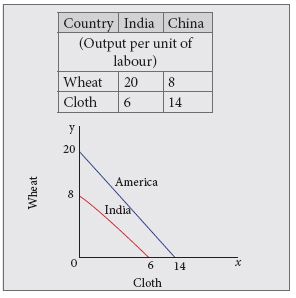
(iii) From the illustration, it is clear that India has an absolute advantage in the production of wheat over China and China has an absolute advantage in the production of cloth over India
(iv) Therefore, India should specialize in the production of wheat and import cloth from China. China should specialize in the production of cloth and import wheat from India
(v) This kind of trade would be mutually beneficial to both India and China.
35.
(i) GST will mainly remove the cascading effect on the sale of goods and services.
(ii) Removal of cascading effect will directly impact of the cost of goods.
(iii) Tax is eliminated in this regime, the cost of goods decreases.
(iv) GST is also mainly technologically driven.
(v) All activities like registration, return filing, application for refund and response to notice need to be done online on the GST portal. This will speed up the processes.
36.
(i) Strong economic growth or high GDP growth leads to excessive use of resources.
(ii) Natural resources are essential inputs for production in many sectors;
(iii) Production and consumption lead to pollution and other pressures on the environments.
(iv) Poor environmental quality affects economic growth and well being by lowering the quantity and quality of resources or due to health impact.
(v) There is the need to balance growth and the sustainability of eco system.
(vi) So we have to ensure our sustainable existence, consume less and curb economic growth.
37.
Public Finance
(i) Public finance is a study of the financial aspects of Government.
Public Revenue:
(i) Public revenue deals with the methods of raising revenue such as tax and non-tax, the principles of taxation, rates of taxation, impact, incidence and shifting of taxes and their effects.
Public Expenditure
(i) It studies the fundamental principles that govern the Government expenditure, effects of public expenditure and control of public expenditure.
Public Debt
(i) Public debt deals with the methods of raising loans from internal and external sources.
(ii) The burden, effects and redemption of public debt fall under this head.
Financial Administration
(i) This part deals with the Annual master financial plan of the Government, the budget, the various objectives, steps in preparing a public budget passing or sanctioning, allocation, evaluation and auditing.
Fiscal Policy
(i) Taxes, subsidies, public debt and public expenditure are the instruments of fiscal policy.
38.
(i) To promote international monetary cooperation among the member nations.
(ii) To facilitate faster and balanced growth of international trade.
(iii) To ensure exchange rate stability by curbing competitive exchange depreciations.
(iv) To reduce exchange controls imposed by member nations.
(v) To establish multilateral trade and payment system in respect of current transactions.
(vi) To promote the flow of capital from developed to developing nations.
(vii) To solve the problem of international liquidity.
39.
Introduction
(i) The credit and debit items are shown vertically in the BoP account of a country.
(ii) Horizontally, they are divided into 3 components.
Current Account
(i) It includes all international trade transactions of goods and services, international service transactions (tourism, transportation, royalty fees) and international unilateral transfers (gifts, foreign aid).
Capital Account
(i) Financial transactions consisting of direct investment and purchases of interest bearing financial instruments, non interest bearing demand deposits and gold are included.
Official Reserve Assets Account
(i) Consist of movements of international reserves by governments and official agencies to accommodate imbalances arising from the current and capital accounts.
(ii) The official reserve assets include its gold stock, holdings of its convertible foreign currencies, SDR and its net position in the IMIF.
40.
Introduction
(i) Monetary Policy is the macroeconomic policy laid down by the Central Bank towards the management of money, supply and interest rate. It is associated with Milton Friedman
1) Neutrality of Money
(i) Wicksteed, Hayek and Robertson are the chief exponents of neutral money.
(ii) They say that the monetary authority should aim at neutrality of money in the economy.
(iii) Monetary changes cause distortion and disturbances in the proper functioning of the economic system of the leading to all economic fluctuations.
2) Exchange Rate Stability
(i) It is a traditional objective from the Gold Standard period
(ii) When there was disequilibrium in the balance of payment, it was automatically corrected by movements.
(iii) It was popularly known as "Expand Currency and Credit when gold is coming in; Contract currency and credit when gold is going out."
(iv) If there is instability in the exchange rates, it would result in outflow or inflow of gold resulting in unfavorable balance of payments.
3) Price Stability
(i) Crustave Cassel and Keynes suggested price stabilization as a main objective of monetary policy.
(ii) Stable Price creates public confidence, promotes business activity and ensures equitable distribution of income and wealth leading to prosperity and welfare
(iii) Price stability does not mean price rigidity or price stagnation.
(iv) A mild increase in the price level provides a tonic for economic growth.
4) Full Employment
(i) Unemployment was socially dangerous, economically wasteful and morally deplorable.
(ii) Both Keynes' General Theory of Employment, Interest and Money in 1936, the objective of full employment became very important
5) Economic Growth
(i) Economic growth is the process whereby the real per capita income of a country increases
(ii) There is increase in the total physical or real output
(iii) Monetary policy should promote sustained and continuous economic growth by maintaining equilibrium between the total demand for money and total production capacity for creating increase in saving and investment.
(iv) Flexible monetary policy is the best solution.
6) Equilibrium in the Balance of Payments (BoP)
(i) World trade was faster than world liquidity.
(ii) Increasing deficit in BoP reduces the ability of an economy to achieve other objectives.
(iii) Many less developed countries reduce their imports which adversely affects development activities, so monetary authority should make efforts to bring equilibrium in the BoP.
41.
Introduction
J.M Keynes has divided factors influencing the consumption function into two namely Subjective factors and Objective factors
Subjective Factors
These factors are internal and related to psychological feelings. Keynes lists 8 motives which lead individuals to refrain from spending
Motive of precaution
To build a reserve against unforeseen contingencies. (eg.) Accidents
Motive of foresight
The desire to provide for anticipated future needs. (eg.) Old age
Motive of calculation
The desire to enjoy interest and appreciation.
Motive of improvernent
(i) The desire to enjoy for improving standard of living.
(ii) Motive of financial independence
(iii) Motive of enterprise - desire to do forward trading
(iv) Motive of pride - desire to leave a fortune
(v) Motive of avarice - miserly instinct
(vi) The government institutions, business corporations and firms may also consume mainly because of:
Motive of enterprise
The desire to get resources to carry out further capital investment without debt.
Motive of liquidity
The desire to secure liquid resources to meet emergency
Motive of improvement
The desire to secure a rising income and to demonstrate successful management
Motive of financial prudence
The desire to ensure adequate financial provision against depreciation, obsolescence and to discharge debt.
Objective Factors
They are the external factors which are real and measurable. They can be easily changed in the long run;
Income Distribution
According to VKRV Rao if incone is equally distributed propensity to consume increases
Price level
When price falls, real income rises; people consume more and save more.
Wage level
Consumption expenditure increases with a rise in wages.
Interest rate
Higher interest rate will encourage people to save more money and reduces consumption.
Fiscal Policy
When government reduces tax, disposable income rises and propensity to consume increases.
Consumer credit
The availability of consumer credit at easy installments will encourage people to buy consumer durables like car, fridge, computer
Demographic factors
(i) Size of family, stage in family life cycle, place of residence and occupation affect the consumption pattern
Duesenberry hypothesis
(i) Consumption expenditure depends on current income, past income and standard of living
(ii) As individuals are accustomed to a particular standard of living, they continue to spend the same amount on consumption
(iii) Consumption of the poor people is influenced by the rich. This is called Demonstration effect.
Windfall gain and loss
Unexpected changes in the stock market leads to gain or loss, so consumption function shifts upward or downward.
Conclusion
According to Keynes only the subjective factors do not change in the short-run, so consumption function remains stable in the short period.
42.
Cyclical unemployment:
(i) During the downturn phase (recession and depression) of trade cycle, income and output fall leading to cyclical unemployment.
(ii) It is caused by deficiency of effective demand
Structural unemployment:
(i) Unemployment due to massive and deep rooted changes in economic structure leads to structural unemployment.
(ii) Lack of demand for the product or shift in demand to other products cause this type of unemployment.
(iii) (e.g.) rise in demand for mobile phones has adversely affected the demand for cameras, tape recorders
Disguised unemployment:
(i) It occurs in agriculture when more people are there than required. Even if some workers are withdrawn, production does not suffer.
Actual marginal productivity is zero, less or negative.
(i) Seasonal unemployment
1. In agriculture and agro based industries like sugar, production activities are carried out only in some seasons.
2. These industries offer employment only during that season in a year.
3. People remain unemployed during the off season.
4. Seasonal unemployment takes place from demand side also (eg) ice cream industry, holiday resorts
(ii) Frictional unemployment (Temporary unemployment)
1. It arises due to imbalance between supply of labour and demand for labour.
2. It is because of immobility of labour, lack of necessary skills, break down of machinery, shortage of raw materials.
3. The persons who lose jobs and in search of jobs also come under frictional unemployment
(iii) Educated unemployment
1. Educated people are underemployed or unemployed when qualification does not match the job.
2. Faulty education system, lack of employable skills, mass student turnout and preference for white collar jobs are highly responsible for educated unemployment.
43.
Introduction:
(i) Whatever is produced is either used for consumption or for saving. So, national output can be computed at any of three levels, ie., production, income and expenditure.
(ii) Therefore there are three methods to measure national income.
Product Method (inventory method):
(i) This method measures the output of the country. Gross value of output from different sectors like agriculture, industry, trade, commerce is obtained by the summation of all the values added in the productive process.
(ii) In India, the gross value of the farm output is obtained as follows:
(iii) Total production of 64 agriculture commodities is estimated. The output of each crop is measured by multiplying the area sown by the average yield per hectare.
(iv) Total output of each commodity is valued at market prices.
(v) The aggregate value of total output of these 64 commodities is taken to measure the gross value of agricultural output.
(vi) The net value of the agricultural output is measured by making deductions for the cost of seed, manures and fertilizers, market charges.
(vii) Net value of each sector is measured in this way.
(viii) Double counting should be avoided.
(ix) Value of output used for self consumption should be counted but sale and purchase of second hand durable goods should be excluded.
Income Method (Factor Earning Method):
(i) National income is calculated by adding up all the incomes generated while producing national product.
(ii) Enterprises are classified into industrial groups.
(iii) Factor incomes are grouped under labour income (wages, salaries, fringe benefits), capital income (profit, interest, dividend) and mixed income (farming, sole proprietorship).
\(\mathrm{Y}=\mathrm{w}+\mathrm{r}+\mathrm{i}+\pi+(\mathrm{R}-\mathrm{P})\)
(iv) Transfer payment, receipt from sale of second hand goods, windfall gains and corporate profit tax must not be included.
(v) Imputed value of rent for self occupied houses or offices and Imputed value of services provided by owners of production units are to be included.
Expenditure method (outlay method):
(i) The total expenditure incurred by the society in a particular year is added together.
(ii) It includes personal consumption expenditure (C), net domestic investment (I), Government expenditure on consumption (G) and net exports (X-M).
\(\mathrm{GNP}=\mathrm{C}+\mathrm{I}+\mathrm{G}+(\mathrm{X}-\mathrm{M})\)
(iii) Expenditure on second hand goods, purchase of shares and bonds, transfer payments and expenditure on intermediate goods should not be included.
Conclusion:
Output = Income = Expenditure
(i) This is because the three methods are circular in nature. So, if the 3 methods are done correctly this equation must hold.
44.
National Income:
(i) Measurement of national income and its composition by sectors are the basic aspects of macro economic analysis.
(ii) It gives a long term understanding of the growth process of an economy.
Inflation:
(i) Estimating the general price level based on wholesale price, index, consumer price.
Business Cycle:
(i) Cyclical movements can be studied based on aggregate economic variables.
Poverty and Unemployment:
(i) Clear understanding about the magnitude of poverty and unemployment helps allocation of resources and adapting corrective measures.
Economic Growth:
(i) The growth and development of an economy and the factors determining them could be understood only through macro analysis.
Economic Policies:
(i) Macro Economics is used to frame economic policies.
(ii) Economic policies are used to solve the basic problems, to overcome the obstacles and to achieve growth.
45.
(i) To achieve economic development for the country, investment in industries and infrastructure is required.
(ii) To make such thing possible there are development banks in India.
(iii) These banks provide credit for a long period to private business companies and public sector units who want to establish industries and create infrastructure.
46.
(i) During 1970s, economic development was redefined in terms of reduction of poverty, ‘inequality’ and unemployment within the context of a growing economy.
(ii) In this phase, ‘Redistribution with Growth’ became the popular slogan.
47.
i. Keynes did not accept the classical view that reduction in money wages led to full employment.
ii. He emphasized that unemployment could be removed by raising the effective demand.
iii. According to Keynes, a cut in money wages applied to the economy as a whole reduces employment rather than increasing it.
48.
i. Subjective factors are the internal factors related to psychological feelings.
ii. According to Keynes, the subjective factors do not change in the short run and hence consumption function remains stable in the short period.
49.
Economic policies are necessary to solve the basic problems to overcome the obstacles and to achieve growth.
50.
(i) A seed ball is a seed that has been wrapped in soil materials, usually a mixture of clay and compost and then dried.
(ii) The seed is pre-planted and can be sown by depositing the seed ball anywhere suitable for the species, keeping the seed safely until the proper germination window arises.
51.
(i) To accelerate the economic growth, social progress and cultural development in the region.
(ii) To promote regional peace and stability and adherence to the principles of the UN Charter.
52.
(i) Surplus goods were exchanged for money which in turn was exchanged for other needed goods.
(ii) Goods like furs, skins, salt, rice, wheat, utensils, weapons were used as money
53.
(i) Aggregate (desired) consumption expenditure (C)
(ii) Aggregate (desired) private savings (S)
(iii) Net tax payments (T)
(iv) Personal (desired) transfer payments to the foreigners (Rf)
AS = C + S + T + Rf
54.
\(\mathrm{GNP}=\mathrm{C}+\mathrm{I}+\mathrm{G}+(\mathrm{X}-\mathrm{M})+(\mathrm{R}-\mathrm{P})\) or \(\mathrm{GNP}_{\mathrm{MP}}=\mathrm{GDP}_{\mathrm{MP}}\) + Net Factor income from Abroad.

12th Standard Syllabus & Materials
12th Standard
TN 12th Computer Applications களப்பெயர் முறைமை (DNS) Sample Question Papers Study Material - QB365 Set A
NEW12th Standard
TN 12th Computer Applications வலையமைப்பு எடுத்துக்காட்டுகள் மற்றும் நெறிமுறைகள் Sample Question Papers Study Material - QB365 Set A
NEW12th Standard
TN 12th Computer Applications கணினி வலையமைப்பு ஓர் அறிமுகம் Sample Question Papers Study Material - QB365 Set A
NEW12th Standard
TN 12th Computer Applications PHP-உடன் MySQL-ஐ இணைத்தல் Sample Question Papers Study Material - QB365 Set A



Tamilnadu Stateboard 12th Standard Subjects

Maths

Chemistry

Physics

Biology

Computer Science

Business Maths and Statistics
Economics

Commerce

Accountancy

History

Computer Applications
Biology
Computer Technology
Computer Applications
Computer Science
Business Maths and Statistics
Commerce
Economics
Maths
Chemistry
Physics
Computer Technology
History
Accountancy

Tamil

English

French
Tamilnadu Stateboard Standards
